


This is part 3 of 3 on brief broad-spectrum screening. Part 1 covers what the mwTool-13 is and how the two studies performed. Part 2 covers why bundled screening exists when clinics still stack four forms.
A positive screen is not an order for a psychiatrist in the next ten minutes. It is a sorting problem.
The U.S. psychiatric ED study of the mwTool-13 and the South African primary-care validation were built for that sort. Three gate questions ask whether any mental disorder is present. If all three are negative, the protocol stops. If any is positive, ten more items classify the case into common mental disorder, severe mental disorder, substance use, or suicide risk — the buckets Annika Sweetland and colleagues said should trigger brief intervention for mild-to-moderate problems and immediate referral for severe symptoms.
Accuracy tables live in part 1. Why one form beats four lives in part 2. This page is the route after the last box is checked.
FasPsych does not sell this instrument. FasPsych staffs licensed psychiatrists and psychiatric nurse practitioners into your program on secure, real-time video. The useful question is which of those clinicians the screen should call, and how soon.
Step 1 is a gate. Step 2 is a map.
Step 1 is built for sensitivity. In the New York sample of 269 psychiatric ED patients, the first three items identified any mental disorder at 95% sensitivity. That is the point of a gate: miss as few people as possible, then spend specialist time on the ones who flagged.
It is not a rule-out for suicide or psychosis. Suicide-risk specificity in that ED was 0.50. Severe-mental-disorder sensitivity was 0.65. A negative first step is not a discharge note if the presenting complaint, the collateral, or what the nurse sees in the room says otherwise.
Step 2 is the map. Common mental disorder, severe mental disorder, substance use, and suicide risk are not four equivalent pager alerts. They are four different next actions.
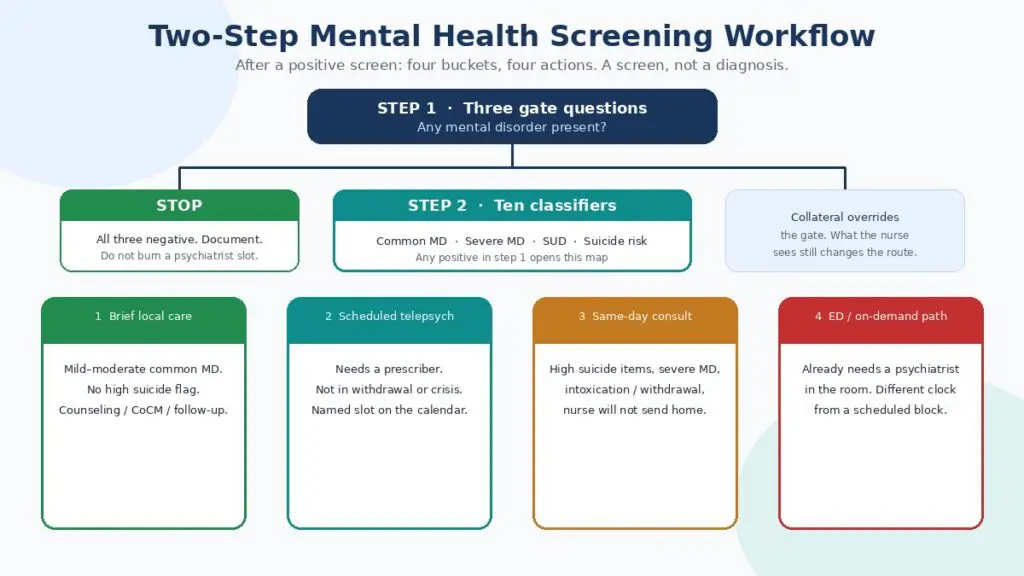
Four buckets, four actions
Stop. All three gate questions negative, no collateral concern, medical issues already addressed. Document the screen. Do not burn a psychiatrist slot to confirm a negative.
Brief local intervention. Mild-to-moderate common mental disorder, no high suicide flag, no psychosis or mania items. This is the lane collaborative care and on-site counseling already own: behavioral activation, problem-solving, a scheduled follow-up, a later PHQ-9 or GAD-7 if the program needs a severity score. Integrated behavioral health is the staffing pattern, not a second clinic brand.
Scheduled telepsychiatry. Common mental disorder that needs a prescriber, substance use that is not in withdrawal, or a mixed picture that can wait until the next clinic block. Put a named clinician on the calendar. Adult psychiatry slots exist for this work. The intake still has to produce a medication decision or a documented reason to defer — that requirement lives in FasPsych’s co-occurring disorders intake guidance, not in the screener.
Same-day consult. High suicide-risk items, severe-mental-disorder items, intoxication or withdrawal that needs a prescriber, or a patient the charge nurse will not send home. This is on-demand coverage and after-hours telepsychiatry, not a waitlist. Emergency-department psychiatry is the setting version of the same rule. If the ED has already decided the patient needs a bed, you are on a different clock — psychiatric boarding is what happens after that decision, not what the screen is for.
Substance-use positives that need medication for opioid or alcohol use disorder follow the MAT path, with a psychiatrist or psychiatric nurse practitioner who can treat the psychiatric cluster in the same encounter. Match the clinician to the unit before the first video visit; that matching job is written separately as specialty-matched telepsychiatry staffing.
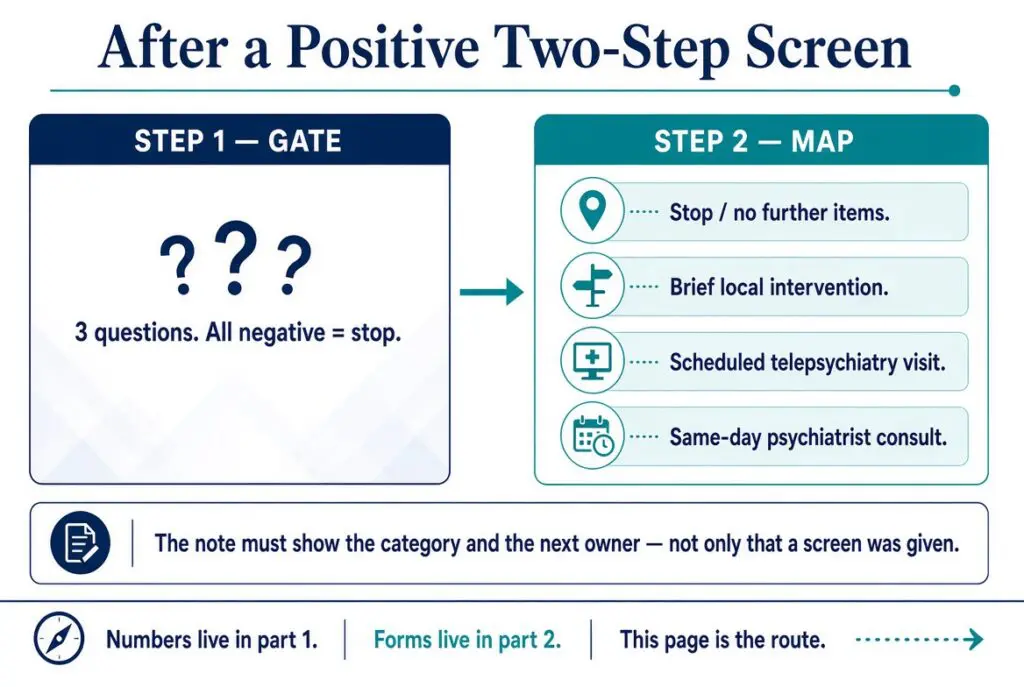
Limits that change the route
Treat these numbers as routing constraints, not trivia. Full methods are in part 1.
- Suicide-risk specificity was 50% in the U.S. ED. A positive is a reason to look, not a reason to lock a hold.
- Severe-mental-disorder sensitivity was 65% in that sample. Do not use this tool as the only psychosis screen.
- The original South African version under-detected alcohol and other substance use until one drinking item moved into the first gate. If substance use is the question, keep a dedicated instrument or put alcohol in step 1. That is the lesson from Stockton et al.
- The U.S. comparator was an attending psychiatrist’s diagnosis in a psych ED. The South African comparator was the MINI in primary and tertiary clinics. Neither sample is a general waiting room.
A licensed psychiatrist or psychiatric nurse practitioner still owns diagnosis, the mental status exam, medication, and level of care. The screen decides who enters that exam. FasPsych clinicians do that work on video inside the partner’s program, not on a consumer app.
What the note has to show
The screen only helps if the chart shows the next step. Quality programs already score whether a positive depression screen produced a plan or a visit. That scoring system is the job of the value-based behavioral health measures page, not this one. For operations, the minimum after a positive two-step screen is:
- Which category fired
- Who is responsible for the next contact
- When that contact is scheduled
- What happens if acuity rises before that visit
If the primary clinician cannot work the morning the follow-up lands, the backup path is already written: backup psychiatrist coverage by secure video.
Language belongs in the same packet. The U.S. study allowed English or Spanish. If the patient and the psychiatrist do not share a first language, use the interpreter-mediated evaluation workflow before the video visit starts.
A Monday protocol, not a new product
Do not wait for a vendor implementation of the mwTool-13. The published papers describe an instrument. A facility can use the two-step logic even if the house form is different:
- Decide who administers the gate questions — intake, nursing, or a care manager — and where the answers live in the EHR.
- Write the four routes above into a one-page protocol with names, not job titles only.
- Put alcohol in the first questions if the population drinks.
- Stand up the same-day video path before the screen goes live. A positive with no prescriber behind it is a completed form.
- Keep the psychiatrist’s exam as the decision. The screen is the door.
FasPsych partners with organizations, not individual patients. To map this routing tree onto an ED, CCBHC, FQHC, jail, or residential template, contact an implementation specialist at (877) 218-4070 or partner with us.
Frequently asked questions
Is a two-step screen a diagnosis?
No. It is a triage device. Diagnosis, safety planning, and disposition stay with a licensed clinician.
Can nursing or intake staff run step 1?
That is how the tool was designed. South African clinics used trained lay workers for the screen. U.S. sites still need a written protocol for who runs it, where it lives in the EHR, and who is paged when step 2 flags suicide risk or severe illness.
Does a negative step 1 mean no psychiatrist is needed?
Not if collateral, observed behavior, or the presenting complaint says otherwise. Step 1 was built for high sensitivity, not as a standalone rule-out.
What if substance use is the presenting problem?
Do not rely on the original three-question gate alone. The South African paper is explicit that alcohol had to enter step 1 before AUD and SUD sensitivity cleared 70%. Use the MAT and co-occurring intake pages for what happens after that flag.
How does this change who we call on-demand versus schedule?
Same-day video for high suicide risk, severe-mental-disorder items, and unstable substance use. Scheduled blocks for common mental disorder that needs a prescriber. Local brief care for mild-to-moderate positives with a documented follow-up.