


This is part 2 of 3 on brief broad-spectrum screening. Part 1 defines the mwTool-13 and the first U.S. validation. Part 3 covers who sees the patient after a positive two-step screen.
The PHQ-9 is a good depression screen. The GAD-7 is a good anxiety screen. The AUDIT is a good alcohol screen. The Columbia-Suicide Severity Rating Scale is a good suicide-risk screen.
None of them was built to see the other three.
That is the problem on most CCBHC, FQHC, and hospital intake desks. A patient can score 16 on the PHQ-9, land in the depression column, and walk out without anyone asking how much they drink or whether they have a plan. Two studies of the same bundled instrument — Stockton and colleagues in South African primary and tertiary care and the 2026 U.S. psychiatric ED validation published in Psychiatric Services (doi:10.1176/appi.ps.20230560) — put numbers on that miss.
This article is for clinical directors who already run single-disorder tools and need a reason to change the form, not the org chart. Accuracy tables and study methods live in part 1. Staffing a dual-diagnosis line after the form is positive is a different page: co-occurring disorders telepsychiatry for program leaders. FasPsych partners with organizations, not individual patients.
What stacked screening actually looks like on a unit
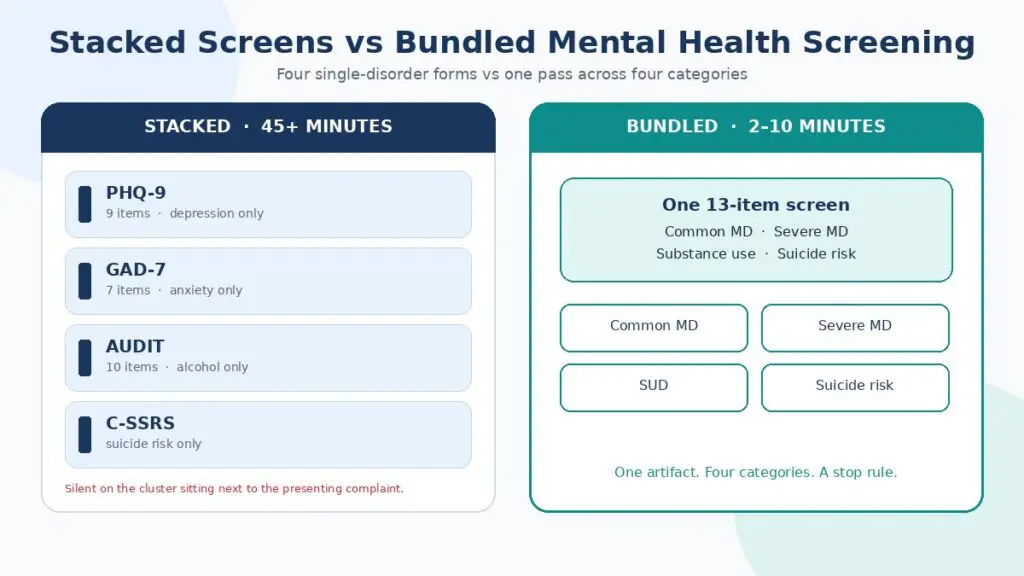
A common adult intake stack is four instruments the U.S. Preventive Services Task Force evidence review lists among the screens used for depression, anxiety, and suicide risk, plus a separate alcohol tool:
- PHQ-9: nine items. Validated as a depression severity measure. Silent on psychosis, mania, and substance use.
- GAD-7: seven items. Built for generalized anxiety.
- AUDIT: ten items in the full WHO version.
- C-SSRS screener: a short algorithm about suicidal ideation and behavior. Not a mood inventory and not a substance inventory.
That is 26-plus items before anyone has asked about hallucinations, mania, or non-alcohol drugs. The U.S. ED paper put the traditional multi-tool battery at well over 45 minutes. The bundled 13-item screen finished in 2 to 10.
Time is not the only cost. Each form produces its own negative. A PHQ-9 under the cutoff feels like clearance for depression. It is silent on the rest of the chart. The next nurse, the next shift, or the next payer measure then treats “depression screening complete” as if the behavioral health question is closed.
USPSTF and most health-system policies never required that stack to be four separate encounters. The stack grew because each instrument was validated for one construct, and quality programs asked for that construct by name. Bundled screening is the opposite design: one pass, several categories, a stop rule.
The cluster the four forms do not share
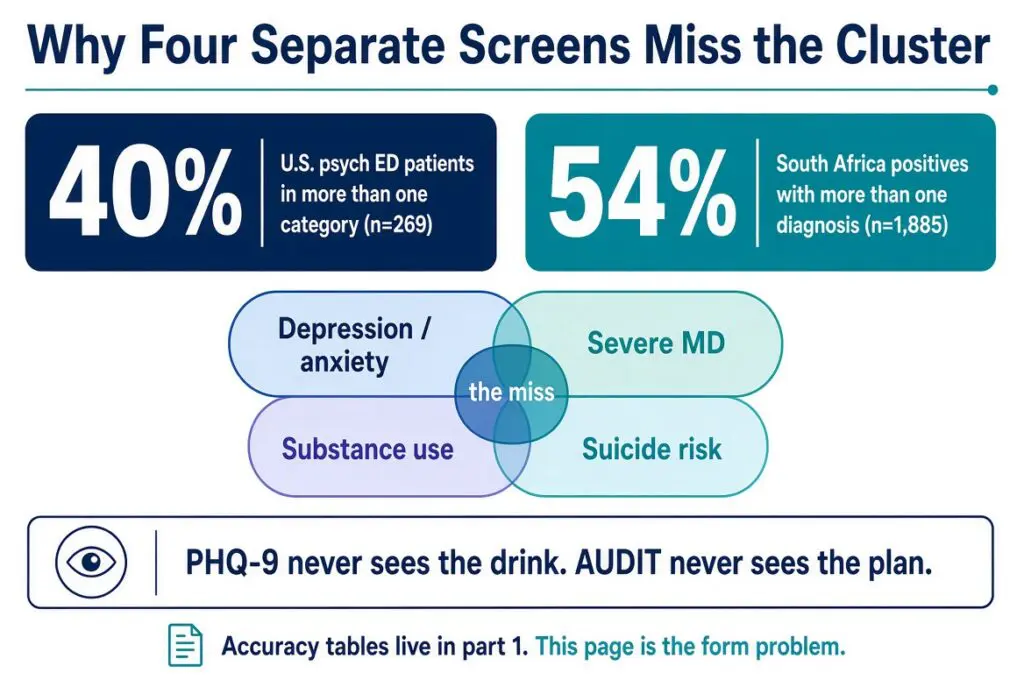
In the New York psychiatric ED sample of 269 adults, two-fifths of patients had a disorder in more than one category. The most common pair was suicide risk plus a common mental disorder. About half the sample had a common mental disorder, 44% a severe mental disorder, 23% a substance use disorder, and 22% high suicide risk.
In the South African validation of 1,885 adults at primary and tertiary clinics, 54% of people with a diagnosis had more than one. Prevalence was lower than in a psych ED — common mental disorder 24.4%, alcohol use disorder 9.5%, severe mental disorder 8.1%, suicide risk 6.0%, other substance use 1.6% — but the overlap among positives was the same story.
A stacked workflow can still catch that cluster if every form is given every time and someone reads all four results together. That is not how a 20-minute primary-care slot or a crowded intake window works. The form that is skipped is usually the one that does not belong to the presenting complaint.
The existing FasPsych guide on co-occurring disorders telepsychiatry is the staffing and compliance half of this problem. This page is the form half. A single intake still has to answer substance-use severity, the psychiatric conditions sitting next to it, and level of care. Four disconnected scores make that harder, not easier.
Why “bundled” is not “good enough at everything”
The original mwTool, developed in Mozambique for non-specialists and published in Psychiatric Services in 2021, pulled items from the same family of instruments clinics already use — PHQ, GAD, psychosis screens, alcohol and substance items, and suicide items from the Columbia lineage. The point was one pass, four buckets: common mental disorder, severe mental disorder, substance use, suicide risk.
It is a triage screen. It is not a diagnosis, and it is not equally strong in every bucket.
The U.S. ED study was highly sensitive for common mental disorders (97%) and suicide risk (93%). Substance use was 80%. Severe mental disorder was 65%. Specificity was modest across the board, and only 50% for suicide risk. A positive suicide flag in that room is a reason to look, not a reason to lock a disposition.
South Africa showed the other failure mode. The original 13-item version was strong on common mental disorders (91.5% sensitivity) and suicide risk (87%). Alcohol use disorder sat at 57% and other substance use at 65%. Moving one drinking-amount item into the first gate — the proposed SA-mwTool-12 — lifted AUD and SUD sensitivity above 70% without making the form long again.
That is the practical lesson for U.S. intake: if alcohol is not in the first questions, people who drink and do not endorse depression or restlessness never reach the substance items. The medication-assisted treatment pathway cannot start if the screen never fired.
Do not pool the two papers into one percentage. The U.S. comparator was an attending psychiatrist’s ED diagnosis. South Africa used the MINI. Sample sizes, prevalence, and rooms are in part 1.
What a bundled screen produces that four forms do not
One artifact. Four categories. A stop rule.
Step 1 of the mwTool-13 is three questions. Negative on all three and the screen stops. Positive on any one and the remaining items classify the category. That is the opposite of a stacked packet, which assumes every patient owes every scale.
For a CCBHC or FQHC, that artifact is what a care manager can hand a prescriber. For an emergency department, it is what tells the charge nurse whether this is a same-day emergency psychiatric evaluation or a scheduled slot. How those buckets map onto coverage is part 3.
Language is not a side issue. The U.S. study offered English or Spanish. South Africa offered isiXhosa or English, and 95% of interviews ran in isiXhosa. A bundled form that only exists in English recreates the same miss as a stacked packet that only exists in English. How the visit itself should be interpreted is already written: interpreter-mediated psychiatric evaluation.
What this does not replace
- A psychiatrist’s mental status exam, diagnosis, or level-of-care decision.
- A dedicated suicide protocol when risk is active. U.S. suicide-risk specificity was 50%.
- A dedicated substance use assessment when the question is dependence, withdrawal, or medication for opioid use disorder.
- The co-occurring intake that still has to produce a medication decision in one encounter.
FasPsych does not sell this instrument. The research is useful because it changes how a partner decides which psychiatrist minute to spend next — and whether the first form the patient sees can see more than one problem.
If the clinic is still stacking four screens and hoping the cluster appears in the note, contact a FasPsych implementation specialist at (877) 218-4070, or start at partner with us.
Frequently asked questions
Is bundled screening a replacement for the PHQ-9 or the C-SSRS?
No. Those instruments remain valid for the single construct they measure. A bundled screen is a first pass across four categories. Many programs will still run a PHQ-9 later for measurement-based care, which is how collaborative care tracks depression to target.
Why not just add PHQ item 9 and call suicide covered?
Item 9 is one question about thoughts of death. The Columbia protocol asks about ideation, plan, intent, and behavior. The mwTool-13 includes suicide items in step 2. Neither is a substitute for a clinician’s risk assessment.
Does this replace the co-occurring-disorders program page?
No. That work is staffing, credentialing, and a single intake that can treat both problems. This page is why the first form should not hide one of those problems.
Can nursing or intake staff administer the first three questions?
That is how the tool was designed in Mozambique and South Africa — non-specialists running a short gate. Who then sees the positives is a coverage question. That is part 3.