

 Psychiatric boarding is not the same problem as a missing psychiatrist on the roster. It is the clock that starts after the emergency department has already decided a patient needs a higher level of psychiatric care—and then has nowhere to put them. Telepsychiatry does not create inpatient beds. What it can change, if it is in the room early enough, is how much of the first four hours is spent waiting for an assessment instead of using that time to treat, disposition, or document why a bed is actually required.
This article is written for hospital and ED leaders. FasPsych partners with organizations and does not accept direct patient referrals.
What psychiatric boarding actually measures
Boarding is holding a patient in the ED after the decision to admit or transfer has been made. That wait can last hours, and in some systems days. During it, there is often little active psychiatric treatment, and the ED environment itself can worsen symptoms.
That distinction matters for measurement. A long ED length of stay that includes medical clearance, imaging, and toxicology is not yet boarding. Boarding starts when psychiatry has already said the patient needs a bed or a transfer and the patient is still in a hallway, a locked room, or under a sitter.
Psychiatric patients board more often and longer than medical patients. About 21.5% of psychiatric ED patients boarded versus 11% of all ED patients; after adjustment, the odds of boarding were 4.78 times higher for psychiatric visits, and those patients boarded nearly three hours longer.
Among children and adolescents, the tail is worse. In 2018–2022 national estimates, about one in three pediatric mental health ED visits that ended in admission or transfer lasted 12 hours or more.
The American Psychiatric Association’s current position is that prolonged boarding of patients with acute mental illness leads to delayed and inadequate treatment, and that every emergency department should have access to psychiatrists on-site or via telepsychiatry.
Why the first four hours are the interval telepsychiatry can own
Most published boarding times sit far past four hours. Adult samples have reported mean boarding around 23.5 hours and total ED stays near 31 hours; patients who had an adverse event while boarded waited much longer than those who did not (35 hours vs. 6.5 hours). Reviews of U.S. emergency practice have put average psychiatric boarding in a range from about 7 to 34 hours.
Telepsychiatry cannot manufacture an adolescent bed at 2 a.m. It can compress the front of the visit: request-to-eval and eval-to-disposition. That is the interval where a missing consultant turns a 90-minute crisis workup into an overnight hold.
A Dutch ED pilot found mean time from consult request to disposition dropped from about 107 minutes to 45 minutes with telepsychiatry, and wait-to-start of the psych eval fell from 53 minutes to 20. Overall ED stay still ran into hours because transfer and bed search did not move at the same speed.
A U.S. comparison of telepsychiatry versus face-to-face consults in general-hospital EDs reported an 84% reduction in consult turnaround time and 97% patient satisfaction.
In pediatric emergencies, telepsychiatry versus usual care—often ambulance transport to a children’s hospital for an in-person consult—cut median ED length of stay from 8.3 hours to 5.5 hours. Nearly 30% of telepsychiatry patients left the ED in under four hours, versus 12% in usual care, and admission rates were also lower (42% vs. 56%). Those results show where the hours come from when consult access is the bottleneck: earlier specialist input, not a new wing of the hospital.
A mental health or substance use disorder accounts for almost 19 million U.S. emergency visits each year, and around 31% of emergency department patients are hospitalized after psychiatric consultation. That is why speed-to-eval is an operations metric. Contracted telepsychiatry is one of the technologies now used to expand behavioral health access for Medicaid populations when a facility cannot staff a psychiatrist on site.
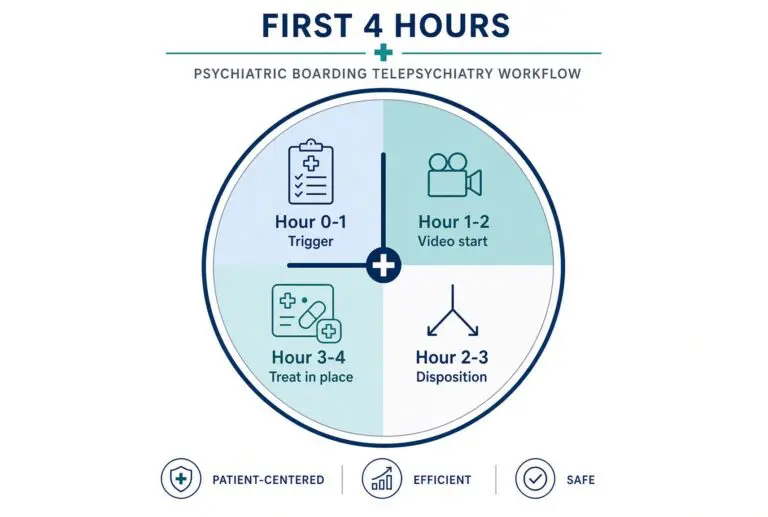
A first-4-hour clock hospitals can run
Treat the first four hours as four jobs, not one “psych consult.”
Hour 0–1: medical clearance and the consult trigger.
ED physicians still own airway, trauma, glucose, intoxication, and whether the patient can participate in a video exam. Telepsychiatry should be requested as soon as the behavioral health path is obvious—not after every lab has resulted, unless those labs change capacity or safety. The failure mode is holding the consult until the psychiatrist can see a sober, fully worked-up patient, which pushes the first available slot into hour five.
Hour 1–2: the video evaluation starts.
This is the interval telepsychiatry is built for. The psychiatrist or psychiatric nurse practitioner needs a private space, a working camera, a staff member who can redirect the patient, and access to the EHR and current meds. On-demand emergency mental health evaluations can be documented in the hospital’s existing record while the ED team stays on the floor. The clinical product of this hour is a documented risk assessment, working diagnosis, and a first treatment recommendation—not a finished discharge summary.
Hour 2–3: disposition that is specific enough to act on.
“Needs psych” is not a disposition. The consult should say whether the patient can go home with a safety plan and an outpatient appointment, needs observation or a crisis unit if the hospital has one, needs a voluntary inpatient bed, or meets criteria for involuntary hold—and which facility type. For contracted partners, FasPsych clinicians can also complete the medical clearance required for psychiatric intake so the receiving unit has a documented go/no-go instead of another wait for an in-house examiner. Pediatric data show telepsychiatry can shift some patients off the default admit path when the alternative is a long transfer for an in-person consult.
Hour 3–4: treatment in place while the bed search runs.
If the decision is already “admit or transfer,” boarding has started. The useful work in this hour is starting indicated medication, documenting medical necessity for the receiving unit, and keeping the patient in a lower-stimulus space than a hallway. Boarded patients often receive no active psychiatric treatment. A live video follow-up in hour 3–4 is how a staffing model prevents that gap without putting a psychiatrist in the building.
If hour 4 arrives and the evaluation has not started, telepsychiatry is not in the workflow. It is an unused contract.
What telepsychiatry does not fix in those four hours
Be precise with CMOs, or the metric will be blamed for the wrong failure.
It does not add child and adolescent inpatient capacity. Pediatric boarding at 12 hours or more is still mostly a bed and continuum problem.
It does not replace sitters, security, or EMTALA obligations. The ED physician remains responsible for the emergency medical screening exam. Medical clearance for psychiatric intake is a separate task: once the ED has ruled out an unstable medical emergency, a contracted FasPsych clinician can complete the intake clearance the receiving unit requires.
It does not, by itself, shorten the tail when the receiving hospital will not take the patient until morning. Studies that show faster consults still show long total stays when transfer is the rate limiter.
Medicare claims research found that adopting telepsychiatry was associated with more admissions to a psychiatric bed and a higher chance of a prolonged ED stay, alongside fewer medical/surgical-bed admissions. Faster access can surface need that was previously deferred or parked on a med-surg floor. Measure request-to-eval and eval-to-disposition separately from total LOS, or you will misread that result.
Overnight and weekend psychiatrist coverage is a different staffing design from the first-four-hour weekday clock. The first interval is request, start, decide, and treat. The night interval is who is on the panel at 01:00 when the next arrival hits.

Metrics that show whether the first four hours improved
Track these as a set. Total boarding hours alone will hide a good consult program behind a bad transfer market.
| Metric | Why it belongs to the first 4 hours |
|---|---|
| Time from ED arrival to psych consult request | Detects delayed triggers |
| Time from request to video start | Detects panel and tech failure |
| Time from video start to documented disposition | Detects consult quality |
| Share of psych ED visits with eval started within 2 hours | The operational target |
| Share of visits dispositioned (not boarded) within 4 hours | The outcome telepsychiatry can influence |
| Admission vs. discharge vs. transfer mix | Distinguishes better triage from more admits |
| Adverse events while waiting (agitation, restraint, elopement) | The clinical cost of the wait |
Longer boarding is associated with higher odds of adverse events. If request-to-eval falls and events do not, look at the room, the sitter model, and whether treatment actually starts after the note is signed.
Staffing the first four hours as a consult SLA
Hospitals that move the needle treat telepsychiatry as a consult service with a response SLA, not as “we have a vendor.” That usually means a defined trigger list so triage and the ED attending request the consult in hour 0–1; privileging and EHR access completed before the first night the service is live; video in a room the charge nurse will actually use; a named backup if the first clinician cannot start within the SLA; and a written split of roles. ED owns the emergency medical screening exam and safety. Psychiatry owns risk, medications, level of care, and medical clearance for psychiatric intake. Case management owns the bed.
Add on-demand psychiatry to your facility
If the first four hours in your ED are still spent waiting for a psychiatrist, contact a FasPsych implementation specialist to add scheduled or on-demand telepsychiatry coverage to your facility—including psychiatric evaluation and medical clearance for intake. Implementation support includes credentialing, EHR access, and a coverage plan matched to your census—not a consumer booking page. Call (877) 218-4070 or request a consultation.
Frequently asked questions
Does telepsychiatry reduce psychiatric boarding hours?
It reduces the hours spent waiting for a psychiatrist. It reduces total boarding only when the delay was consult access, or when an earlier eval sends a patient home or to a crisis unit instead of an inpatient queue. Bed shortages still dominate the tail.
When should the ED request the telepsychiatry consult?
As soon as the presentation is clearly behavioral health and the patient can participate, not after every pending lab unless those results change safety or capacity.
Is a four-hour eval-to-disposition target realistic?
For many medically cleared adults, yes, if the consultant starts in the first one to two hours. For pediatric patients needing a scarce specialty bed, four hours is often eval-complete, not boarding-over.
Who still has to be in the department?
Nursing, security or sitters as indicated, and an ED physician who owns the emergency medical screening exam. Telepsychiatry does not replace those roles. A contracted FasPsych clinician can complete medical clearance for psychiatric intake after that exam.
Can FasPsych cover a single on-demand patient for our facility?
Yes—once your hospital or clinic is a contracted partner. FasPsych works with facilities, not as a direct-to-consumer clinic. A contracted ED can request one on-demand consult when census is low or when a single boarding case needs a psychiatrist, including medical clearance for intake. FasPsych cannot accept online referrals from patients, families, or from clinics and hospitals that do not have a contract. An implementation specialist can set up that facility agreement before the first consult is requested.
Psychiatric boarding telepsychiatry is a first-interval problem: request, start, decide, treat. Measure those four hours on their own. Leave overnight roster design, launch sequencing, and the ED service catalog on the pages that already own them. Talk with a FasPsych implementation specialist when you are ready to put that coverage in the first four hours.