

This is part 1 of 3 on brief broad-spectrum screening. Part 2 covers bundled screening versus stacked PHQ-9, GAD-7, AUDIT, and C-SSRS forms. Part 3 covers who to route after a positive two-step screen.
A 13-item screen just finished its first U.S. test in a New York psychiatric emergency department. The tool is the Mental Wellness Tool-13, or mwTool-13. It is not a diagnosis. It is not a replacement for a psychiatrist. It is a two-step instrument that tries to answer, in minutes, whether any mental disorder is present — and, if so, whether the signal looks like a common disorder, a severe disorder, a substance use disorder, or suicide risk.
That is a different job from the 45-minute stack most units still run: a PHQ-9, a GAD-7, an AUDIT, a Columbia Suicide Severity Rating Scale, and whatever psychosis items the house added later. Medscape’s coverage of the U.S. study, published online September 3, 2026, in Psychiatric Services (doi:10.1176/appi.ps.20230560), put the time contrast in one line: the mwTool-13 finished the same range of questions in 2 to 10 minutes.
This article is what the two published validations actually measured. It is not a protocol for psychiatric boarding in the first four hours, and it is not a staffing plan. Those are later jobs. The first job is to know what the form is.
FasPsych does not sell or endorse the mwTool-13. FasPsych staffs licensed psychiatrists and psychiatric nurse practitioners into your program on secure, real-time video. A faster screen only matters if someone qualified can act on a positive. Contact an implementation specialist at (877) 218-4070 if you want that second half mapped onto your rooms.
What the mwTool-13 is
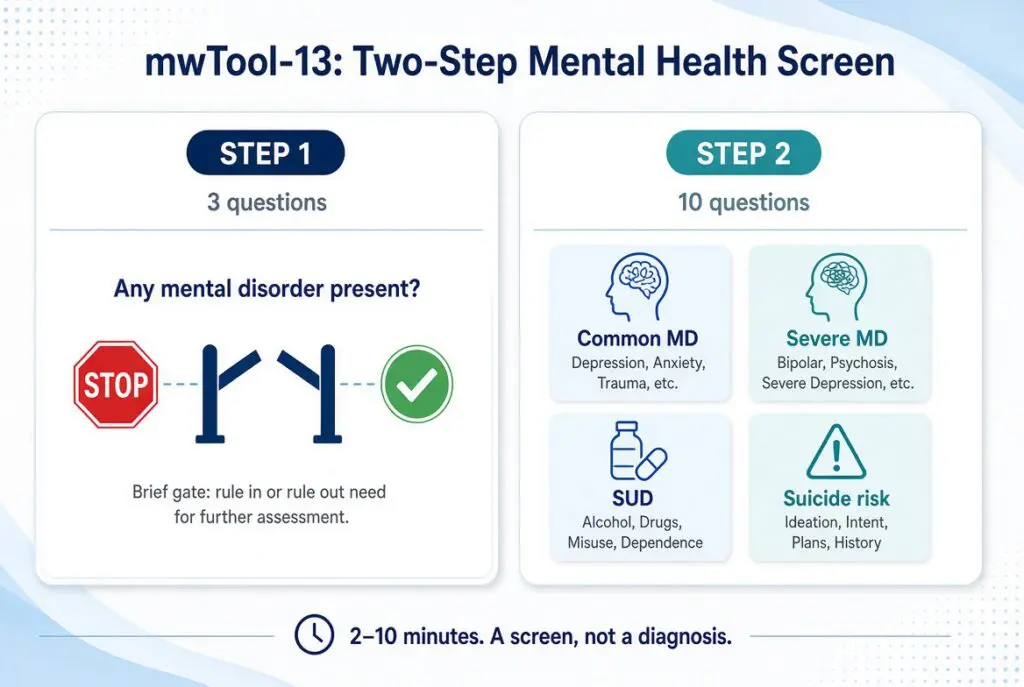
The mwTool-13 is a 13-item, two-step screener. Items were drawn from existing instruments, including the Patient Health Questionnaire, the Generalized Anxiety Disorder assessment, and the Psychosis Screening Questionnaire. The original development work, led by Kathryn Lovero and colleagues in Mozambique and published in Psychiatric Services in 2021, selected 13 items from a 99-item battery so a non-specialist could identify any mental disorder with three questions and then classify the positive cases with the rest. That development paper is open in PMC as “Brief Screening Tool for Stepped-Care Management of Mental and Substance Use Disorders.”
Administration is the point of the design:
- Step 1. Three questions. If all three are negative, stop. The U.S. study found those three questions identified any mental disorder with 95% sensitivity.
- Step 2. Ten more questions, asked only after a positive in step 1, that sort the case into common mental disorder, severe mental disorder, substance use disorder, or suicide risk.
Common mental disorders in this family of papers means depression, anxiety, and related conditions. Severe mental disorders means psychosis and mania. Suicide risk and substance use sit in their own buckets. The tool was built for stepped care: find anyone who needs a look, then sort them into a treatment category instead of running four separate screens to get there.
Two validations, two rooms
The same Columbia research family produced both papers that matter for a U.S. facility. Annika Sweetland, DrPH, of Columbia University and the New York State Psychiatric Institute, is an author on the South African validation and lead investigator on the U.S. emergency-department study.
South Africa, 2024. Melissa Stockton and colleagues validated the mwTool-13 against the Mini International Neuropsychiatric Interview in 1,885 adults at four primary-care clinics and one tertiary facility in Eastern Cape Province. Mean age was 39. Sixty-five percent were women. Ninety-five percent of interviews were in isiXhosa. Trained research assistants — community health workers — administered the screen. Nurses with psychiatric training, blinded to the screen, administered the MINI. The paper is open access: Stockton et al., Global Mental Health, 2024 (doi:10.1017/gmh.2023.89).
MINI prevalence in that sample: any disorder 36%, common mental disorder 24.4%, alcohol use disorder 9.5%, severe mental disorder 8.1%, suicide risk 6.0%, other substance use disorder 1.6%. More than half of people with a diagnosis had more than one.
New York, 2026. The first U.S. assessment enrolled 269 patients receiving psychiatric emergency care in a New York City hospital between 2021 and 2022. Mean age was 40. Fifty-three percent were women. Forty-seven percent were Latinx. Patients could complete the interview in English or Spanish. Results were compared with routine assessment by attending psychiatrists — not with the MINI. About half the sample had a common mental disorder, 44% a severe mental disorder, 23% a substance use disorder, and 22% high suicide risk. Two-fifths screened into more than one category. The most common pair was suicide risk plus a common mental disorder.
That last number is why a single-disorder form is the wrong instrument for this room. How clinics still end up running four of them is part 2.
The numbers that matter — and the ones that do not
| Finding | U.S. psychiatric ED (n=269) | South Africa primary + tertiary care (n=1,885) |
|---|---|---|
| Gold standard | Attending psychiatrist diagnosis | MINI |
| Time | 2–10 minutes | Brief two-step screen; lay workers administered it |
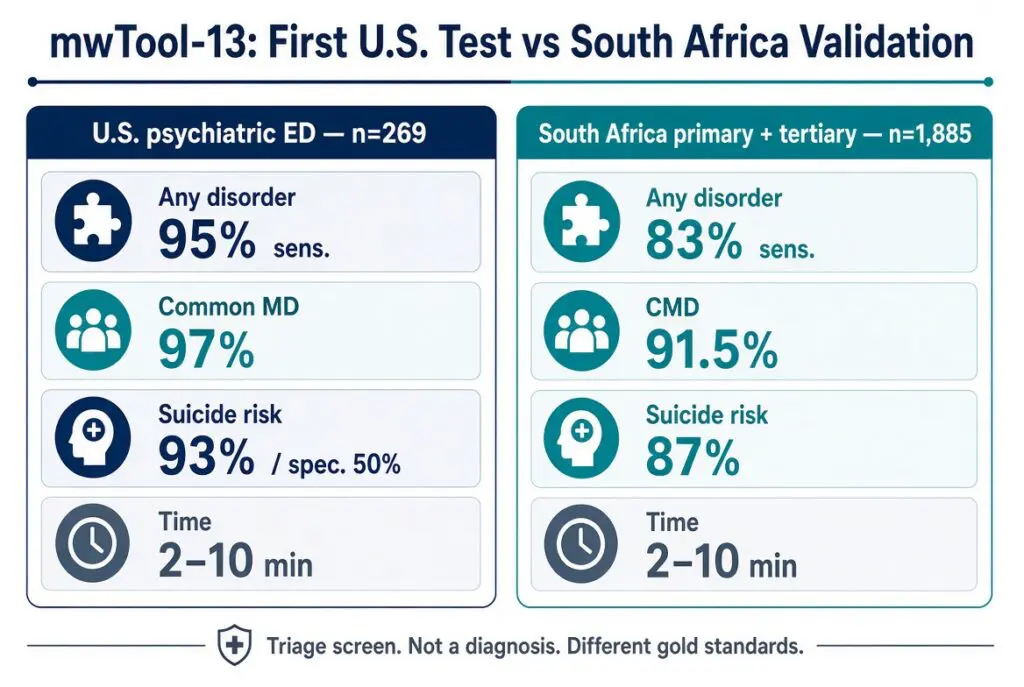
| Any mental disorder, step 1 (3 questions) | 95% sensitivity (95% CI 0.91–0.97) | 83% sensitivity; 46% specificity |
| Common mental disorder | 97% sensitivity; 67% specificity | 91.5% sensitivity |
| Suicide risk | 93% sensitivity; 50% specificity | 87% sensitivity |
| Substance use disorder | 80% sensitivity; 58% specificity | 65% sensitivity (AUD 57%) |
| Severe mental disorder | 65% sensitivity; 71% specificity | 72% sensitivity |
| Multi-category cases | 40% | 54% of those with any diagnosis |
Read the table as a triage tool, not as a lab test. Sensitivity is the number that keeps a case from walking past the desk. Specificity is the number that keeps the psychiatrist from seeing everyone. The U.S. study is strong on the first and modest on the second. Suicide-risk specificity of 0.50 in a psychiatric ED means a positive suicide flag is a reason to look, not a reason to lock a disposition. Severe-mental-disorder sensitivity of 0.65 means this is not a psychosis screen you can trust to stand alone.
The South African paper is honest about the same weak cell. Original mwTool-13 sensitivity for alcohol use disorder was 57% and for other substance use 65%. The authors fixed it by moving one drinking-amount question into step 1 and dropping the frequency item — a 12-item South African adaptation that lifted AUD and SUD sensitivity above 70% and any-disorder sensitivity to about 90%. That modification is an operations lesson, not a trivia note: if alcohol is not in the first gate, substance use walks past. Part 2 takes that lesson into the stacked-form problem.
Do not pool the two papers into one accuracy figure. They used different gold standards, different prevalence, and different rooms. The U.S. authors also warned that the mix of conditions in a psychiatric ED is not the mix in a community clinic or a general emergency department.
What the authors said the tool is for
Sweetland and colleagues wrote that the mwTool-13 “may help increase mental health equity by facilitating efficient, comprehensive community screening for early detection of treatable conditions among hard-to-reach populations that may otherwise not seek mental healthcare.” They also described the operational use: a 2-to-10-minute screen that supports a more targeted assessment, then “pairing the mwTool-13 with brief evidence-based interventions for mild-to-moderate common mental disorders, substance use disorders, and suicide risk — and triggering immediate referrals for more severe symptoms.”
That last sentence is the routing rule. It is part 3. It is not a claim that the form replaces the psychiatrist who still has to complete the interview, the mental status exam, the medication decision, and the level-of-care call.
Language is a footnote here, not the article. The U.S. sample offered English or Spanish. The South African sample ran in isiXhosa and English. A screen that can be read in the patient’s language still fails if the psychiatric interview that follows is guessed through a family member. That workflow is already written: interpreter-mediated psychiatric evaluation.
What this is not
The mwTool-13 is not a diagnosis. It is not a mental status exam. It is not medical clearance. It is not a hold document. It is not a substitute for emergency-department psychiatric coverage when the patient already needs a psychiatrist in the room.
The U.S. comparator was an attending psychiatrist’s diagnosis in a psychiatric ED. That is a high-prevalence room with clinicians who already know how to find severe illness. Performance will look different at a front desk in primary care, a jail intake, or a general ED. The South African study is closer to that second setting — and even there, specificity sat in the mid-40s for any disorder. High sensitivity plus modest specificity is the profile of a rule-in screen. Plan for false positives or the “efficiency” reappears as a queue of unnecessary consults.
FasPsych psychiatrists and psychiatric nurse practitioners still own the work the screen cannot do: differential diagnosis, risk formulation, prescribing, and disposition. The network is licensed for the state the patient is in. The screen is a door. It is not the visit.
What a FasPsych partner does with this research
Do not wait for a vendor to “implement mwTool-13.” The published papers describe an instrument, not a product FasPsych installs. What a partner can do with the research is narrower and more useful:
- Stop treating four single-disorder forms as the only way to cover depression, anxiety, psychosis, substance use, and suicide risk in one encounter.
- Treat step 1 as a gate that can be run by intake or nursing, and step 2 as the sort that decides whether the next psychiatrist minute is scheduled or same-day.
- Put alcohol in the first questions if substance use is part of the population. The South African revision is the evidence for that change.
- Build the psychiatrist path before the screen goes live. A positive with no prescriber behind it is a completed form.
If the patient is already in an emergency department and the question is how fast the video consult starts, that clock is written in Psychiatric Boarding Hours: What Telepsychiatry Changes in the First 4 Hours. If the question is how a dual-diagnosis program turns a positive into a medication decision, that is co-occurring disorders telepsychiatry for intake and compliance. This page is the tool.
Contact a FasPsych implementation specialist at (877) 218-4070, or partner with us, if you want the screen’s output mapped onto scheduled coverage, same-day consults, and the clinicians who will actually see the positives.
Frequently asked questions
What is the mwTool-13?
A 13-item, two-step mental health screener for adults. The first three questions look for any mental disorder. The remaining ten classify positives into common mental disorder, severe mental disorder, substance use disorder, or suicide risk. It was developed for stepped care and non-specialist administration, then tested in South African primary and tertiary care and in a U.S. psychiatric emergency department.
Is the mwTool-13 a diagnosis?
No. Both papers treat it as a screen. Diagnosis, risk formulation, and level of care remain a licensed clinician’s work.
How accurate was the first U.S. study?
In 269 psychiatric ED patients, the first three questions identified any mental disorder with 95% sensitivity. The full tool reached 97% sensitivity for common mental disorders and 93% for suicide risk. Substance use was 80%. Severe mental disorder was 65%. Specificity was lower across the board, and 50% for suicide risk. Cite the Psychiatric Services paper (doi:10.1176/appi.ps.20230560), not only the Medscape summary.
How does that compare with the South African study?
Stockton et al. tested 1,885 adults against the MINI. Sensitivity was high for common mental disorders (91.5%) and suicide risk (87%), weaker for alcohol (57%) and other substances (65%) until the authors moved a drinking-amount item into step 1. Full text: PMC10808975.
Can nursing or intake administer it?
The South African study used trained community health workers for the screen. The U.S. study ran in a psychiatric ED against psychiatrist diagnosis. Neither paper clears a specific U.S. job title. House policy, scope of practice, and what happens after a positive are the actual design questions.
Does FasPsych use the mwTool-13?
FasPsych does not sell the instrument. FasPsych provides the psychiatrists and psychiatric nurse practitioners who complete the assessment a positive screen is supposed to trigger, on secure video inside your program.
Where should a reader go next?
Part 2: why clinics still run four screens. Part 3: who needs a psychiatrist today versus next week.