

 The Shanghai Dragons open a KHL season with Russians, Canadians, Americans, a Czech winger, and a German-born center sharing one bench. Justin Bailey, a Buffalo native now with Barys Astana in Kazakhstan, is among the early scoring leaders. The league runs clubs in Russia, Belarus, Kazakhstan, and China. A medical staff that treats that locker room as one language is not being efficient. It is guessing.
A hospital, jail, FQHC, school, or community clinic that treats every psychiatric interview as English-until-proven-otherwise is making the same guess.
This article is how FasPsych telepsychiatry video services run an interpreter-mediated psychiatric evaluation inside your program: preferred language identified before the psychiatrist logs in, a qualified interpreter on the same secure video path, consent the patient actually understood, and a note that records who interpreted.
It is not a page about hiring bilingual psychiatrists. That is a staffing question. This page is the interview when the psychiatrist and the patient do not share a first language.
Two other jobs live on other pages. If the assignment is keeping this week’s appointments alive while a named clinician is out, use backup psychiatrist coverage through video visits. If the clock is emergency-department throughput in the first four hours, use psychiatric boarding. If the mismatch is adult versus child, start with types of psychiatrists.
Contact a FasPsych implementation specialist at (877) 218-4070 to map this workflow onto your rooms — ED bay, intake window, school clinic, med pass — before the first booked visit. Or start at partner with us.

The interview is the instrument. Language is not optional equipment.
A psychiatric evaluation is not a form with boxes. It is an interview that has to carry thought process, word choice, tone, insight, and risk. The mental status exam listens for loose associations, delayed answers, the way a person names a voice or a plan. Those details do not survive a family member who “gets the gist.”
About 26 million people in the United States speak English less than “very well.” In some urban emergency departments, more than one in four encounters is with a patient who prefers a language other than English. Patients who need an interpreter wait longer for a physician to start care. Interpreter use is often undocumented, and unplanned revisits run higher when language access is missing. An AHRQ review of LEP outcomes is consistent with that pattern.
That is not a translation inconvenience. It is a diagnostic error waiting on the next hold, the next refill, and the next discharge.
The American Psychiatric Association’s position on telemedicine in psychiatry is explicit: identify barriers such as foreign language and provide appropriate workarounds, including interpreters. APA and ATA videoconferencing best practices treat the telepsychiatry visit as clinically equivalent only when it is used well — including who is in the room and how the patient can actually speak.
Title VI and Section 1557 of the Affordable Care Act require covered entities to offer free, timely, qualified language assistance. The patient cannot be told to bring their own interpreter. A minor cannot interpret. An unqualified adult is not the plan except as a brief emergency bridge while a qualified interpreter is being arranged. HHS telehealth guidance makes the same point for remote visits: the platform has to let the interpreter join the session.
Hospitals accredited by The Joint Commission are expected, under rights standard RI.01.01.03, to give information in a manner the patient understands and to furnish interpreting and translation services. FasPsych is not affiliated with, accredited by, endorsed by, or a representative of The Joint Commission. The standard is cited because many partner hospitals already operate under it — not because FasPsych and The Joint Commission have any relationship. National CLAS standards say the same in operational language: offer language assistance, inform people it is free, ensure competence of those providing it, and provide easy-to-understand materials. See also 45 CFR 92.201.
This is not legal advice. Confirm current federal and state rules with counsel. The operational point is simpler: if the psychiatrist cannot hear the patient’s actual words, the FasPsych visit is not finished.
Call (877) 218-4070 if that is the gap on your unit.
What breaks when the floor “helps with Spanish”
Ad-hoc interpretation — a spouse, a housekeeper, a bilingual aide who was not tested or designated, a child pulled from the waiting room — fails psychiatric work in predictable ways.
Thought process gets cleaned up. Guidance for mental-health interpreting is consistent: the interpreter must not smooth incoherence, finish sentences, or make disordered speech sound organized. A family member who “helps” the patient sound clearer can erase the finding the psychiatrist needed.
Risk language gets omitted. Suicide, command hallucinations, sexual trauma, immigration status, and shame topics disappear when the person interpreting is also the person who lives with the patient. A Psychiatric Services review of language proficiency and interpreter use in psychiatric care found ad-hoc interpreters editorializing, answering for the patient, and producing fewer reported psychological symptoms.
Consent is not consent. Section 1557 requires language assistance that protects independent decision-making. A treatment option explained by a relative who wants the patient to “just sign” is not informed consent. Neither is a hold advisory the patient nodded through because nodding ends the conversation.
The note cannot defend the visit. “Interpreter used” with no name, language, modality, or time is not documentation. Reviews look for how the facility identified limited English proficiency, how a qualified interpreter was obtained, and whether the patient was offered that service free of charge.
A bilingual staff member is not automatically a qualified interpreter. Under the Section 1557 rule, bilingual staff may provide in-language assistance only when they are designated for that work, proficient, and able to interpret accurately and impartially using specialized vocabulary. “Speaks some Spanish” is not a designation.
What a FasPsych interpreter-mediated visit requires
FasPsych staffs licensed psychiatrists and psychiatric nurse practitioners into your program on interactive, real-time video — the same modality used with partner organizations since 2007. Before that clinician joins, someone on site has to complete four steps. If those steps wait until the cart is already on, the visit starts late and the interview is already compromised.
1. Identify preferred language at triage or intake — not after login.
Ask the patient or guardian which language they want for a medical conversation. Do not assume Spanish from a surname. Do not assume English because the patient answered “yes” to a greeting. Document the preferred language in the chart the psychiatrist will open.
2. Offer a qualified interpreter before consent.
A qualified interpreter is proficient in both languages, interprets accurately and impartially without additions or omissions, can handle specialized vocabulary, and follows interpreter ethics including confidentiality. Remote video or telephone interpreting counts when the audio is clear and the psychiatrist can still see the patient. The offer is free. Record that the offer was made, accepted, or declined.
3. Brief the interpreter on psychiatric rules.
Two minutes is enough if someone owns the brief:
- Consecutive mode for the assessment. Do not summarize.
- First person. “I hear a voice,” not “he says he hears a voice.”
- Do not tidy thought disorder. Repeat fragments, pauses, and repeated phrases as spoken.
- Do not omit suicide, homicide, abuse, or substance questions because they are uncomfortable.
- Stay in role. The interpreter is not the collateral historian unless the psychiatrist asks a separate question of a family member.
4. Set the room so three people can work.
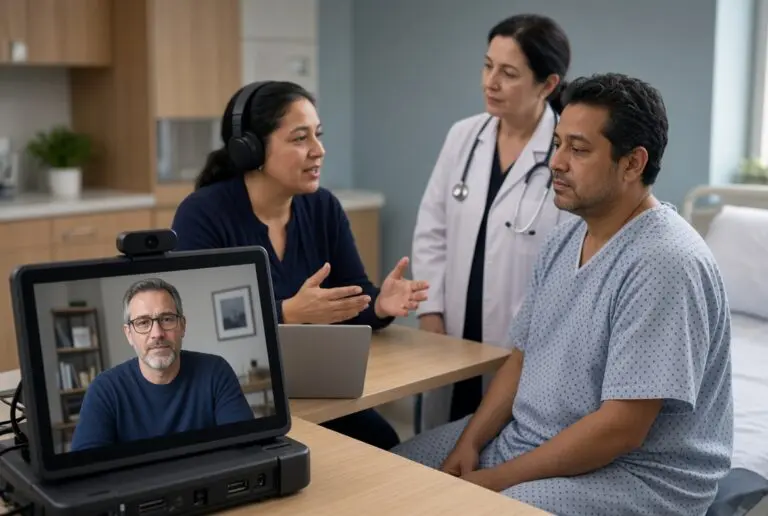
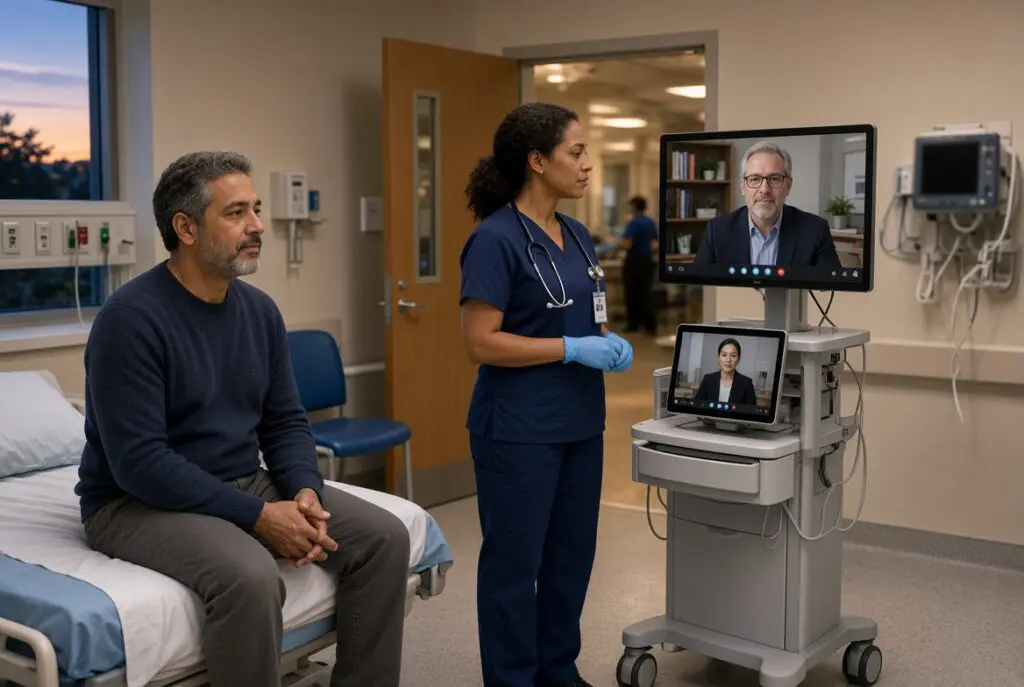
The FasPsych psychiatrist is on secure, HIPAA-compliant video. The interpreter conferences into the same session or sits on a second device in the room. The on-site staff member who stays with the patient is named. If video drops, the nurse knows whether to hold the patient and how to reconnect. Test this path in the actual bay, playroom, med window, or classroom — not in an unused conference room.
Then the psychiatrist can do the job: interview, mental status, risk, capacity where required, medication decision, and a note in your EHR.
FasPsych’s telepsychiatry implementation process starts with a needs assessment: population, site type, privileging, EHR, and which languages actually walk into your rooms. Contact an implementation specialist at (877) 218-4070 to run that assessment against your template, not a generic demo.
How this shows up by setting
Emergency departments. Language access for LEP patients in the ED is a door-to-eval problem and a hold problem. A family member translating “he’s fine, he wants to go home” is not a safety assessment. Identify language at triage. Start the interpreter while registration finishes, not after the psychiatrist has already waited on a silent cart. See FasPsych emergency department coverage and on-demand psychiatry for how that consult is supposed to land. More on ER telepsychiatry.
Inpatient units and medical floors. Collateral from family is useful. Family as interpreter is not the same task. Separate them: qualified interpreter for the patient interview; family interview in its own block, with the same interpreter or a second session.
Jails, prisons, and juvenile detention. Dialect, community size, and confidentiality matter more, not less. A patient from a small language community may refuse an interpreter they might see at church or in the housing unit. Document the refusal after a qualified offer. Never use another detainee to interpret a psychiatric evaluation. FasPsych already staffs correctional and organizational partners.
FQHCs, CMHCs, and primary-care integration. Panel visits run short. That is not a reason to skip the interpreter. Build the interpreter request into the scheduling template so the 20-minute med check does not spend 12 minutes finding a line. Clinic staffing and PCP / multi-site coverage are the pages for how those books are built.
Schools and pediatric clinics. A child must not interpret for a parent. A parent must not interpret a child’s suicidal ideation back to the psychiatrist. Guardian consent and youth assent both have to happen in a language each person understands. Pair the site with child and adolescent psychiatric services, not an adult book plus a family translator.
SNF and geriatric units. Hearing loss plus a second language plus delirium will defeat a phone interpreter if the volume is low and the room is a shared bay. Test the device in the room you will actually use.
The video cart can look the same in each of those rooms. The language plan cannot. A FasPsych implementation specialist will write that plan against the rooms you actually run.
How FasPsych telepsychiatry carries the interpreter into the visit
Once the clinician is matched and the interpreter path is tested, the visit should look like your program — not a parallel clinic.
- Interactive, real-time audio and video with HIPAA-compliant encryption
- Platform-neutral software so staff are not asked to learn a second culture of logins
- Notes and e-prescribing in your EHR when the workflow allows
- The same dedicated psychiatrist or PMHNP returning whenever possible, so literacy in the house compounds
- On-demand psychiatry behind that dedicated relationship when the day’s book includes a patient whose language was not on yesterday’s template
- A one-page house brief for the incoming clinician: how your site requests interpreters, which vendor or internal pool you use, and where that fact is documented
Keep the patient in your program. A psychiatry staffing network supplies the clinician. Your medical-staff rules, your interpreter contract, and your chart stay yours.
If the only plan is “we have a bilingual nurse on days,” you do not have interpreter-mediated psychiatric evaluation. You have a hope. Call (877) 218-4070.
Make the interpreter part of FasPsych go-live
Treat language access as a gate in implementation, not a later correction.
- Write preferred language into intake. The psychiatrist should see it before joining.
- Name the interpreter source. Vendor, internal qualified pool, or video remote service — with a backup if the first line fails.
- Prohibit children as interpreters in policy, not in a poster.
- Script the offer. Staff should be able to say, in plain language, that a qualified interpreter is free and that family may stay as family.
- Brief the interpreter on psychiatric rules every time the interpreter is new to this service line.
- Document interpreter name or ID, language, modality, and time in the same note as the exam.
- Test the three-way path — FasPsych psychiatrist, interpreter, on-site staff — in the actual room before the first booked LEP visit.
The organizations that skip that step spend the next quarter explaining why “telepsychiatry didn’t work with our Spanish-speaking patients.” Usually the video worked. The interview did not.
Contact a FasPsych implementation specialist
If your hospital, clinic, residential program, school, SNF, or correctional facility is about to turn on psychiatric video without a written interpreter-mediated workflow, contact a FasPsych implementation specialist.
They will map population, site type, privileges, EHR, and the actual languages in your rooms to licensed psychiatrists and psychiatric nurse practitioners — then test the video path, including the interpreter, before the first booked visit.
- Call (877) 218-4070
- Start at partner with us
- Or use the contact page
FasPsych works with organizations, not as a direct-to-consumer clinic. You keep the service line. FasPsych supplies the telepsychiatry clinicians who can already sit in the interview — with the interpreter on the line.
Frequently asked questions
What is an interpreter-mediated psychiatric evaluation?
A psychiatric interview, mental status exam, and related decisions conducted with a qualified interpreter so the psychiatrist and the patient share the same words — not a family summary and not a bilingual staff member who was never designated or tested.
Is this the same as hiring bilingual psychiatrists?
No. Bilingual clinicians are a staffing asset. Interpreter-mediated psychiatric evaluation is the workflow used when the assigned psychiatrist and the patient do not share a first language. FasPsych telepsychiatry runs that workflow on video inside your program.
Can we use a family member if the patient asks?
Offer a qualified interpreter first, free of charge, and document the offer. A minor must not interpret. An adult family member is not the default. If the patient declines a qualified interpreter after that offer, record the decline and the reason. Confirm current Section 1557 and state rules with counsel; this page is operational, not legal advice.
Does remote interpreting work for FasPsych video visits?
Yes, when audio is clear, the psychiatrist can still see the patient, and the interpreter has been briefed not to tidy thought process or skip risk questions. HHS telehealth guidance expects the platform to let the interpreter join. Test the three-way connection in the actual room during implementation.
How is this different from backup psychiatrist coverage?
Backup coverage keeps the current week alive when a named clinician is out. This article is what that clinician — or the backup — needs in the room when the patient and the psychiatrist do not share a language. Most facilities need both.
Is FasPsych affiliated with The Joint Commission?
No. FasPsych is not affiliated with, accredited by, endorsed by, or a representative of The Joint Commission. Any mention of Joint Commission standards in this article is a citation of a hospital accreditation expectation many facilities already follow.
Who should I call first?
A FasPsych implementation specialist at (877) 218-4070, or through partner with us.