
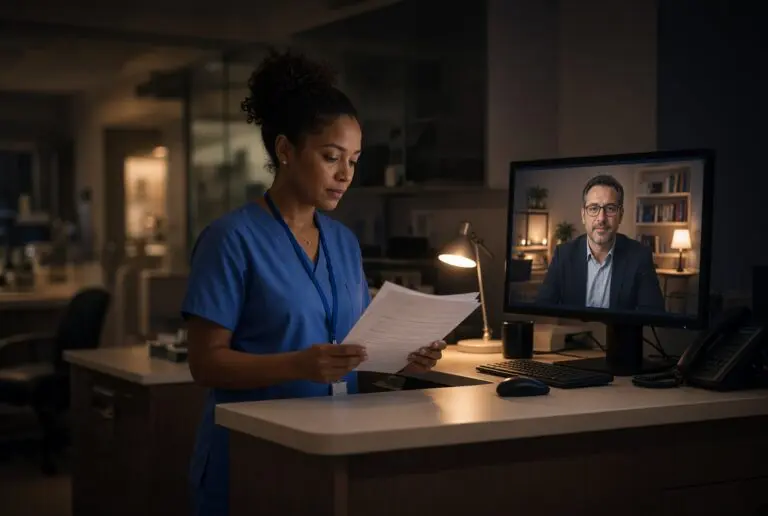

 Mental health needs do not follow a 9-to-5 schedule. In hospitals, residential treatment programs, correctional units, community clinics, and smaller facilities, some of the most useful clinical information appears after visiting hours end. Night staff see pacing, sleeplessness, nightmares, withdrawal restlessness, medication refusal, and early-morning mood shifts that daytime routines can mask.
The problem is operational as much as clinical. Many facilities have little or no on-site psychiatric coverage overnight or on weekends. Observations get written down. Morning arrives. The person who saw the change is off shift. The psychiatrist, if one is available at all, may not see the patient until hours or days later.
Telepsychiatry does not replace night staff. It gives those observations somewhere to go.
Why After-Hours Coverage Still Breaks Down
Several pressures keep psychiatric coverage thin when facilities need it most:
- Workforce shortages. As of mid-2026, HRSA counted more than 7,100 mental health Health Professional Shortage Area designations covering about 157 million people, with only about 27% of estimated need met. KFF’s compilation of HRSA data put the U.S. figure at roughly 137 million people in designated mental health shortage areas as of late 2025. HRSA’s Bureau of Health Workforce projections also estimate a shortfall of about 43,800 psychiatrist FTEs by 2038. A 2026 workforce analysis summarized in Psychiatric Times projects adult psychiatrist supply declining about 12% from 2024 to 2037 while demand rises more than 40%.
- Hiring models that assume daytime demand. Full-time on-site psychiatrists are expensive, hard to recruit, and rarely scheduled for overnight or weekend coverage at smaller sites. That is the gap FasPsych telepsychiatry staffing is built to fill: coverage matched to nights, weekends, and surge periods instead of a single daytime FTE.
- Medicaid and community-program constraints. Low reimbursement, claim complexity, and limited new-patient capacity make it difficult for CMHCs and FQHCs to keep specialist hours available after the clinic day ends. Third-party staffing models that handle scheduling and reduce hiring overhead are one reason telepsychiatry has become a practical option for Medicaid mental health programs and for FasPsych partners using the Collaborative Care Model in FQHCs and CMHCs.
- Handoff loss. Night notes that stay in a binder or an EHR comment field do not automatically become a psychiatric evaluation. That delay is the same pattern FasPsych described in why everyday mental health crises still slip through: distress is visible to someone on site, but the specialist is not available until later.
Technology has changed what is possible. The American Psychiatric Association and American Telemedicine Association treat synchronous video as an accepted method for psychiatric evaluation, therapy, and medication management when privacy, licensing, and clinical standards are met. A meta-analysis of videoconferenced mental health care found treatment effects largely equivalent to in-person care across dozens of studies. The remaining gap is usually coverage design, not the video platform itself.
What Night Staff See That Daytime Teams Often Miss
Daytime programs are full of structure: groups, meals, therapy, visitors, and scheduled appointments. A person under significant stress can still hold it together for a short conversation. At night, those buffers disappear.
A quiet hallway can intensify anxiety. A closed door can trigger trauma memories. Withdrawal symptoms often worsen as evening medications wear off. Someone entering a manic state may feel no need to sleep and spend the night writing, cleaning, talking, or planning. Nightmares, panic, pacing, repeated requests, or refusal to enter a room are easy to misread as attention-seeking or defiance when they are actually early clinical signals.
That is not only a staffing anecdote. Sleep disturbance is common among people with mental disorders and is often worse on inpatient and residential units. A scoping review of sleep interventions in psychiatric inpatient settings notes that more than half of adults with a mental disorder have sleep problems, and that poor sleep is linked to worse mood, cognition, impulsivity, aggression, and suicidality. Qualitative work from secure and inpatient units finds irregular sleep, nightmares, and nights with little or no sleep at all, alongside staff recognition that overnight behavior carries clinical meaning (Gardiner et al., Sleep Medicine; Veale et al., Journal of Psychiatric and Mental Health Nursing).
Reporting on what night staff can learn from changes in sleep has described the operational version of this for residential treatment facilities, correctional settings, college residence programs, rehabilitation centers, and psychiatric units. Night staff are not only maintaining safety until morning. They are watching the hours when symptoms are hardest to hide.
Useful notes describe what staff actually saw:
- Time the person entered the room and estimated sleep onset
- Number and length of awakenings
- Pacing, shouting, crying, eating, or repeated requests
- Nightmares or fear after waking
- Breathing pauses, loud snoring, or gasping
- Medication refusal
- Mood and energy in the early morning
Direct description is more useful than labels. Words such as “manic,” “manipulative,” or “psychotic” can shape later readers before a specialist has evaluated the person. A short shared format also helps. When every shift uses different language, patterns disappear.
Those notes become clinically valuable when a psychiatrist from the FasPsych provider network can review them the same night or the next morning and, when needed, speak with the patient by secure video.
What After-Hours Telepsychiatry Coverage Looks Like in Practice
After-hours telepsychiatry is not a single product. Facilities typically use one or more of these arrangements:
On-demand overnight consults. Night staff document a change, notify the charge nurse or on-call clinician, and request a video evaluation. A licensed psychiatrist or psychiatric nurse practitioner reviews the observations, speaks with the patient, and recommends next steps for safety, medication, or monitoring. This is the same model FasPsych uses for on-demand coverage in correctional units and other high-acuity settings.
Scheduled night or weekend blocks. Some programs need predictable coverage rather than only crisis response: weekend medication reviews, Saturday admissions, Sunday discharges, or overnight support on high-census units.
Handoff support. The remote provider documents in the facility EHR, speaks with night staff who observed the behavior, and leaves a clear plan for the incoming day shift.
Some sites also use hybrid coverage, with on-site staff remaining in the building and a remote psychiatrist joining for selected evaluations. It is an option when a facility already has daytime on-site psychiatry, not the default after-hours model.
Emergency departments that added telepsychiatry have shown that faster specialist access is possible when no psychiatrist is in the building. A Netherlands ED pilot found time from consult request to disposition dropped from about 107 minutes to about 45 minutes (International Journal of Emergency Medicine). In a rural critical-access ED, mean time to mental health consult fell from 16.2 hours to 5.4 hours once telemedicine was available around the clock, and consults shifted into evenings and nights (Southard et al., Telemedicine and e-Health). Hospitals that added 24/7 virtual behavioral health coverage have also reported shorter psychiatric ED stays and fewer overflow hours (Healthcare IT News).
That is the same technology shift described in broader accounts of telepsychiatry transforming behavioral health care: secure, HIPAA-compliant video used for evaluations, medication management, and follow-up across hospitals, emergency departments, clinics, universities, and correctional facilities. The after-hours use case is simply the one facilities feel first when no psychiatrist is in the building.
Where the After-Hours Gap Shows Up Most
Residential treatment and rehabilitation programs
Residents are on site around the clock. Sleep disruption after trauma work, new medications, or withdrawal is common. Night staff often notice the first change. FasPsych services for residential treatment centers let the program act on that change without waiting for the next scheduled psychiatric clinic day or transporting a resident off site.
Correctional and detention settings
Transporting a person off site at night creates security risk, staffing strain, and delay. On-demand video evaluation keeps the assessment inside the facility. Night observations about sleeplessness, agitation, withdrawal, or suicidal statements can inform housing, monitoring, and medication decisions before the situation escalates.
The need is concentrated. BJS inmate survey data summarized in later epidemiologic work found that 44% of jail inmates and 37% of state and federal prisoners reported being told by a mental health professional that they have a mental disorder, and 26% of jail inmates met the threshold for serious psychological distress in the past 30 days (Epidemiologic Reviews / PMC). FasPsych already documents that about 20% of state prisoners and 21% of local jail inmates have a history of serious mental illness. After-hours coverage is how those numbers become a workflow instead of a waiting list.
Hospitals and emergency departments
Boarding, weekend admissions, and overnight agitation are familiar problems. After-hours telepsychiatry for inpatient psychiatric hospitals and medical EDs can support units that need a psychiatric assessment without transferring the patient or waiting for morning rounds. Organizations looking at the broader access picture can also see how this fits mental health access for organizations in 2026.
Smaller clinics, CMHCs, and FQHCs
Smaller organizations rarely employ a psychiatrist for nights and weekends. They still serve people whose symptoms worsen after hours. Flexible contractor models—hourly, visit-based, or block coverage—let those sites add psychiatric access without creating a full-time position or absorbing the billing burden that often deters providers from Medicaid work.
Smaller facilities do not need a large internal build-out to start. A focused needs assessment, a private video space, EHR access for the remote provider, staff training on when to request a consult, and a coverage schedule matched to actual overnight demand are usually enough to launch an effective program. That stepwise approach is consistent with published steps for creating an effective telepsychiatry program in smaller facilities and with FasPsych’s clinic staffing model.
How Night Observations and Telepsychiatry Work Together
The most useful after-hours programs treat night staff notes as part of the clinical record, not as incidental comments.
- Staff notice a change from the person’s usual pattern.
- They document specific behaviors and times, not diagnostic labels.
- The charge nurse or designated clinician decides whether the change needs same-night evaluation, morning follow-up, or closer monitoring.
- If a consult is needed, the facility connects to a licensed psychiatric provider by secure video.
- The remote provider reviews the notes, speaks with staff who saw the behavior, evaluates the patient when appropriate, and documents a plan in the existing record.
- Day shift receives a usable handoff instead of a vague report that “he had a rough night.”
This workflow reduces two common failures: unused observations and delayed response. It also protects staff. Night teams should not be left to interpret psychiatric risk alone when a specialist can join the conversation.
How FasPsych Supports After-Hours and Weekend Coverage
FasPsych has provided telepsychiatry staffing since 2007. The model is built for organizations that need coverage that matches real demand rather than a rigid full-time hire.
Facilities can use FasPsych for:
- On-demand overnight and weekend psychiatric evaluations
- Scheduled night or weekend blocks
- Medication management and follow-up
- Collaboration with nurses, therapists, and on-site leadership
- Remote medical director support where that role is needed
- Coverage across hospitals, residential programs, correctional units, clinics, CMHCs, and FQHCs
Providers in the FasPsych network are licensed for the facility’s state, credentialed to the site’s requirements, and experienced in secure video care. Documentation can go into the organization’s existing EHR. Coverage can scale up during census spikes or high-risk periods and scale down when volume drops. Organizations pay for the hours or visits used, without the overhead of recruiting, relocating, and employing a psychiatrist for shifts that may only be needed a few nights a week.
That flexibility matters after hours. A smaller residential program may need two overnight consults a week. A jail may need 24/7 availability. A community clinic may need Saturday medication reviews and an on-call path for weekend crises. One staffing model can support all three if it is designed around utilization rather than a single job description.
How to Evaluate Whether Your Facility Would Benefit
Not every site needs 24/7 psychiatry. Many need something narrower: weekend admissions, two overnight consults a week, or a defined path when night staff document a change. A short internal review is enough to see where you sit.
1. Map current patient and care arrangements
Start with who is on site after hours and what already happens to them.
- Setting and census. Are people in the building overnight (residential, inpatient, jail, hospital) or only reachable if they call or return to clinic? Around-the-clock populations generate night observations. Day-only clinics still generate weekend crises and Monday backlogs.
- Acuity mix. Count how often nights and weekends involve withdrawal, new medications, trauma work, suicidal statements, agitation, confusion, or sleep collapse. Those events are the demand signal.
- Payer and documentation reality. Medicaid, uninsured, and mixed-payer sites often have the thinnest specialist hours. If billing, credentialing, or paneling already slows daytime access, after-hours hired coverage will be even harder to sustain in-house. FasPsych’s Collaborative Care and Medicaid-focused models are relevant when the constraint is specialist supply plus reimbursement, not only the clock.
- Where psychiatric decisions are made now. Intake, housing, hold decisions, medication changes, and discharge planning should each have an owner after 5 p.m. If the owner is “wait for morning rounds,” you already have an after-hours gap.
- EHR and handoff path. Can a remote psychiatrist see last night’s notes, the med list, and the current safety plan? If not, fix access as part of the evaluation, not after go-live.
Write down the last 30 nights and weekends in plain language: how many sleep or behavior changes were documented, how many led to a same-night specialist review, and how many waited until the next business day.
2. Describe how nightly coverage exists now
Name the current model honestly. Most facilities are in one of these patterns:
| Current arrangement | What it usually looks like | Typical risk |
|---|---|---|
| No psychiatric coverage after hours | Night staff document and hold until morning | Unused observations, delayed med changes, preventable transfers |
| Informal “call the medical director if it is bad” | One person carries a phone with no defined response time | Burnout, inconsistent decisions, no backup |
| ED or off-site transfer | Overnight problems leave the facility | Transport cost, security risk, boarding, lost continuity |
| Daytime psychiatrist only | Strong weekday clinic, thin Saturday–Sunday and nights | Weekend admission and discharge delays |
| Locum or moonlighting patches | Coverage exists some nights, disappears when the contract ends | Cost spikes, no standard workflow |
| Defined on-demand or block telepsychiatry | Night staff know when and how to request a consult | Lowest operational gap if EHR and training are in place |
If your answer is any of the first five rows, after-hours telepsychiatry is worth pricing. If you already have defined coverage, the question is whether night notes actually reach the psychiatrist and whether weekend volume is still leaking into Monday.
Ask night and weekend staff three questions:
- When something changes at 2 a.m., who can you get on a screen or a phone within an hour?
- What do you do instead when that person is unavailable?
- How often do you write a note you do not expect anyone to act on until morning?
Their answers are more useful than an org chart.
3. Compare costs against how you actually use coverage
Do not compare telepsychiatry to “free.” Compare it to the fully loaded cost of the coverage you do not have, and to the downstream cost of waiting.
Employed overnight coverage is a fixed cost. Hospital and inpatient psychiatrist compensation commonly lands in the $290,000–$450,000 range when salary, call stipends, and incentives are included, with national survey medians for psychiatrists around the mid-$300,000s in 2025–2026. Benefits, recruiting, credentialing time, malpractice, PTO, and the fact that one hire still cannot sit every night and every weekend push the true cost higher. FasPsych has previously framed avoided traditional recruitment and employment overhead in the range of up to $200,000 per new hire when organizations use contracted telepsychiatry instead of standing up another employed role.
Night differentials make dedicated overnight presence even more expensive. In other 24/7 physician lines, overnight work often carries a 15–25% premium. Psychiatry is no different when a facility tries to buy true night presence rather than daytime hours plus hope.
After-hours telepsychiatry is a utilization cost. FasPsych’s model is built so organizations pay for the visits, hours, or blocks actually used, with no upfront staffing outlay and no benefits or PTO load for a psychiatrist who may only be needed a few nights a week. A residential program that needs two overnight consults a week should not budget a full-time inpatient psychiatrist. A jail that needs 24/7 availability should not pay that full-time rate on quiet nights and then have no backup when volume spikes.
Price three scenarios internally before you request a proposal:
- Low use: a defined weekend block plus a small overnight consult allowance
- Medium use: scheduled weekend hours plus on-demand nights for change-of-condition
- High use: 24/7 on-demand access for a unit that cannot transfer or wait
Then add the costs you already pay when coverage is missing: ED boarding or overflow, officer or staff escort time, after-hours transfers, extra observation hours, delayed discharges, and incidents that follow an unreviewed night. Those line items often exceed the consult itself.
A simple rule: if night and weekend events already happen, and the current response is transfer, delay, or an unpaid medical director on a cell phone, the facility can usually benefit. If events are rare and morning review is clinically safe, start with a small weekend block rather than 24/7.
Quick scorecard
Give your site one point for each “yes”:
- People remain on site overnight or return in crisis on weekends
- Night staff regularly document sleep, pacing, withdrawal, nightmares, or medication refusal
- There is no psychiatrist available within a defined after-hours response time
- After-hours problems currently go to the ED, another facility, or “see you in the morning”
- Weekend admissions, discharges, or medication questions wait for Monday
- Leadership cannot justify a full-time employed psychiatrist for nights alone
- The EHR can be opened for a remote provider, or that access can be granted
Four or more points: design coverage. Two or three: start with a weekend or on-demand pilot. Zero or one: keep the documentation standard anyway so the gap is visible if volume changes.
Partner with FasPsych when you want that review turned into a coverage plan matched to census, setting, and actual overnight demand.
What Facilities Can Do This Month
Organizations do not need a complete overnight program before they improve the after-hours gap. A practical starting sequence:
- Agree on what night staff should document and keep the language descriptive.
- Identify which overnight and weekend events should trigger a psychiatric consult versus monitoring and morning review.
- Confirm a private space, working camera/audio, and EHR access for remote providers.
- Train night and weekend staff on how to request a consult and what information the psychiatrist needs.
- Start with defined coverage windows rather than an undefined “call us anytime” expectation, then expand once the workflow is reliable.
- Review a few weeks of overnight notes and consults together so night staff see that their observations change care.
The goal is continuity. Night observations should reach a psychiatric decision-maker while they are still clinically relevant.
Frequently Asked Questions
What is after-hours telepsychiatry?
After-hours telepsychiatry is licensed psychiatric care delivered by secure video during nights, weekends, and other times when an on-site psychiatrist is not available. It can include on-demand evaluations, scheduled coverage blocks, medication management, and collaboration with facility staff. See what telepsychiatry is for the broader definition.
Can night staff observations really change treatment?
Yes. Sleep pattern changes, nightmares, pacing, withdrawal restlessness, medication refusal, and early-morning mood shifts often appear first at night. Research in psychiatric inpatient settings links poor sleep with worse mood, impulsivity, aggression, and suicide risk. When those observations are documented clearly and reviewed by a psychiatrist, they can inform safety planning, medication adjustments, sleep evaluation, or closer monitoring.
Is this only for large hospitals?
No. Smaller residential programs, community clinics, FQHCs, CMHCs, and correctional units often feel the after-hours gap more sharply because they cannot staff a psychiatrist overnight. Flexible telepsychiatry staffing is designed for that constraint.
Does the psychiatrist need to be on site to evaluate risk?
Not in every case. APA/ATA best practices support synchronous video evaluation when clinical, privacy, and safety protocols are in place. The provider can speak with the patient and the staff who observed the behavior. Facilities still follow their own safety protocols, including in-person response when imminent risk requires it.
How does FasPsych work with existing teams and records?
FasPsych providers work as an extension of the facility team. They use the organization’s workflows and, where set up, document in the existing EHR so night notes, the consult, and the day-shift plan stay in one record.
How do we know if after-hours coverage is worth the cost?
Compare utilization to a full-time hire. If nights and weekends already produce transfers, delayed discharges, or unreviewed sleep and behavior notes, the facility is already paying for the gap. FasPsych coverage is priced on hours or visits used, with no upfront staffing cost, so a small weekend block can be tested before 24/7 access.
Who does FasPsych partner with?
FasPsych works with medical facilities and behavioral health organizations, including hospitals, emergency departments, clinics, residential treatment programs, community mental health centers, FQHCs, and correctional settings. Start at Partner With Us.
Close the Gap Before Morning Rounds
Night and weekend coverage is not a luxury add-on. It is the difference between catching a change while it is still manageable and discovering it after a crisis, a transfer, or a preventable incident.
If your facility has night staff watching for sleep and behavior changes but limited psychiatric backup when those changes appear, FasPsych can help design coverage that fits your setting and census. To discuss on-demand overnight consults or weekend blocks, visit faspsych.com/partner-with-us or call 877-218-4070.