
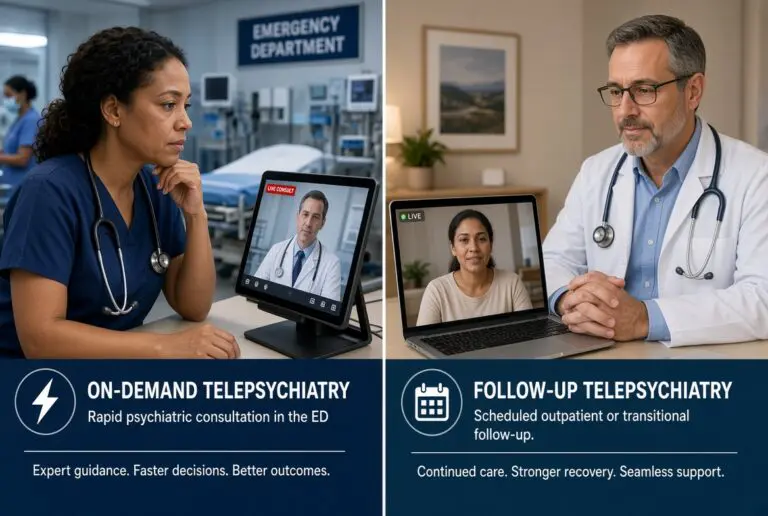

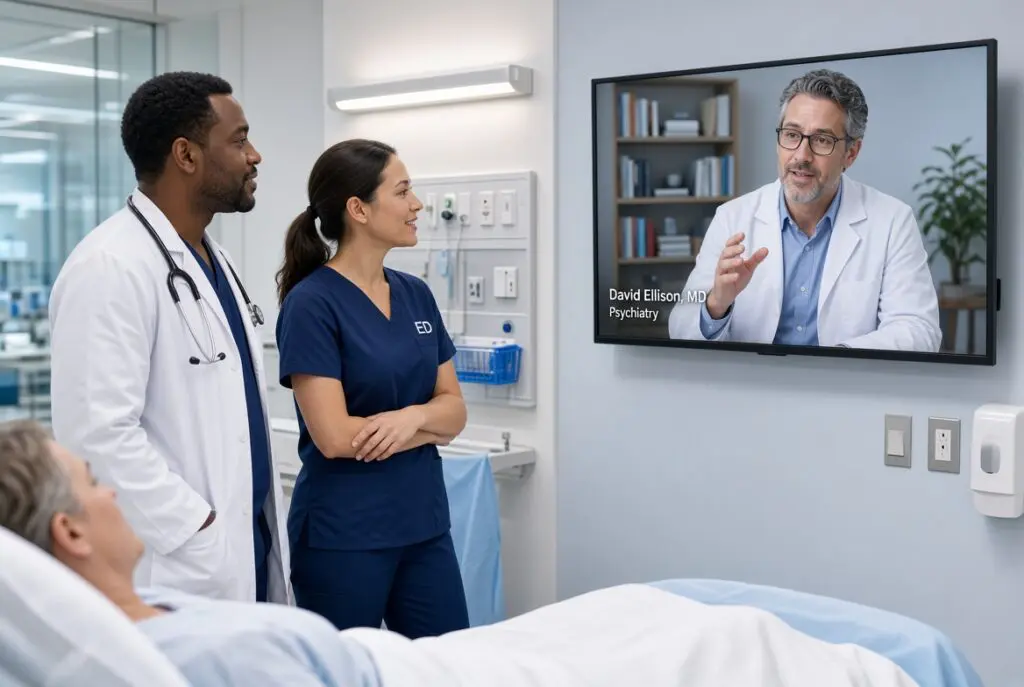
Emergency departments face high volumes of behavioral health patients, boarding challenges, and limited on-site psychiatric availability. On-demand telepsychiatry can reduce wait times for evaluation and disposition recommendations.
FasPsych already publishes detailed guidance on ED telepsychiatry workflows, boarding reduction in the first four hours, medication management, virtual rounding, and rural hospital models. This article does not repeat those topics. Instead, it compares pure on-demand ED coverage with follow-up and transitional telepsychiatry models that can also support scheduled outpatient or step-down continuity when an organization wants it. For operational details on rapid evaluations and boarding, see Psychiatric Boarding Hours: What Telepsychiatry Changes and Telepsychiatry for Emergency Rooms.
Some telepsychiatry providers emphasize pure on-demand ED coverage focused on throughput. Those models address acute ED needs effectively. Organizations that also operate outpatient, step-down, or community programs often need a complementary approach that supports continuity beyond the single ED encounter without creating a separate virtual clinic. Follow-up and transitional telepsychiatry models can also support broader integration goals such as those described in the Collaborative Care Model, where psychiatric expertise is available to primary or acute teams without building a full separate service.
This guide focuses on model fit and handoff design. For non-ED community staffing, see the flexible telepsychiatry staffing models for community and outpatient programs and the telepsychiatry staffing playbook for FQHCs, CMHCs, and CCBHCs. Broader model comparisons appear in FasPsych’s analysis of virtual clinic vs. psychiatry staffing network.
ED Staffing Models Comparison
| Model | Response Time | Continuity Beyond ED | Cost Structure | Best Fit |
|---|---|---|---|---|
| Pure on-demand ED telepsychiatry | Rapid (often <2 hours SLA) | Low (encounter-specific) | Per consult or block | High-volume EDs focused on disposition and boarding reduction |
| On-demand + follow-up/transitional telepsychiatry | Rapid for ED + scheduled for follow-up | Moderate to high | Hours or encounters used | Hospitals or systems with ED + outpatient or community programs |
| Employed or partnership ED team | Variable | High within system | Fixed or revenue-share | Large systems with consistent volume |
Pure on-demand models excel at reducing ED boarding and providing rapid risk assessment and disposition support. Models that combine on-demand coverage with follow-up or transitional telepsychiatry add the option for the same provider group to support scheduled outpatient or step-down visits when the organization wants continuity without building a separate clinic. For evaluation criteria that keep coverage inside existing workflows, see how to write a telepsychiatry staffing RFP.
Implementation Notes
- Confirm state licensing and hospital privileging timelines. HRSA Mental Health HPSA data continues to show limited local psychiatric supply in many regions, making remote coverage practical.
- Integrate request workflow (portal or EHR order) with clear response-time expectations. Detailed first-four-hours workflow guidance is already available in Psychiatric Boarding Hours: What Telepsychiatry Changes.
- Define documentation standards so ED notes flow into the hospital record.
- For organizations with affiliated outpatient or community programs, map handoff processes so patients can move from ED disposition to scheduled follow-up without a new front door. Related guidance on multi-site and rural coverage appears in telemed psychiatric services for rural and remote FQHCs and Virtual Psychiatric Evaluation Services for Rural Hospitals. Technology-enabled behavioral health access under Medicaid is also discussed in this overview of how technology is changing behavioral health coverage.
- Pilot with a defined consult volume, measure time-to-evaluation and boarding metrics, then adjust. Existing FasPsych resources on after-hours telepsychiatry and virtual rounding cover complementary operational details.
Frequently Asked Questions
What is on-demand ED telepsychiatry?
It is rapid-response psychiatric evaluation and disposition support for emergency department patients, typically available 24/7 with defined response-time targets. FasPsych’s existing Emergency Room Mental Health Crisis Services page and On-Demand Psychiatry Services page describe the core service.
How does follow-up or transitional telepsychiatry differ from pure on-demand?
Follow-up or transitional telepsychiatry uses the same staffing partner for both rapid ED consults and scheduled outpatient or community follow-up hours, supporting continuity when the organization wants it. This aligns with the staffing-network approach described in FasPsych’s virtual clinic vs. staffing network comparison.
Does this replace on-site ED behavioral health staff?
No. It supplements existing teams by providing psychiatric expertise for evaluation, risk assessment, medication guidance, and disposition recommendations. Medication management specifics for EDs are covered in Telehealth Medication Management for EDs.
Next Steps
Emergency departments can reduce boarding and improve disposition speed with on-demand telepsychiatry. Organizations that also need outpatient or community continuity can combine it with follow-up or transitional telepsychiatry coverage. FasPsych has supported hospital and community settings since 2007 with state-licensed psychiatrists and psychiatric nurse practitioners. Learn more about the provider network on the FasPsych providers page.
To map coverage for an emergency department or follow-up program, contact FasPsych at (877) 218-4070 or visit faspsych.com/partner-with-us.