
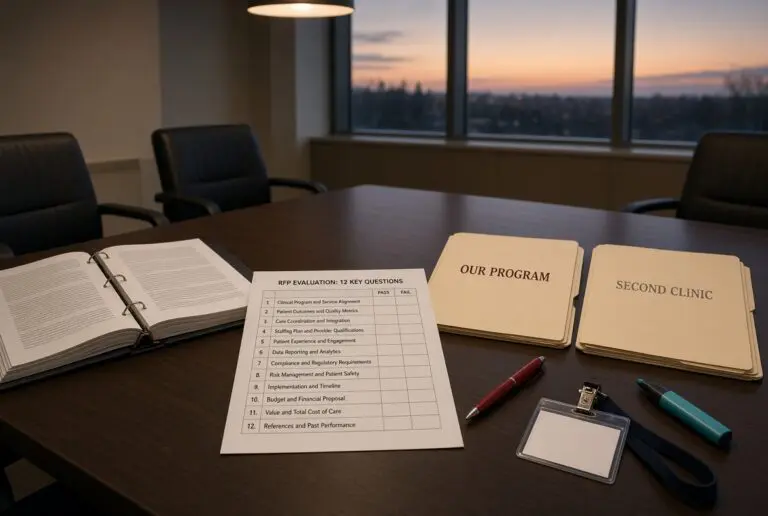

Most telepsychiatry RFPs ask the wrong first question. They ask who can put a psychiatrist on a screen. Almost every bidder can. The question that decides whether the contract helps your program — or quietly replaces it — is this: when the term ends, whose patients are those?
If the answer is the contractor’s, you did not buy telepsychiatry staffing. You bought a second clinic. The visits may look the same in month one. By month eighteen the panel, the notes, the quality measures, and sometimes the billing NPI sit on someone else’s books.
That failure is expensive because the underlying shortage is real. When there are no psychiatrists, the cost is not only an empty FTE — it is months-long waits, diverted emergency volume, and lost encounters in counties that already have no full-time psychiatric coverage. HRSA’s shortage-area data still puts well over 100 million Americans in mental health professional shortage areas. An RFP that only buys “a psychiatrist on video” does not close that gap if the patients leave with the vendor.
FasPsych has staffed psychiatry for organizations since 2007 — hospitals, FQHCs, CCBHCs, community mental health centers, correctional facilities, schools, and rural clinics. The model is telepsychiatry staffing inside your program, not a parallel practice. This guide is the scoring grid organizations use when they write a telepsychiatry staffing RFP. Under each question is an example of how FasPsych typically answers that item when a client asks us to bid — written for that client’s program, not as boilerplate to paste into someone else’s contract.
If you already have a scope of work, send it. FasPsych will write a staffing plan against your hours, sites, and billing rules. Most partners go live in 2–6 weeks. Call (877) 218-4070 or partner with us.
Staffing a Program vs. Standing Up a Second Clinic
Two contracts can use the same words — “telepsychiatry,” “board-certified,” “HIPAA-compliant video” — and deliver opposite operating models. The American Psychiatric Association treats telepsychiatry as comparable to in-person care for evaluation, treatment, and medication management. That clinical equivalence does not decide who owns the panel.
| Staffing inside your program | A second clinic under your roof | |
|---|---|---|
| Who owns the panel? | Your organization. Patients stay on your census, your UDS or quality file, and your discharge list. | The contractor. Patients are enrolled in the vendor’s practice and leave when the contract ends. |
| Whose medical staff? | The psychiatrist is privileged or contracted onto your medical staff and follows your bylaws. | The psychiatrist practices under the vendor’s group, with your site as a location. |
| Whose chart? | Notes, orders, and e-prescribing live in your EHR. | Notes live in the vendor’s system. You get a PDF, a portal, or a delayed feed. |
| Who bills? | Your NPI and your encounter rules, including FQHC PPS where those rules apply. | The vendor bills, or split-bills in a way that pulls the visit off your books. |
| What happens at termination? | Coverage ends. The panel, the record, and the measures stay. | Coverage ends and a share of the caseload leaves with it. |
Write the left-hand column into the RFP as mandatory requirements, not as “preferred.” For the fuller operating-model comparison, see Virtual Clinic vs Psychiatry Staffing Network. For how that model scales without a second front door, see scalable telepsychiatry staffing.
Who This RFP Is For
- A hospital or emergency department that needs consults, virtual rounding, or on-demand psychiatry without building a virtual behavioral-health department from scratch.
- An FQHC or rural health clinic that must keep PPS encounters and UDS visits on the health center. Why telepsychiatry belongs in an FQHC is a capacity question; who bills the visit is the RFP question. Rural sites should also see telemed psychiatric services for rural FQHCs.
- A CCBHC scored on SAMHSA time-to-service and quality measures that cannot split the denominator across two front doors.
- A community mental health center, residential program, or school-based clinic that already has intake, therapists, and a medical record.
- A jail, prison, or juvenile facility that needs scheduled psychiatry plus after-hours coverage. Pair this RFP language with on-demand telepsychiatry for correctional units so crisis coverage is not the entire award.
FasPsych partners with organizations, not individual patients.
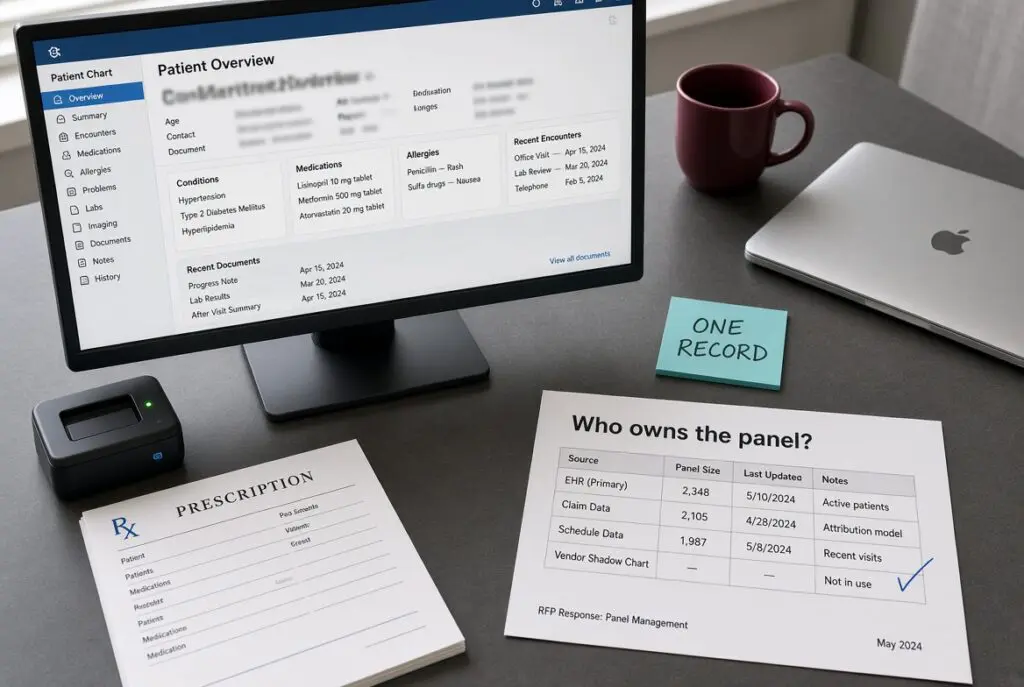
Twelve Questions to Put in the Telepsychiatry Staffing RFP
Score each item as pass/fail before you score price. Price-only scoring is how a cheap second clinic beats a staffing partner.
The paragraphs labeled Example: how FasPsych answers this on a client bid are illustrations of a FasPsych proposal to an organizational client. They are not scope language for you to drop into an RFP, and they are not a stock template we send unchanged. Every live bid is written against that client’s setting, census, privileging rules, and payer mix.
1. Who owns the patient panel during the contract and after it ends?
Require a written answer: patients remain patients of the issuing organization. At termination, caseloads stay with you. If you report behavioral health value-based measures, those numerators have to sit on your file, not the vendor’s.
Example: how FasPsych answers this on a client bid: Providers treat as an extension of that client’s team. They do not take the panel if the contract ends. See virtual clinic vs. psychiatry staffing network.
2. Who is the billing NPI, and under whose encounter rules is the visit paid?
If the contractor bills the visit, you can lose the PPS encounter and the UDS attribution. CMS’s FQHC booklet and HHS safety-net telehealth billing guidance treat qualifying mental-health visits furnished by telehealth as FQHC visits when the rules are met.
Medicaid-heavy CMHCs and FQHCs already know the other half of this problem. Technology has changed how behavioral health is delivered under Medicaid — remote specialists, multi-site coverage, and EHR-integrated video that lets the health center keep the panel. An RFP that lets the vendor bill the visit gives that advantage away. For collaborative-care billing that stays on the clinic, see FasPsych’s CoCM guide.
Example: how FasPsych answers this on a client bid: Where that client’s program rules allow, the encounter stays on the health center. Start from the FQHC telepsychiatry page.
3. Whose EHR holds the note, the order, and the prescription?
“We can send a summary” is not integration. Unified documentation is how Medicaid and FQHC teams keep remote psychiatrists inside one care plan — the same EHR point made in the Medicaid behavioral-health technology overview.
Example: how FasPsych answers this on a client bid: Providers document in that client’s existing EHR where the organization uses one. That is also how backup psychiatrist coverage works: a second licensed clinician opens the same record, not a parallel chart.
4. Does the psychiatrist join our medical staff and report to our clinical leadership?
Matching also has to happen before the first login — specialty-matched telepsychiatry staffing.
Example: how FasPsych answers this on a client bid: Partner organizations interview the provider and have the psychiatrist report to their clinical leadership. If the fit fails after that client’s process, FasPsych works a plan of correction or replaces the provider at no additional charge.
5. What is the replacement SLA when a provider leaves, is ill, or does not meet the standard?
Retirements still outrun new psychiatrists, so a single named clinician is a single point of failure.
Example: how FasPsych answers this on a client bid: Per the partner terms, if performance concerns are not resolved after the client’s standard process, FasPsych finds a replacement at no additional charge. Put backup video coverage in the same award so a call-out does not cancel the clinic.
6. Can the same network cover scheduled clinics, on-demand consults, and after-hours — or is that three contracts?
Example: how FasPsych answers this on a client bid: One contract can include the mix that client asked for: scheduled clinics, on-demand psychiatry, virtual rounding, after-hours. For SUD plus mental health, see co-occurring disorders telepsychiatry staffing.
7. Do you staff hybrid on-site days, or is this video only?
APA’s current telepsychiatry FAQs and HHS telehealth policy updates note that Congress has extended key Medicare telehealth flexibilities, including a delay of the in-person requirement for mental and behavioral health telehealth through December 31, 2027. That delay is not a reason to ignore accreditation rules or units that still need periodic presence.
Example: how FasPsych answers this on a client bid: Intermittent on-site days and ongoing virtual care from the same contracted network, when that client’s scope includes both. See hybrid telemedicine and hybrid telepsychiatry staffing models.
8. Can you place a remote psychiatric medical director as well as treating clinicians?
SAMHSA’s CCBHC criteria put medical leadership and access measures on the clinic, not on a vendor brand.
Example: how FasPsych answers this on a client bid: The remote medical director and treating psychiatrists can be bid as one team when the client’s RFP asks for both. See co-occurring disorders program staffing.
9. How is the contract priced — and what are we not paying for?
Unfilled psychiatric seats show up as overtime, diversion, and missed visits.
Example: how FasPsych answers this on a client bid: No upfront fee. Pay by visit, hour, or day for time worked and required training. See scalable telepsychiatry staffing.
10. What is the start clock, including privileging and EHR access?
Example: how FasPsych answers this on a client bid: Most partners begin services within 2–6 weeks, subject to that facility’s privileging. Detail on the partner page.
11. Which settings have you actually staffed — and can you staff more than one under the same agreement?
APA’s resource on telepsychiatry for adults in jails and prisons is the standard document correctional evaluators already know.
Example: how FasPsych answers this on a client bid: Nearly 130 organizational partners across hospitals, community programs, FQHCs, CCBHCs, correctional facilities, tribal programs, residential settings, and schools. The written bid lists only the settings that client put in scope. Attach FQHCs, CCBHCs, correctional, clinics.
12. What language in your standard contract would move patients, records, or billing off our books?
Example: how FasPsych answers this on a client bid: If a clause would move panel, record, or billing off that client’s books, it does not belong in a staffing award. Same test as Virtual Clinic vs Psychiatry Staffing Network.

Red-Flag Language That Means You Bought a Second Clinic
- “Patients will be established with our practice” or “our providers carry their own panel.”
- “Documentation in our proprietary platform” as the default, with your EHR listed as optional.
- “We bill and remit” with no path for your NPI or your encounter rate.
- No interview of the individual psychiatrist who will treat your patients.
- Replacement described as “we will recruit,” with no clock and no coverage during the gap.
- Video-only, with on-site days priced later as a separate locum engagement.
- A long implementation fee before any clinical hour is delivered.
Example: what a FasPsych client bid usually covers
The table below is a snapshot of how FasPsych has answered client RFPs. It is not a stock proposal and it is not language for you to paste into your own solicitation. Hours, sites, payer mix, and privileging change the written response. Why organizations partner with FasPsych is the contract-level version of the same points.
| What clients usually ask | How FasPsych has answered on client bids |
|---|---|
| Tenure | Telepsychiatry staffing for organizations since 2007. |
| Scale | Nearly 130 organizational partners. |
| Model | Providers join that client’s workflow and report to that client’s clinical leadership. |
| Record | Documentation in the client’s EHR where the organization uses one. |
| Price | No upfront cost. Pay by visit, hour, or day. |
| Fit | The client interviews the provider. If the fit fails after the client’s process, FasPsych replaces the provider at no additional charge. |
| Clock | Most partners begin services in 2–6 weeks, subject to that facility’s privileging. |
| Breadth | Only the items that client asked for. |
Send your scope. FasPsych will map hours, modality, and start date against what you issued — not a reused template.
What evaluators should put in the packet
- This twelve-question grid, scored pass/fail before price.
- Your privileging timeline.
- Whether on-site days, remote medical director hours, or after-hours coverage are in-scope for this award.
- Who will interview the clinician.
Do not paste a vendor’s sample clause into the RFP and call it your scope. Write the requirements in your voice. Invite FasPsych to answer them against that scope.
Request a staffing plan written against your scope
If you are scoring a telepsychiatry staffing RFP this quarter, send the actual statement of work. You will get a plan written for those sites and hours — not boilerplate.
- Call (877) 218-4070
- Partner with us
What if the assigned psychiatrist is not a fit? Use your standard performance process first. If it does not resolve, FasPsych finds a replacement at no additional charge, as stated on the partner page.