
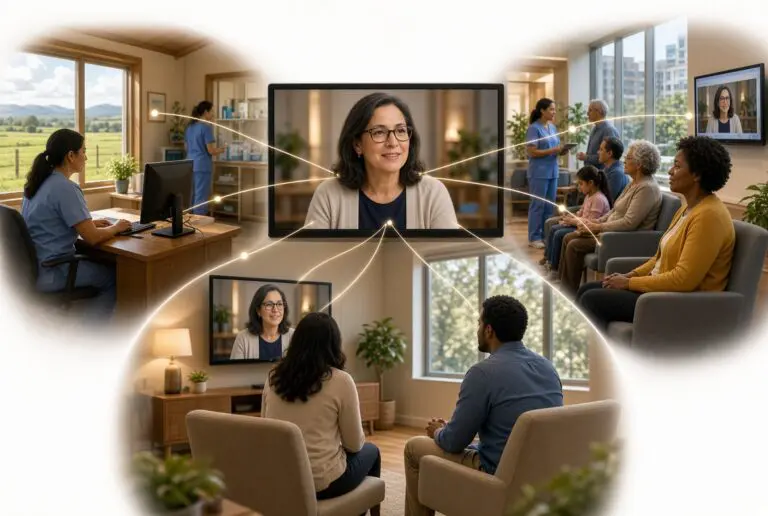

Community mental health centers, FQHCs, outpatient clinics, multi-site programs, and other non-acute settings face a recurring problem: psychiatric demand fluctuates, local recruitment is difficult, and full-time employed or partnership models create fixed costs that do not match variable volume.
Some groups emphasize physician-owned partnership structures and integrated acute-care teams, particularly for emergency departments and inpatient units. Those models can work well in hospital settings with consistent volume and on-site infrastructure. They are often a poorer fit for community and outpatient programs that need fractional coverage, multi-site reach, or the ability to scale hours up or down without long-term commitments.
This guide compares flexible telepsychiatry staffing models with employed, locum, and partnership approaches for community and outpatient organizations. It focuses on practical fit, cost structure, continuity, and implementation. For broader model comparisons, see FasPsych’s analysis of virtual clinic vs. psychiatry staffing network. For evaluation criteria when writing RFPs, see how to write a telepsychiatry staffing RFP.
Why Community and Outpatient Programs Need Different Staffing Models
HRSA Mental Health HPSA data continues to show large shortages of psychiatrists, with only a fraction of need met in designated areas. Community programs often serve high Medicaid populations with uneven demand. A full-time psychiatrist or a partnership that expects consistent volume can leave organizations paying for idle capacity during lower-volume periods.
Flexible telepsychiatry staffing reverses the fixed-cost problem. Organizations pay for hours or encounters delivered. Providers work inside the host program’s EHR and clinical governance rather than operating a separate virtual clinic. This structure supports continuity for patients while avoiding the overhead of employment or long-term partnership agreements. FasPsych has used this approach since 2007 across hospitals, FQHCs, CMHCs, CCBHCs, rural clinics, and other community settings.

Staffing Model Comparison
| Model | Cost Structure | Volume Flexibility | Continuity | Best Fit | Limitations for Community/Outpatient Programs |
|---|---|---|---|---|---|
| Employed (remote or on-site) | Full salary + benefits + overhead | Low | High (if retained) | Steady high-volume panels | Fixed cost even when volume drops; long recruitment |
| Traditional locum | Daily/hourly rate + platform or agency fees | Moderate | Low (rotating providers) | Short-term gaps | High cost per hour; limited continuity |
| Physician partnership / integrated team | Revenue share or employment-like structure | Low to moderate | High within partnership | Hospital systems with consistent acute volume | Less flexible for pure outpatient or variable-volume community programs |
| Flexible vendor telepsychiatry staffing | Pay for hours or encounters used; no long-term commitment | High | Moderate to high (dedicated providers possible) | Variable volume, multi-site, fractional coverage | Requires clear workflows and governance |
The flexible model is usually the strongest match for community and outpatient programs that cannot justify full-time employment or a formal partnership. It allows organizations to start with a defined number of hours, measure results, and adjust without residual fixed costs.
Implementation Checklist
- Map exact coverage needs (medication management hours, after-hours support, child/adolescent panels, multi-site reach, medical direction).
- Confirm state licensing requirements and facility privileging timelines.
- Select a partner that offers hour- or encounter-based contracts, EHR integration, and dedicated (not purely rotating) providers when continuity matters.
- Define referral, scheduling, documentation, e-prescribing, and care-coordination workflows so encounters remain inside the existing program.
- Establish clinical governance and quality review processes.
- Pilot with a defined number of hours, track access and no-show metrics, then scale.
- Review outcomes at 60–90 days and adjust hours or provider mix.
Frequently Asked Questions
What is flexible telepsychiatry staffing?
It is a model in which organizations pay for psychiatric hours or encounters delivered by credentialed providers who work inside the host program’s EHR and workflows, without long-term employment or partnership commitments.
How does it differ from a physician partnership model?
Partnership models typically involve shared ownership, revenue alignment, and integrated teams suited to consistent hospital volume. Flexible staffing is a service agreement focused on variable or fractional coverage without equity or long-term volume guarantees.
Can the same providers stay with our panel for continuity?
Yes. Many organizations use dedicated or semi-dedicated providers for recurring panels while retaining the ability to adjust total hours.
Does this model work for multi-site or rural programs?
Yes. One provider group can cover multiple sites when local full-time recruitment is not feasible at each location. See related guidance on telemed psychiatric services for rural and remote FQHCs.

Next Steps
Community and outpatient programs can obtain reliable psychiatric coverage without the fixed costs of employment or the structural commitments of a full partnership. FasPsych has supported these settings since 2007. To map flexible coverage, contact FasPsych at (877) 218-4070 or visit faspsych.com/partner-with-us.