


The best virtual psychiatric evaluation services for rural hospitals use a coverage model that matches the hospital’s setting. Rural and critical access hospitals rarely struggle with telepsychiatry because the video cart fails. Instead, they struggle because they buy the wrong service. Some buy on-demand consults for a unit that needs scheduled rounding. Others pay for full-time remote staff when the ED sees a few psychiatric patients a week. So decide first which beds need coverage, how often, and for which ages. For most small facilities, a telepsychiatry partner such as FasPsych is the practical way to close the overnight gap without recruiting a local psychiatrist, because FasPsych provides 24/7 virtual mental health evaluations and remote psychiatric staffing for hospitals.
Which Virtual Psychiatric Evaluation Services Fit Rural Hospitals?
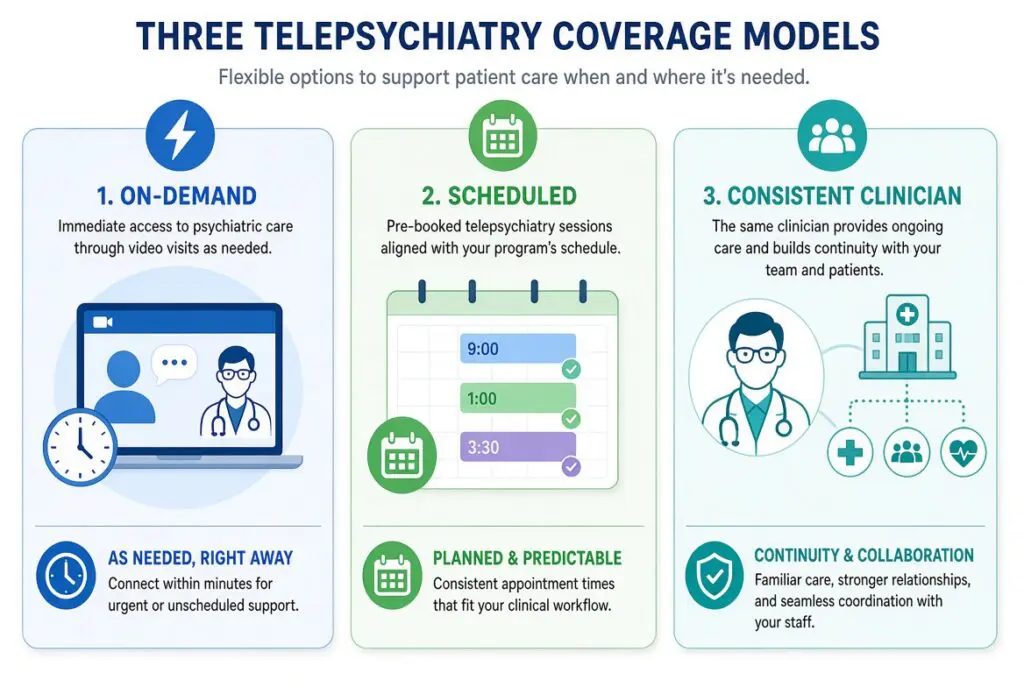
The right model depends on the kind of hospital you run. On-demand per-consult coverage usually fits a critical access hospital that sees psychiatric patients mainly in the ED. By contrast, scheduled block or subscription coverage fits a small hospital with inpatient or med-surg beds. Dedicated remote psychiatric staffing fits a multi-site system with steady volume across facilities.
The deciding factor is how predictable your demand is. ED psychiatric presentations arrive unannounced, often overnight, so paying per evaluation keeps costs tied to actual use. Inpatient needs, however, are different. Med-surg patients with delirium, alcohol withdrawal, post-overdose capacity questions, or medication reviews can usually wait for a scheduled session. As a result, telepsychiatry coverage for inpatient and med-surg units works best as recurring blocks. Systems with several facilities often reach the point where a named remote psychiatrist, or a remote medical director, costs less than stacked consults and also gives clinical continuity.
Because your needs will shift as volume grows, you should not have to switch vendors to follow them. FasPsych offers both consult services and remote psychiatric staffing, so you can choose by fit rather than by whoever happens to be available. Learn more about telepsychiatry for hospitals and multi-site systems.
| Factor | On-demand per-consult | Scheduled block or subscription | Dedicated remote staffing |
|---|---|---|---|
| Typical pricing | Fee per evaluation | Hourly blocks or flat monthly fee | Salaried or contracted FTE equivalent |
| Response expectation | Fast, 24/7, set by SLA | Fixed session times, plus on-call add-on | Set clinic and rounding hours, consistent clinician |
| Best-fit hospital | Critical access, ED-only psychiatric demand | Small hospital with inpatient or med-surg beds | Multi-site system |
| Pediatric coverage | Confirm child and adolescent availability overnight | Can schedule a child psychiatrist into blocks | Can hire for child and adolescent expertise |
| Credentialing burden | Many rotating clinicians to credential | Smaller, stable clinician pool | One or a few clinicians |

Telepsychiatry for Emergency Departments: Contract on Consult-to-Disposition Metrics
Whichever model you choose, the ED is where the contract terms matter most, because boarding is the cost that hits a rural ED hardest. Your contract should therefore measure the full path from consult request to disposition. ED boarding in one health system’s data rose from 4.1% in 2019 to 10.8% in 2025, according to a 2026 study in the Journal of Rural Health. The increase was steeper in rural hospitals, with an annual percentage change of 31.2% against 13.6% in urban hospitals. Behavioral-health transfers also had the highest boarding levels, and rural hospitals transfer a larger share of patients each year.
These numbers explain why response time alone is not enough. Write targets into the agreement for time from request to video contact and time to a disposition recommendation. Then add boarding hours for psychiatric patients, safe discharge rate, and transfers avoided. In addition, define who reassesses patients on emergency holds, how the remote psychiatrist documents a hold or its release under your state’s law, and who coordinates the transfer when one is needed. FasPsych’s emergency room mental health crisis services are built around this consult, hold, and transfer workflow.
Statewide programs show that these outcomes can be tracked at scale. For example, a review of the North Carolina Statewide Telepsychiatry Program logged 67,543 ED psychiatric assessments, 11,802 prevented hospitalizations, and $63.7 million in cost savings. The review concluded that telepsychiatry increased safe discharges and reduced ED boarding. Those are the benefits of telepsychiatry that matter most to a rural CFO.
How Pricing Models Interact with 2026 Rural Hospital Telepsychiatry Reimbursement
Once the ED metrics are set, consult volume decides which pricing model costs less. As the model comparison above shows, per-consult pricing suits a low-volume ED and block hours suit scheduled inpatient work. A subscription, meanwhile, buys guaranteed 24/7 availability for a flat fee. That fee makes sense once your monthly consults would cost more at per-evaluation rates. To find that point, pull a year of psychiatric ED visits and inpatient consult requests, then price each model against them.
Reimbursement then offsets part of that cost. Under Medicare telehealth, the remote clinician bills the professional service. Your hospital, as the originating site where the patient sits, may be able to bill a facility fee. However, telehealth rules have changed on short notice in recent years. Have your billing team confirm how current 2026 rules apply to behavioral health visits and originating-site claims before you build the budget. See CMS guidance on Medicare telehealth services.
Shortage designations can also widen your funding options. HRSA’s shortage-area data include geographic, population, and facility designations for mental health. More than 34 federal programs use HPSA, MUA, or MUP designations for eligibility or funding preference. Check your county’s status, then review 2026 state behavioral health funding and Medicaid options that can fund start-up and ongoing coverage. FasPsych also supports organizations pursuing rural telehealth grants.
What to Ask Telepsychiatry Providers Before the First Evaluation
With a model and budget in hand, screen telepsychiatry companies against a compliance and fit checklist before you sign. Credentialing is where small hospitals lose the most time. CMS Conditions of Participation allow your medical staff to rely on the credentialing decisions of a distant-site hospital or telemedicine entity, and Joint Commission standards include matching provisions. The agreement must be written to meet those requirements. Ask for it early, because your bylaws may need an update too.
| Criterion | What to ask each telepsychiatry provider |
|---|---|
| 24/7 hours | Is overnight and weekend coverage staffed by psychiatrists or psychiatric nurse practitioners, and is a backup on call? |
| Response time SLA | What is the contracted time to video contact, and how are misses reported and credited? |
| State licensure footprint | How many clinicians hold an active license in our state, and how deep is the overnight bench? |
| Credentialing by proxy | Will you sign an agreement that meets CMS and Joint Commission requirements and supply the documents our medical staff office needs? |
| EHR integration | Will clinicians document in our EHR, and who arranges access? |
| Disposition and follow-up handoff | Who writes the discharge plan, and how are outpatient referrals arranged? |
| Child and adolescent coverage | Is a child and adolescent psychiatrist available around the clock or by schedule? |
| Reporting metrics | Do you report response time, boarding hours, safe discharges, and transfers avoided each month? |

After you sign, the hospital side of the work begins. First, secure reliable bandwidth with backup connectivity, so a dropped connection does not end an evaluation. Next, place carts or fixed video stations in safe rooms in the ED and on inpatient units. Remote psychiatrists also need EHR access, and the credentialing agreement described above should start weeks before go-live. Finally, train nursing staff to start a consult, present the patient, and carry out recommendations.
Because FasPsych supports setup and integration into existing hospital systems, your team does not have to plan the deployment alone. The next step is to contact FasPsych for a coverage assessment that matches a service model to your beds, volume, and patient ages.
Frequently Asked Questions
What is the best telepsychiatry model for a critical access hospital with mostly ED demand?
On-demand per-consult coverage is usually the best fit. It keeps costs tied to actual use when psychiatric presentations are unpredictable and concentrated in the emergency department. See FasPsych’s approach to telepsychiatry for emergency rooms.
How does telepsychiatry reduce ED boarding in rural hospitals?
Timely virtual evaluations support faster disposition decisions, higher safe discharge rates, and fewer unnecessary transfers. A review of the North Carolina Statewide Telepsychiatry Program documented reduced boarding, more safe discharges, and substantial cost savings.
Can rural hospitals use credentialing by proxy for telepsychiatry?
Yes. CMS Conditions of Participation and Joint Commission standards allow medical staff to rely on the credentialing decisions of a distant-site hospital or telemedicine entity when the agreement meets the requirements.
How does Medicare reimburse telepsychiatry at a critical access hospital in 2026?
The remote clinician typically bills the professional service. The hospital, as the originating site, may bill a facility fee. Confirm current 2026 rules with your billing team and CMS telehealth guidance, as policy has changed in recent years.
Does FasPsych offer both on-demand consults and dedicated remote staffing?
Yes. FasPsych provides on-demand virtual psychiatric evaluations, scheduled block coverage, and dedicated remote psychiatric staffing so hospitals can match the model to their volume and settings without switching vendors.