

Federally Qualified Health Centers (FQHCs), Community Mental Health Centers (CMHCs), and Certified Community Behavioral Health Clinics (CCBHCs) share a structural problem: demand for psychiatric prescribing and medical direction exceeds the local supply of psychiatrists and psychiatric nurse practitioners, while budgets and regulatory rules limit full-time hiring.
Some groups emphasize embedding dedicated virtual teams into hospital workflows, including 24/7 ED coverage, inpatient units, and freestanding behavioral health hospitals, often positioning as the facility’s professional psychiatric department. Those models can work for acute hospital settings. They are frequently a poorer fit for community programs that must keep encounters, quality measures, and billing inside an existing FQHC, CMHC, or CCBHC structure.
This playbook focuses on staffing models, regulatory alignment, and implementation steps that work across FQHCs, CMHCs, and CCBHCs. It emphasizes flexible coverage that stays inside the host organization rather than creating a separate virtual department. For setting-specific resources, see FasPsych’s dedicated pages on FQHC telepsychiatry services, CMHC telepsychiatry, and CCBHC telepsychiatry support. Broader model comparisons appear in the virtual clinic vs. psychiatry staffing network analysis.
Shared Staffing Constraints Across FQHCs, CMHCs, and CCBHCs
As of late 2026 HRSA Health Professional Shortage Area data, more than 7,100 Mental Health HPSA designations cover approximately 154.5 million people, with only about 26% of psychiatrist need met in those areas. All three settings face variable volume, heavy Medicaid mix, and difficulty recruiting locally.
CCBHCs face additional requirements under the 2023 SAMHSA CCBHC Certification Criteria:
- A management team that includes a Medical Director (preferably a psychiatrist; if reasonable recruitment efforts fail, another qualified independent prescriber with appropriate psychopharmacology experience may serve). The role does not have to be full-time.
- A staffing plan informed by a community needs assessment.
- Delivery of the nine required services, with the CCBHC directly providing the majority (51% or more) of non-crisis encounters.
- Timely access and 24/7 crisis availability.
Telepsychiatry staffing can support the Medical Director function, outpatient psychopharmacological treatment, screening and risk assessment, and after-hours crisis coverage while keeping documentation and quality measures inside the host organization. This differs from models that establish a separate virtual psychiatric department. FasPsych’s approach keeps providers working inside the partner’s EHR and clinical governance.

Staffing Models Comparison
| Model | Who Employs the Clinician | Cost Structure | Credentialing Burden | Fit for FQHCs / CMHCs / CCBHCs |
|---|---|---|---|---|
| Employed (remote or on-site) | Organization | Full salary + benefits + overhead | Highest | Steady high-volume panels only |
| Traditional locum | Agency / contractor | Daily or hourly + platform costs | High per placement | Short-term gaps |
| Dedicated virtual department / hospital-embedded team | External group becomes or supplements the psychiatric department | Often more structured or volume-based | Shared to high | Hospital systems and freestanding behavioral health hospitals |
| Flexible vendor telepsychiatry staffing | Staffing partner | Pay for hours or encounters used; no long-term commitment | Shared (partner credentials; organization privileges) | Variable volume, fractional Medical Director, multi-site or rural coverage |
| Hybrid | Mix of employed + contracted | Core salary + flexible hours | Moderate | Centers with an on-site director who still need backup |
The flexible model is usually the strongest match for these organizations because it avoids idle capacity charges and keeps the encounter inside the existing program. FasPsych has operated this way since 2007. For evaluation criteria that protect this structure, see how to write a telepsychiatry staffing RFP.
Regulatory and Reimbursement Alignment
CCBHC Medical Director and direct-service rules
A remote psychiatrist or qualified PMHNP can fulfill the Medical Director role on a fractional basis under the flexibility built into the 2023 criteria. Services delivered under the organization’s governance and documented in its system generally support the 51% direct-encounter requirement. Confirm details with your state certifying authority. Related operational guidance appears in FasPsych’s remote medical director services for rural health clinics.
FQHC Medicare telehealth
Behavioral/mental health telehealth is permanently covered when the FQHC serves as the distant site. The in-person visit requirement remains delayed until at least January 1, 2028. For dates of service on or after October 1, 2026, bill the individual CPT or HCPCS code plus the appropriate telehealth modifier (95 or 93). See current CMS guidance on telehealth policy for RHCs and FQHCs and the CMS FQHC Center.
Medicaid rules vary by state but commonly reimburse telepsychiatry for these settings when licensed providers and documentation standards are met. CCBHC demonstration or state-plan benefits often reward the full scope of required services. For broader Medicaid context, see FasPsych’s analysis of how Medicaid cuts affect CMHCs, FQHCs, and CCBHCs.
 Implementation Checklist
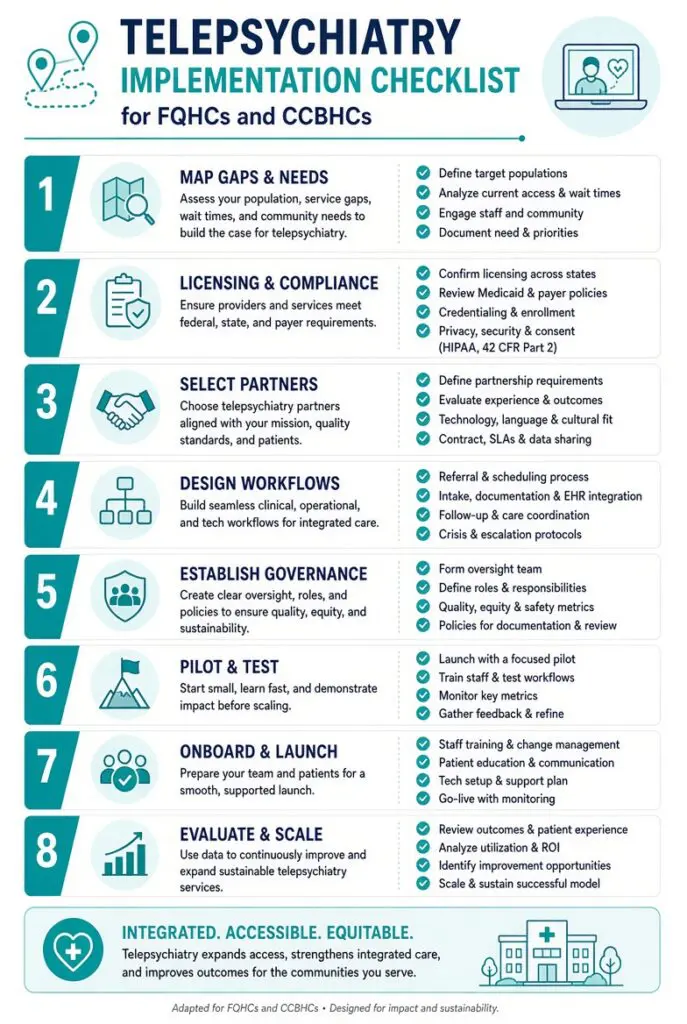
- Map exact gaps (Medical Director oversight, adult vs. child panels, MAT/SUD prescribing, after-hours crisis, multi-site coverage) against your community needs assessment if you are a CCBHC.
- Confirm state licensing and facility privileging timelines.
- Select a partner that credentials thoroughly, integrates with your EHR, and offers hour-based or encounter-based contracts rather than fixed blocks or full virtual department structures.
- Define referral, scheduling, documentation, e-prescribing, and care-coordination workflows so encounters remain inside your system.
- Establish clinical governance and quality review (especially for the Medical Director function).
- Pilot with a defined number of hours, measure access metrics, then scale.
- Typical onboarding (credentialing + EHR access + test sessions) is often 4–6 weeks once scope is clear.
Frequently Asked Questions
Can a remote provider serve as CCBHC Medical Director?
Yes. The SAMHSA CCBHC criteria prefer a psychiatrist but allow another qualified independent prescriber if reasonable recruitment efforts fail. The role does not require full-time status.
Does telepsychiatry count toward the 51% direct-service requirement?
Services provided under your clinical governance and documented in your system generally do. Confirm with your state authority. This aligns with the staffing-network model described in FasPsych’s virtual clinic vs. staffing network comparison.
How does this differ from a dedicated virtual psychiatric department?
A dedicated virtual department often functions as the facility’s primary or supplemental psychiatric service with structured teams and medical directors, which fits many hospitals. Flexible staffing keeps the encounter, measures, and governance inside the existing FQHC, CMHC, or CCBHC program and scales hours to actual demand.
How should FQHCs bill Medicare telepsychiatry after October 1, 2026?
Use the individual CPT/HCPCS code plus telehealth modifier. Behavioral health telehealth remains permanently covered with the in-person rule delayed. See HHS telehealth billing guidance for safety-net providers.
Next Steps
FQHCs, CMHCs, and CCBHCs can meet access and certification requirements with flexible telepsychiatry staffing that stays inside the existing program. FasPsych has supported these exact settings since 2007. To map coverage for a CCBHC Medical Director role, an FQHC expansion, or a CMHC panel, contact FasPsych at (877) 218-4070 or visit faspsych.com/partner-with-us.
For a broader comparison of flexible models versus partnership structures, see the flexible telepsychiatry staffing models article. For emergency department-specific coverage, see the on-demand ED article.