

In Blake Edwards’s 1961 film Breakfast at Tiffany’s, Holly Golightly’s treatment for the days she cannot name is not a pill. She gets in a cab and goes to the store. The quietness and the proud look of it settle her: “Nothing very bad could happen to you there.” Paramount’s film page still frames that scene as the movie’s emotional center — a room that tells a frightened person the next hour will hold.
Emergency departments, residential units, FQHCs, and child clinics already know the other version of that hour. The patient is on a hallway gurney under fluorescent light. A television is on. Two conversations are happening at once. Staff reach for a PRN because the room itself is doing the opposite of a quiet, ordered place.
Facilities that already run emergency-department psychiatry, residential programs, FQHCs and CMHCs, and child and adolescent clinics do not need a jewelry counter. They need a first-contact space whose lighting, noise, privacy, and crowding do not manufacture the agitation the psychiatrist is then asked to medicate.
This article is written for hospitals, clinics, and behavioral health program leaders. It is educational and operational. It is not medical advice, a diagnosis, or a substitute for evaluation by a licensed clinician. It is not a recommendation to withhold indicated medication. If you or someone with you is in immediate danger, call 911. If you or someone with you is in crisis or having thoughts of suicide, call or text 988 (Suicide & Crisis Lifeline) or go to the nearest emergency department.
Key Takeaways
- A predictable room — quiet, even light, the sense that the next hour will hold — is an environmental intervention, not décor. Psychiatric units and consult rooms can buy some of that without a capital project.
- Design is not décor. A BMJ Open review of mental-health facilities found that a beneficial physical environment, sensory or comfort rooms, and private, uncrowded, calm spaces were the design themes most often tied to less seclusion and restraint.
- Roger Ulrich’s ten-feature model, tested when a Swedish hospital moved from an old ward to a new one, linked those features to fewer injections for aggression and a 50 percent drop in physical restraints among patients who had been restrained.
- A hallway is not a calming room. Neither is a telepsychiatry cart left in a nursing station. APA/ATA telemental-health guidance treats both ends of a video visit as examination rooms: private, lit, camera at eye level, discussion not overheard.
- Environment does not replace a psychiatrist. When the patient cannot stay in the room, safety is positive, or the presentation is mixed and escalating, book same-day or on-demand psychiatry and use the quieter room as the place that visit happens.
What a Calming Room Is Actually Doing
A usable consult room is predictable. The light is even. The noise is low. No one is shouting a room number over the patient’s head. The person is allowed to sit still without being a problem.
That is closer to what agitated patients are missing than another milligram on a standing order. Units already know the opposite list from after-hours coverage: a quiet hallway that feels unsafe, a closed door that triggers a trauma memory, overnight noise that reads as defiance. Those are clinical signals. They are also design failures.
Do not confuse this page with three neighbors:
- Sleep as a syndrome belongs on FasPsych’s insomnia guide. Bedroom hygiene at home is not an ED consult-room spec.
- Light-box protocols for seasonal depression belong on the SAD page. Circadian lighting on a ward is related. It is not the same order set.
- The first-four-hour boarding clock — when the consult starts, when treatment in place begins — is already written in Psychiatric Boarding Hours. This page is what that consult room should look and sound like when the psychiatrist arrives.
A calming room lowers arousal enough for an interview to happen. It is not a promise that the patient will not need medication. It is the difference between a PRN given because the bay is unbearable and a PRN given after someone has actually been examined.
What the Evidence Says Rooms Change
Psychiatric architecture has a thinner evidence base than medical-surgical design. The papers that exist are still usable for operations.
The BMJ Open rapid review (Oostermeijer and colleagues, 2021) screened design studies aimed at seclusion and restraint. Three themes recurred: a beneficial physical environment (daylight, gardens or recreation, less institutional finishes), sensory or comfort rooms, and private, uncrowded, calm space. The authors were careful. Design sits on top of staffing and model of care. A pretty unit with no psychiatrist still secludes.
Ulrich, Bogren, Gardiner, and Lundin (2018, Journal of Environmental Psychology) proposed ten stress-reducing features and then watched a Swedish hospital move from an old building that had one of them to a new building that had nine. Compulsory-care patients needing injections for aggression fell in the new hospital and did not fall in a control hospital that never moved. Among patients who were restrained at least once, average physical-restraint use dropped by half after the move. The model is not a furniture catalog. It is crowding, noise, private rooms, daylight, nature views, and places where a patient can step out of other people’s intensity.
Later relocation studies keep landing in the same neighborhood. A 2025 forensic-hospital relocation analysis reported restrictive practices more than halved after a move into a building that incorporated several of Ulrich’s features, with a lower daily mean score on a violence checklist. Design is not the only variable in a move. It is one of the variables facilities can specify.
Sensory and comfort rooms are the small-footprint version. The same BMJ Open review found them among the features tied to fewer restrictive practices, with effects that vary by how the room is staffed and whether patients can actually choose it. A locked “sensory room” that no one is free to open is storage.
The VA Whole Health library makes the same point in operational language: lighting, noise, nature, and a sense of control are treatment variables, not amenities. A 2024 built-environment review of therapeutic mental-health spaces lands there too — privacy, daylight, and lower stimulation show up more often than any single piece of furniture.
None of this tells an ED to rebuild. It tells an ED that the consult space is part of the treatment plan, the same way a suture tray is part of a laceration repair.
Hallway, Dedicated Space, Video Room
| Cue | Hallway gurney / nursing-station cart | Dedicated psych space | Telepsychiatry consult room |
|---|---|---|---|
| Privacy | Conversations overheard; family and other patients in frame | Door, sign, and a rule about who may enter | Both ends treated as exam rooms; discussion not audible outside |
| Noise | Overhead pages, monitors, other crises | Soft finishes, TV off or absent, one conversation | Door closed; staff know not to interrupt mid-exam |
| Light | Harsh overhead, faces in silhouette | Even light on the face; daylight if the room has it | Camera at eye level; face lit from the front, not a window behind the head |
| Crowding | Census visible and audible | Room for the patient to sit without touching equipment | One identified patient; extra people named and consented |
| Control | None | Chair they can move, dimmer they can use, option to step into a quieter corner | Patient told who is on camera and how to stop the visit |
| What the psychiatrist can do | Guess at affect through a curtain | Interview, safety, medication decision | Same interview — if the room lets the face and voice through |
| Typical failure | PRN for the bay, not the person | Room built and then used as overflow storage | Cart left where everyone can hear the trauma history |
Center for Health Design behavioral-health room guidance is a spec sheet, not a brand. The operational test is simpler: can this person sit still long enough for a mental status exam without the room picking a fight?
Cues a Facility Can Change This Week
Capital projects change restraint rates over years. Tuesday’s census does not wait. These are the cues that do not require a bond issue.
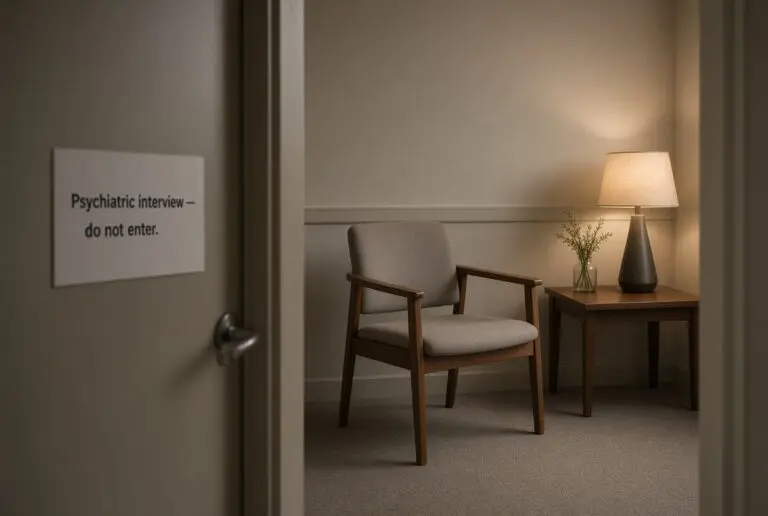
Give the visit a door. A paper sign that says “Psychiatric interview — do not enter” is not décor. It is how the caregiver article’s “separate the rooms” rule and the interpreter-mediated visit both stay confidential. If the only camera is at the desk, the interview is public.
Turn the television off. Unpredictable noise raises stress in volunteers and on wards. Staff already know this at 2 a.m.; the after-hours post names it. Day shift treats the same TV as furniture.
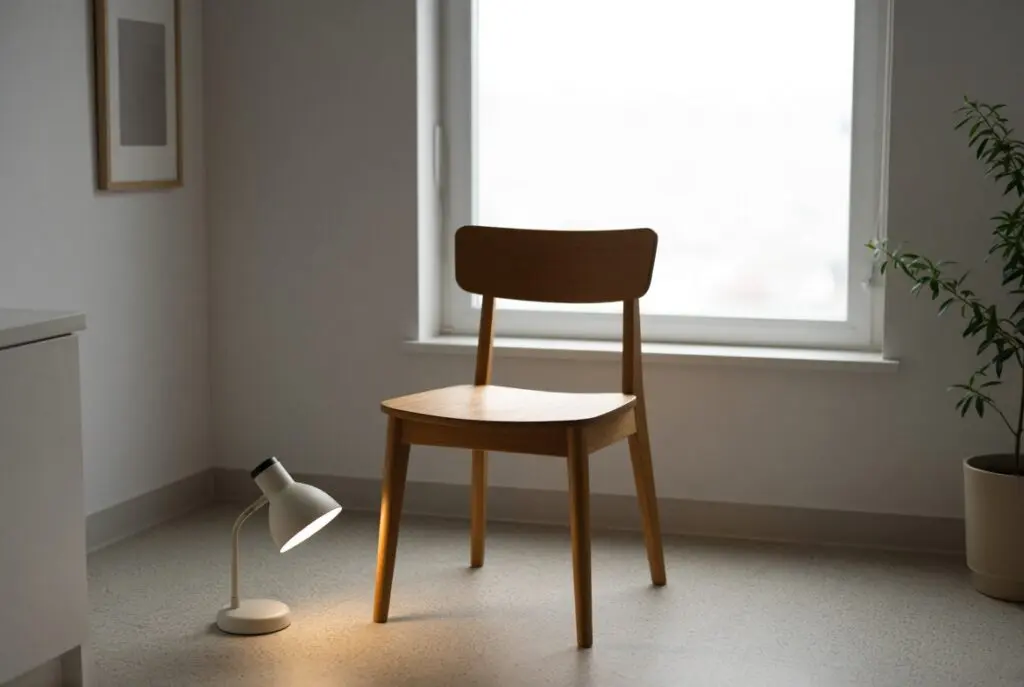
Light the face, not the ceiling. APA/ATA guidance is blunt: cameras near eye height, face visible, space adjusted for lighting and comfort. A window behind the patient turns them into a silhouette. The psychiatrist then writes “flat affect” about a lighting problem.
Name who is in the room. Family as historian is useful. Family as an extra body in a seven-by-ten consult room is crowding. If the extra person is a minor used as a translator, stop and match the visit to child and adolescent psychiatry plus a qualified interpreter.
Offer one controllable thing. A dimmer, a chair they can move, a blanket, permission to face away from the door. Patient-controlled lighting and music show up repeatedly in renovation studies as the features patients themselves call calming. Control is the opposite of a hallway gurney.
Keep the cart out of the station. A video visit at a nurses’ station is an examination conducted in a corridor. Move the patient, then start the consult. If no room exists, that is a facilities problem the psychiatrist should document rather than improvise around.
Do not confuse calm with isolation. A seclusion room is not a comfort room. Private space that the patient can leave is Ulrich’s crowding fix. A locked room with nothing in it is the outcome the design literature is trying to make rarer.
Medicaid-heavy clinics already run a large share of this work on video; telepsychiatry is how that behavioral health volume gets staffed. The missing piece is rarely another platform. It is a door that closes.

When the Room Is Not Enough
Environment buys an interview. It does not close a risk presentation.
Book same-day psychiatry — on site or by video with staff in the room — when any of the following are true, even in a well-designed space:
- The patient cannot stay seated, stay clothed, or stay off the floor.
- Safety questions are positive, or the patient cannot contract for the next hour in this building.
- Agitation is escalating after the room has already been quieted.
- The presentation is mixed, manic, or withdrawing, and intake cannot tell which problem is driving the motor.
- A child is in the room and the adult cannot be examined without them.
- New psychiatric symptoms after a head injury, a new medication, or age 50-plus with no prior history.
A beautiful room that delays the consult is how boarding hours accumulate. Use the quieter space as the place the psychiatrist lands, not as a reason to wait. Backup video coverage is the weekday version of the same rule: the room is ready and the named psychiatrist is not.
If substance use is the frame, finish the history and use the co-occurring intake path. If the fight in the room is a partner who will not leave, that may be a pathological jealousy or safety problem, not a lighting problem. If the question is capacity to leave against advice, that is conservatorship and guardianship work. Do not write “environment” on those charts.
Telepsychiatry When the Room Is the Intervention
Video is a good fit for this problem in one direction and a poor fit in another.
It is a good fit because the psychiatrist can see the room the facility actually has. Clutter, glare, extra people, and an open door are visible. A covering clinician who works emergency departments, residential, and clinic workflows already knows when the space is the reason the patient cannot complete a sentence.
It is a poor fit when the cart is the intervention. APA and ATA language is not optional color: both locations shall be treated as examination rooms, privacy so the discussion cannot be overheard, cameras at eye elevation, lighting and comfort adjusted. Child-and-adolescent telepsychiatry guidance adds a second test — the patient’s room has to be large enough to see motor activity, affect, and relatedness. A laptop on a bed with a parent off-camera fails that test.
Before the visit:
- Close the door. Say so on the record.
- Confirm who can hear, who is on camera, and whether this is the patient’s appointment.
- Move glare and backlight. If the only light is a ceiling panel behind the patient, turn on a lamp in front of them.
- Put a nurse or tech in the room when disposition may be a hold, a medication start, or a patient who cannot stay on camera alone.
- Do not run the first trauma or abuse history if a partner, a roommate, or a custody officer is the reason the door cannot close. Move rooms or stop.
Online psychiatrists can prescribe when the facility model allows it. A PRN written because the bay is loud is still a medication decision. It should live in the facility EHR under the correct patient, with the environmental context in the note — “interview completed in private consult room” or “interview attempted at nursing station; limited by noise and traffic.” The next shift cannot use a note that pretends the hallway was quiet.
How FasPsych Supports Organizations That Already Have a Room
FasPsych does not sell furniture, dimmers, or comfort rooms. The work is a licensed psychiatrist or psychiatric nurse practitioner who can use the room you already have — and tell you when that room is why the exam failed.
Hospitals and clinics already feel the cost of psychiatrist gaps when the quiet room is ready and no prescriber is free. A psychiatry staffing network is how the evaluation happens inside the existing team instead of as a referral that lands after the PRN. Facilities reviewing telepsychiatry staffing in medical care facilities can pair that quieter room with a covering psychiatrist.
- Same-day and on-demand psychiatric coverage when the consult room is empty and the named psychiatrist is not in the building.
- Scheduled adult psychiatry and child and adolescent psychiatry so the quieter room is used for an actual appointment, not only crises.
- Clinicians used to emergency department, residential, primary-care, and community-clinic workflows — the rooms where environmental noise is part of the mental status exam.
- Notes that enter the facility EHR, including whether the visit was private enough to trust.
- Continuity after the first visit, which is what keeps a one-time “calm the bay” order from becoming the treatment plan.
Organizations keep the floor, the door, and the light switch. FasPsych supplies the clinician who can work in that room.
Frequently Asked Questions
Is this article medical advice?
No. It is operational guidance for facilities. It is not a diagnosis or a treatment plan for any individual. Anyone in immediate danger should call 911. Anyone in the United States who is in crisis or having thoughts of suicide can call or text 988.
Does a calmer room mean we should hold medication?
No. Indicated medication still belongs on the plan. The point of the room is to stop using the bay itself as the reason for the first PRN.
Do we need a capital project?
No. A door, a sign, a lamp, a rule about the television, and a cart that is not parked at the desk change more Tuesday nights than a rendering of a future unit.
Can telepsychiatry work in a loud ED?
Only if the patient is moved into a private, staffed room first. Video does not cancel overhead pages. It transmits them.
What if the only private room is also the seclusion room?
Use it for the interview if safety requires it, and document that it was the only door that closed. Do not relabel seclusion as a comfort room.
How does FasPsych help if the room is ready and no psychiatrist is free?
That wait is an examined space with no clinician behind it. FasPsych places credentialed psychiatrists and psychiatric nurse practitioners into the facility workflow for scheduled and on-demand coverage. Call (877) 218-4070 or start at faspsych.com/partner-with-us.
From a Hallway to a Room That Holds
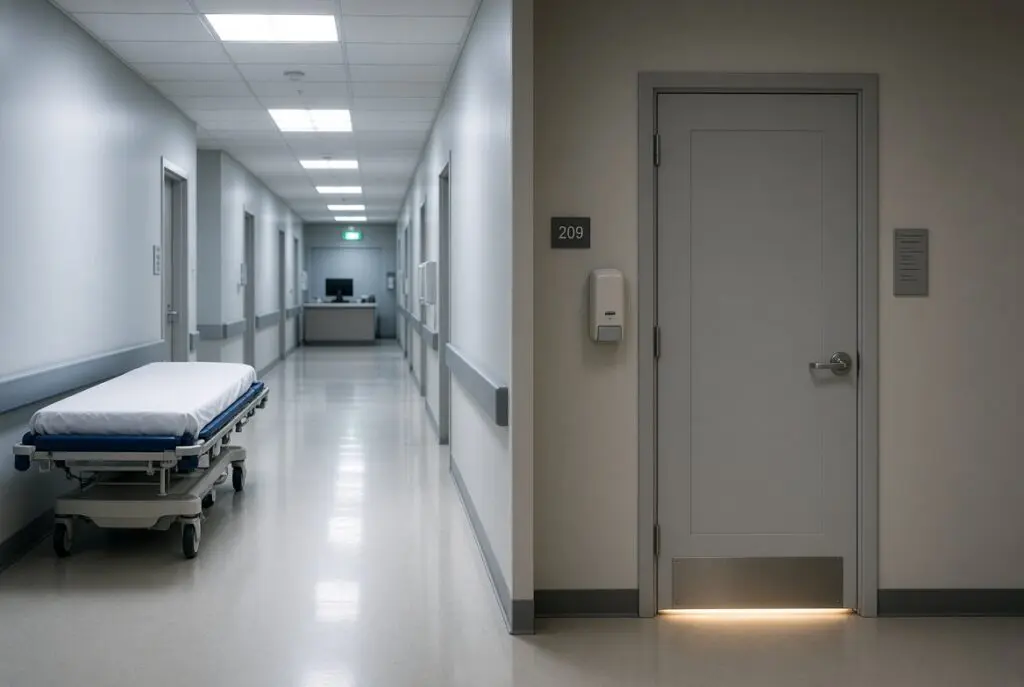
Most psychiatric presentations still get the hallway.
If your ED, residential program, pediatric clinic, or community center is writing “agitated, PRN given” without asking whether the room picked that fight, the next step is a first-contact habit that treats privacy, noise, light, and crowding as part of the exam — and a psychiatrist who can start when that room is ready.
FasPsych can add licensed psychiatric coverage to that workflow. Contact faspsych.com/partner-with-us or call (877) 218-4070.