


Conservatorships and guardianships protect adults who can no longer manage personal care, medical decisions, or finances because of mental illness, dementia, brain injury, or related conditions. Psychiatrists sit at the center of that work. They evaluate decision-making capacity, document functional limits, support or challenge a petition, treat the person after appointment, and help courts use the least restrictive option.
This guide is written for hospitals, emergency departments, inpatient psychiatry units, community mental health centers, FQHCs, residential programs, and skilled nursing facilities—the settings where these questions usually surface first.
How this article differs from court-ordered forensic evaluations
This article covers civil adult protective proceedings: probate guardianship, conservatorship of the person or estate, and mental health conservatorships such as California’s LPS process and similar grave-disability statutes in other states.
It is not a guide to criminal competency, insanity evaluations, or services built for courts and law firms. For those topics, see FasPsych’s court evaluation guide and forensic telepsychiatry page.
| Proceeding | Core question | Typical psychiatrist role |
|---|---|---|
| Adult guardianship / conservatorship of the person | Can this adult manage health, safety, and daily needs? | Capacity evaluation, functional report, treatment after appointment |
| Conservatorship of the estate | Can this adult manage money and property? | Capacity evaluation focused on financial decision-making |
| Mental health conservatorship (LPS-style / grave disability) | Is the person unable to meet basic needs because of a mental disorder or severe substance use disorder? | Designated-facility evaluation, referral, treatment, and placement recommendations |
| Competency to stand trial | Can the defendant understand the proceedings and assist counsel? | Covered in the court evaluation guide linked above |
| Involuntary civil commitment | Is emergency or short-term involuntary treatment legally justified? | Hold assessments and testimony; distinct from long-term guardianship |
Guardianship vs. conservatorship: what facility teams need to know
There is no single federal adult guardianship statute. State law controls terminology, standards, and who may evaluate.
- Many states use guardianship for decisions about the person and conservatorship for money and property.
- Some states, including California, use “conservatorship” more broadly. California’s Lanterman-Petris-Short (LPS) Act creates a mental health conservatorship for adults who are gravely disabled because of a mental disorder or, under recent updates, a severe substance use disorder. Other states use different labels for the same clinical problem: an adult who cannot meet basic needs for food, clothing, shelter, safety, or necessary medical care.
- The Uniform Guardianship, Conservatorship, and Other Protective Arrangements Act (UGCOPAA) is the current model act. It favors limited appointments, functional assessments, and less restrictive alternatives.
Courts generally require clear and convincing evidence of incapacity. That finding is legal. The clinical evaluation is what usually supplies the facts.
How psychiatrists evaluate decision-making capacity
A diagnosis is not enough. Schizophrenia, bipolar disorder, major depression, or dementia may raise concern, but incapacity is decision-specific and functional.
Psychiatrists typically assess whether the person can:
- Understand relevant information
- Appreciate the situation and likely consequences
- Reason through options
- Communicate a consistent choice
Those four abilities follow the framework used in the American Psychiatric Association resource document on decisional capacity and the ABA/APA Assessment of Capacity in Older Adults.
A useful evaluation also covers:
- Psychiatric and medical diagnoses, including delirium or other reversible causes
- Cognitive function
- Ability to manage food, clothing, shelter, safety, and medical care
- Financial management, if estate powers are at issue
- Risk of self-neglect, exploitation, or harm
- Supports already in place
- Prognosis and whether function may improve with treatment
For older adults, geriatric psychiatry expertise matters. Dementia, polypharmacy, sensory loss, and medical comorbidity often change both the evaluation and the treatment plan.
Five ways psychiatrists are involved
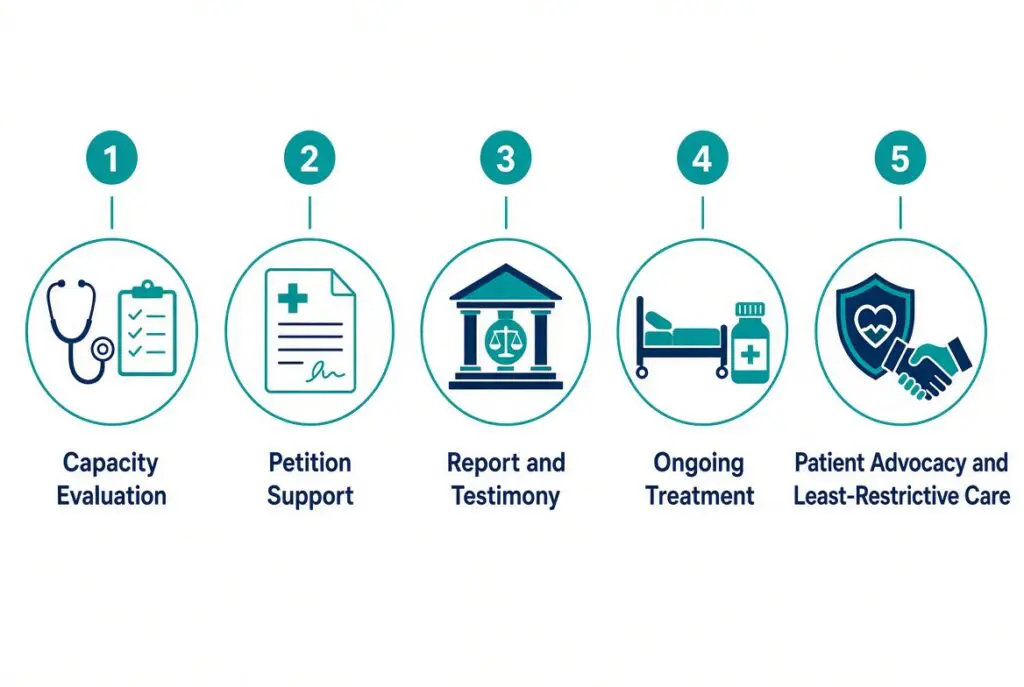
1. Capacity evaluations
Forensic, consultation-liaison, and geriatric psychiatrists often complete independent evaluations. Treating psychiatrists may provide supporting opinions, but many courts prefer a separate examiner when the petition is contested.
A routine clinical evaluation answers a different question—diagnosis and treatment planning. A guardianship capacity evaluation is narrower: can this person make the decisions the court is being asked to remove?
2. Initiating or supporting a petition
In mental health conservatorship systems, authorized psychiatrists or psychologists at designated facilities often start the referral after finding the person gravely disabled. Families cannot usually file those petitions directly.
In probate-style cases, the petition often comes from family, an agency, or a hospital. The psychiatrist supplies the clinical evidence: letters, declarations, or an independent examination.
3. Reports and testimony
Psychiatrists prepare written reports and may testify when a conservatorship or guardianship is established, renewed, contested, or ended. The most useful reports describe specific functional deficits, remaining abilities, and whether a limited order would suffice.
4. Ongoing treatment after appointment
Once a guardian or conservator is appointed, psychiatrists continue treatment. In mental health conservatorships, the appointed person may consent to psychiatric treatment and, when authorized, placement. Ethical duties still run to the patient.
5. Reassessment, advocacy, and restoration
Psychiatrists should revisit whether the arrangement is still needed, document tasks the person can still perform, and support restoration of rights when capacity returns. Psychiatric News advises clinicians not to discard the conserved patient’s voice and to petition the court if a conservator’s decisions conflict with the patient’s best interests.
Some states also require a psychiatrist or psychologist opinion before a guardian may consent to inpatient psychiatric placement. The APA position statement on consent to mental health treatment by guardians sets useful principles for those cases.
Mental health conservatorship vs. probate proceedings
These pathways are easy to confuse on an inpatient unit. They are not the same.
| Mental health conservatorship (LPS-style / grave disability) | Probate guardianship / conservatorship | |
|---|---|---|
| Typical trigger | Inability to meet basic needs because of a mental disorder or severe substance use disorder | Functional incapacity from any qualifying condition, including dementia |
| Who usually starts it | Authorized clinician at a designated facility | Family, agency, hospital, or other petitioner |
| Core powers | Treatment, placement, and often psychotropic consent | Person, estate, or both—scoped by the court |
| Setting | Often begins during an involuntary psychiatric hold | Clinic, hospital, SNF, or community |
| Psychiatrist’s role | Frequently required to initiate and sustain the case | Examiner, treating clinician, or both |
| Review | Time-limited and periodically renewed | Varies; many orders last until modified or terminated |
The statute name changes from state to state. The clinical task does not: determine whether mental illness or cognitive impairment has removed the person’s ability to make the decisions at issue, and whether a less restrictive support would be enough.

What a court-ready capacity report should include
Facilities help the examiner—and later the court—when the chart already contains the right material.
Gather before the evaluation
- Current psychiatric and medical diagnoses, medications, and recent notes
- Imaging, labs, and delirium workup when cognition changed suddenly
- Nursing, therapy, and case-management observations about ADLs and IADLs
- Collateral from family, conservators, or prior providers
- Existing legal documents: powers of attorney, advance directives, prior orders
- Less-restrictive options already tried
The report itself should cover
- Purpose of the evaluation and the specific decisions at issue
- Sources of information and limits of the exam
- Mental status and cognitive findings tied to function
- The four decision-making abilities applied to real choices
- Remaining strengths, not only deficits
- Risk if no substitute decision-maker is appointed
- Whether a limited order or non-judicial support would be enough
- Prognosis and recommended review interval
- Clear separation of clinical opinion from the court’s legal finding
Document alternatives before recommending a full order:
- Informal family or facility support
- Supported decision-making
- Power of attorney and advance directives
- Representative payee or limited financial tools
- Limited guardianship or conservatorship
- Full appointment only when nothing less will protect the person
State variations in who may evaluate
Who may complete a guardianship examination is a state-law question.
- Most states allow physicians (including psychiatrists), psychologists, and other qualified professionals.
- Only a small group of states limits the role mainly to physicians.
- Some states require a team.
- Timing windows, required forms, and rules about treating versus independent examiners differ.
Mental health-specific standards—danger to self or others, or inability to meet basic needs—also vary and often sit beside emergency-hold statutes. Confirm the current statute and local probate or mental health court practice before relying on a template from another state.
Care after appointment: ethics and restoration of rights
Appointment does not end the psychiatrist’s duty.
- Reassess capacity on a schedule, not only when a crisis appears.
- Record what the person can still decide.
- Treat reversible contributors: delirium, depression, psychosis, substance use, medication toxicity.
- Raise concerns if a conservator’s choices appear self-serving or unsafe.
- Support termination or narrowing of the order when treatment restores function.
The goal is protection with the smallest possible loss of autonomy.
How telepsychiatry helps in conservatorship and guardianship cases
Capacity questions rarely wait for a local forensic or geriatric psychiatrist to have an opening. They appear in emergency departments, medical floors, inpatient psychiatry, CMHCs, FQHCs, SNFs, and residential programs.
That access problem is especially sharp in Medicaid behavioral health. As Free Medical Journals notes, CMHCs and FQHCs often struggle to recruit and retain psychiatrists because of location, reimbursement, and unpredictable funding—while up to 90% of mental health providers now use some form of telemedicine to stretch scarce specialists across multiple sites.
What telepsychiatry can do in these cases
- Faster capacity evaluations. Secure video lets a licensed psychiatrist interview the adult, review the chart, and speak with on-site nurses, social workers, and family without waiting days for an in-person specialist.
- Coverage in shortage areas. Rural hospitals, FQHCs, and CMHCs can obtain psychiatric coverage instead of holding a patient solely because no local psychiatrist is available.
- Continuity after the order. Once a guardian or conservator is appointed, telepsychiatry supports medication management, follow-up, and scheduled reassessment—the work that can later support restoration of rights.
- Geriatric and dementia-related cases. Remote geriatric psychiatry helps teams separate delirium, depression, and dementia-related functional loss from a premature finding of permanent incapacity.
- ED and inpatient throughput. On-demand coverage can complete an assessment while the patient is still in the hospital, reducing delayed discharges and incomplete court packets.
- Team-based documentation. Video visits can fit the facility’s workflow so collateral from nursing, case management, and family is captured in a court-ready note.
Telepsychiatry does not replace an independent in-person exam where the statute or court requires one. Confirm licensing, informed consent, identity verification, and local court acceptance before relying on a remote capacity exam.
How FasPsych telemedicine supports facility teams
FasPsych partners with organizations—hospitals, CMHCs, FQHCs, residential programs, and public agencies—not with private individuals seeking a conservatorship evaluator for a family dispute.
Organizations can add licensed psychiatrists and psychiatric APRNs without a full-time hire, schedule by visit, hour, or day, and use on-demand coverage when a capacity question cannot wait. Evaluations, medication management, and follow-up stay inside the existing care team.
Call 877-218-4070 or become a partner organization to match coverage to the settings where guardianship and conservatorship questions actually start.
Key takeaways
- Adult guardianship and conservatorship law is state-specific. Use functional capacity, not diagnosis alone.
- Psychiatrists evaluate, document, treat, and advocate—including for restoration of rights.
- Mental health conservatorships and probate guardianships follow different paths.
- Courts expect the least restrictive alternative that still protects the person.
- Telepsychiatry can extend capacity evaluations, treatment, and reassessment into hospitals and clinics when law and court practice permit.
If your organization needs psychiatric coverage for evaluations, treatment, or on-demand support, partner with FasPsych.
This article is educational and is not legal advice. Laws and court procedures vary by state and change over time. Consult qualified counsel and local rules for a specific case.
Frequently asked questions
What is the difference between a conservatorship and a guardianship?
Terminology varies by state. In many jurisdictions, a guardianship covers decisions about the person and a conservatorship covers finances and property. Some states, including California, use “conservatorship” for both. See the U.S. Department of Justice overview.
Do all states require a psychiatrist for a guardianship evaluation?
No. Most states allow physicians, psychologists, and other qualified professionals. A minority limit the role mainly to physicians. Local statutes and court rules control.
Can a treating psychiatrist perform a capacity evaluation for guardianship?
Sometimes. Some courts prefer an independent examiner to avoid dual-role problems. Treating psychiatrists still often provide supporting documentation.
What does a typical psychiatric capacity evaluation include?
Interview, record review, collateral, cognitive and functional assessment, and analysis of understanding, appreciation, reasoning, and choice. See APA and ABA/APA resources.
How can telepsychiatry help with conservatorship or guardianship cases?
When state law, licensure, and the court allow it, telepsychiatry can speed capacity interviews, gather collateral from on-site staff, produce written reports, and continue treatment after an order is entered. It is especially useful in EDs, CMHCs, FQHCs, SNFs, and rural hospitals that cannot staff a local specialist quickly.
Does FasPsych provide telemedicine for these cases?
Yes, for organizations. FasPsych staffs licensed psychiatrists for evaluations, medication management, crisis coverage, and capacity-related assessments inside a facility’s existing team. It does not take direct-to-consumer cases from families or private parties. Start at partner organizations.
Can telepsychiatry replace an in-person guardianship exam?
Only if the statute and the court accept a remote exam. Some courts still require an in-person independent examiner. Confirm local practice first.
How long does a conservatorship or guardianship last?
It varies. Many orders continue until modified or terminated. Clinicians should reassess and support restoration when capacity returns.