

 In 1993, Blue System released “History,” the opening track on Backstreet Dreams. The song’s lyrics and their meaning are not a study of ordinary insecurity. Mid-song the narrator stops performing ordinary heartbreak and names something tighter: “I’m just a jealous guy. I drown in my tears when I lose control… you are playing tricks again.” That is still how many patients describe the problem when they first sit down in an emergency department, a residential unit, or a community clinic — as jealousy, as betrayal, as a partner who cannot be trusted.
Ordinary jealousy is common. Pathological jealousy is not a mood. It is a clinical presentation in which a person holds a fixed, poorly evidenced conviction that a partner is unfaithful, then organizes monitoring, confrontation, and sometimes violence around that belief. The eponym used in the literature is Othello syndrome. It is not a standalone DSM-5-TR diagnosis. It is a pattern that can appear as delusional disorder, jealous type; as a symptom of schizophrenia, bipolar disorder, or major depression with psychosis; or as the first visible sign of stroke, dementia, Parkinson’s disease treatment, or chronic alcohol use.
For program leaders, the operational question is narrower than couples counseling. FasPsych already covers ordinary relationship distress separately. This article is the syndrome, the safety plan, and the same-day psychiatry decision. Can the team tell normative suspicion from a delusion? Has anyone asked about weapons, prior assaults, and who else is in the house? Does the chart show a medical workup when the onset is late or sudden? And can a psychiatrist see the patient the same day when risk is rising?
Key Takeaways
- Pathological jealousy is a safety presentation, not a relationship-style problem. In published case series, roughly one in three patients with Othello syndrome has a documented episode of violence.
- Most cases in the contemporary literature are secondary. A 2024 systematic review of 73 published cases found medical conditions in 52% of reports, medications or substances in 26%, and a primary psychiatric disorder in 22%.
- The belief may look “understandable” because infidelity is a real-world possibility. The clinical test is whether the conviction is fixed, resistant to contrary evidence, and driving surveillance or confrontation.
- Same-day psychiatry is indicated when there are threats, weapons, command hallucinations, escalating monitoring, an identified rival, new late-life onset, or a partner who is afraid to go home.
- Telepsychiatry can speed evaluation and collateral in shortage settings. It does not replace a privacy check. If the accused partner is in the room or within earshot, the visit is not a safe place to take a full abuse history.
Normative Jealousy vs. Delusional, Organic, and Substance-Induced Jealousy
Staff hear “jealous” every week. The word does not tell them what they are treating. Four presentations get collapsed into one intake checkbox, and only one of them belongs in couples work alone.
Normative and non-delusional pathological jealousy
Normative jealousy is an unpleasant but reality-bound response to a possible rival. The person can usually entertain doubt, accept some contrary evidence, and keep functioning outside the argument.
Non-delusional pathological jealousy — sometimes called morbid or obsessive jealousy — sits between that and a true delusion. The idea of infidelity is overvalued. It dominates attention, produces checking and reassurance-seeking, and intensifies when the person is dysregulated. Insight flickers. Shame is often present. This pattern can appear in obsessive-compulsive presentations and in some personality disorders. It still warrants a risk assessment. It is not the same as a fixed psychotic conviction. Kingham and Gordon’s review remains a useful map of that spectrum: obsessional jealousy, overvalued idea, and delusion are not interchangeable.
Delusional jealousy
In delusional jealousy the belief is held with psychotic certainty. Neutral facts are recruited as proof: a wrinkled shirt, a delayed text, a coworker’s name. DSM-5-TR places the primary form under delusional disorder, jealous type: one or more delusions lasting at least a month, without the broader picture of schizophrenia, and not better explained by substances or another medical condition. Functioning may look preserved outside the delusional theme, which is why these patients are easy to underestimate in primary care and on a medical floor.
The same content can appear inside schizophrenia, schizoaffective disorder, or a mood episode with psychosis. Those cases usually declare themselves with other psychotic or affective signs. Isolated jealous delusions in a middle-aged or older adult who otherwise “seems fine” should trigger a medical differential, not an automatic personality-disorder label.

Organic and neurodegenerative causes
Othello syndrome is over-represented in neurological disease. A Mayo Clinic series of 105 patients found a neurological association in about 70% of cases, most often a neurodegenerative disorder — dementia with Lewy bodies, Parkinson’s disease, and Alzheimer’s disease prominent among them. In one dementia clinic sample, delusional jealousy was present in 8.7% of patients overall, including 26.3% of those with dementia with Lewy bodies versus 5.5% with Alzheimer’s disease.
Stroke, traumatic brain injury, epilepsy, brain tumors, multiple sclerosis, and normal-pressure hydrocephalus have all been reported. Imaging, when lesions are found, often implicates frontal or right-hemisphere networks, but localization is not consistent enough to replace a full workup. Late first onset, cognitive change, focal neurologic signs, or a temporal link to a new brain event are the practical flags for medical workup rather than “relationship conflict.”
Substance- and medication-induced jealousy
Chronic heavy alcohol use has been linked to pathological jealousy since the nineteenth century and remains a common pathway into psychiatric and forensic services. Psychiatric Times still lists alcoholic pathological jealousy (Othello syndrome) among persistent psychoses that can follow long-term alcohol use. Stimulants such as cocaine and amphetamines can produce or intensify jealous delusions during intoxication or a prolonged psychotic state. Facilities that already run co-occurring disorders programs will see this presentation at intake more often than they name it.
Medications matter as much as illicit drugs. Dopamine agonists used for Parkinson’s disease — including pramipexole and ropinirole — have a documented, sometimes reversible association with Othello syndrome. In several non-demented Parkinson’s patients the delusion appeared after an agonist was started or increased and receded when the dose was reduced or stopped. Any new late-life jealous delusion in a movement-disorder clinic should prompt a medication review before the team assumes a primary psychotic disorder.
A 2024 systematic review of 73 published Othello syndrome cases found a mean age of 58.2 years and a male-to-female ratio of about 1.9 to 1. Among reported etiologies, other medical conditions accounted for 52%, medications or substances 26%, and primary psychiatric disorders 22%. The most common diagnosis in each group was delusional disorder, cerebrovascular accident, and dopaminergic agonists, respectively. Average duration before treatment in that literature was 39.5 months — more than three years of monitoring, accusations, and unassessed risk.
How the four presentations differ in practice
| Feature | Normative / overvalued | Primary delusional | Organic / substance-induced |
|---|---|---|---|
| Conviction | Doubt is possible; shame common | Fixed; contrary evidence is “proof they are hiding it” | Fixed, often of late or sudden onset |
| Typical age / course | Any adult; tracks relationship stress | Often midlife; months to years of a single theme | Older adult, post-stroke, post-agonist, or after heavy alcohol use |
| Associated signs | Reassurance-seeking, checking, jealousy confined to the relationship | May look intact outside the theme; other psychosis may be absent | Cognitive change, neurologic findings, intoxication, withdrawal, new meds |
| First clinical move | Safety screen, then therapy if risk is low | Psychiatry, antipsychotic treatment, collateral, safety plan | Medical / neurologic workup plus psychiatry; treat the cause |

What to Document for Risk, Collateral, and Medication Decisions
Jealousy content is easy to under-document because it sounds interpersonal. The chart needs the belief, the behavior it produces, the people in the blast radius, and the medical facts that would change treatment. Incomplete notes are how a “marital issue” returns as an assault, a boarding problem, or a partner who will not come back to the building.
Document the belief as a clinical object
- Exact wording of the accusation, onset, and whether the belief is new, recurrent, or lifelong.
- Degree of conviction and response to contrary evidence. Note whether the patient can entertain any alternative explanation.
- The “evidence” the patient cites. Innocent details treated as proof are more informative than the theme itself.
- Whether other delusions, hallucinations (including command hallucinations to confront or harm the partner), mood symptoms, or cognitive changes are present.
- Alcohol, stimulants, and every dopaminergic or other recently changed medication, with dates.
Document risk in behavioral terms
Classic case series make the safety case without metaphor. In a U.S. sample of 20 people with delusional jealousy, 13 had threatened to kill the spouse over alleged infidelity and 12 had already harmed the spouse. Across Othello syndrome case literature, violence appears in about 34% of reports. Separate work on morbid jealousy has described suicide attempts in roughly one in five patients. Intimate-partner homicide research is broader than this syndrome, but jealousy remains a documented precipitant; in National Violent Death Reporting System data from 2016–2020, homicide-suicide cases had 3.5 times the odds of recorded jealousy compared with homicide-only cases.
The note should state, in plain language:
- Threats toward the partner, a suspected rival, children, or the patient.
- Prior assaults, stalking, confinement, forced “confessions,” or property destruction tied to the accusation.
- Access to weapons and whether the partner still shares a residence.
- Current monitoring: phone checks, tracking, unexpected appearances at work, demands to account for time.
- The partner’s own fear, and whether that person is in the waiting room, on the unit, or expected to take the patient home.
Ask the partner or another collateral source separately when it is safe to do so. Patients with jealous delusions often minimize, reframe violence as “getting at the truth,” or refuse to identify a rival who is in fact a coworker, neighbor, or adult child. Joint couples therapy is the wrong tool while the belief is delusional. Putting the accused partner in the room to “clear things up” turns the session into another interrogation. Note whether children or other dependents live in the home; that fact changes both disposition and reporting duties. Correctional and residential programs should also document whether the accused person can physically leave the setting.
Document enough for a medication decision
Antipsychotics are the most commonly reported treatment for Othello syndrome — used in 78% of cases in the 2024 review, with symptom remission described in 70%. That is encouraging and not a protocol. Choice and dose depend on age, dementia, Parkinson’s disease, QTc, metabolic risk, and whether the delusion is secondary. In Parkinson’s disease and dementia with Lewy bodies, typical high-potency antipsychotics are a poor fit because of neuroleptic sensitivity; published practice favors reducing the implicated agonist when motor status allows and using an agent such as quetiapine or clozapine if psychosis persists. Do not spend the interview trying to disprove the affair. Fact-checking a delusion rarely loosens it and can escalate interrogation of the partner.
Practical documentation that a covering psychiatrist can use the same day:
- Working differential: primary delusional disorder vs. mood/psychotic disorder vs. neurocognitive vs. substance- or medication-induced.
- What has already been tried, including dopamine-agonist changes in Parkinson’s disease.
- Capacity to agree to treatment, willingness to involve the partner, and whether separation is already underway.
- Labs, imaging, and cognitive screening if onset is late, sudden, or neurologically flagged — or a clear statement that those are still pending.
SSRIs appear in the literature mainly for non-delusional obsessive jealousy or when depression is prominent. They are not a substitute for an antipsychotic when the belief is delusional, and they are not a substitute for treating alcohol use or stopping an offending agonist.
When This Presentation Needs Psychiatry the Same Day
Most jealous complaints can wait for a scheduled adult psychiatry visit. Pathological jealousy should not be booked three weeks out when any of the following are present. These are operational triggers for same-day psychiatric evaluation — in person or by telepsychiatry with on-site staff who can act on the plan.
- A threat to harm the partner, a suspected rival, a child, or the self, including “I just want the truth” delivered as an ultimatum.
- A recent assault, forced confinement, or destruction of property tied to the accusation.
- Weapons in the home, or the patient asking where the partner will be after discharge.
- Command hallucinations or other psychotic symptoms joined to the jealous theme.
- Rapid escalation of surveillance after a perceived slight — new tracking, new accusations in a matter of hours or days.
- First onset after age 50, or any sudden onset with cognitive change, focal neurologic signs, new dopamine agonist, or heavy alcohol use.
- The accused partner is afraid to leave with the patient, or staff are being asked to “talk sense into” a spouse who is already being monitored.
- The patient is leaving against medical advice and the only follow-up plan is “they’ll work it out at home.”
Same-day psychiatry is not only a violence screen. It is also how organic causes get caught before the team writes “relationship stress” on a discharge summary and sends an older adult home. When the psychiatrist is not in the building, a credentialed telepsychiatrist who can interview the patient, speak with nursing or case management, review the medication list, and write an immediate plan is the difference between an assessed risk and a hoped-for one. That is the same operational logic as ED coverage and after-hours psychiatric coverage: the clock starts when the presentation is recognized, not when a local specialist has an opening.
Disposition follows the risk, not the label. Some patients need involuntary hold criteria reviewed. Some need a medical admission and imaging. Some can go home only if the partner has a separate safe plan and a follow-up slot already exists. Geographical separation of the couple is a documented management option in the morbid-jealousy literature when risk cannot be contained in the shared household. Facilities should not treat that recommendation as a therapy goal. It is a safety decision.
Telepsychiatry When the Partner May Be in the Room
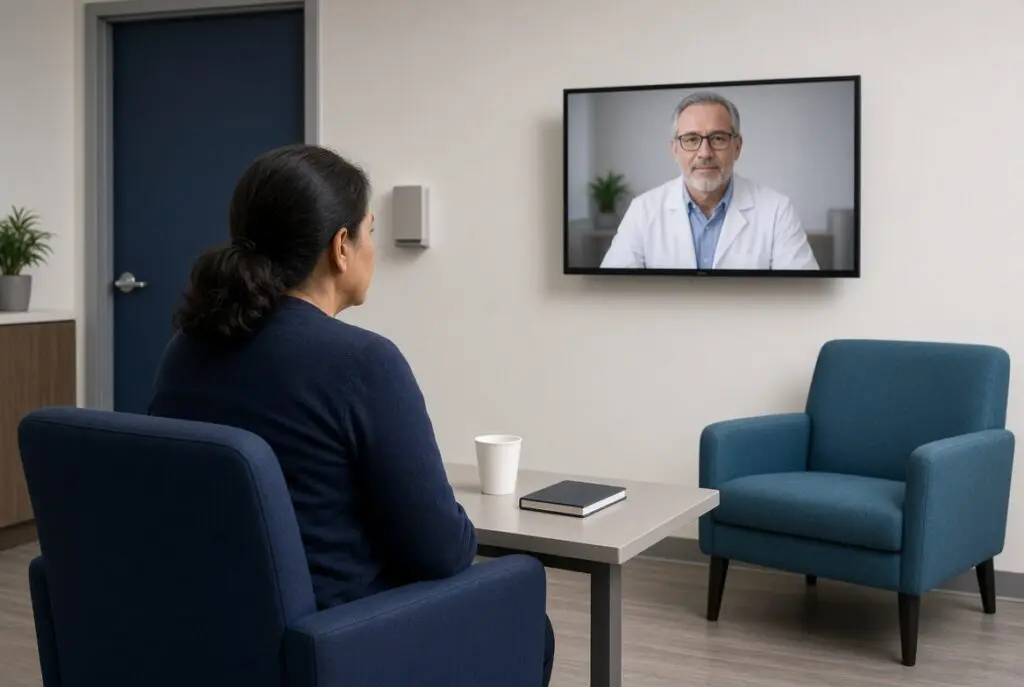
Video evaluation is well suited to this presentation in one respect and poorly suited in another. It is well suited because specialist psychiatrists are scarce, jealous delusions often present in rural hospitals, movement-disorder clinics, and after-hours emergency departments, and collateral from on-site staff can be gathered on the same call. It is poorly suited if the accused partner is sitting off-camera.
Before the interview goes near infidelity, violence, or whether the patient should go home, the clinician should establish:
- The patient’s exact location and local emergency number.
- Whether anyone else is in the room, just outside the door, or able to view the screen.
- A plan if the call drops, and a pre-agreed signal if the patient suddenly cannot speak freely.
- Whether this is a safe moment to take an intimate-partner violence history at all. If it is not, document that limit and arrange a private follow-up or an on-site interview.
American Psychiatric Association guidance on telehealth and intimate partner violence is direct: do not assume a home video visit is private. Schedule when the partner is not home when possible. Use yes/no questions if safety is uncertain. Do not leave a digital trail the patient cannot control. On-site telepsychiatry — the patient in a clinic, unit, or emergency department room, the psychiatrist on a secure video link — avoids most of that problem and is the better default whenever staff already suspect coercive control or delusional jealousy.
Telepsychiatry also helps the longitudinal piece these cases usually lack. The 2024 review’s average delay to treatment was measured in years, not visits. A covering psychiatrist who can see the same patient after discharge, speak with the outpatient team, and adjust an antipsychotic or a Parkinson’s regimen is how the chart stops resetting to “jealousy issues” every time a new clinician appears.
How FasPsych Supports Organizations Facing These Cases
FasPsych does not treat pathological jealousy as a couples product. The work is psychiatric evaluation, risk formulation, medication management, and continuity across the settings where this presentation actually arrives: emergency departments, inpatient psychiatry, residential programs, correctional facilities, and the hospitals, FQHCs, and CMHCs that already care for older adults with Parkinson’s disease or dementia.
- Same-day and on-demand psychiatric coverage when a jealous presentation crosses a safety threshold and no staff psychiatrist is available.
- Scheduled follow-up after stabilization so the 7- and 30-day gap does not become another unmonitored month at home.
- Providers experienced with psychosis, neurocognitive disorders, and substance-related presentations — the three pathways that produce most Othello syndrome cases.
- Integration with the facility’s EHR, on-site nursing, and case management so collateral and disposition are part of the same encounter.
- Longer-term matching of the same clinician when possible, so institutional memory does not walk out with the last locums shift.
Organizations keep the patient relationship. FasPsych supplies licensed psychiatrists and psychiatric nurse practitioners who can join the existing team rather than reroute the case into a separate virtual clinic.
Frequently Asked Questions
Is Othello syndrome a formal diagnosis?
No. It is a descriptive label for a delusion of a partner’s infidelity. The chart diagnosis is usually delusional disorder, jealous type; a primary psychotic or mood disorder; a neurocognitive disorder with psychosis; or a substance- or medication-induced psychotic disorder. Use the syndrome name in the formulation so the next clinician recognizes the risk pattern.
How is pathological jealousy different from ordinary relationship conflict?
Ordinary conflict can include jealousy and still leave room for doubt, negotiation, and evidence. Pathological jealousy organizes life around a poorly evidenced conviction and produces surveillance, forced confessions, or violence. If staff are being asked to adjudicate whether an affair happened, they are already in the wrong frame. The clinical questions are conviction, behavior, medical cause, and risk. For ordinary discord without a fixed delusion, see FasPsych’s article on telepsychiatry for relationship distress.
Can telepsychiatry be used for delusional jealousy?
Yes, when privacy and location are confirmed and on-site staff can carry out the safety plan. Telepsychiatry is appropriate for evaluation, capacity-adjacent risk formulation, medication decisions, and follow-up. It is the wrong tool for a first violence or abuse history if the accused partner can hear the visit. In those cases, move the patient to a private on-site room and bring the psychiatrist in by video.
What medications are used?
Antipsychotics are first-line for delusional jealousy. Treat the underlying driver at the same time: reduce or stop an implicated dopamine agonist in Parkinson’s disease when neurology agrees, address alcohol or stimulant use, and treat a mood or neurocognitive disorder on its own terms. Medication choice should be individualized. There is no single “Othello drug.”
When should the couple be separated?
When risk to the partner, a child, or a suspected rival cannot be managed in the shared household. Separation is a safety intervention, not a moral judgment about the relationship. Facilities should involve case management, document the recommendation, and avoid discharging the patient into the accused partner’s custody when that person has already said they are afraid.
How does FasPsych help if our psychiatrist is not on site?
FasPsych places credentialed psychiatrists and psychiatric nurse practitioners into the facility’s existing workflow for scheduled and on-demand coverage. That includes urgent evaluations in emergency and inpatient settings, medication management, and continuity after discharge. Call (877) 218-4070 or start at faspsych.com/partner-with-us.
From a Song Lyric to a Disposition
“I’m just a jealous guy” is a line most adults recognize. In a hospital doorway it can also be the only sentence a patient will offer before staff file the visit under relationship distress and move on. Pathological jealousy does not give facilities that luxury. One-third of published Othello syndrome cases include violence. Most are not primary “relationship” diagnoses. Many wait years for a treatment that often responds once it is actually started.
If your emergency department, inpatient unit, residential program, or community clinic is seeing accusations of infidelity joined to monitoring, threats, late-life change, or a partner who does not feel safe going home, the next step is a psychiatric evaluation the same day — not a referral that assumes the couple will sort it out.
FasPsych can add licensed psychiatric coverage to the settings where these cases arrive. Contact faspsych.com/partner-with-us or call (877) 218-4070 to match same-day evaluation and follow-up to your volume.