


Family-involved behavioral health programs treat the parent in the child-clinic waiting room, the spouse who drove the residential admission, and the adult child who sits through every medication-management visit as historians, drivers, and unpaid case managers. They are often the reason the identified patient made it through the door. They are also a second clinical presentation hiding in the same appointment block.
This article is for hospitals, emergency departments, FQHCs and CMHCs, residential programs, and child and adolescent clinics that already run family nights, collateral interviews, and caregiver-attended telepsychiatry. Ordinary relationship distress, conservatorship and capacity work, staff burnout, and media-diet secondary stress already have their own pages. This page stays on one operational split: when is the family member a collateral source, and when do they need their own evaluation?
This article is written for hospitals, clinics, and behavioral health program leaders. It is educational and operational. It is not medical advice, a diagnosis, or a substitute for evaluation by a licensed clinician. If you or someone with you is in immediate danger, call 911. If you or someone with you is in crisis or having thoughts of suicide, call or text 988 (Suicide & Crisis Lifeline) or go to the nearest emergency department.
Key Takeaways
- Family involvement is a program asset. Unassessed caregiver burden and secondary traumatic stress are how that asset becomes a missed second patient.
- Caregiver burden is load: time, money, sleep, role strain, the sense of having no choice. Secondary traumatic stress is what happens when the family member absorbs the identified patient’s trauma story or crisis behavior until their own arousal, avoidance, and sleep start to look like PTSD.
- The two overlap. They are distinct from staff burnout, vicarious trauma in clinicians, and ordinary relationship conflict.
- Ask the family member two questions in their own block, not in front of the patient: what did this week cost you, and what from their story or behavior is now living in your body?
- Same-day psychiatry for the caregiver is indicated when they endorse their own crisis, cannot leave the building safely, are using substances to stay functional, or are about to take the identified patient home without anyone asking whether the home is still workable.
- Telepsychiatry can evaluate the caregiver the same week the identified patient is seen. A family session that never separates the two people produces one chart and two untreated syndromes.
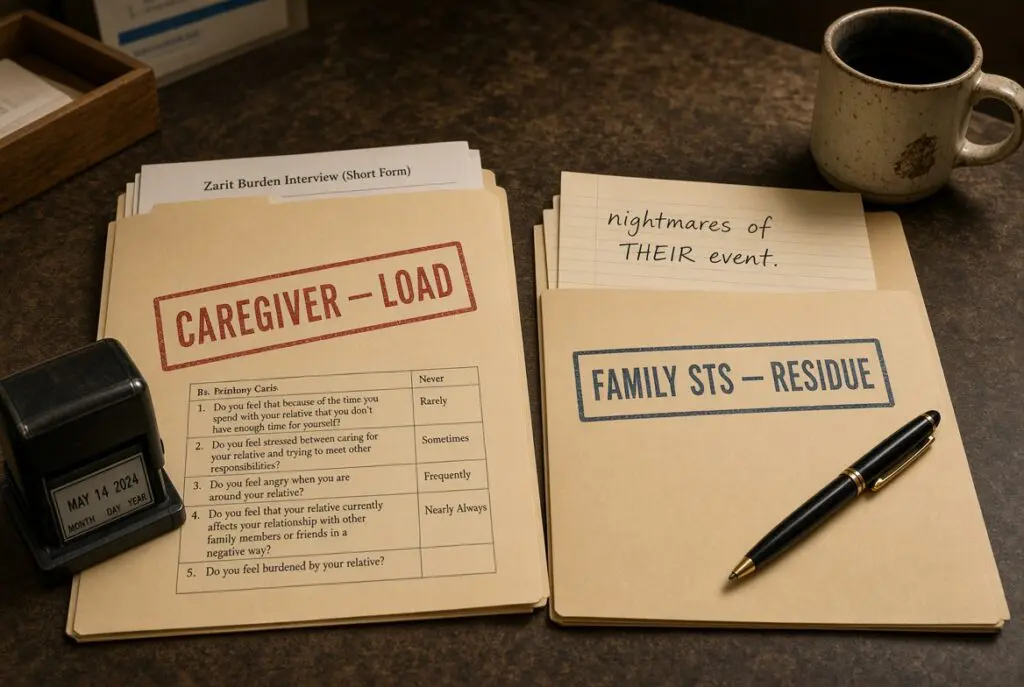
What Caregiver Strain Looks Like on a Unit
Family-involved programs are built on a true premise: outcomes improve when the people who live with the patient are in the room. Child and adolescent services need caregiver collaboration. Residential and SUD programs need a discharge destination that will actually hold. ACT-style and CMHC work runs on family contact. None of that makes the family member a clinician, and none of it makes them immune.
AARP and the National Alliance for Caregiving estimate that 63 million U.S. adults provided ongoing care in 2025 — nearly one in four adults. The American Psychiatric Association’s summary of that report is more specific: two in three caregivers experience high emotional stress, nearly half report physical strain, and more than half said they did not have a choice in the role. Those without a choice have worse mental-health outcomes. Among sandwich-generation caregivers, only 16 percent have ever been asked by a health-care provider what they need to take care of themselves.
Behavioral health programs recreate that problem in miniature. The family member arrives already fluent in the patient’s diagnosis, pharmacy, and last crisis. Intake writes “supportive family” and moves on. What does not get written:
- Hours of unpaid nursing, crisis de-escalation, and medication watching.
- Lost work, lost sleep, and the decision to stop seeing friends because the patient cannot be left.
- Intrusive images of an overdose, a suicide attempt, a psychotic episode, or a child’s disclosure — material the family member did not live as the primary victim and now cannot put down.
NAMI’s Family Caregiver HelpLine exists because that load is common enough to need its own door, and the evidence-based Family-to-Family course is the education version of the same problem. NIMH-funded work found Family-to-Family improved coping and reduced family distress; a class is still not a substitute for screening the person sitting in your waiting room. Facilities that already have the family in the building do not need a new product line. They need a first-contact habit that notices the second person. At home, that habit often starts as a routine family mental health check-in. On the unit, it is a separate interview and, when safety will not wait, a same-day psychiatric slot. In Medicaid-heavy clinics, telepsychiatry is already how a large share of that behavioral health work gets staffed. The missing piece is rarely another family night. It is a slot for the person who has been holding the night together.
Caregiver Burden Is Load. Secondary Trauma Is Residue.
Burden is the better-studied construct. The Zarit Burden Interview and its short forms ask about time, embarrassment, anger, health, finances, and the feeling of losing one’s own life to the role. APA’s broader caregiver mental-health toolkit treats PHQ-9 and related screens as the next step when burden is high. High scores predict depression in the caregiver. APA’s caregiver guidance is blunt: caregivers are at elevated risk for mental disorders and should be screened even when they present only as “here about my son.”
Secondary traumatic stress is a different mechanism. NCTSN defines it as the emotional duress that results from hearing about another person’s firsthand trauma; SAMHSA treats the same construct as a recognizable occupational and family risk. The literature started with child-serving professionals. The same exposure happens at the kitchen table. Siblings who were never in the room for the original event can still carry secondary stress from the family story. A parent who sat through a forensic interview, a spouse who found the body once and now checks the bathroom every night, an adult child who can recite every detail of a manic week — they have been listening to trauma material without a shift change or a supervisor.
The VA National Center for PTSD names the family version directly: partners and children can feel caregiver burden and distress from learning about the loved one’s trauma or living inside the symptoms. That presentation is different from the online-conflict secondary stress FasPsych already covered, and different from staff compassion fatigue. It is the person in the second chair.
A 2025 study of family caregivers of people with chronic illness found secondary traumatic stress scores above the scale midpoint, with avoidance the highest subscale. Foster-carer research finds elevated STS in a sizable share of the sample. The exact percentage matters less than the operational fact: if your program invites families into trauma history, some of those families will leave carrying it.
How the presentations differ when family is already in the program
| Feature | Caregiver burden | Secondary traumatic stress | Staff burnout / compassion fatigue | Ordinary relationship distress |
|---|---|---|---|---|
| Core problem | Role load: time, money, sleep, no choice | PTSD-like residue from the other person’s trauma or crisis | Workplace exhaustion and thinning empathy in paid staff | Conflict, distance, or attachment injury between two adults |
| Typical sentence | “I cannot keep doing this and still go to work.” | “I see his overdose when I close my eyes.” | “This caseload is flattening me.” | “We cannot talk without a fight.” |
| Body / sleep | Depletion, skipped meals, no time to see a doctor | Hypervigilance, nightmares about their event, startle | Cynicism, Sunday dread, screen fatigue | Tension tied to the relationship, not the trauma story |
| What intake often does | Writes “supportive family” | Never asks | Sends the staff member to EAP | Books couples work or ignores it |
| First clinical move | Name the load; screen the caregiver; offer their own slot | Separate interview; trauma-informed history of exposure, not of the patient’s event as if it were theirs | Supervisor and staffing plan — see FasPsych’s retention page | If there is no fixed delusion or violence, use the relationship-distress path |
Overlap is expected. A mother can be exhausted and haunted. Label both. Do not pick the tidier word.
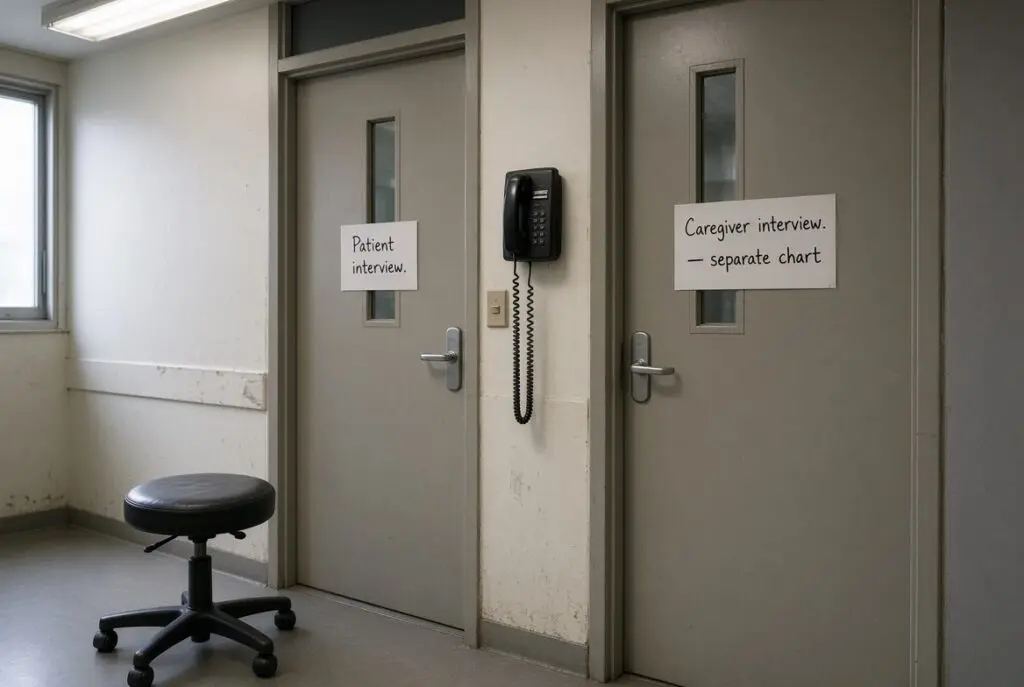
What to Collect Before Anyone Calls Them “Just Family”
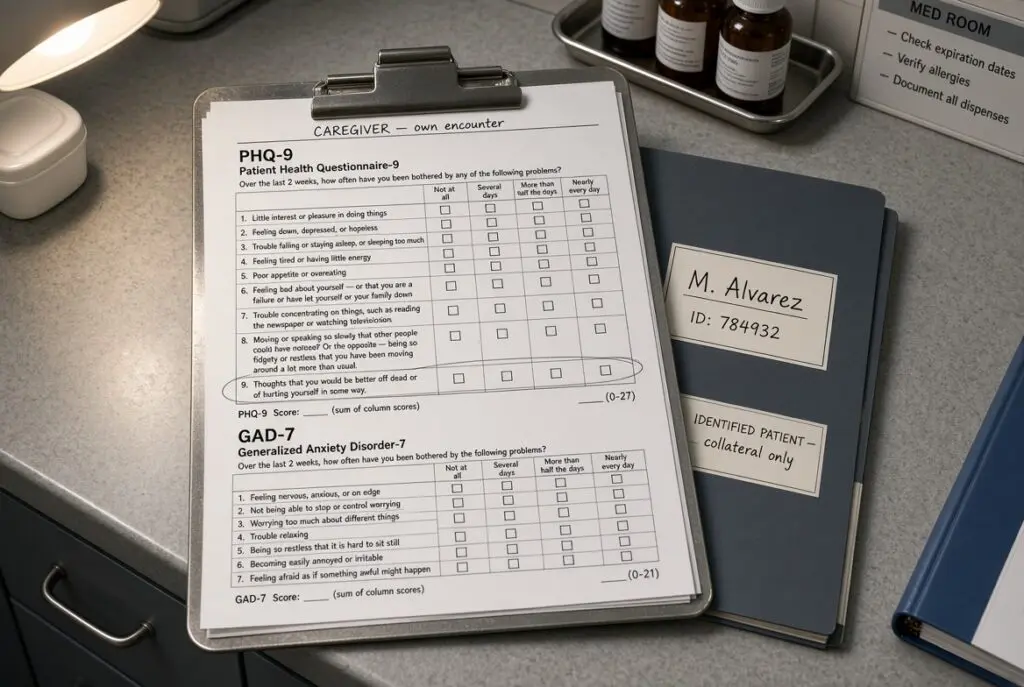
The identified patient’s chart is not the caregiver’s chart. Collateral belongs in the patient’s record. The caregiver’s sleep, substances, ideation, and functioning belong in a note that can travel if they become a patient of the same organization — with consent, and without turning family night into a covert intake they did not agree to.
Separate the rooms
- Interview the identified patient without the family member interpreting. Family as historian is useful. Family as interpreter is a different, usually worse, task.
- Give the caregiver their own ten minutes. Ask what the week cost, what they stopped doing, and what from the patient’s crisis is now in their own sleep.
- If the caregiver is also a minor — a teen parenting a parent, a sibling used as translator — stop and match the visit to child and adolescent psychiatry, not an adult collateral add-on.
Screen load and residue, not personality
Use what you already have. A PHQ-9 and GAD-7 on the caregiver, when they consent, will catch depression and free-floating anxiety. They will not catch burden or STS by themselves. How those scores later feed depression-screening quality measures is a separate operations question.
Add four questions the scales miss:
- How many hours last week were actually care, not companionship?
- Did you have a choice in this role?
- What image or story from their illness arrives when you are trying to sleep?
- What would happen to them this week if you were the one in a hospital bed?
A short Zarit form is optional. The answers above are enough to decide whether this person needs their own appointment.
Document risk in the right name
A scoping review of caregiver suicidality found ideation rates from the low single digits to far higher in selected samples, plus documented attempts, suicide deaths, and homicide-suicide. Strained older caregivers also carry higher all-cause mortality than noncaregiving peers. That is why the caregiver’s own risk belongs in writing. If the person in front of you is in crisis now, this page is not the intervention — call or text 988, or 911 if there is immediate danger.
- The caregiver’s own ideation, intent, plan, and access — asked privately.
- Whether the home is still safe to return to for both people.
- Substances the caregiver is using to stay awake or to fall asleep.
- Whether children are in the house, and who is actually watching them.
If the question has become whether the identified patient can still manage care, money, or safety, that is a capacity problem, not a burden score. If substance use is the frame for either person, finish the history and use the co-occurring intake path. If the partner’s “care” looks like surveillance, weapons, or a rival, get off this page and onto pathological jealousy.
When the Caregiver Needs Psychiatry the Same Day
Most strained families can wait for a scheduled adult psychiatry slot if safety is negative, the caregiver can still work and sleep in fragments, and someone will actually keep the follow-up. Book same-day psychiatry — on site or by video with staff in the room — when any of the following are true of the family member.
- They endorse a wish to be dead, or they cannot say whether the identified patient is safe with them tonight.
- They have not slept in days because they are on watch.
- They are using alcohol, sedatives, or stimulants to perform the caregiver role.
- A child in the home is being parented by a caregiver who is decompensating.
- They refuse to leave the building because they do not trust the discharge plan, and the conflict is about to become a scene.
- New psychiatric symptoms in a caregiver over 50 with no prior history, or after they themselves were injured in a crisis.
Same-day coverage is how family night stays a program and not an unplanned ED return for the second person. On-demand psychiatry covers the version of this visit that happens when the identified patient is already asleep on the unit and the spouse is still in the lobby. Backup video coverage is the weekday version of the same rule: the presentation does not wait for the named psychiatrist’s next opening.
Telepsychiatry When the Family Is Already on Camera
Video is a good fit for caregiver evaluation. The psychiatrist can see the identified patient in one block and the caregiver in another without making the family drive twice. It is a poor fit when both people are on the same laptop in the same kitchen and one of them is the reason the other cannot speak.
Before the visit:
- Confirm who is in the room, who can hear, and whether this is the patient’s appointment, the caregiver’s, or a planned family session. Those are three different consents.
- Do not let the caregiver sit off-camera as a silent editor of the patient’s history.
- If the caregiver needs their own evaluation, schedule it as their own encounter in the facility workflow, not as extra minutes tacked onto the patient’s med check.
Online psychiatrists can prescribe for the caregiver when state law and the facility model allow a second identified patient. That is a program decision, not a courtesy refill. An SSRI written “for stress” on the patient’s chart, in the caregiver’s name, is how the next covering clinician inherits a chart that explains nothing.
Specialty match still matters. A parent in a pediatric clinic is not an adult walk-in. Pair the book before the first video visit; FasPsych’s specialty-matched staffing page is that operations decision. This page is the clinical reason the parent may need a slot of their own.
How FasPsych Supports Organizations Running Family-Involved Programs
FasPsych does not sell a caregiver-burden product. The work is a usable split between collateral and second patient, a medication decision when one is indicated, and a follow-up that can actually be kept. Hospitals and clinics already feel the cost of psychiatrist gaps when family night uncovers a second person and no prescriber is free. A psychiatry staffing network is how that second evaluation happens inside the existing team instead of as a referral that never lands.
- Same-day and on-demand psychiatric coverage when family night or an admission uncovers a caregiver in crisis and no staff psychiatrist is in the building.
- Scheduled adult psychiatry and child and adolescent psychiatry so the identified patient and the caregiver are not forced onto the same template.
- Clinicians used to emergency department, residential, primary-care, and community-clinic workflows — the rooms where family is already present.
- Notes that enter the facility EHR under the correct patient, so the next shift can tell historian from identified patient.
- Continuity after the first visit, which is what screening-and-follow-up measures actually pay on when the caregiver becomes a patient.
Organizations keep both people. FasPsych supplies licensed psychiatrists and psychiatric nurse practitioners who join the existing team.
Frequently Asked Questions
Is this article medical advice?
No. It is operational guidance for facilities. It is not a diagnosis or a treatment plan for any individual. Anyone in immediate danger should call 911. Anyone in the United States who is in crisis or having thoughts of suicide can call or text 988 (Suicide & Crisis Lifeline).
Is caregiver burden a diagnosis?
No. Burden and secondary traumatic stress are clinical constructs that explain why the family member in the second chair is not functioning. The chart diagnosis, if one is reached, will be an anxiety disorder, a depressive episode, an adjustment disorder, PTSD, or a substance-use disorder — not a role label.
Can the family member sit in on the identified patient’s telepsychiatry visit?
Yes, when the patient consents and the purpose is collateral or family psychoeducation. No, when the purpose is a private risk history, an abuse history, or the caregiver’s own symptoms. Say which visit this is before the camera goes on.
Do we have to open a second chart?
If you are evaluating and treating the caregiver, yes. Collateral about the identified patient stays in the identified patient’s record. Mixing the two is how a PHQ-9 on the wrong person dies in the wrong chart.
Is this the same as staff secondary trauma?
Same mechanism, different employment relationship. Staff STS is a workplace and supervision problem. Family STS is a clinical presentation in a person your program already invited into the room. Do not send the parent to the employee assistance program.
Does screening the caregiver replace a medical workup?
No. New anxiety, low mood, or cognitive change after age 50, after an injury during a crisis, or with chest pain still needs a medical pass. Psychiatry and that workup can run the same afternoon.
How does FasPsych help if family night is already on the calendar and no psychiatrist is free?
That wait is a second patient with no clinician behind them. FasPsych places credentialed psychiatrists and psychiatric nurse practitioners into the facility workflow for scheduled and on-demand coverage. Call (877) 218-4070 or start at faspsych.com/partner-with-us.
From Collateral to a Second Appointment
The people who absorb the cost so the identified patient can stay in treatment are already in your building. Most of them will keep doing it. Some of them cannot, and the program will find out when the caregiver is the next admission.
If your clinic, residential program, pediatric service, or community center is writing “supportive family” without asking what the week cost that person, the next step is a first-contact habit that splits historian from second patient — same day when safety will not wait.
FasPsych can add licensed psychiatric coverage to that workflow. Contact faspsych.com/partner-with-us or call (877) 218-4070.