
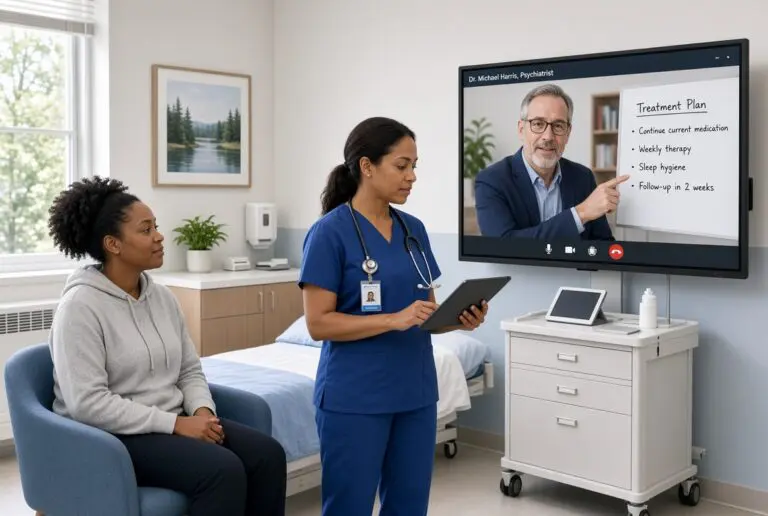

Crisis Stabilization Units (CSUs) and other short-stay behavioral health programs sit between the emergency department and longer inpatient care. They are designed for rapid assessment, medication management, brief intervention, and disposition—usually within 24 hours or a few days. Census can swing sharply, and many programs lack continuous on-site psychiatric coverage.
Some telepsychiatry providers emphasize rapid evaluations and 24/7 on-call support that can help CSUs, but their public content is heavier on hospital ED and inpatient models than on the operational details of short-stay units. Those units need coverage that scales with variable census, integrates with existing on-site nursing and therapy staff, and supports clear handoffs rather than functioning as a full virtual department.
This guide focuses on staffing models and implementation for CSUs and comparable short-stay programs. It does not address pure ED boarding reduction, FQHC/CMHC/CCBHC certification criteria, or general community outpatient flexible models. For those topics, see FasPsych’s related articles on on-demand and follow-up telepsychiatry models for emergency departments, the telepsychiatry staffing playbook for FQHCs, CMHCs, and CCBHCs, and flexible telepsychiatry staffing models for community and outpatient programs. Broader model comparisons appear in FasPsych’s analysis of virtual clinic vs. psychiatry staffing network.
Why CSUs Need Distinct Staffing Approaches
CSUs typically aim to stabilize patients in crisis and return them to the community or transfer them to a more appropriate level of care within a short window. Psychiatric demand is uneven. A full-time employed psychiatrist creates fixed cost during low-census periods. Pure on-demand ED-style coverage can leave gaps in daily rounding or medication titration when patients stay beyond a single evaluation.
Flexible telepsychiatry staffing addresses this by supplying hours or encounters that match actual census. Providers document in the host program’s record and work with the on-site team rather than operating a separate service. FasPsych has supported hospital-based and freestanding short-stay programs since 2007 using this structure. Related operational guidance on rapid evaluations appears in Psychiatric Boarding Hours: What Telepsychiatry Changes and Telepsychiatry for Emergency Rooms.
Staffing Models for CSUs and Short-Stay Programs
| Model | Cost Structure | Census Flexibility | Continuity Within Stay | Best Fit for CSUs |
|---|---|---|---|---|
| Employed (remote or on-site) | Full salary + benefits + overhead | Low | High | Programs with consistently high daily census |
| Traditional locum | Daily or hourly + agency fees | Moderate | Low | Short-term gaps only |
| Pure on-demand ED-style | Per consult or rapid-response block | High for single evaluations | Low | Units that only need initial disposition support |
| Flexible vendor telepsychiatry staffing | Pay for hours or encounters used | High | Moderate to high (dedicated providers possible) | Variable census, daily rounding + after-hours needs |
| On-demand + follow-up/transitional | Mix of rapid response + scheduled hours | High | Moderate to high | Programs that need both initial evaluation and ongoing short-stay input |
 The flexible or combined on-demand plus follow-up/transitional model is usually the strongest match. It allows a program to schedule core daytime hours for assessments and medication management while retaining the ability to add after-hours or high-census support without residual fixed cost. For evaluation criteria that keep coverage inside existing workflows, see how to write a telepsychiatry staffing RFP.
Operational Considerations Unique to Short-Stay Units
- Census variability: Coverage should scale with average daily census rather than a fixed FTE. Many programs start with a defined weekly hour block and adjust after 60–90 days of data.
- Handoffs: Clear protocols are needed between the ED or mobile crisis team and the CSU, and again between the CSU and outpatient or residential follow-up. Telepsychiatry notes must land in the host record so the next provider has complete information. Related ED handoff considerations appear in the on-demand and follow-up telepsychiatry models article. Complementary details on virtual rounding are available on the Virtual Rounding Services page.
- Medication and risk decisions: Providers need timely access to labs, medication history, and collateral information. Most organizations solve this through EHR integration or a structured request workflow. Medication management specifics for acute settings are covered in Telehealth Medication Management for EDs.
- Regulatory and payer alignment: CSUs often operate under crisis stabilization or observation rules that differ from full inpatient psychiatry. Confirm state Medicaid and commercial payer requirements for telepsychiatry in this setting before launch. HRSA shortage-area data continues to show limited local psychiatric supply in many regions, making remote coverage practical. Technology-enabled behavioral health access under Medicaid is also discussed in this overview of how technology is changing behavioral health coverage. Broader integration concepts appear in the Collaborative Care Model overview.
Implementation Checklist
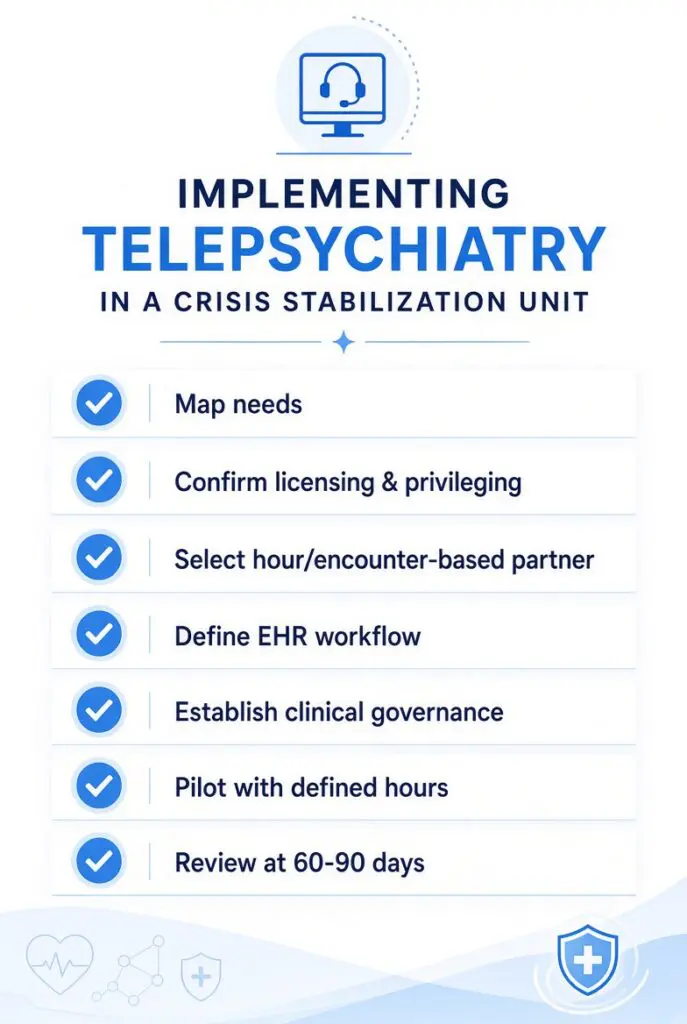
- Map exact needs (initial evaluations, daily rounding, medication titration, after-hours backup, child/adolescent vs. adult panels).
- Confirm state licensing and facility privileging timelines for the CSU location.
- Select a partner that offers hour- or encounter-based contracts, EHR integration, and the option for dedicated or semi-dedicated providers.
- Define the request and documentation workflow so notes and orders stay inside the host system. For evaluation criteria that protect this structure, see how to write a telepsychiatry staffing RFP.
- Establish clinical governance and escalation criteria with the on-site nursing and therapy team.
- Pilot with a defined number of weekly hours plus after-hours backup. Track time-to-evaluation, length of stay, and disposition metrics.
- Review results at 60–90 days and adjust the hour block or provider mix.
Typical onboarding (credentialing + EHR access + test sessions) is often 4–6 weeks once scope is clear. After-hours coverage considerations are addressed in After-Hours Telepsychiatry: Night & Weekend Facility Coverage.
Frequently Asked Questions
What is telepsychiatry staffing for a crisis stabilization unit?
It is psychiatric coverage delivered by credentialed remote providers who perform evaluations, medication management, and disposition support inside the CSU’s existing workflows and record, scaled to actual census.
How is this different from pure on-demand ED telepsychiatry?
On-demand ED coverage focuses on rapid single evaluations and disposition from the emergency department. CSU staffing usually includes a mix of scheduled rounding and backup so patients who stay longer receive ongoing psychiatric input during their short stay. See the related on-demand and follow-up telepsychiatry models for emergency departments article for the ED-specific comparison and the Emergency Room Mental Health Crisis Services page for core on-demand service details.
Can the same providers support both the CSU and an affiliated outpatient or residential program?
Yes, when the organization wants continuity. Many programs use the same staffing partner for CSU coverage and scheduled follow-up hours so patients can move between levels of care without a new front door.
What is a typical start timeline?
Most organizations begin scheduled or combined coverage within 4–6 weeks after scope, licensing, and EHR access are confirmed.
Next Steps
Crisis stabilization units and short-stay behavioral health programs can maintain reliable psychiatric coverage without the fixed cost of full-time employment or the continuity limits of pure rotating locum coverage. FasPsych has supported these and related hospital-based settings since 2007 with state-licensed psychiatrists and psychiatric nurse practitioners who document in the partner system and scale with demand. Learn more about the provider network on the FasPsych providers page.
To map coverage for a CSU or short-stay program, contact FasPsych at (877) 218-4070 or visit faspsych.com/partner-with-us.
For emergency department-specific models, see the on-demand and follow-up telepsychiatry models article. For community and FQHC/CMHC/CCBHC needs, see the flexible community models and FQHC/CMHC/CCBHC playbook articles.