

In Blake Edwards’s 1961 film Breakfast at Tiffany’s, Holly Golightly asks Paul Varjak whether he ever gets “the mean reds.” He assumes she means the blues. She corrects him. The blues, she says, are because you are getting fat and it has been raining too long — you are just sad. The mean reds are different: “Suddenly you’re afraid and you don’t know what you’re afraid of.” The only thing that settles her is a cab to Tiffany’s, a place where “nothing very bad could happen to you.”
Intake staff hear the same two complaints every shift, usually fused into one sentence: “I’m anxious and depressed.” That fusion is how a generalized anxiety presentation gets a depression-only plan, and how a major depressive episode gets treated as nerves. The movie line is useful because it is already a differential. Free-floating fear without an object is not the same clinical object as low mood, anhedonia, and stalled drive — even when the patient uses both words, and even when both syndromes are present.
This article is for hospitals, emergency departments, FQHCs and CMHCs, residential programs, and primary-care clinics that run first-contact behavioral health intakes. Many of those sites are Medicaid-heavy; telepsychiatry is already how a large share of that behavioral health work gets staffed. Facility teams already have separate playbooks for seasonal affective disorder, CBT integration, and co-occurring substance-use intake. This page stays on the first-contact split: can intake separate free-floating anxiety from depression well enough to choose the right screen, the right first appointment, and the right same-day psychiatry trigger?
Key Takeaways
- “Anxious and depressed” is a patient sentence, not a diagnosis. Intake has to decide which syndrome is driving function today, and whether both are present.
- Free-floating anxiety — fear without a clear object, restlessness, muscle tension, unproductive worry that jumps domains — maps closest to generalized anxiety disorder. Low mood, loss of interest, guilt, and slowed thinking map to major depression.
- Shared symptoms (sleep, energy, concentration, irritability) are the usual source of mis-triage. Shared symptoms do not make the two conditions the same.
- Run both a GAD-7 and a PHQ-9 at first contact when the complaint is mixed. A single scale will hide the second syndrome.
- Same-day psychiatry is indicated when PHQ-9 item 9 is positive, when panic or agitation is escalating, when intake cannot tell a mixed state from bipolar agitation, or when the patient cannot leave the building safely.
- Telepsychiatry can complete that first psychiatric pass the same day. A screen without a clinician who can act on it is how depression-screening quality measures fail.
What Holly Called the Mean Reds
Holly’s description is almost a textbook stem for free-floating anxiety. The fear has no named threat. It arrives suddenly. The body is already in it — in Truman Capote’s novella she sweats and expects something bad she cannot specify. The coping move is not rest. It is scanning for a place that feels safe.
NIMH describes generalized anxiety the same way in clinical language: excessive worry about a range of everyday problems, difficulty turning the worry off, and physical tension that outlasts any single stressor. DSM-5-TR requires the worry to be difficult to control and present more days than not for at least six months, with associated features such as restlessness, fatigue, concentration problems, irritability, muscle tension, and sleep disturbance. Duration matters for the disorder label. It does not matter for the intake decision. A patient who has had three weeks of objectless dread still needs a plan today.
Free-floating anxiety is easy to miss at intake for three operational reasons:
- The patient often leads with a body complaint — chest tightness, GI upset, insomnia, headache — and never uses the word worry.
- The worry, once elicited, sounds reasonable in pieces (money, health, work, family, what they just saw online). The pattern is that it will not stay on one topic. Social media can load the chart with anxiety and low mood; it still does not tell intake which syndrome is driving function today.
- Staff trained on crisis protocols look for a discrete panic attack or a trauma trigger. Generalized anxiety produces neither on demand. It produces a person who cannot settle.
Panic disorder, social anxiety, OCD, and PTSD can all walk in saying they are “anxious.” Those presentations have an object: a surge, a feared situation, an intrusion, a memory. Free-floating anxiety is what is left when the object will not stay still. If intake treats every anxious patient as panic, the chart will fill with unused benzodiazepine language and miss the chronic worry that is actually driving function.
What the Blues Actually Are at Intake
Holly’s “blues” line is folk depression: rain, weight, a sagging mood with an explanation. That folk picture is thinner than what shows up in an ED or FQHC waiting room. When the low mood follows a seasonal clock, use the SAD workup. Most depressed patients at intake do not have that clock.
Major depressive disorder is a syndrome: depressed mood or anhedonia plus a cluster of vegetative and cognitive signs lasting at least two weeks and impairing function. APA patient guidance lists the familiar set — sleep change, appetite change, low energy, guilt or worthlessness, poor concentration, psychomotor change, and thoughts of death. The clinical tell at intake is loss of return. Activities that used to produce anything now produce nothing. Anxiety patients are exhausted from scanning. Depressed patients are exhausted from the absence of signal.
Two traps show up in first-contact notes:
- Calling every low mood “the blues” and booking therapy in three weeks, while PHQ-9 item 9 sits unanswered.
- Calling every tearful, tired patient depressed when the driver is still undiagnosed anxiety, untreated apnea, hypothyroidism, alcohol withdrawal, or a medication effect.
Depression screening is already a paid quality event in many of the facilities FasPsych covers. The CMS and HEDIS depression-screen-and-follow-up measures do not give credit for a PHQ-9 that dies in the chart. They give credit when a positive screen produces a documented plan. That plan is a psychiatric or care-management action, not a sticky note. Medicaid-serving CMHCs and FQHCs hit the same mixed presentation with thinner local specialist supply; telepsychiatry under Medicaid is often how those clinics complete the follow-up a positive screen actually requires.
Why the Two Get Collapsed — and Why That Costs the Facility
Anxiety and depression co-occur often enough that staff stop hearing them as separate. Community surveys have shown high comorbidity between mood and anxiety disorders for decades. DSM-5-TR added an anxious-distress specifier to major depression for a reason: keyed-up tension, restlessness, worry-driven concentration loss, and a sense that something awful is about to happen are common inside a depressive episode. That specifier is not the same as a standalone GAD diagnosis. It is a flag that the depressed patient in front of you is also a safety and dropout risk.
Overlap is not identity. Sleep, energy, and concentration appear on both lists. The questions that separate them are older than any rating scale:
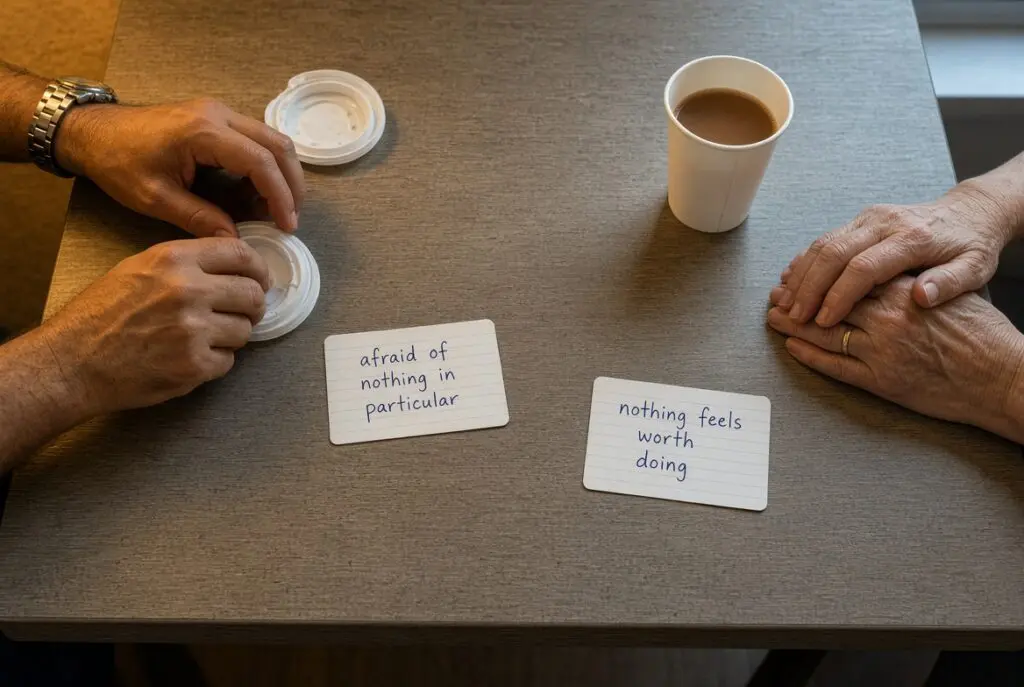
- Is the patient avoiding because they expect catastrophe, or because nothing feels worth doing?
- Is rumination future-facing (“what if”) or past-and-self-facing (“I already failed”)?
- Does a good hour restore them, or does a good hour change nothing?
- Is the body tight and scanning, or heavy and slowed?
Getting this wrong at intake has operational costs. An SSRI started for “depression” in a patient whose picture is mostly GAD may still help — many first-line agents overlap — but the follow-up question, the therapy referral, and the safety plan will be aimed at the wrong target. A depressed patient labeled “just anxious” leaves without a suicide screen. A mixed presentation labeled as one or the other produces a 30-day follow-up that does not match either score.
How the two presentations differ at first contact
| Feature | Free-floating anxiety (“mean reds”) | Depression (“the blues” as syndrome) | Mixed / anxious depression |
|---|---|---|---|
| Core complaint | Fear without a stable object; “something bad is coming” | Low mood or loss of interest; “nothing matters” | Both, often with restlessness on top of emptiness |
| Thought pattern | What-if chains that jump domains | Self-attack, hopelessness, slowed thinking | Catastrophe and worthlessness |
| Body | Tension, startle, GI/chest symptoms, restlessness | Heaviness, slowness, or agitation in some | Tension plus leaden fatigue |
| Sleep | Trouble falling asleep because the mind will not stop | Early waking, hypersomnia, or both | Either pattern; document which |
| Screen pair | GAD-7 elevated; PHQ-9 may be modest | PHQ-9 elevated; GAD-7 may be modest | Both elevated — do not pick one and stop |
| First clinical move | Anxiety-focused history, medical rule-outs, GAD-7, safety | Depression history, PHQ-9 including item 9, safety | Treat as two problems; same-day psychiatry if either side is acute |
What to Collect at Intake Before Anyone Names a Disorder
The first visit does not need a perfect DSM formulation. It needs a chart a covering psychiatrist can use the same afternoon.
Run both brief scales, and write down what they do not capture
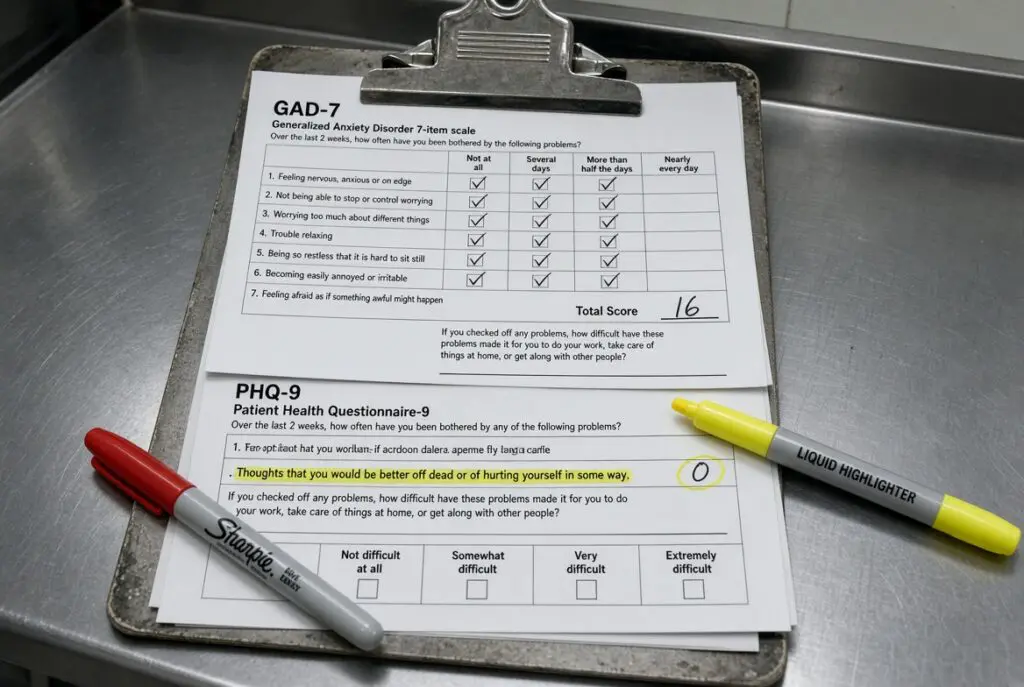
The GAD-7 (Spitzer, Kroenke, Williams, Löwe, 2006) and the PHQ-9 (Kroenke, Spitzer, Williams, 2001) are the default pair in U.S. primary care and in collaborative-care programs for a reason. They are short, scored the same way, and sensitive to change. Cut-points of 5, 10, and 15 mark mild, moderate, and severe ranges on both. They are screens. They are not diagnoses. Psychiatric specialty settings already know the PHQ-9 over-identifies major depression if the score is treated as a verdict.
Document:
- Raw GAD-7 and PHQ-9 totals, plus PHQ-9 item 9 in its own line.
- Which symptoms the patient actually endorsed, not only the number.
- Whether the patient had help completing the form, and whether a partner or parent was in the room.
- What the scales missed: panic surges, trauma intrusions, compulsive rituals, manic speed, cognitive change, or a substance that would explain the week.
USPSTF recommends depression screening in adults when systems exist to follow a positive result. That last clause is the staffing problem. When there are no psychiatrists, a GAD-7 of 16 with no one to act on it is a risk note, not a completed intake.
Document the course, not the adjective
- Onset and duration of the fear versus the low mood. Which came first this episode? Ask what has been feeding either side, including social media and mental health patterns. Feed-driven scanning can intensify objectless worry; withdrawal from feeds can travel with anhedonia. Note the pattern and keep moving.
- Whether worry is controllable for even an hour.
- Anhedonia asked as a behavior: what did they stop doing, and when?
- Prior episodes, prior medication trials, and whether an antidepressant ever produced activation, insomnia, or a mood switch.
- Alcohol, cannabis, stimulants, and withdrawal timing. If substance use is the frame, finish the history here and send the chart down the co-occurring intake path.
- Medical anchors that change the differential: thyroid, anemia, cardiac workup already done, new steroids, new dopamine agonists, recent concussion.
Sleep belongs in the note as a feature of whichever syndrome is present. For insomnia as the primary problem, use FasPsych’s insomnia guide. In this intake, sleep is evidence: difficulty initiating because of worry points one way; early-morning waking with dread that the day has no point points another.
Document risk in one place
Anxiety and depression both raise suicide risk. Depression does it more reliably in the public mind; severe GAD and panic do it in the building. Put the answer in the intake, not in a later therapist’s note:
- Current ideation, intent, plan, and access.
- Prior attempts or aborted attempts.
- Whether agitation or inner restlessness is new this week.
- Who is at home, and whether the patient can be left there tonight.
When This Presentation Needs Psychiatry the Same Day
Most mixed “anxious-depressed” intakes can wait for a scheduled adult psychiatry visit if scales are moderate, safety is negative, and a follow-up slot exists. Book same-day psychiatry — on site or by video with staff in the room — when any of the following are true.
- PHQ-9 item 9 is positive, or the patient endorses a wish to be dead in the interview.
- Agitation, pacing, or inner tension is escalating during the intake itself.
- Intake cannot tell severe anxiety from a mixed bipolar state, a first-break psychosis, or stimulant intoxication.
- Panic symptoms with chest pain or syncope have not had a medical screen, and the patient is still in the ED.
- The patient is not eating, not sleeping at all, or not leaving the house, and the collateral historian is asking whether they can go home.
- A positive depression screen has no follow-up clinician available inside the measure window.
- New psychiatric symptoms after a medical event, a new medication, or in a patient over 50 with no prior anxiety or mood history. If staff are also asking whether the adult can still manage care, money, or safety, ask for a capacity evaluation. Depression and anxiety can raise that question. The GAD-7 and PHQ-9 do not settle it.
Same-day psychiatry is how facilities keep the “mean reds” from becoming an unplanned ED return, and how they keep the blues from leaving with a therapy referral and an unanswered item 9. In hospitals that first mixed presentation often lands in the ED or on a medical floor, not in an outpatient therapy slot. The real cost of that coverage gap is a mixed screen and no psychiatrist on the unit — same-day video is how those floors finish the differential before the patient leaves. After-hours coverage exists for the version of this visit that does not happen at 10 a.m.
Telepsychiatry When the Complaint Is Mixed
Video intake is a good fit for this differential. The psychiatrist can watch psychomotor speed, hear the worry jump topics, and score both scales in one encounter. It is a poor fit only when the room is not private, the patient is too agitated to stay on camera, or a medical clearance question still belongs to the emergency physician in the same hallway.
Before the visit:
- Confirm location, emergency number, and who else can hear the call.
- Have the GAD-7 and PHQ-9 already completed, or complete them live.
- Put a nurse or case manager in the room if disposition may be a hold, a medical workup, or a same-day medication start.
Online psychiatrists can prescribe for anxiety and depressive disorders in facility settings when state law and the facility formulary allow it. That is not a reason to skip the differential. An SSRI written for “anxiety-depression” without a working diagnosis is how the next covering clinician inherits a chart that explains nothing.
Measurement after the first visit is what separates a staffing model from a one-off consult. Collaborative care already treats PHQ-9 and GAD-7 as instruments you repeat until the score moves. Facilities that only buy a single intake hour never see that movement.
How FasPsych Supports Organizations Running These Intakes
FasPsych does not sell a “mean reds” product. The work is first-contact psychiatric evaluation, a usable differential, a medication decision when one is indicated, and a follow-up that can actually be kept.
- Same-day and on-demand psychiatric coverage when intake uncovers mixed anxiety-depression and no staff psychiatrist is in the building. Facilities that already run their own intake usually add those hours through a psychiatry staffing network rather than a three-week new hire. A flexible hospital-and-clinic coverage model is one way the psychiatrist actually appears. The differential still has to be done on this visit.
- Scheduled adult psychiatry for the moderate cases that should not wait three weeks but do not meet hold criteria.
- Clinicians used to emergency department, primary-care, residential, and community-clinic workflows — the rooms where this sentence is spoken.
- Notes that enter the facility EHR so the GAD-7, PHQ-9, and item 9 are visible to the next shift.
- Continuity after the first visit, which is what screening-and-follow-up measures actually pay on.
Organizations keep the patient. FasPsych supplies licensed psychiatrists and psychiatric nurse practitioners who join the existing team.
Frequently Asked Questions
Is “the mean reds” a diagnosis?
No. It is Holly Golightly’s name for objectless fear in Breakfast at Tiffany’s. At intake, treat it as a stem for free-floating anxiety and complete a GAD-7 plus a full anxiety history. The chart diagnosis, if one is reached, will be GAD or another anxiety disorder — not a movie line.
Can anxiety and depression be present at the same time?
Yes. Comorbidity is common, and major depression has an anxious-distress specifier for a reason. Do not pick the louder word and ignore the other scale. Document both and let the psychiatrist decide what is primary this episode.
Which screen should intake use if we can only give one?
Give both. If operations truly allow only one form, match it to the chief complaint and schedule the other within the same visit block. A PHQ-9 alone will miss a severe GAD-7. A GAD-7 alone will miss item 9.
Does this replace a medical workup?
No. New anxiety or low mood after age 50, with focal neurologic signs, with chest pain, or after a medication change still needs a medical pass. Psychiatry and the medical workup can run the same afternoon. If staff are also asking whether the adult can still make medical or financial decisions, see FasPsych’s guide to the psychiatrist’s role in conservatorship and guardianship. Score the GAD-7 and PHQ-9 first; capacity is a separate evaluation.
When is same-day telepsychiatry enough?
When the patient is in a private, staffed room, medical emergencies are already addressed, and on-site staff can carry out the plan. It is not enough if the patient is too agitated to stay on camera or if item 9 is positive and no one on site can implement a safety plan.
How does FasPsych help if our psychiatrist is booked out three weeks?
That wait is a mixed screen with no psychiatrist behind it. FasPsych places credentialed psychiatrists and psychiatric nurse practitioners into the facility workflow for scheduled and on-demand coverage. Call (877) 218-4070 or start at faspsych.com/partner-with-us.
From a Movie Line to a Disposition
Holly Golightly could tell the difference between being sad and being afraid of nothing in particular. Most intake forms still cannot. The cost of that blur is a depression plan for a patient who cannot stop scanning, or a “just anxious” label on a patient whose PHQ-9 item 9 was never asked.
If your ED, clinic, residential program, or community center is hearing “anxious and depressed” as one word, the next step is a first-contact evaluation that splits the two — same day when safety or mixed-state questions will not wait.
FasPsych can add licensed psychiatric coverage to that intake. Contact faspsych.com/partner-with-us or call (877) 218-4070.