


Mitch Hedberg used to say he was sick of following his dreams. He was going to ask where they were going and hook up with them later.
The joke works because pursuit sounds like a virtue until you notice the speaker has already quit. He is not lost. He has the destination. He has decided that later is close enough, and that the dream will still be holding the table when he arrives. A dream is not a person with a calendar. Delay is not a plan. It just sounds like one.
A hospital, FQHC, CMHC, jail, or rural clinic that takes the name, books week six, and hopes the crisis keeps the appointment is running that sentence as policy. Acute psychiatry does not wait in the lobby. It leaves. It boards. It no-shows. It comes back worse.
This article is for administrators who still treat a waitlist as a holding pattern. It is not a consumer guide to “what to do while you wait.” It is not psychiatric boarding in the first four hours — that clock starts after psychiatry has already said the patient needs a bed. It is not after-hours coverage as a product. Those pages own those jobs. This page is narrower: what a waitlist does to an acute case that is still being scheduled.
FasPsych staffs licensed psychiatrists and psychiatric nurse practitioners into your program on secure, real-time video. We do not treat individual consumers. The useful question after intake is whether the next psychiatrist minute is same-day, next-day, or actually allowed to wait.
Key Takeaways
- A waitlist is not a treatment plan. For an acute presentation it is a discharge without a clinician.
- Certified Community Behavioral Health Clinic clocks are emergency now, urgent within one business day, routine initial evaluation within ten business days. Sixty-seven days is not one of those clocks.
- A secret-shopper study in General Hospital Psychiatry found only 18.5 percent of sampled psychiatrists available to new patients, with a median wait of 67 days in person and 43 days by telepsychiatry. That is access, not acuity.
- Delay itself loses the visit. In one community-center series, same-day first appointments no-showed at 12 percent; a seven-day delay ran 42 percent.
- Killing a waitlist is a staffing and routing job, not a courtesy. Phase-based care at one FQHC cleared 614 of 702 waitlisted people in 3.5 months; 37 percent needed acute care and entered treatment within two weeks.
- Telepsychiatry inside your program can cover the acute slot the same day. A consumer app with a 43-day median is still a waitlist.
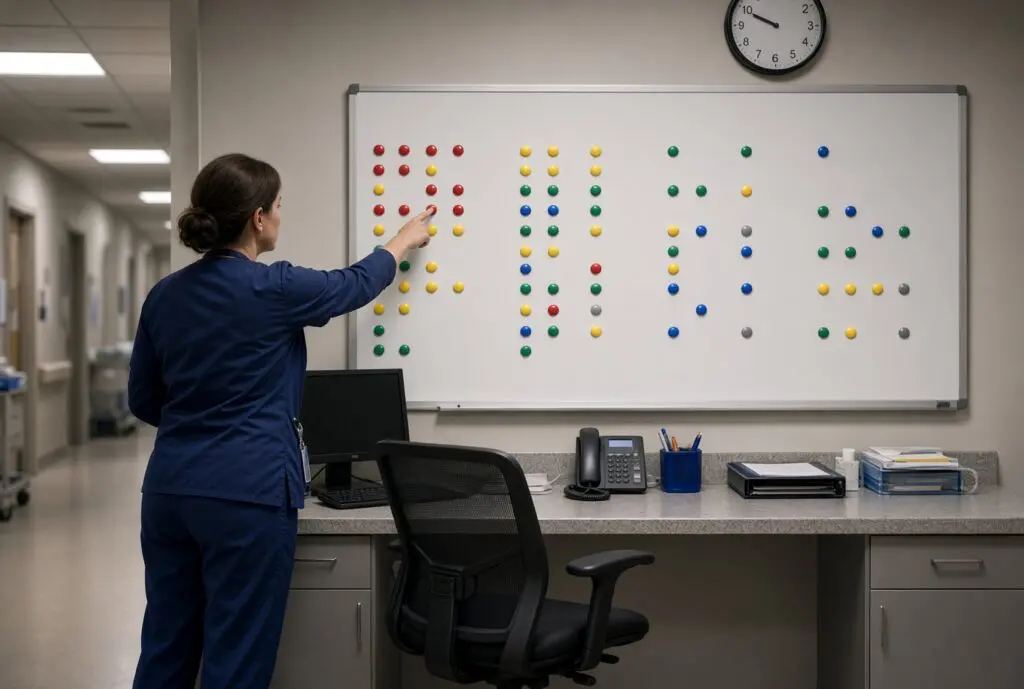
Four clocks, one list
Most programs run one calendar for every referral. That is how an urgent case inherits a routine date.
| Clock | What it is | What a waitlist does to it |
|---|---|---|
| Emergency / now | Danger to self or others, hold question, withdrawal that cannot wait, cannot leave the building safely | The list is a clinical error. This is crisis response or same-day psychiatry, not a booked future. |
| Urgent / one business day | Escalating agitation, interrupted MAT, first-break question, court or jail screen, a family who will not take the person home | CCBHC criteria put the initial evaluation inside one business day. Week three is not “urgent with a delay.” |
| Routine / ten business days | Moderate symptoms, safety negative, sleep and appetite intact, someone will keep the follow-up | Ten business days is the outer bound for a routine initial evaluation — not a floor to aim for. |
| Already in the building | ED cart, jail intake, residential med pass, the rural Tuesday clinic that is live this week | This is coverage, not a waitlist. If no one is privileged to open the record, you do not have a list. You have a hole. |
Same Day Access is not “fast access in seven to ten days.” The National Council’s CCBHC access work treats same-day as unscheduled capacity on the day the person asks. Fast access is a different product. Mixing the two is how a ten-day standard becomes a sixty-seven-day median.
What happens on the list
A waitlist assumes calendar time is clinically neutral. Acute psychiatry is not.
The visit dies. Gallucci and colleagues tracked first appointments at a community mental health center. Same-day bookings cancelled or no-showed at 12 percent. Next-day rose to 23 percent. By day seven the rate was 42 percent. The damage concentrated in the first week of delay. After that the list was mostly a record of people who were not coming.
The acuity was already high. When one FQHC dismantled a 702-person behavioral health waitlist with phase-based triage, 37 percent of those who attended needed acute care and entered treatment within two weeks. A list that long is not a queue of stable outpatients. It is a stack of untriaged urgency wearing a routine date.
The medical system absorbs the miss. After that waitlist was cleared, waitlisted patients had 23 percent fewer non-behavioral medical encounters per month. The list had been sending people back into primary care and the ED while they waited for psychiatry.
The quality numerator never starts. Follow-up after hospitalization and follow-up after ED visit pay on a kept appointment in seven or thirty days. A name on a waitlist is not a kept appointment. That scoring problem already lives on the value-based measures page. This page only names the mechanism: the waitlist is how the clock runs out.
The induction window closes. Dual-diagnosis programs lose people between referral and first evaluation — the same window when withdrawal, interrupted buprenorphine, or an ED bounce is most likely. That staffing problem is already on the co-occurring disorders page. The waitlist is the instrument that opens the window and then leaves it open.
A local waitlist does not shrink the mental health shortage map. It only decides whether your rooms will see the person before the map does.
What a waitlist assumes
Three assumptions sit under most psychiatry waitlists. None of them survive an acute presentation.
The person is stable enough to wait. Intake already decided they were not stable enough to leave without a name on a calendar. Booking week six does not revise that decision. It postpones the person who made it.
The first available slot is the right slot. A routine block is the right slot for a moderate PHQ-9 and a negative safety screen. It is the wrong slot for item 9, a mixed state, a MAT gap, or a charge nurse who will not send the person home. Two-step screening is the routing map. This page is what happens when the map says same-day and the calendar says October.
Someone else will catch them if they drop. EDs catch some of them. Jails catch some of them. Families catch some of them. A share of them are not caught. “Hook up with them later” is not a safety plan.
A planned wait is the one advantage a routine case has. Use it for the cases that can actually keep the date.
Who cannot wait
Most moderate intakes can take a scheduled adult psychiatry slot if safety is negative, sleep and appetite are intact, and a follow-up exists this week or next.
Do not put any of the following on a weeks-long list. Book same-day or next-day psychiatry — on site or by video with staff in the room.
- PHQ-9 item 9 is positive, or the person endorses a wish to be dead.
- Agitation, pacing, or inner tension is escalating during the intake itself.
- Intake cannot tell severe anxiety from a mixed bipolar state, a first-break psychosis, or intoxication. The differential for that sentence lives on Mean Reds vs. Blues. This page only refuses the six-week date.
- MAT is interrupted, withdrawal is starting, or the induction will not survive a delay.
- A hold, a jail screen, or a court date is already on the clock.
- The person cannot leave the building safely, or the family will not take them home.
- This is a 7-day or 30-day follow-up after discharge or an ED visit. That is a booked slot, not a waitlist.
If the answer is “we’ll put them on the list and call if something opens,” the acuity was already above the list.

Telepsychiatry when the next slot is week six
Video is a good fit when the patient is still your patient, the note goes in your EHR, and on-site staff can carry out the plan. It is a poor fit when the “faster” option is a consumer platform whose own median wait is still 43 days, or when the only video path is a call center that has never opened your record.
Sun’s secret-shopper sample is useful here for what it is not. Those 43 days were telepsychiatry offered by individual psychiatrists taking new outpatients. That is not on-demand coverage inside a facility workflow. It is a shorter waitlist.
Before the first acute video visit: confirm the room, the emergency number, and that the incoming clinician can see today’s screen and yesterday’s med list. Decide whether the block is on-demand, a same-week scheduled clinic, or after-hours. Mixing all three without naming them is how night staff put an urgent case on the morning list.
After the visit the note should say one of three things: same-day plan with a dated follow-up, scheduled block inside ten business days, or this person cannot wait and no slot exists. That last sentence belongs to the medical director the same day. It is not a reason to print another waitlist letter.
How FasPsych supports organizations that still run a list
FasPsych staffs licensed psychiatrists and psychiatric nurse practitioners into the program you already own — hospital, FQHC, CMHC, jail, rural health clinic, residential unit — on interactive, real-time video. The visit is not a second clinic door and not a consumer waitlist.
For a waitlist week that means same-day and on-demand hours for the cases that cannot take a routine date, scheduled blocks so the ten-day clock is a roster instead of a hope, documentation in your EHR so follow-up measures can extract a kept visit, and backup behind the named clinician so the next sick day does not rebuild the list.
Keep psychiatry inside the program the patient already uses. Do not open a second door labeled “interim waitlist.”
Call (877) 218-4070 or start at Partner With Us.
Related FasPsych reading
- Psychiatric Boarding: The First Four Hours — the ED clock after psychiatry has already said they need a bed.
- Two-Step Mental Health Screening Workflow — who routes same-day versus scheduled after the form.
- Mean Reds vs. Blues — mixed anxiety-depression that cannot take a three-week date.
- Co-Occurring Disorders Telepsychiatry — waitlists that push people out before induction.
- After-Hours Telepsychiatry — nights as a named service, not a morning list.
- On-Demand Mental Health Services for Intake — jail and correctional screens that cannot wait 24 hours.
- Behavioral Health Value-Based Measures — a waitlist is not a booked 7-day follow-up.
- Backup Psychiatrist Coverage — the named clinician is out; this page is the slot was never real.
Frequently Asked Questions
Is a waitlist a clinical intervention?
No. It is a calendar. For routine cases a short, dated slot can be appropriate. For acute cases it is a discharge without a psychiatrist.
Does telepsychiatry eliminate waitlists?
Only the telepsychiatry that is already privileged in your program, live in your EHR, and staffed for same-day or next-day work. A platform whose median new-patient wait is 43 days is still a waitlist.
Is this the same as psychiatric boarding?
No. Boarding starts after psychiatry has said the patient needs a bed or a transfer and the patient is still in the ED. This page is the outpatient or intake case that is being asked to wait weeks for the first psychiatrist.
Is this the same as after-hours coverage?
No. After-hours is a named night and weekend service. A waitlist that tells an evening arrival to “call back in the morning” is how after-hours demand becomes a routine date.
What is the difference between Same Day Access and a ten-day standard?
Same Day Access is unscheduled capacity on the day the person asks. The CCBHC routine standard is an initial evaluation within ten business days. Fast access in seven to ten days is a third thing. Do not file all three under “we have a waitlist.”
If our psychiatrist is booked out six weeks, can video cover tomorrow?
Only if someone is already licensed for your state, privileged or privilege-ready, and able to open your record. A new vendor conversation is not tomorrow’s slot.
Does FasPsych take the patients off our list?
No. FasPsych staffs into the organization’s program. The organization keeps the record, the brand, and the panel. The list shrinks because the hours exist, not because the patients left.
If you or someone with you is in crisis or having thoughts of suicide, call or text 988.