
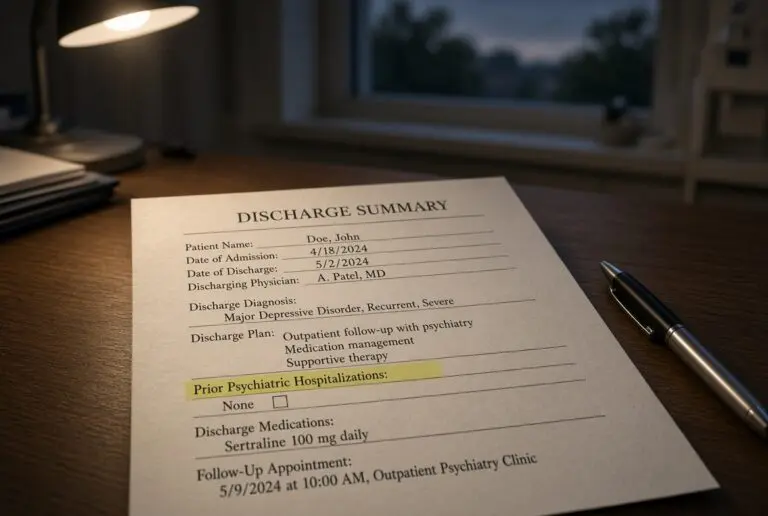

 In Blue System’s 1993 track History (from the album Backstreet Dreams), the chorus treats the past as settled: “It’s history, there is enough for you and me.” SongMeanings and Genius frame the song as a ballad about a shared past that still carries weight. In an inpatient psychiatric unit the same phrase works differently. An incomplete history is not settled. Prior admissions, suicide attempts, failed medication trials, and substance patterns stay invisible, and the next team treats a patient whose risk profile was never written down.
Emergency departments, inpatient psychiatric units, residential programs, and skilled nursing facilities already see the operational version. A patient returns within 30 days. The chart from the index admission lists a diagnosis and a discharge medication list. It does not list the three prior hospitalizations, the last suicide attempt, or the fact that the patient stopped the antipsychotic within a week of the previous discharge. Staff write “readmission” as if the event were unpredictable. The history that would have predicted it was never collected.
Facilities that already run emergency-department psychiatry, inpatient psychiatric coverage, residential programs, and skilled nursing workflows do not need a longer interview template. They need a first-contact and pre-discharge habit that treats prior admissions, attempts, medication response, and collateral as part of the risk calculation, not optional background.
This article is written for hospitals, clinics, and behavioral health program leaders. It is educational and operational. It is not medical advice, a diagnosis, or a substitute for evaluation by a licensed clinician. It is not a recommendation to withhold indicated treatment. If you or someone with you is in immediate danger, call 911. If you or someone with you is in crisis or having thoughts of suicide, call or text 988 (Suicide & Crisis Lifeline) or go to the nearest emergency department.
Key Takeaways
- Prior psychiatric hospitalizations are among the strongest and most consistent predictors of future readmission. An incomplete history that omits the count leaves the current team treating a patient whose risk is invisible.
- A 2022 BMC Psychiatry study of 1,001 inpatients found previous hospitalizations and a history of suicide attempts independently associated with re-hospitalization; patients with prior admissions had roughly two- to three-fold higher odds of return.
- Medication discrepancies and unfilled discharge prescriptions contribute to return visits. One analysis found medication was a significant or partial factor in roughly two-thirds of readmissions reviewed, with omissions and dosing errors common on discharge plans.
- Collateral is not optional color. Family, prior clinicians, and pharmacy records often supply the admission count, the attempt history, and the actual medication list that the patient cannot or will not provide.
- Completing the history does not replace a psychiatrist. When risk is already positive, the presentation is mixed, or the patient is leaving against advice, book same-day or on-demand psychiatry and use the completed history as the chart that clinician works from.
What an Incomplete History Actually Omits
A usable psychiatric history is not a long narrative. It is a short set of facts that change the next decision.
The minimum that alters readmission risk includes:
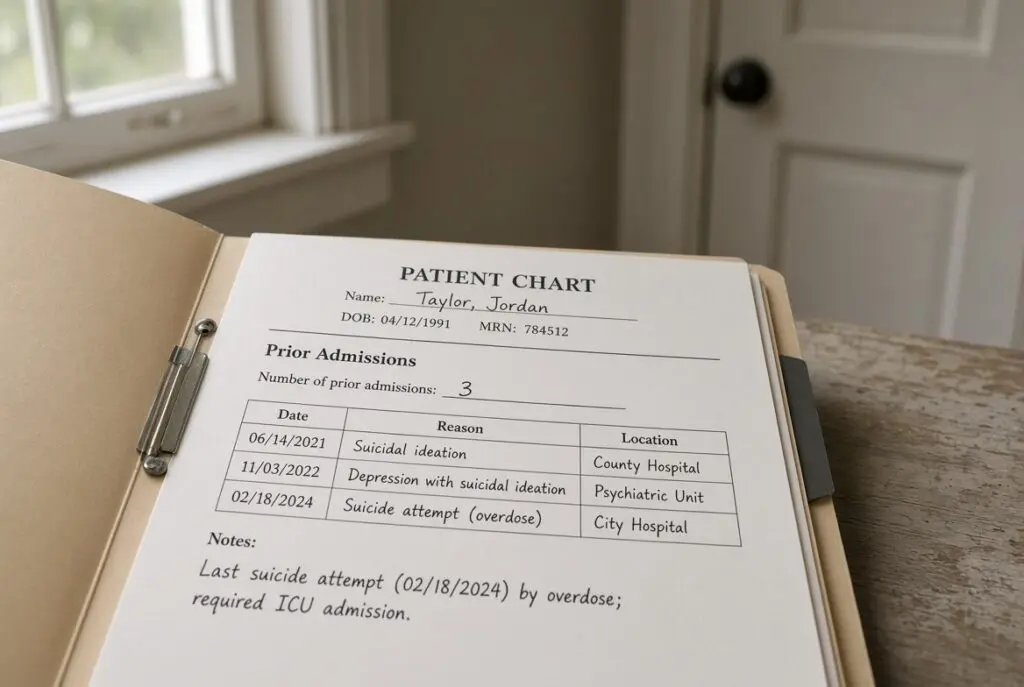
- Number of prior psychiatric hospitalizations and the approximate dates or facilities.
- History of suicide attempts, including method and recency, and any prior self-harm that required medical care.
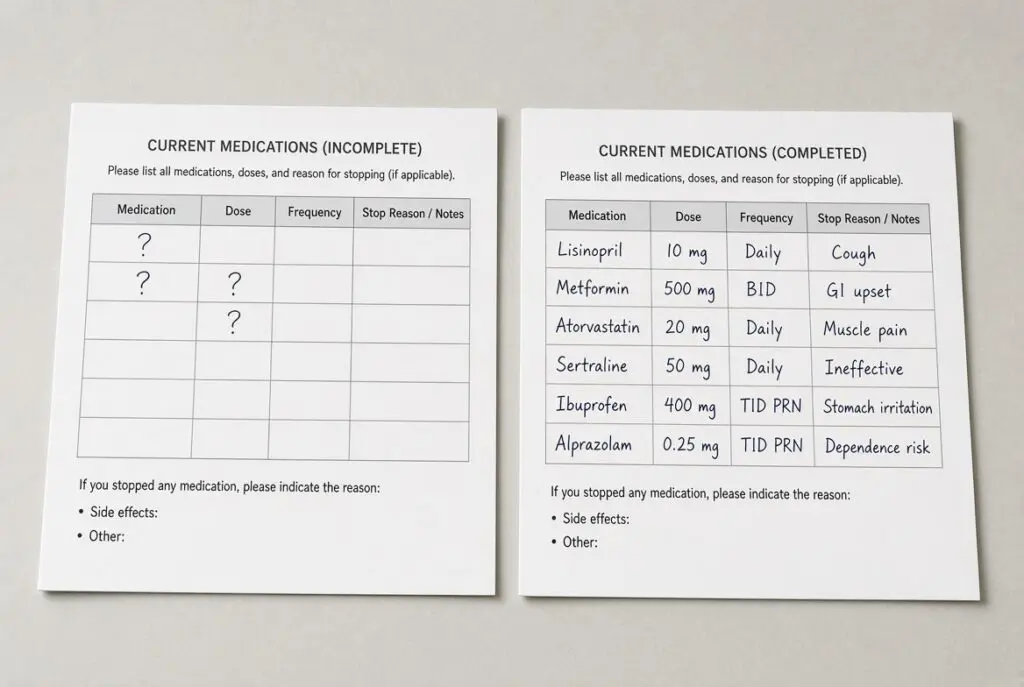
- Medication trials: which agents were tried, at what doses, for how long, and why they stopped (side effects, lack of effect, cost, or patient decision).
- Substance use pattern, including last use, withdrawal history, and prior treatment episodes.
- Collateral from at least one other source — family, a prior outpatient clinician, or a pharmacy — confirming or correcting the above.
Kaplan and Sadock’s outline and standard psychiatric textbooks treat past psychiatric history, family history, and personal history as core domains. Documentation audits repeatedly show these domains incomplete. One quality-improvement re-audit found personal and social history documentation rising only after focused attention, while collateral history and current medication lists remained weak under ordinary workload.
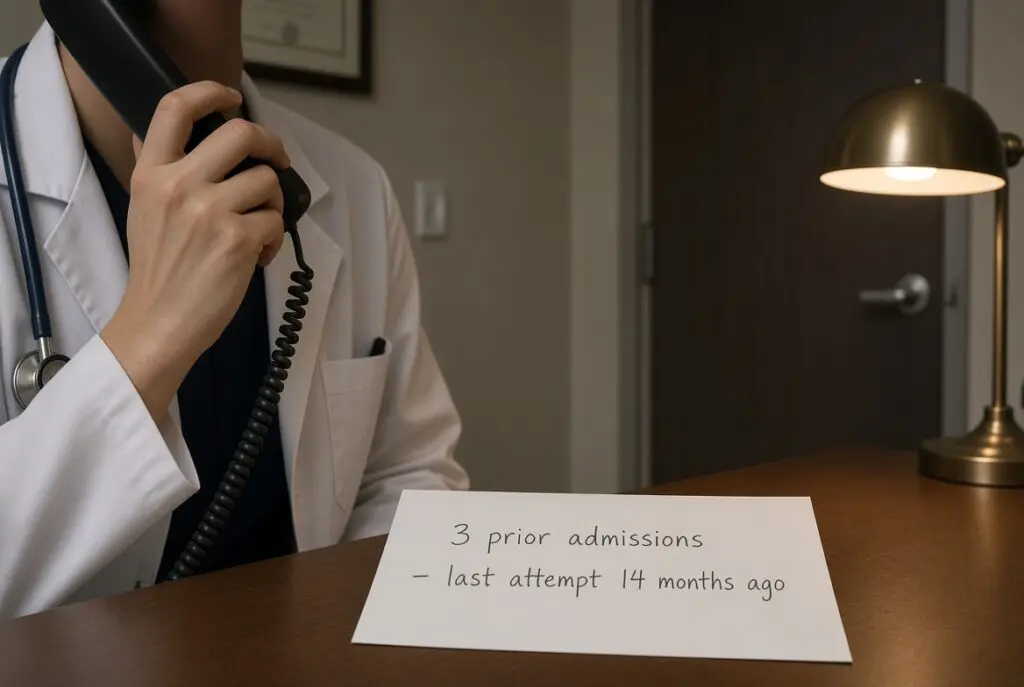
An incomplete history is not the same as a short one. A ten-minute interview that captures prior admissions, the last attempt, and a reconciled medication list is more useful for the next 30 days than a longer interview that never asks.
Psychiatric History Taking: The Domains That Change the Next 30 Days
Standard psychiatric history taking covers a fixed set of domains. Kaplan and Sadock’s outline and most training texts treat the following as core:
- Identifying information and chief complaint.
- History of the present illness.
- Past psychiatric history (prior diagnoses, hospitalizations, suicide attempts, treatments).
- Medication history and response.
- Substance use history.
- Medical history.
- Family history.
- Personal and social history.
- Forensic or legal history when relevant.
- Collateral from at least one other source.
- Risk assessment (current and historical).
For readmission risk, not every domain carries equal weight. The elements that most often change the discharge plan are the past psychiatric history (especially the admission count and attempt history), the medication response history, the substance pattern, and the collateral that confirms or corrects them. A full personal history is useful for treatment planning. The admission count and the last attempt are useful for predicting who is likely to return in 30 days.
Practical questions that capture the high-yield facts:
- “How many times have you been in a psychiatric hospital? Approximately when was the last one?”
- “Have you ever tried to kill yourself or seriously hurt yourself? What happened and when?”
- “Which medications have you tried for this? What dose, for how long, and why did you stop?”
- “What substances are you using now, and have you ever been in treatment or had withdrawal?”
- “Who else knows this history — a family member, a prior doctor, or a pharmacy — that we can check with?”
These questions are short. They are also the ones documentation audits most often find blank. Completing them does not require a longer interview. It requires asking the specific items that the BMC Psychiatry data and other readmission cohorts have linked to return. Structured psychiatric screening tools can support consistent capture of risk and history elements at intake, but they do not replace the prior-admission count or the collateral call.
This page is not a general guide to psychiatric interviewing. It is the subset of history-taking domains that facilities can capture before discharge when the goal is to stop treating the next readmission as a surprise. Neighbor pages already cover co-occurring intake structure, caregiver collateral in family programs, and SNF-specific readmission tactics. Those stay on their own URLs.
What the Evidence Links to Return
Psychiatric architecture and model-of-care studies have thinner evidence than medical-surgical design. The papers on readmission predictors are clearer.
The BMC Psychiatry 2022 analysis of 1,001 psychiatric inpatients found 21.1 percent re-hospitalized during the study period. Previous hospitalizations and a history of suicide attempts were independently associated with return. Patients with prior admissions had higher odds of one readmission (OR 2.28) and of two or more (OR 3.13). A history of suicide attempts roughly doubled the odds of multiple returns. Age at onset and length of stay also differed, but the history variables were the ones a facility can act on at intake.
Other cohorts land in the same place. A machine-learning analysis of early psychiatric rehospitalization identified previous psychiatric hospitalizations, number of post-discharge needs, and social isolation as top risk factors. A 2024 Finnish register study reported that a history of psychiatric hospitalization was associated with both any readmission and multiple readmissions in a dose-response pattern: more prior admissions, higher likelihood of return. Systematic reviews of 30-day unplanned psychiatric readmission consistently list previous mental-illness hospital admission among the most reliable predictors.
CMS tracks the operational consequence. The Inpatient Psychiatric Facility Quality Reporting (IPFQR) program includes a 30-day all-cause unplanned readmission measure following psychiatric hospitalization. National rates have hovered near 19 percent in recent reporting periods. Facilities that cannot name which patients already carry the strongest predictor — prior admissions — are flying the measure without the instrument.
Medication history is a second, narrower gap. A Pharmaceutical Journal analysis of mental-health ward readmissions found medication was a significant factor in 33 percent of cases and a partial factor in another 32 percent. Omissions of scheduled medications on the discharge plan and failure to send the electronic discharge notification to the GP were common. Patients discharged with psychotropic medications also show higher rates of discrepancies during pharmacist reconciliation. An incomplete medication history at intake produces an incomplete discharge list. The next admission then starts with the same gap.
Complete vs. Incomplete: What Changes the Next Decision
| Element | Incomplete chart | Complete enough for the next 30 days |
|---|---|---|
| Prior admissions | “No known prior hospitalizations” or blank | Count, approximate dates, and facilities if known |
| Suicide / self-harm | Not asked, or “denies SI” with no attempt history | Attempts, method, recency, and medical consequences |
| Medication response | Current list only | Trials, doses, duration, reason stopped, and actual adherence |
| Substance pattern | “Social drinker” or blank | Last use, withdrawal history, prior treatment, overdose |
| Collateral | Patient report only | At least one other source (family, prior clinician, pharmacy) confirming or correcting |
| Discharge plan | Medication list without the above | List plus the risk facts that change follow-up intensity |
| Typical failure | Readmission treated as unpredictable | Readmission flagged at intake; follow-up intensity matched to history |
A complete history does not guarantee the patient will not return. It does change whether the return is a surprise. Facilities already know the difference between a patient whose chart says “three prior admissions in 18 months” and a patient whose chart is silent.
What a Facility Can Capture This Week
Capital projects and full electronic health-record rebuilds take months. Tuesday’s discharge does not. These are the history elements that do not require a new form.
Count the prior admissions. Ask the number, not whether there were “any.” A single “yes” is less useful than “three in the last two years.” If the patient cannot say, note that and move to collateral.
Ask the attempt history explicitly. “Have you ever tried to kill yourself or seriously hurt yourself?” followed by method and when. A “no” on current suicidal ideation does not close the past. The BMC Psychiatry data linked prior attempts to multiple returns.
Reconcile the medication list with a second source. Pharmacy records, a prior discharge summary, or a family member who fills the prescriptions. The Pharmaceutical Journal review showed omissions and unfilled scripts driving return. The online psychiatrist coordination page already treats medication reconciliation as a shared data set; the same habit belongs on the psychiatric admission.
Get one piece of collateral before discharge. A phone call to a family member, a prior outpatient clinician, or the pharmacy. Document who was asked and what they added. The caregiver burden article notes that family as historian is useful when the purpose is collateral; the same rule applies at discharge.
Write the risk facts into the discharge summary. Prior admission count, attempt history, and known non-adherence belong in the document the next clinician will see. A transition record that omits them fails the practical test of the IPFQR transition-record measure even when the form is complete.
Flag the high-history patient for closer follow-up. Patients with multiple prior admissions or a recent attempt need a booked follow-up, not a waitlist. The waitlist article already treats a post-discharge 7- or 30-day slot as a booked appointment, not a list.
Medicaid-heavy facilities already staff a large share of this work by video; telepsychiatry is how that behavioral health volume gets covered. The missing piece is rarely another platform. It is the five facts above written in the chart before the patient leaves. When the completed history feeds an outpatient plan, the same facts travel into a Collaborative Care Model registry so primary care and psychiatry share the prior-admission count and medication response instead of starting over.
When the History Is Not Enough
A complete history buys a better discharge plan. It does not close an acute risk presentation.
Book same-day psychiatry — on site or by video with staff in the room — when any of the following are true, even after the history is collected:
- Current safety questions are positive, or the patient cannot contract for the next 24 hours outside a staffed setting.
- The patient is leaving against medical advice and the attempt or admission history is positive.
- The presentation is mixed, manic, or withdrawing, and the medication list cannot be reconciled before departure.
- A child or adolescent is being discharged and the adult historian cannot supply the prior treatment history.
- New psychiatric symptoms appear after a head injury, a new medical medication, or age 50-plus with no prior history.
A beautiful discharge summary that delays the consult is how boarding hours accumulate. Use the completed history as the chart the psychiatrist works from, not as a reason to wait. Backup video coverage is the weekday version of the same rule: the history is ready and the named psychiatrist is not.
If substance use is the dominant frame, finish the history and route to the co-occurring intake path. If the question is capacity to leave against advice, that is conservatorship and guardianship work. Do not write “incomplete history” on those charts as the only problem.
Telepsychiatry When the History Is the Intervention
Video is a good fit for this problem in one direction and a poor fit in another.
It is a good fit because a covering psychiatrist can review the prior records, call the collateral, and complete the admission count and medication reconciliation while the patient is still in the facility. A clinician who works emergency departments, inpatient units, and residential workflows already knows which missing facts change the discharge intensity. Facilities reviewing telepsychiatry staffing in medical care facilities can pair that history-completion task with a covering psychiatrist rather than leaving it to the on-site team alone.
It is a poor fit when the video visit is the only contact and no one has asked the patient or the collateral the five facts. APA and ATA guidance treats both ends of a video visit as examination rooms. The history still has to be taken. A laptop on a cart that never asks about prior admissions transmits the gap.
Before the visit or before discharge:
- Confirm the prior admission count and write the number.
- Ask the attempt history and record method and recency.
- Reconcile medications against a second source.
- Document the collateral contact and what it added or failed to add.
- Put a nurse or case manager in the room when the patient is leaving against advice or the history shows multiple recent returns.
Online psychiatrists can prescribe when the facility model allows it. A discharge medication list written without the prior response history is still a medication decision. It should live in the facility EHR with the environmental and historical context in the note — “prior admission count obtained from patient and confirmed by mother; last attempt 14 months ago by overdose; stopped aripiprazole after two weeks for akathisia.” The next shift cannot use a note that pretends the history was quiet.
How FasPsych Supports Organizations That Already Have a Chart
FasPsych does not sell electronic health-record templates or collateral-call scripts. The work is a licensed psychiatrist or psychiatric nurse practitioner who can complete the history the facility already started — and tell you when that history is why the discharge plan is incomplete.
Hospitals and clinics already feel the cost of psychiatrist gaps when the chart is thin and no prescriber is free to finish it. A psychiatry staffing network is how the evaluation happens inside the existing team instead of as a referral that lands after the patient has already left.
- Same-day and on-demand psychiatric coverage when the history is incomplete and the named psychiatrist is not in the building.
- Scheduled adult psychiatry and child and adolescent psychiatry so the post-discharge follow-up for high-history patients is an actual appointment.
- Clinicians used to emergency department, residential, and skilled-nursing workflows — the settings where prior admissions and medication discrepancies are part of the mental status exam.
- Notes that enter the facility EHR, including the prior admission count, attempt history, and collateral source.
- Continuity after the first visit, which is what keeps a one-time “history completed” note from becoming the entire treatment plan.
Organizations keep the floor, the chart, and the discharge process. FasPsych supplies the clinician who can finish the history that process needs.
Frequently Asked Questions
Is this article medical advice?
No. It is operational guidance for facilities. It is not a diagnosis or a treatment plan for any individual. Anyone in immediate danger should call 911. Anyone in the United States who is in crisis or having thoughts of suicide can call or text 988.
Does a complete history mean we should delay discharge?
No. Indicated discharge still belongs on the plan. The point of the history is to stop treating the next 30 days as unpredictable when the strongest predictors were never written down.
Do we need a new form or EHR build?
No. A count of prior admissions, an explicit attempt question, a second-source medication check, and one collateral contact change more Tuesday discharges than a new template.
Can telepsychiatry complete the history in a busy ED or inpatient unit?
Yes, if the covering clinician is given access to prior records and a staff member who can place the collateral call. Video does not invent the prior admissions. It records them.
What if the patient refuses collateral or cannot remember prior admissions?
Document the refusal or the inability, note the source that was attempted, and flag the chart as high-uncertainty for the next clinician. A blank is not the same as a negative.
How does FasPsych help if the history is incomplete and no psychiatrist is free?
That wait is a thin chart with no clinician behind it. FasPsych places credentialed psychiatrists and psychiatric nurse practitioners into the facility workflow for scheduled and on-demand coverage. Call (877) 218-4070 or start at faspsych.com/partner-with-us.
From a Silent Chart to a History That Travels
Most psychiatric discharges still leave with a diagnosis and a medication list. Fewer leave with the prior admission count, the attempt history, and a reconciled medication response that the next team can use.
If your ED, inpatient unit, residential program, or skilled nursing facility is writing “readmission” without asking whether the index chart already contained the strongest predictors, the next step is a first-contact and pre-discharge habit that treats those facts as part of the exam — and a psychiatrist who can finish the history when the on-site team cannot.
FasPsych can add licensed psychiatric coverage to that workflow. Contact faspsych.com/partner-with-us or call (877) 218-4070.