


How administrators evaluate telepsychiatry partners across hospitals, schools, managed care, and substance use programs
Key Takeaways
- Selecting a telepsychiatry partner is an operating decision before it is an access decision.
- Score every finalist on the same five criteria: coverage and licensure, compliance and documentation, continuity planning, payment structure, and workflow fit.
- Hospitals buy rounding plus on-call. Schools buy calendar-fit evaluations and consent workflows. SUD programs buy MAT continuity. Managed care buys notes that survive utilization review.
- Typical onboarding is two to six weeks — ask where a mid-contract vacancy lands against that.
- Request a written, setting-specific coverage proposal, not a blanket attestation.
Selecting a telepsychiatry vendor is an operating decision before it is an access decision. The clinical need is rarely in dispute — FasPsych’s overview of inpatient psychiatric hospital coverage notes close to 600 registered psychiatric hospitals in the U.S., a 17% rise in inpatient psychiatric beds between 2010 and 2018, and a projected national shortfall of roughly 23,000 psychiatrists. What differs is how each setting absorbs virtual care.
An inpatient unit buys rounding and on-call coverage that fits daily census and discharge timing. A school district buys scheduled student evaluations, crisis response, and parental consent workflows. A managed care organization buys documentation that survives utilization review and prior authorization. A substance use treatment program buys prescriber availability for medication-assisted treatment and coordination with counseling staff.
Those differences drive five criteria worth scoring the same way across every finalist.
Five criteria to score every telepsychiatry finalist
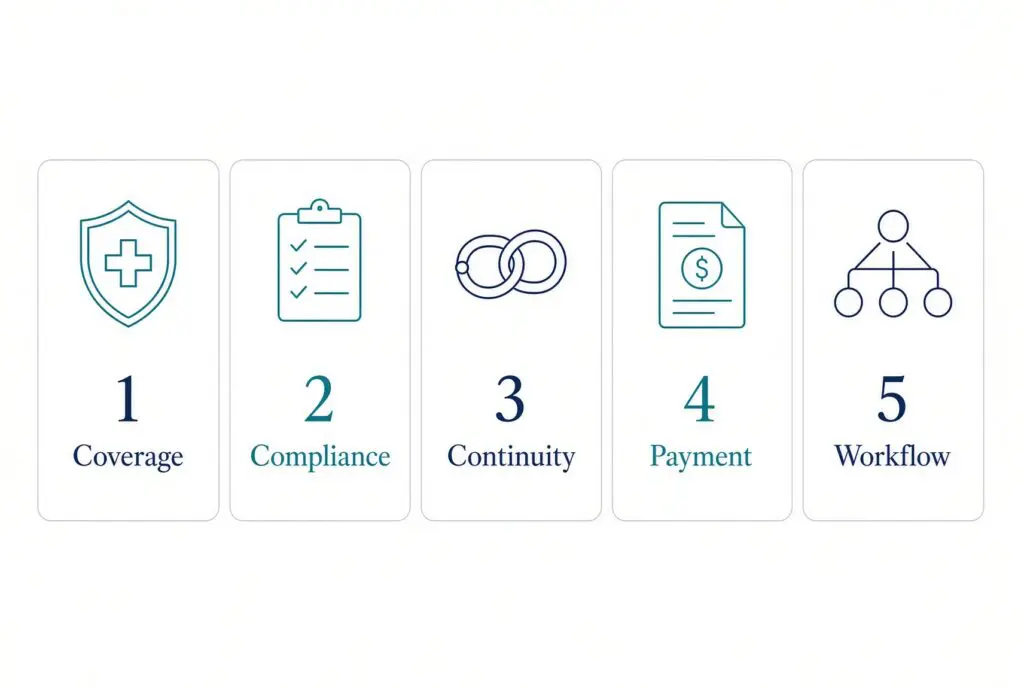
- Clinical coverage and licensure
- Compliance and documentation
- Continuity planning when a provider or platform drops
- Payment structure
- Workflow fit with existing staff
The sections that follow apply them setting by setting. Once a shortlist exists, score bids with the questions in How to Write a Telepsychiatry Staffing RFP so the contract staffs your program instead of standing up a second clinic.
Clinical coverage and staffing depth
Coverage is the first thing to pressure-test. Ask whether the vendor provides true 24/7 availability or business-hours scheduling only, how fast an on-call psychiatrist responds overnight, whether daily inpatient virtual rounding is included, and what the capacity is for urgent intake assessments when a unit is holding a patient. Ask the same questions about documentation depth — managed care buyers need psychiatrists who will write to the standard utilization review and prior authorization decisions require, including continued-stay justification and medication-assisted treatment requests.
Staffing depth is what makes those answers durable. Inpatient units, correctional healthcare programs, and substance abuse treatment teams cannot absorb a single provider’s vacation. Vendors also specialize differently: some emphasize bedside, emergent response and publish a median request-to-decision under 10 minutes in their own data, while other groups are built around scheduled consults and ongoing outpatient follow-up.
FasPsych ties staffing to fee-for-service, rounding with on-call, and block-hour arrangements — useful operational signals, not a universal fit. Either way, confirm who supervises: a remote medical director or equivalent clinical lead stabilizes coverage and provider oversight.
Compliance, credentialing, and payer fit
Start with the baseline: HIPAA-compliant technology and privacy safeguards, Medicare telehealth coverage and billing rules, Medicaid rules, Medicare telehealth waiver status, and state-by-state licensure and prescribing requirements for the states where your patients physically sit. Ask who holds credentialing responsibility — the vendor, your medical staff office, or both — and how long privileging adds to go-live. Hold other bids against the same onboarding window and the steps in FasPsych’s telepsychiatry implementation guide.
Managed care buyers should separate two different purchases. Clinical telepsychiatry staffing supplies licensed psychiatrists and nurse practitioners who perform intake assessments, remote psychiatric evaluations, and medication management, and whose notes must support medical necessity. Utilization management and prior authorization review — typically handled by payer-side utilization management organizations — is a payer-side function. A clinical staffing partner supports that process through documentation quality and turnaround, not by adjudicating it.
Verify claims in writing. Consent, guardian authorization, and record-retention rules differ sharply between a school-based program and an inpatient psychiatric unit, so request setting-specific answers rather than one blanket attestation.
Disaster recovery and continuity planning
Coverage promises mean little without a written continuity plan. Ask any prospective partner to document four things: the bench of credentialed backup clinicians licensed in your state, platform redundancy and a fallback modality when video drops, a named escalation path after hours, and how encounters, intake assessments, and follow-up appointments are recovered once service resumes. Also confirm who carries utilization review and prior authorization work during a gap — if that falls back on your staff, workload and denials both climb.
Requirements diverge by setting. Inpatient units and residential substance use programs need same-day replacement and rounding coverage; a school-based program can often absorb a rescheduled evaluation but needs a clear crisis route. Some vendors publish their own hospital metrics, including a median request-to-decision under 10 minutes and 24/7 operational support in large health-system deployments — a reasonable benchmark to hold vendors to, provided you ask how those figures are measured.
The decisive question is time-to-replacement. Ask where a mid-contract vacancy lands against that onboarding window — and whether backup psychiatrist coverage is already credentialed for your site before the gap appears.
Payment models for hospitals, schools, and SUD teams
Billing structure shapes adoption as much as clinical quality does. Four purchasing models dominate: fee for service, block hours purchased in advance, per-consult pricing, and scheduled coverage paired with on-call availability. FasPsych’s published payment options include fee for service, rounding with on-call, and block hours, with no upfront cost to join its network — terms that lower the barrier for a pilot in a budget-constrained program.
Volume volatility drives the fit. Inpatient units with predictable daily rounding often do better with block or scheduled hours; a school district with episodic crisis needs and academic-calendar gaps may prefer per-consult or on-demand evaluations; substance use treatment teams coordinating medication-assisted treatment typically need recurring, named-provider continuity rather than whoever is available. For the finance decision behind those shapes, see how to choose a behavioral health staffing payment model.
Flexible terms are not a substitute for clinical scope — check licensure coverage, child and adolescent capability, and prescribing before comparing rate cards. Managed care buyers should press further: ask how the vendor documents medical necessity, supports prior authorization, and feeds utilization management reporting for behavioral health telepsychiatry services.
Request a written coverage proposal for your setting at faspsych.com/partner-with-us or call (877) 218-4070.
Which service model fits each buyer type
Four buyer groups dominate telepsychiatry procurement, and each one needs a different coverage structure.
| Buyer | Coverage that fits | Must-ask questions |
|---|---|---|
| Hospitals / inpatient | Rounding + on-call; 24/7 depth | Daily rounding included? Overnight response time? Privileging vs. bylaws? |
| Schools / universities | On-demand evals around the academic calendar | Child/adolescent capability? Consent and FERPA workflow? Crisis route during school hours? |
| SUD / residential | Named-provider MAT continuity | Buprenorphine/naltrexone prescribing? Same clinician for follow-up? Counseling-staff coordination? |
| Managed care | Documentation that survives UR/PA | Medical-necessity notes? Continued-stay justification? Who owns prior-auth paperwork? |
Hospitals and inpatient psychiatric facilities
Hospitals and inpatient psychiatric facilities need daily rounding, urgent evaluations in the emergency department, and enough provider depth to hold coverage through census spikes and vacancies. Rounding paired with on-call is the usual fit; FasPsych lists that model alongside fee-for-service and block hours.
School and university programs

School and university programs need student-facing psychiatric evaluations, crisis assistance, medication management, and therapy access scheduled around the academic calendar — often on-demand rather than fixed clinic blocks.
Substance use treatment teams

Substance use treatment teams need intake assessments, medication-assisted treatment oversight, and coordination that holds continuity between levels of care.
Managed care organizations
Managed care organizations need something different again: utilization review support, prior authorization documentation, and notes disciplined enough to survive audit. Ask any vendor how its clinicians handle that paperwork before signing.
Setting examples: hospital, school district, SUD program
A 90-bed psychiatric hospital weighs the checklist differently than a district. Its priorities are daily rounding and admission consults, credentialing speed against its medical staff bylaws, and named backup coverage when a remote psychiatrist is out — the kind of emergency department efficiency gains hospitals look for when psychiatric holds back up. Rounding with on-call or block-hour arrangements matter when census swings; they are less relevant to a buyer purchasing a fixed monthly seat. For how coverage works across sites and referral workflows, see telepsychiatry for PCP referrals, hospitals, and multi-site care.
A school district cares about something else: same-week student evaluations, crisis assistance during the school day, and documentation that counselors and families can act on. FasPsych lists on-demand psychiatric evaluations, crisis assistance, medication management, and child and adolescent psychiatry among its school and university services. Its guide on how schools can choose a virtual mental health partner walks through clinical qualifications, technology integration, and funding models in more depth, including Medicaid and staffing models for districts.
A substance use program screens for medication-assisted treatment prescribing, intake assessments that feed the treatment plan, and follow-up continuity with the same clinician. A vendor built only for one-off emergency consults can answer speed well and still miss longitudinal care. Ask each vendor which of the three they actually staff today, and request utilization review and prior authorization support in writing. Telehealth medication management for substance use treatment covers the MAT workflow.
FAQ: HIPAA, continuity planning, and implementation timelines
What should we look for in a telepsychiatry partner? Score coverage and licensure, compliance and documentation, continuity planning, payment structure, and workflow fit with existing staff. Apply the same five criteria to every finalist, then adjust weights by setting — rounding and on-call for hospitals, consent and calendar fit for schools, named-provider MAT continuity for SUD programs, and audit-ready notes for managed care.
What HIPAA and documentation controls should we verify first? Ask for the business associate agreement, encryption and audit-log specifications, role-based access rules, and written confirmation that clinician notes flow into your electronic health record rather than a separate vendor system. Check any vendor’s claims against HHS HIPAA and telehealth guidance and HIPAA rules for telehealth technology.
What belongs in a telepsychiatry continuity plan? Named backup clinicians licensed in your state, a fallback modality when video drops, a downtime protocol for urgent intake assessments, an after-hours escalation path, and notice periods when a provider exits. Confirm who carries utilization review work during a gap so denials do not land on your staff.
How long does telepsychiatry implementation take? Implementation typically takes two to six weeks, including provider matching, credentialing, and EHR access. That window matters when a vacancy is already delaying admissions. Ask where a mid-contract replacement lands against the same timeline.
How do hospitals, schools, and SUD programs evaluate vendors differently? Hospitals score daily rounding, overnight response, and privileging against medical staff bylaws. School districts score child and adolescent capability, parental consent, and crisis coverage during the school day. SUD programs score MAT prescribing, named-clinician follow-up, and coordination with counseling staff. Managed care scores medical-necessity documentation and prior-authorization turnaround.
What payment models are used for telepsychiatry staffing? Four models dominate: fee for service, block hours purchased in advance, per-consult pricing, and rounding paired with on-call availability. Match the model to volume shape — predictable rounding lists favor blocks or rounding-with-on-call; episodic school or crisis demand often fits per-consult or fee for service.
Can a telepsychiatry partner support medication-assisted treatment and prior authorization documentation? Yes, if the partner actually staffs MAT-capable prescribers and writes notes to medical-necessity standards. Confirm buprenorphine or naltrexone prescribing against SAMHSA medications-for-OUD guidance and current buprenorphine telemedicine rules, and ask how clinicians support prior authorization rather than shifting that work to your team.
Who handles credentialing — the vendor or our medical staff office? Usually both. The vendor assembles primary-source verification; your medical staff office still privileges against bylaws. Ask how long privileging adds to go-live and whether backup clinicians are credentialed before the first vacancy.
What else should we confirm? Payer enrollment including Medicaid, state licensure coverage for every site, and how the vendor handles prior authorization and utilization review documentation. Cross-check any Medicare telehealth waiver claims against CMS’s current telehealth coverage rules, since eligible services and originating-site rules change.
Request a written coverage proposal
Score every candidate against that same operational checklist — then request a written coverage proposal from FasPsych for your specific settings. Call (877) 218-4070.