


How to choose telepsychiatry services for referrals, inpatient coverage, and multi-site systems
 Four buyer groups reach this decision from different directions. Primary care practices need somewhere to send patients when a PCP’s referral list has no local psychiatrist. Inpatient psychiatric hospitals need admission evaluations and daily rounding coverage that holds through nights and weekends. Rural clinics and critical access hospitals face the widest gap—approximately 137 million Americans (about 40% of the U.S. population) live in designated Mental Health Professional Shortage Areas. Multi-site systems need one coverage model that works across locations with different licenses, payers, and electronic health records.
The useful question is no longer whether virtual psychiatric treatment produces sound outcomes; the comparative evidence on that is settled. Systematic reviews and meta-analyses show high diagnostic concordance and comparable patient satisfaction between telepsychiatry and in-person care. The real decision is which service model matches your referral volume, staffing gap, and setting. That comes down to consult turnaround times, whether coverage survives a provider’s departure, how quickly clinicians clear credentialing and payer enrollment, and how well the handoff back to the treating team is documented.
The sections that follow cover referral and consult workflow, fit by setting, staffing models including a remote medical director, and the operational questions administrators should verify before signing.
How Referral Workflow and Collaborative Care Should Work in Telepsychiatry
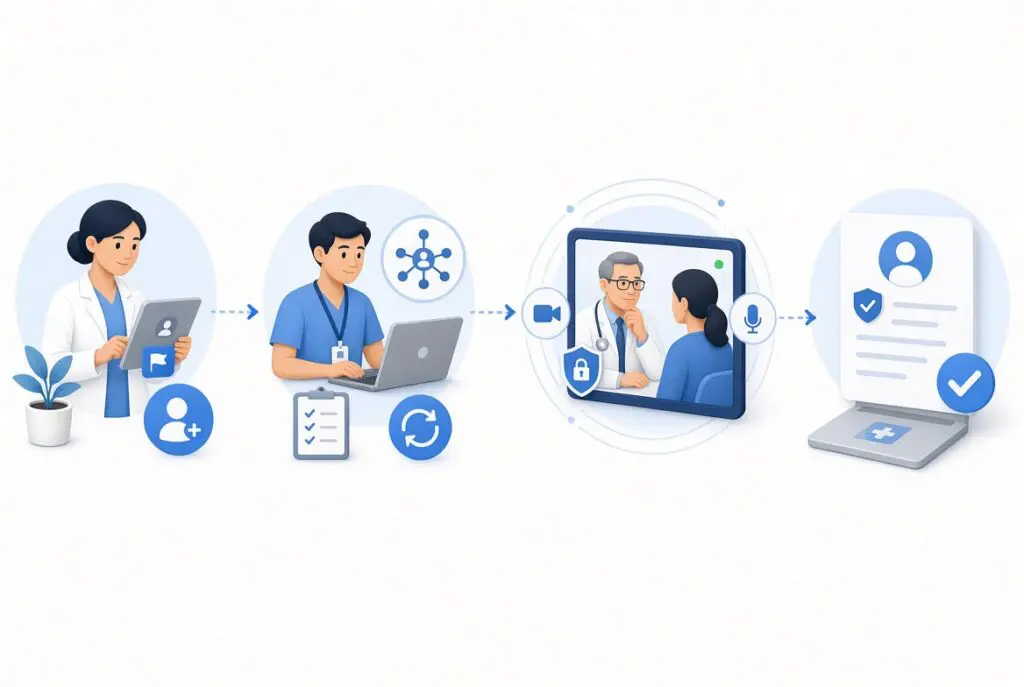
A referral should move on a defined path, not an email chain. A primary care provider flags a behavioral health concern, care coordination staff route the referral, and intake assessments establish urgency and triage the patient into the right slot—a routine evaluation, a medication management follow-up, or same-day crisis intervention.
Handoffs are where programs fail. Notes must land in the same electronic health record the PCP already reads, with a named coordinator responsible for closing the loop.
Inpatient consults run differently. Hospital teams need on-call coverage by phone or video, daily rounds, written recommendations that support disposition decisions, and participation in clinical staffings—plus court-ordered evaluation and competency restoration work in some facilities. Research consistently finds virtual and in-person evaluations comparable on diagnostic accuracy and patient satisfaction.
For a practical look at how telepsychiatry supports primary care practices, see FasPsych’s primary care integration overview.
Where Telepsychiatry Fits by Setting: Rural Hospitals, Inpatient Psychiatric Hospitals, School Districts, and Multi-Site Systems
Deployment fit varies more than most vendor pages admit.
Rural hospitals and critical access facilities usually face transfer pressure. Without a psychiatrist on site, patients hold in the emergency department or move to a distant facility. Remote psychiatric evaluations can shorten that wait and keep the case local. As noted above, a large share of the U.S. population lives in Mental Health Professional Shortage Areas, with rural counties disproportionately affected.
Inpatient psychiatric hospitals need a different build: on-call consults, daily rounds with medication management, court-ordered civil commitment evaluations, restoration to competency, treatment coordination, and clinical staffings by video. Coverage continuity—not one-off consults—is the buying question. Workforce projections continue to show substantial shortfalls in adult and child psychiatrists in the coming years. Onboarding for these arrangements typically runs two to six weeks. Learn more about inpatient models on the FasPsych inpatient psychiatric hospitals page.
School districts sit closer to the access end. Student scheduling windows are narrow, parental consent and coordination with county behavioral health partners matter, and continuity between school-year and summer coverage has to be planned. See FasPsych’s schools and universities overview for setting-specific considerations.
Multi-site systems use virtual coverage to standardize protocols and documentation across locations with uneven staffing. If the emergency department is your entry point, ask any vendor for its specific ED consult workflow and confirm current capabilities directly before signing. For deeper strategies on technology integration, quality tracking, and care continuity across locations, review FasPsych’s multi-site telepsychiatry optimization guide.
Operational Requirements That Determine Whether Coverage Holds Up
Coverage fails in the details. Before signing, define the staffing model precisely:
- 24/7 on-call and daily rounds
- Part-time augmentation of existing psychiatrists and psychiatric APRNs
- Access to a remote medical director for oversight and clinical policy
Flexible scheduling should support either around-the-clock coverage or supplementation of on-site staff, with full-time, part-time, and on-demand consultation options.
Ask what happens when something breaks. Written continuity expectations should name backup clinicians, an alternate communication path if video drops, and how consults continue through severe weather, network outages, or a provider’s unplanned absence. HHS telehealth emergency preparedness guidance provides a useful checklist for evaluating a vendor’s continuity plan.
Scheduling flexibility matters most where demand is uneven—an inpatient unit with census swings, a rural clinic needing two half-days, or a multi-site system rebalancing hours across locations.
Finally, confirm the money works. Credentialing at each facility and paneling with your payers, including Medicaid, should be scoped in the contract. Onboarding that includes credentialing and payer paneling typically runs two to six weeks with experienced partners.
What Administrators Should Verify in Reviews and Vendor Discussions
Vendor marketing rarely answers the operational questions. Use this checklist when evaluating options:
| Evaluation Area | Key Questions to Ask | Why It Matters |
|---|---|---|
| Response times | What are consult turnaround times by setting (ED, inpatient, outpatient referral)? | Affects patient flow and boarding |
| Staffing model | Dedicated psychiatrists or rotating pool? What happens when a provider leaves? | Determines coverage continuity |
| Documentation & handoffs | Who writes the note and into which record? How is the loop closed with the referring clinician? | Prevents care fragmentation |
| Onboarding timeline | How long for credentialing, privileging, and payer enrollment? | Impacts time-to-coverage |
| Continuity plan | Backup clinicians, alternate communication paths, outage procedures? | Protects against single points of failure |
| Setting experience | Evidence of running inpatient units, rural clinics, and primary care referral pipelines? | Marketing claims vs. operational proof |
| Payment structure | Hourly vs. per-encounter? Medicaid participation? Contract flexibility? | Aligns with your budget and payer mix |
Treat satisfaction and outcomes claims as setting-specific. A high satisfaction figure from outpatient therapy says nothing about emergency psychiatric consults. Confirm current capabilities, licensure coverage, and Medicaid enrollment directly with any vendor rather than relying on general marketing claims.
FAQ: Inpatient Reviews, Rural Hospital Fit, School District Use, and Payment Questions
What do inpatient telepsychiatry evaluations typically look at? Published reviews and hospital-side assessments tend to weigh four things: consult turnaround and after-hours coverage, clinical quality of remote psychiatric evaluations, patient and staff satisfaction, and implementation barriers such as cart logistics, electronic record access, and credentialing. Onboarding usually runs two to six weeks—a useful benchmark when comparing vendors. See the FasPsych inpatient page for additional context.
How should a rural hospital judge fit? Focus on transfer avoidance and continuity. The core question is whether coverage holds when local staffing is thin, not whether a platform simply exists.
What should school districts ask? Scheduling around the academic calendar, parental consent handling, and how clinicians coordinate with outside prescribers and PCPs. More details are available on the FasPsych schools and universities page.
How does payment work? Confirm payer enrollment, Medicaid participation, hourly versus per-encounter billing, and contract flexibility before signing.
Ready to evaluate coverage for your setting? Contact FasPsych to discuss telepsychiatry options matched to your referral volume, staffing gaps, and operational requirements. Most partners move from agreement to live coverage in two to six weeks, including credentialing and payer paneling.