

Key takeaways
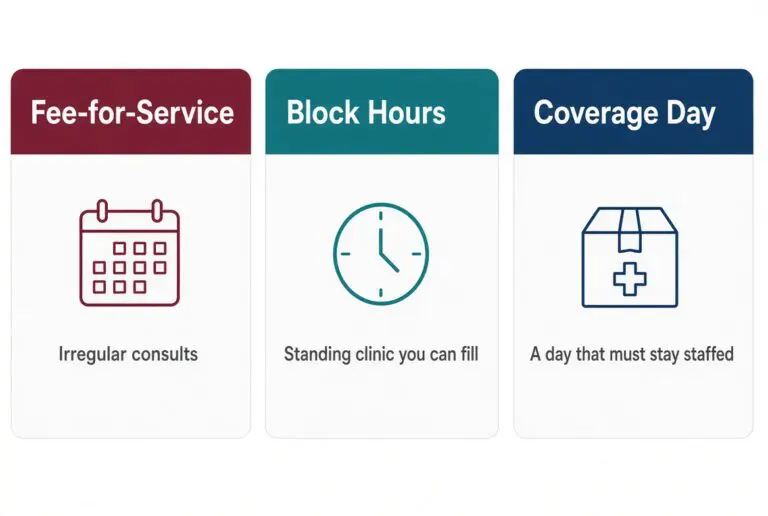
- A salaried psychiatrist FTE and a contracted coverage hour are different cost shapes. Pick the shape that matches how volume actually arrives — standing clinic, irregular consults, or a day that must stay staffed.
- Fee-for-service, block hours, rounding with on-call, and a coverage day are defined on FasPsych’s payment options page. This article only answers when each shape fits.
- Compare block hours vs fee-for-service on unused time and spike risk. Compare rounding with on-call when the week is a morning list plus afternoon availability — not a longer block and not fee-for-service with extra hours.
- The invoice is not the whole risk. Confirm whose encounter rules the visit sits on before you compare unit prices. That scoring list lives in how to write a telepsychiatry staffing RFP.
- About 60% of federally designated Mental Health Professional Shortage Areas are rural, according to HRSA’s HPSA dashboard. Uneven volume is why contract shape matters more than a single plan.
Most behavioral health organizations cannot carry a salaried psychiatrist for every site and every hour they need covered. How to choose a behavioral health staffing payment model is a finance question first: whether the next increment of coverage should be a fixed FTE or a contract whose cost follows the clinic template. When there are no psychiatrists, the empty seat is not only a recruiting line — it is months of wait, diverted volume, and a clinic that cannot keep a full-time hire occupied.
FasPsych places licensed psychiatrists and psychiatric nurse practitioners into the partner’s workflow. Current billing structures are on the payment options page. What follows is the decision rule for which structure to open first.
Why contract shape matters more than a rate

A salaried psychiatrist is predictable until census drops, a site goes dark overnight, or privileging leaves a gap. Contracted coverage fails in the opposite direction: unused block hours if the template is thin, or an uncontained line item if every consult is fee-for-service and volume spikes.
That mismatch is sharpest where volume is uneven — rural clinics, school-year programs, correctional intake, and hospital days that need a morning clinic plus afternoon availability. HRSA’s shortage-area data is the reason one model does not travel: a critical-access clinic filling eight scheduled slots a week and a hospital covering unscheduled consults should not sign the same unit of payment. The Rural Health Information Hub tracks the same rural-urban split on the provider side.
The bind is sharper where Medicaid is the payer. Technology revolutionizes behavioral health under Medicaid describes the CMHC and FQHC problem: thin reimbursement, recruitment difficulty, and no-show risk that makes a salaried psychiatrist hard to carry. Coverage purchased on an hourly or appointment contract follows completed work instead of an empty FTE.
Reimbursement language is a second mismatch, not a reason to treat every telehealth contract as temporary. HHS telehealth policy is the current federal source: Medicare patients can permanently receive behavioral and mental health telehealth in the home, with no geographic restriction on the originating site. The in-person-visit waiver for Medicare behavioral telehealth runs through December 31, 2027. What still moves after that date is the billing pathway — whose NPI, which encounter rules — which is why unit price is the wrong first comparison. Score that on the RFP checklist, then pick a contract shape.
Hours can still move when volume moves; that operating model is covered in scalable telepsychiatry staffing. This page stops at the finance choice.
When each contract shape fits
Do not treat the rows below as a catalog. Definitions, typical settings, and current options are on payment options for partner organizations.
| Volume shape | Start with | Don’t use it when |
|---|---|---|
| Irregular consults; you cannot forecast next month | Fee-for-service / pay per consult | Volume is about to spike and every visit as a new line item will blow the month |
| A standing clinic you can actually fill (FQHC, CMHC, outpatient template) | Block hours | No-shows or a thin schedule will leave purchased hours unused |
| A morning block of scheduled patients plus the rest of the day must stay covered | Rounding with on-call | You only needed completed visits and will resent paying for availability |
| A day that has to be staffed — surge, go-live, vacant FTE | Per-diem / coverage day | You have not defined what the day includes (scheduled only vs. on-call vs. documentation after the last patient) |
After you pick a row, read the matching option on the payment options page. Partner-level terms — when billing starts and what is excluded from the invoice — are on Why Partner with FasPsych.
Compare block hours vs. fee-for-service
These two shapes get compared most often. They are not interchangeable units of the same product. Block hours buy a reserved template. Fee-for-service buys completed visits. Definitions stay on the payment options page; the decision is which risk you would rather carry.
| Fee-for-service | Block hours | |
|---|---|---|
| What you are buying | Completed consults | Reserved hours on a standing template |
| Monthly number | Moves with volume | Known in advance if the block is fixed |
| Unused-time risk | Low — you do not pay for empty slots | High — purchased hours that go unused still hit the invoice unless they roll or convert |
| Spike risk | High — a busy month is a stack of new line items | Low — extra visits inside the block do not each add a fee |
| Cash-flow fit | Irregular consults, new sites, unproven demand | FQHC, CMHC, or outpatient clinic that can fill the same hours each week |
| When it wins | You cannot forecast next month, or no-shows would leave a block half empty | The schedule is already full enough that unused hours would be rare |
| When it fails | Volume jumps and finance cannot absorb an open-ended line | The template is thin, seasonal, or still being built |
Start on fee-for-service when demand is a guess. After 60 to 90 days of measured visits, switch to block hours if the same slots fill week after week and you want a known monthly cost. Stay on fee-for-service if those weeks stay lumpy. That is the same logic as buying coverage on an hourly or appointment contract instead of carrying the no-show risk on a salaried seat, which Technology Revolutionizes Behavioral Health Under Medicaid flags for CMHCs and FQHCs.
Do not pick block hours because the monthly number looks cleaner on a board slide. If unused hours expire, fee-for-service is the cheaper “predictable” option. Ask whether unused block hours roll, expire, or convert before you compare a per-visit rate to a per-hour block.
Compare rounding with on-call
Rounding with on-call is not a cheaper block and not fee-for-service with a longer day. You buy a morning list plus availability for the rest of the day. Use it when the week is a scheduled census that still produces interruptions after lunch. Do not use it when you only intend to pay for completed visits. The live definition is on payment options.
| Rounding with on-call | Block hours | Fee-for-service | |
|---|---|---|---|
| What you are buying | A morning list plus remaining-day availability | Reserved hours you can fill | Completed consults |
| Fits the week when | There is a real rounding list and the floor still needs a psychiatrist after it | The afternoon is empty and you can release the hours | There is no morning list to round |
| Unused-time risk | You pay for on-call you may not use | You pay for reserved hours that sit empty | Low — empty slots are not billed |
| Interruption risk | Built in — that is the point of the afternoon | Low if the template is protected clinic time | Each interruption is a new consult |
| When it wins | Inpatient, residential, or hospital days with a list and later calls | Outpatient template with few interruptions | Irregular consults and no standing list |
| When it fails | You only wanted completed visits and will resent paying for standby | You needed afternoon coverage and the block ends when the last slot does | A predictable morning list is already on the books every day |
Choose rounding with on-call only if both halves of the day are real. If the afternoon is quiet most weeks, a block that ends after the last scheduled patient is cheaper. If there is no morning list, fee-for-service is the cleaner unit.
Do not use rounding with on-call as a substitute for nights and weekends. That is a different product: after-hours telepsychiatry. A coverage day is the other outlier — use it when a vacant FTE or a go-live has to stay staffed and you have defined what the day includes.

What finance should confirm before comparing unit prices
- Census, not preference. Can this site fill a standing template, or does demand arrive as unscheduled consults? Is there a morning list that still needs afternoon coverage?
- Unused hours. If you buy a block, do unused hours roll, expire, or convert? If they expire, fee-for-service is cheaper than a “predictable” block you cannot fill. If you buy rounding with on-call, ask how unused afternoon availability is billed.
- What sits inside the unit. Visit, hour, and day are not interchangeable. Confirm whether training time, no-shows, and after-hours calls are inside the unit you are pricing.
- Guaranteed vs. best-effort. Primary coverage, overflow, and nights/weekends are different products.
- Whose encounter it is. Unit price is meaningless if the visit lands on the vendor’s books when the health center needed it. Use the RFP scoring list.
Conclusion
Compare block hours vs fee-for-service against how volume actually arrives. Add rounding with on-call only when the week is a morning list plus afternoon availability. Then read the live option on payment options. To scope coverage against your sites and hours, partner with FasPsych.
Frequently asked questions
When does a salaried psychiatrist FTE fail the math?
When the site cannot keep that person occupied — overnight and weekend gaps, rural panels too small for a full-time hire, or a six-week credentialing hole. The real cost of mental health workforce gaps is that empty seat, not only the salary line. Contracted coverage is for those hours, not a substitute for a present emergency physician.
When should we choose block hours vs. fee-for-service?
Block hours when you can fill a standing clinic and want a known monthly cost. Fee-for-service when volume is irregular and you only want to pay for completed consults. If purchased hours will sit unused, fee-for-service is the cheaper predictable option. After 60 to 90 days of measured demand, switch only if the same slots keep filling. Definitions live on payment options.
When should we choose rounding with on-call?
When there is a real morning list and the rest of the day still needs a psychiatrist. If you only wanted completed visits, use fee-for-service. If the afternoon is empty, use block hours and release the unused time. Nights and weekends are not the afternoon half of this model.
How does contract shape absorb a vacant FTE or a census swing?
A coverage day or a short block can hold a vacant seat without opening a requisition. Fee-for-service can absorb a temporary spike without a new FTE. Neither replaces the need to decide whose encounter rules the visit sits on — that is the staffing RFP.