


A psychiatrist once told Norm Macdonald that he gambled in order to escape the reality of life. Macdonald told him that’s why everyone does everything.
He was not entirely wrong. A lot of human behavior is an exit — work, overtime, the sportsbook, the phone, the extra shift on the unit. Intake that treats every exit as an addiction will pathologize coping. Intake that treats every “I just like sports” as recreation will miss gambling disorder, gaming that has already taken the rent, and the alcohol that is holding the schedule together. The line is useful because it is already a differential. Escape is not the diagnosis. What the escape has done to sleep, money, work, and the next 24 hours is.
This article is for hospitals, emergency departments, FQHCs and CMHCs, employee assistance programs, jails, residential programs, and primary-care clinics that run first-contact behavioral health intakes. Facility teams already have playbooks for telehealth medication management, co-occurring disorders staffing, and two-step mental health screening. This page stays on one first-contact split: can intake separate ordinary avoidance from a behavioral addiction well enough to choose the right screen, the right first appointment, and the right same-day psychiatry trigger?
It is not a treatment guide for gambling disorder — that work lives on FasPsych’s gambling addiction treatment page. It is not a sports-betting-as-investing essay — that is When Betting Feels Like a Retirement Plan. It is the intake companion to Mean Reds vs. Blues: another collapsed patient sentence that has to become a disposition before anyone leaves the desk.
FasPsych staffs licensed psychiatrists and psychiatric nurse practitioners into your program on secure, real-time video. We do not treat individual consumers. The useful question is which of those clinicians the screen should call, and how soon.
Key Takeaways
- “I do it to unwind” is a patient sentence, not a diagnosis. Intake has to decide whether the behavior is recreation, high-functioning avoidance, a behavioral addiction, or substance use — and whether more than one is present.
- Gambling disorder sits in DSM-5-TR with substance-related and addictive disorders: four or more of nine criteria in 12 months, not better explained by a manic episode. ICD-11 also names gaming disorder. Work, scrolling, and “I just need the noise” are not automatic diagnoses. Impairment and loss of control are.
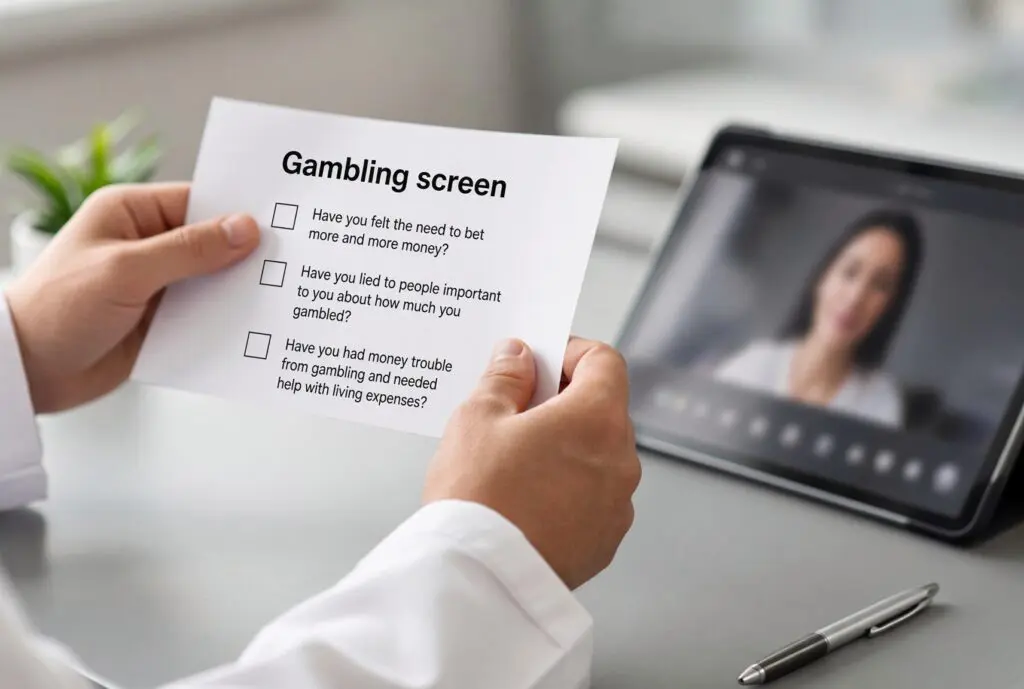
- Brief screens exist. The Lie/Bet Questionnaire is two items. The Brief Biosocial Gambling Screen (BBGS) is three. Neither replaces a psychiatrist. Both beat a 26-item stack that never asks about betting.
- “He’s still working” is not a negative screen — in patients or in staff. High-functioning avoidance and high-functioning addiction look the same from the time clock.
- Same-day psychiatry is indicated when money, housing, or a job is already breaking, when the patient cannot stop for 24 hours, when mania cannot be ruled out, or when suicide risk is on the form.
- Telepsychiatry can complete that first psychiatric pass the same day. A screen without a clinician who can act on it is how dual-diagnosis quality measures fail.
What the joke names — and what it does not
Macdonald’s psychiatrist offered a formulation that is still taught: the bet is an escape from life. Macdonald’s reply is also still true. Work, comedy, exercise, religion, and a fourteen-hour shift on the unit can be escapes. If escape were enough for a diagnosis, half the building would meet criteria before lunch.
Leave him there. The rest of the visit is operational.
Escape-when-distressed is one DSM-5-TR criterion for gambling disorder — “often gambles when feeling distressed (e.g., helpless, guilty, anxious, depressed).” It is not the whole disorder. Treating it as the whole disorder is how high-functioning avoidance gets a treatment plan it does not need, and how a collapsing sports-book habit gets filed as “self-care.”
Intake staff hear the collapsed version every shift: “I gamble a little when I’m stressed.” “I work so I don’t have to think.” “I’m not an addict, I just don’t like being home.” Those sentences mix four different presentations.
Four presentations intake collapses into one
Recreation. Money the person can afford to lose. A planned stop. Sleep and work intact. No lying. No borrowing. No using the behavior to treat a mood. Document it and move on.
High-functioning avoidance. The behavior is doing psychological work — numbing, postponing, filling the hour so a thought does not arrive. Function is still mostly intact. The cost is time, irritability, and a life that only works when the activity is available. This is not automatically gambling disorder. It is also not “fine.” It is a mood, anxiety, trauma, or occupational question that still needs a screen for the thing they are using as the exit. Pair it with the anxiety-versus-depression split when the complaint is mixed.
Behavioral addiction. Persistent betting, gaming, crypto-trading, loot boxes, claw machines, live-stream pack openings, or similar reward-loop activity with loss of control, tolerance, withdrawal-when-stopped, chasing, concealment, and harm to money, role, or relationships. DSM-5-TR names gambling disorder. Gaming and compulsive crypto trading can present the same way even when they lack the same billing code. Rule out a manic episode before you stop.
Substance use sitting next to it. Alcohol, cannabis, stimulants, opioids — including the drink that starts when the game starts. Dual diagnosis is common. SAMHSA TIP 42 treats co-occurring mental and substance use disorders as the rule, not the exception. If substance use is in the room, finish that history and send the chart down the co-occurring intake path. Do not let the sportsbook story hide the bottle.
| Recreation | High-functioning avoidance | Behavioral addiction | Substance use sitting next to it | |
|---|---|---|---|---|
| Stop rule | Planned, kept | Can stop; pays for it later in mood | Cannot stop for a day without irritability or a chase | Withdrawal, tolerance, using to bet or to come down |
| Money | Disposable | Time more than money | Rent, credit, payday loans, “borrowing” from family | Same, plus the substance budget |
| Concealment | None needed | Minimizes time | Lies about amounts; second phone; hidden apps | Lies about both |
| Screen | None required | PHQ-9, GAD-7, occupational questions | Lie/Bet or BBGS → full DSM criteria if positive | AUDIT / substance items and the gambling screen |
| First move | Document and close | Treat the thing being avoided | Gambling history, mania rule-out, money/safety | Co-occurring intake, not two referrals |
A table is a routing map, not a diagnosis. The psychiatrist still has to see the person.
Why the two get collapsed — and why that costs the facility
Staff hear “escape” and pick a camp. One camp moralizes. The other camp shrugs. Both miss the middle.
Sports betting is legal in most states and sold as fandom. Crypto is sold as investing — the pattern FasPsych already mapped when betting starts to feel like a retirement plan. Overtime is sold as loyalty. The patient already has a story that makes the behavior look like a plan. Primary-care and FQHC intakes that never ask a gambling question will file the case under anxiety or “stress” and book therapy in three weeks while the next paycheck is already on a parlay.
The other error is the opposite: treating every nurse who works a second job, every student who games after class, and every veteran who watches football as a case. That is how people stop telling the truth at the door.
Comorbidity is the third reason staff stop hearing two objects. People with gambling disorder often also drink, sit in a major depression, or ride a bipolar mixed state. The National Council on Problem Gambling and SAMHSA treat co-occurring conditions as expected, not rare. Criterion B exists because a manic spending-and-betting binge is not the same illness as a twelve-month gambling disorder. If intake cannot tell those apart, that is a same-day psychiatry question, not a coping-skills handout.
The cost to the facility is the same cost as collapsing anxiety and depression into one sentence: the wrong first appointment, a quality measure that looks complete, and a return visit that is worse.
What to collect at intake before anyone names a disorder
The first visit does not need a 45-minute stacked battery. It needs a chart a covering psychiatrist can use the same afternoon. Keep the existing two-step mental health screen and the bundled substance-use gate. Add a two- or three-item gambling gate. Do not replace AUDIT. Gambling and alcohol travel together often enough that one screen without the other is how the cluster gets missed.
Ask one opening question that does not sound like a trap: “In the last year, have you bet money on sports, cards, machines, or apps — or spent time you couldn’t spare on games or trading?”
If yes, run Lie/Bet (Johnson et al., 1997):
- Have you ever felt the need to bet more and more money?
- Have you ever had to lie to people important to you about how much you gambled?
One yes is a positive screen, not a diagnosis.
Or run the Brief Biosocial Gambling Screen (Gebauer, LaBrie & Shaffer, 2010; instrument page at the International Center for Responsible Gaming):
- Have you become restless, irritable, or anxious when trying to stop or cut down on gambling?
- Have you tried to keep your family or friends from knowing how much you gambled?
- Have you had such financial trouble as a result of gambling that you had to get help with living expenses from family, friends, or welfare?
One yes is a positive. In the original NESARC-based validation, BBGS sensitivity was 0.96 and specificity 0.99 for current gambling disorder among gamblers. A 2019 meta-analysis of brief gambling screens (Dowling et al.) found two- and three-item instruments adequate to detect problem gambling in health and treatment settings — which is the point of putting Lie/Bet or BBGS on a packed intake instead of waiting for a gambling clinic.
Then four facts the psychiatrist will actually use:
- Frequency, dollars, and channel — sports book, casino, cards, lottery, loot boxes, claw machines, live-stream breaks. “I gamble” is not a history.
- Control — failed cut-downs, chasing, lying, bailouts. What happens if they do not do it for 24 hours.
- Function — job, housing, custody, criminal exposure, who is covering the shortfall.
- The other syndrome — PHQ-9 including item 9, GAD-7, a mania screen, last drink, last opioid, last stimulant.
If the patient is a staff member or a high-visibility professional, the same four facts apply. “He’s still producing” is not a negative screen. That sentence already failed alcohol. It fails gambling the same way. Route staff through the EAP pathway so the first visit is not a public scene.

When this presentation needs psychiatry the same day
Avoidance with a negative item 9 and a stable house can wait for a scheduled visit. Book same-day psychiatry — on site or by video with staff in the room — when any of the following are true:
- PHQ-9 item 9 is positive, or the patient cannot say they are safe tonight. Use 988 if they are not in a staffed room.
- They cannot go 24 hours without betting, gaming, or using, and they are already in your building.
- A job, a lease, or a relationship is breaking this week because of money already gone.
- Intake cannot tell a gambling binge from a manic or mixed state, or from stimulant intoxication.
- They are on the unit or in the ED after a loss and want to leave to “fix it.”
- Staff or an EAP referral is the identified patient and cannot be sent back to the floor on “he’s still producing.”
A positive Lie/Bet alone is not a hold. It is a scheduled psychiatric slot in the same week, with the substance and mood screens already in the chart. A waitlist is not a plan.
Telepsychiatry when the complaint is “I just unwind”
Video intake is a good fit for this differential. The psychiatrist can take the gambling history, score the mood and substance screens, watch whether the story is pressured or avoidant, and decide whether this is coping, addiction, mania, or all three. It is a poor fit only when the room is not private — a partner who covers the losses should not be in earshot for the lying-and-bailout questions — or when the patient is too agitated to stay on camera.
Before the visit:
- Confirm location, emergency number, and who else can hear the call.
- Have PHQ-9, GAD-7, and Lie/Bet or BBGS already done, or complete them live.
- Put a nurse or case manager in the room if disposition may be a hold, a medical workup, a same-day medication start, or a call about whether the person can go home to a sportsbook app.
- Send the referring clinician’s problem list, current medications, and any known substance or gambling history with the first message. Coordination with primary care follows the same cadence already written for addiction care shared with a PCP.
After the visit the note should say one of four things, not “anxious and avoidant”:
- Recreation — document and close.
- Avoidance plus a mood or anxiety syndrome — treat the syndrome, scheduled follow-up.
- Behavioral addiction, with or without substance use — evaluation complete enough to start treatment, mania ruled out or named. Hand off treatment planning to the gambling-treatment and MAT playbooks; do not rebuild them here.
- Cannot tell yet — same-day or next-day return, not a six-week callback.
There is no FDA-approved medication labeled for gambling disorder. Naltrexone and other agents are used off-label in some programs; the evidence is adjunctive. Treat co-occurring depression, bipolar disorder, and SUD as if they were the reason the person is in your building — because they often are.
How FasPsych supports organizations running these intakes
FasPsych staffs licensed psychiatrists and psychiatric nurse practitioners into the program the patient already uses — hospital, FQHC, CMHC, jail, residential unit — on interactive, real-time video. The visit is not a second clinic door. It is coverage for the intake you already run.
For this differential that means:
- A prescriber who can finish the first psychiatric pass the day the Lie/Bet or BBGS fires.
- Dual-diagnosis capacity so gambling, alcohol, and depression are not three separate referral queues — see co-occurring disorders telepsychiatry.
- Coordination language with primary care so the escape behavior and the buprenorphine dose are in the same chart.
- Backup coverage when the named clinician is out, so a positive screen does not wait for the next posted clinic.
Keep psychiatry inside the program the patient already uses. Do not open a second door labeled “addiction” that the Monday schedule cannot staff. Employee and EAP pathways use the same clinical standard as the waiting room.
Call (877) 218-4070 or start at Partner With Us.
Related FasPsych reading
- Mean Reds vs. Blues: Anxiety vs. Depression at Intake — the other first-contact split this page is modeled on.
- Two-Step Mental Health Screening Workflow — where a positive gate goes next.
- Bundled Mental Health and Substance Use Screening — why alcohol cannot sit behind the mood form.
- Co-Occurring Disorders Telepsychiatry for Program Leaders — staffing and compliance after the screen fires.
- How Online Psychiatrists Coordinate Addiction Care With Primary Physicians — the shared-care message after this visit.
- When Betting Feels Like a Retirement Plan — the Gen Z sports-betting-as-investing presentation.
- Gambling Addiction Treatment: Symptoms and Recovery Options — what happens after this page names the disorder.
- Bitcoin Addiction: Mental Health Risks of Crypto — the trading-as-gambling variant.
Frequently Asked Questions
Is “that’s why everyone does everything” a diagnosis?
No. It is Norm Macdonald’s reply to a psychiatrist who reduced gambling to escape. At intake, treat it as a stem: is this recreation, avoidance, a behavioral addiction, or substance use. The chart diagnosis, if one is reached, will be gambling disorder, an SUD, a mood or anxiety disorder, or more than one — not a joke.
Does everyone who bets have gambling disorder?
No. Recreational betting exists. Four or more DSM-5-TR criteria in twelve months, not better explained by mania, is the line. A positive Lie/Bet or BBGS earns a longer look. It is not the diagnosis.
Why not just ask “do you gamble?”
Because people who meet criteria often say no, then yes to lying or bailouts. Lie/Bet and BBGS are built for that.
Do we need a full PGSI on every adult?
No. Lie/Bet or BBGS at the door. A longer instrument after a positive, or when money harm is already obvious. Stacking PGSI on top of PHQ-9, GAD-7, and AUDIT for every arrival is how the gambling question never gets asked. That is the same argument as the bundled-versus-stacked screening page.
Is there a MAT for gambling?
No FDA-approved medication is labeled for gambling disorder. Naltrexone and other agents are used off-label in some programs. Treat co-occurring depression, bipolar disorder, and SUD on the MAT and gambling-treatment pages. This page does not rebuild those protocols.
Can telepsychiatry diagnose gambling disorder?
A licensed psychiatrist or psychiatric nurse practitioner can evaluate it by video when the room is private and on-site staff can carry out the plan. Diagnosis is not the same as a two-item screen.
What about staff who “just work all the time”?
Treat that as high-functioning avoidance until the facts say otherwise. If the overtime, the sportsbook, or the after-shift drinks have produced role damage, failed cut-downs, or a safety issue, it leaves the coping column. Use the EAP pathway.
Does this replace the co-occurring-disorders program page or the gambling-treatment page?
No. Those pages are staffing, treatment options, and a single intake that can treat substance use and psychiatry together. This page is why the first five minutes cannot treat every escape as the same object.
If you or someone with you is in crisis or having thoughts of suicide, call or text 988. For gambling-specific support, call 1-800-GAMBLER (1-800-426-2537).