
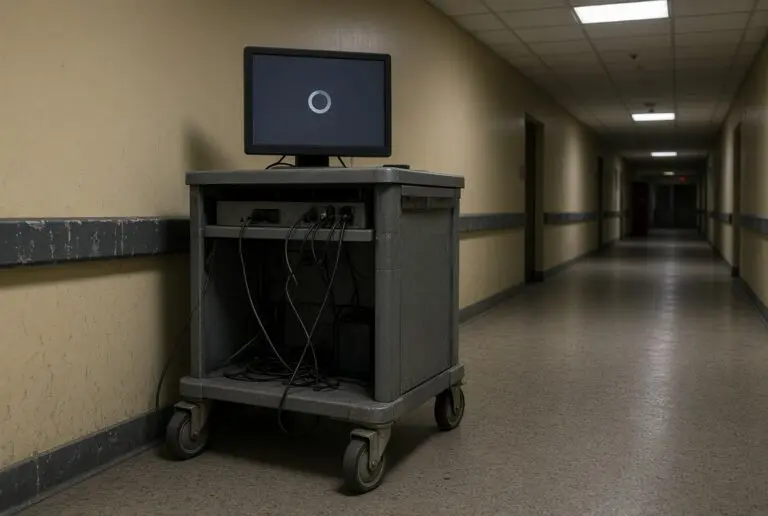

The video visit stays thin after you swap the clinician. Inspect the cart, the room, the brief, the template, and the after-call owner — not another résumé.
Gilles Deleuze and Félix Guattari would not start with the name on the schedule. They would start with the machine the name gets dropped into. Their word for that machine was assemblage (French: agencement) — not a pile of objects, and not a team on an org chart, but a temporary arrangement of unlike parts that produces an effect. They developed the idea in A Thousand Plateaus. For a compact map of Deleuze’s concepts, including the later collaborative work, see the Stanford Encyclopedia of Philosophy entry. For a readable overview of the collaboration itself, see Edward Thornton’s essay in Aeon.
A psychiatric unit is that kind of machine. The night-shift culture, the video cart that takes four minutes to boot, the charge nurse who has already decided the patient is “behavioral,” the note template that only has checkboxes for yesterday’s problem, the officer in the doorway, the room that echoes, the family member on speaker who was never briefed — those pieces keep producing a visit even when the psychiatrist changes. Swap the MD and the machine often does not notice.
This article is not about picking the right specialty. That work lives in Matching the Psychiatrist to the Unit Before the First Video Visit. It is also not about rebuilding the week after a resignation. That work lives in After the Break. If the named psychiatrist cannot work this morning, that is backup psychiatrist coverage by video. This page is a fourth problem: the psychiatrist on the schedule is already the right person, the hours exist, and the video visit is still the visit you had last month.
FasPsych staffs licensed psychiatrists and psychiatric nurse practitioners into your program on secure, real-time video. The useful question on a failing unit is not “do we have a psychiatrist.” It is which parts of the visit the new clinician cannot change from the other side of the screen. If that is already the problem on your floor, call (877) 218-4070 or start at Partner With Us.
Why the video visit does not change when the psychiatrist does
A video encounter looks like two people talking. On a unit it is closer to eight or nine parts trying to occupy the same twenty minutes. That is not a metaphor borrowed from philosophy. It is the same operational fact the APA–ATA best practices on synchronous videoconferencing treat when they say both locations shall be treated as an examination room: privacy, lighting, camera height, who else is present, and what the lens can actually show. The APA telepsychiatry toolkit and the APA position statement on telemedicine in psychiatry hold that visit to the same standard of care as an in-person exam. APA policy on telepsychiatry is the same rule in shorter form. A new résumé does not create that room.
Name the parts before you name the next replacement:
- The room. Lighting, noise, door traffic, whether the patient can sit without being watched through a window by half the hallway.
- The cart or laptop. Boot time, camera height, speaker volume, whether it lives on the unit or gets wheeled from another floor.
- Who stays in the room. Nurse, sitter, custody officer, family, a student, nobody. Each one changes what the patient will say and what the psychiatrist can claim to have observed.
- The two-minute brief. Who tells the covering clinician why this patient is on the list today — not the whole chart, the reason for this encounter.
- The template. A note built for an annual clinic visit will flatten an inpatient risk exam. A jail template will flatten a med-surg consult.
- The after-the-call owner. Who puts the order in, who watches the patient until it starts, who calls if the video drops, who tells the family what was decided.
- The house rules the screen cannot see. Restraint protocol, hold paperwork, formulary quirks, which meds require a second signature, what happens at change of shift.
Change only the psychiatrist and those seven parts keep doing what they already know how to do. That is why a credentialed, well-matched clinician still produces a thin note, a missed risk item, or a nurse who says the new person “doesn’t get nights.”
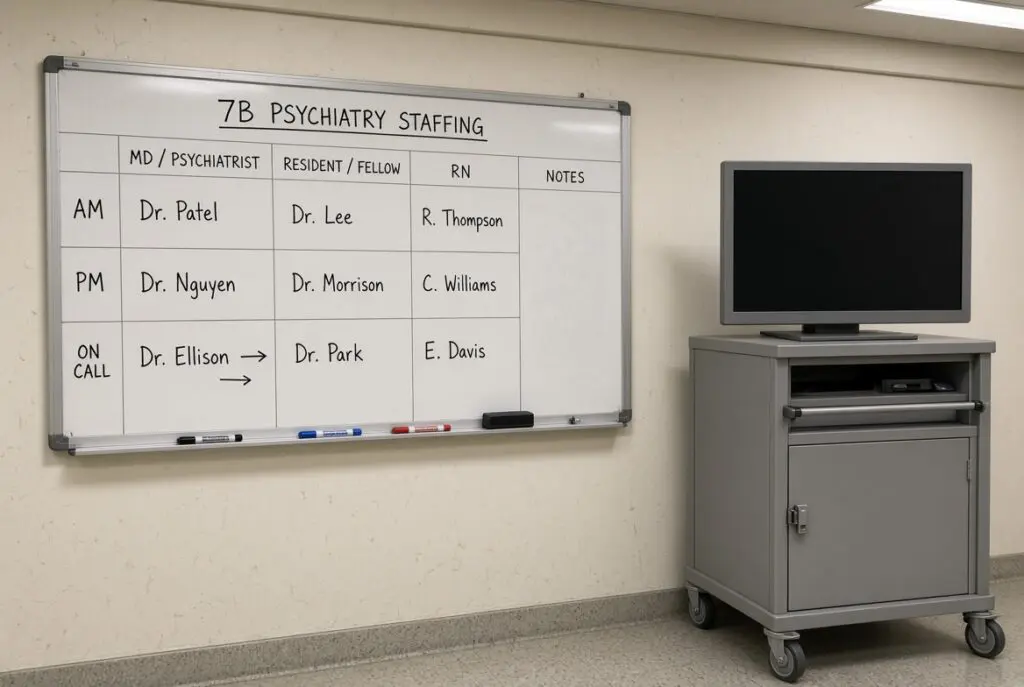
What failure looks like when the psychiatrist on the schedule is fine
The complaints that reach an administrator rarely say “our machine is wrong.” They say the new psychiatrist is slow, cold, or “doesn’t get this place.” Look at the visit before you look at the person.
The cart arrives after the decision has already been made
Night staff called because the patient was escalating. By the time the laptop is found, plugged in, and logged into the correct meeting, the nurse has already chosen a plan: an as-needed med, a quiet room, a security walk. The psychiatrist then interviews a settled patient and writes a note that does not match the reason for the call. The machine taught the unit that video is a delayed rubber stamp. In an emergency department that delay is the boarding clock — see what telepsychiatry can change in the first four hours.
Someone is in the room who was never named
A custody officer stands in the frame. A parent answers for a teenager. A sitter coaches the patient with looks. A charge nurse remains “just in case” and the patient stops talking about the actual threat. None of that is a specialty mismatch. It is an unnamed participant in the interview. The note then records a mental status exam that was performed in front of an audience. Language access is a separate, named workflow — see interpreter-mediated psychiatric evaluation — not a job for whoever happens to speak some Spanish.
The brief is the last three notes, forwarded
Forwarding the chart is not a brief. A brief is one spoken or written paragraph: why this patient is on the list now, what the unit needs decided in this encounter, what already failed, and who will carry the plan when the window closes. Without that, a competent psychiatrist spends the first ten minutes reconstructing last night while the unit waits for an order.
The template wins the interview
If the only boxes that save are PHQ-9, ROS, and “medication list reviewed,” the visit will fill those boxes. Copy-forward is a clinical decision the software already made. Risk language, collateral, and the thing the nurse actually called about will live in a free-text field that nobody reads at 2 a.m. The grid is not the enemy of care. An unmatched grid is.
The order has no owner on the floor
The psychiatrist recommends a start, a hold, a level of observation, or a next-day follow-up. Then the window closes. If the unit has not named who enters the order, who watches until it starts, and who tells the oncoming shift, the recommendation dies in the transcript. Staff will report that telepsychiatry “doesn’t follow through.” The follow-through was never staffed.
This is not matching, not a rebuild, and not backup coverage
If the clinician is an adult psychiatrist covering a child unit, or a clinic prescriber dropped into an ED hold, fix the match first. That page is Matching the Psychiatrist to the Unit. Matching asks who belongs in the chair.
If last month’s week no longer exists — resignation, contract end, census change — rebuild the week. That page is After the Break.
If the named psychiatrist cannot work this morning and the panel still has to be seen, that is backup psychiatrist coverage by video.
Use this page when those three jobs are already done, or will be done on their own pages, and the visit is still thin. The test is simple: would this encounter still fail if the previous psychiatrist were still here? If yes, the product you have not staffed is the visit itself.
How the same thin visit shows up by setting
The parts do not travel as a kit. They rearrange. FasPsych works with hospitals, clinics, FQHCs, CMHCs, residential programs, schools, and correctional facilities — and each building produces the visit differently.
Emergency department
The room is a hallway, a locked interview closet, or a chair next to a sitter. Boarding time is already running. The brief has to name the decision the ED actually needs: discharge, hold, medical clearance still open, or “psych has not seen them yet.” A psychiatrist who cannot get hands in the frame, cannot hear over the bay, and cannot find the nurse after the call will not change the first four hours. The cart has to live where the psychiatric patients wait. See ER psychiatrist support and psychiatric boarding hours.
Inpatient psychiatry
The machine includes the milieu. Who walks the patient to the room, whether the door stays cracked, whether peers can see the screen, and whether the treatment team expects the video psychiatrist at rounds are not courtesy questions. They decide if the visit is treatment or a drive-by. A covering prescriber who never hears the night report will keep writing the day-shift version of the patient. Adult psychiatry services still have to sit inside that milieu, not beside it.
Med-surg and consult-liaison
The floor already has a plan. Telepsychiatry arrives as a guest: primary team, sitters, family in the chair, a patient on oxygen, a nurse who can give you four minutes. If the brief is “psych consult” with no question, the note will be a recitation of the chart. Name the question before the camera goes on: capacity, agitation, withdrawal, disposition, or restart of home meds.
Correctional
Movement, count, and the officer in the room are not interruptions. They are parts of the visit. A psychiatrist who cannot see the patient’s hands, cannot hear over the housing unit, and cannot write into the jail record is not conducting an exam. The brief has to include housing status, recent use of force, and whether the patient can actually be moved at that hour. Standardized documentation is part of that machine — see mental status exams in correctional telepsychiatry and on-demand psychiatry for correctional units. The APA resource document on telepsychiatry for adults in jails and prisons treats confidentiality and who is in earshot as part of the exam, not a courtesy. Facility context lives on correctional and juvenile facilities.
FQHC, CMHC, and outpatient
The machine is quieter and easier to miss. Front desk, MA, the room that doubles as storage, the template built for primary care, the no-show that was never briefed as a no-show. A new psychiatrist inherits a panel and a room that still points the camera at a forehead. Outpatient failure looks polite: short notes, rising no-shows, nurses who stop warm-handing anyone to video. Clinic staffing does not replace that walkthrough.
Residential, SUD, and SNF
Staff who live with the patient already know the answer they want from the visit. If they stay in the room unbriefed, the interview becomes a confirmation of the house plan. If they leave and nobody owns the order, the house plan continues anyway. Either way the psychiatrist is decoration. Dual-diagnosis programs have a related intake problem; that work is on co-occurring disorders telepsychiatry for program leaders.
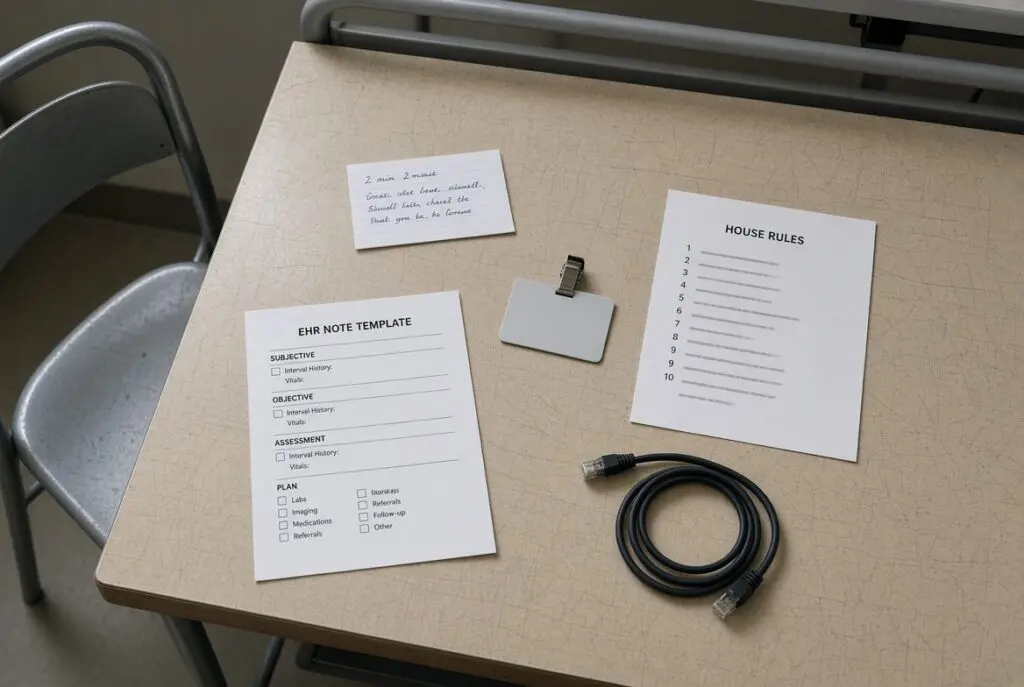
Inspect the video visit before you blame the new psychiatrist
Do this on the actual floor, at the actual hour the coverage will run. A demo in a conference room will certify a visit that does not exist at 11 p.m. Matching already asked whether this clinician belongs on this unit. The implementation guide already asked whether the vendor rollout has a sequence. This list assumes both answers are yes. The 2024 APA–ATA resource document on synchronous videoconferencing is explicit that camera elevation should sit near eye level, that both parties should be visible and heard, and that the physical space is part of the exam — not an IT afterthought.
- Stand in the room that will be used. Sit where the patient sits. Check light on the face, noise, door traffic, and whether the camera sees hands. If the only available room is a hallway, write that down as a limit of the exam, not as a later complaint about the psychiatrist.
- Time the cart. From “we need psych” to “the clinician can see and hear the patient” should be a measured number, not a hope. If it is twelve minutes, the unit will make decisions without psychiatry and then call video to bless them.
- Write who is allowed in the frame. Default is: patient, one designated staff member who can act after the call, and anyone the patient and the house rules require (interpreter, guardian, custody). Everyone else is a clinical decision, named in the brief, not a habit.
- Require a two-minute brief before the psychiatrist logs in. One paragraph: reason for this encounter, current risk, what the unit needs decided, what already failed, who will carry the plan. Chart access is not a substitute.
- Open the note template the covering clinician will actually use. If it cannot hold a risk formulation, a collateral line, and an order-owner field without fighting the form, change the form before the next coverage block.
- Name the after-call owner on that shift. Orders, observation level, family call, oncoming-shift handoff. If that name is “whoever is around,” the recommendation will not survive change of shift.
- Give the covering clinician a card for this encounter, not a matching dossier. Matching already covers specialty and site. This card only adds the drop protocol, who may stand in the frame, and the named after-call owner on that shift.
- Run one observed visit at the hour of coverage. Watch cart time, who is in the frame, and whether an order owner exists when the window closes. Do not use this walkthrough to re-judge specialty match. That job is Matching the Psychiatrist to the Unit.
What to change besides the name on the schedule
Most units that “tried telepsychiatry” changed one variable and kept seven. Change the seven.
- Park the cart on the unit that calls. A shared laptop two floors away is a policy that video arrives late.
- Put the camera at face-and-hands height. Forehead shots and ceiling tiles are not a mental status exam.
- Stop forwarding the last three notes as the brief. Teach one spoken paragraph. Put it in the same place every time — chat, a field in the EHR, a card on the cart.
- Decide the audience before the patient sits. Staff presence is sometimes required for safety. It is never required by default.
- Give the covering clinician write access that works on that shift. A psychiatrist who must dictate into a void while the floor waits for an order is not slow. The record is closed.
- Put the night report in the same path as the day report. If only day-shift attends rounds, night coverage will keep treating a different patient.
- Write the drop protocol on the encounter card. Who redials, who stays with the patient, who documents an incomplete exam. Unplanned disconnects are part of the machine.
What FasPsych can staff — and what the unit still has to own
FasPsych partners with organizations, not individual patients. You keep the service line, the record, and the house rules. FasPsych supplies licensed psychiatrists and psychiatric nurse practitioners — see the provider network — who work inside that program on interactive, real-time video, the same modality used with partner organizations since 2007.
A staffing network can match the clinician to the age group and the site. It can put a second prescriber behind the first when someone cannot work. It cannot, from the other side of the screen, invent a room, a brief, or an order-owner the floor has not named. Shortage explains why organizations swap names quickly. It does not explain a thin visit after the new name is already working.
The sequence of a rollout lives in the telepsychiatry implementation guide. This page is the unit-level inspection that sequence is worthless without. Treat the visit as a go-live item, not a complaint after week three:
- Name the rooms and the hours, not only the vacancy.
- Write the brief, the in-room rule, and the after-call owner into the same card the clinician receives.
- Keep the patient in your program. Do not export the encounter to a consumer app that does not carry your floor.
If the assignment is “the psychiatrist is fine and the visits are still thin,” that is the call to make. The match may already be right. The week may already exist. The visit is what is still producing last month’s note.
Contact a FasPsych implementation specialist
If a hospital, ED, inpatient unit, jail, FQHC, CMHC, residential program, or SNF already changed the name on the schedule and the floor is still blaming the new person — map the visit before you map another roster.
Call (877) 218-4070. Start at Partner With Us.
FasPsych works with organizations, not as a direct-to-consumer clinic. You keep the service line. FasPsych supplies the clinicians. The unit still has to decide who stands in the room.
Frequently asked questions
Why does the video visit stay the same after we change psychiatrists?
Because most of the visit is not the psychiatrist. Room, cart, audience, brief, template, and after-call owner keep producing the same encounter. A new license does not automatically change those parts.
Is this the same as matching the psychiatrist to the unit?
No. Matching asks whether this clinician can read this age group, this site, and these house rules. That page is Matching the Psychiatrist to the Unit. This page assumes that match is already right, or that you will do that work separately. A thin visit after the right person is on the schedule is a different job.
Is this the same as rebuilding the program after a break?
No. A rebuild decides which week you can actually staff after hours disappear. See After the Break. This page is for units that have hours and a clinician and still get a thin visit. You can need both. They are not the same job.
Who should stay in the room during a video psychiatric evaluation?
Default to the patient, one staff member who can act when the window closes, plus anyone the clinical situation or the house rules require — an interpreter, a guardian, custody. Extra audience is a decision, documented in the brief. Family and students are not the default interpreter and not the default witness. For language, use interpreter-mediated evaluation.
What belongs in the two-minute brief?
Why this patient is on the list now, current risk, what the unit needs decided in this encounter, what already failed, and who will carry the plan. The last three notes are source material. They are not the brief.
Can FasPsych fix a bad room from the clinician side?
No. A psychiatrist can document the limits of what the camera showed. The organization owns the room, the cart, write access, and the owner of the order. Inspect those before the next coverage block, not after the floor decides the new name is the problem.
Does this apply to on-demand and after-hours coverage?
Especially then. After-hours is when the cart is farthest away, the brief is thinnest, and the after-call owner is “whoever is left.” Backup coverage still needs a visit that can receive a decision at the hour it is requested.
What should we measure after go-live?
Time from request to visible, audible connection. Percent of visits that had a written brief. Percent of recommendations that had a named floor owner within the shift. How often extra people were in the frame without being named. Those numbers describe the visit. Star ratings of the psychiatrist do not.
What if the unit culture is the part that will not move?
Say that out loud. A video psychiatrist can work inside a rigid floor. They cannot secretly replace a huddle, a handoff, or a charge nurse’s first sentence. If those are the product you want to keep, stop calling the thin visit a staffing failure.