


 In 1993 the Pet Shop Boys released their cover of “Go West,” a track that turned a bright call to start over into something more complicated. The original Village People version had pointed toward San Francisco as a place of freedom and belonging. The Pet Shop Boys version kept the forward motion but added a note of elegy—the sense that the promised land people hoped for often proved harder to reach, or less complete, than the lyrics suggested.
That tension between the desire for a better place and the cost of chasing it still shows up in behavioral health. Patients, families, and sometimes entire programs feel pressure to relocate—to a larger city, a different state, or a bigger health system—simply to reach a psychiatrist who can stay with the case. The move is framed as progress. In practice it often fractures continuity, severs local supports, and leaves the original facility with the same empty roster it started with.
Organizations already know the pattern. A clinician retires or leaves. Recruiting takes months. In the interim, patients board longer in the emergency department, residential programs lose medication management capacity, or clinics refer everything out. Some patients decide the only reliable next step is to move closer to denser specialty care. Others stay and cycle through the emergency department. Either path raises the same operational questions: Who owns the panel after the move? Whose record holds the history? Who is still available when the next crisis arrives?
Relocation itself carries measurable mental health weight. Major life transitions—job changes, family moves, post-discharge housing shifts—are associated with elevated rates of depression, anxiety, and disrupted treatment adherence. Longitudinal evidence shows a bidirectional relationship: higher residential mobility correlates with increased prevalence of depression and anxiety, while people already experiencing these conditions are more likely to move again, often into higher-deprivation areas (Hobbs et al., Health & Place, 2025). Facilities that lose patients to out-of-area transfers also lose the ability to track outcomes, close the loop on aftercare, and demonstrate continuity for payers and quality programs. The geography changes; the clinical need does not.
Telepsychiatry can reduce the pressure to relocate by bringing a licensed psychiatrist or psychiatric nurse practitioner into the facility’s existing electronic health record and workflow. The patient stays on the organization’s census. The medical staff and nursing team keep the same documentation stream. When the local clinician returns or a permanent hire is completed, the virtual coverage can taper without creating a second transition for the patient. Systematic reviews and meta-analyses consistently find telepsychiatry clinically equivalent to in-person care for diagnosis, medication management, and many forms of psychotherapy when patients would otherwise face long travel or wait times (APA Telepsychiatry resources; British Journal of Psychiatry meta-analysis).
The pressure to relocate is often strongest during transitions that already have dedicated operational guidance elsewhere on this site:
- A primary psychiatrist announces retirement or medical leave. Advance credentialing of a second licensed clinician can keep weekday clinics and medication management running. Operational detail lives on the backup psychiatrist coverage page.
- A program needs to rebuild its schedule after a lasting break or contract end. The decision framework is covered in the rebuild psychiatric coverage and post-contract coverage posts.
- A patient is discharged from an inpatient unit or emergency department to a community setting with no local psychiatrist. Virtual bridge visits can reduce the incentive for an out-of-area transfer while local resources stabilize (psychiatric boarding and first-four-hours coverage).
- An organization expands to a new site or service line but cannot recruit a specialist for the additional hours. Flexible virtual blocks keep the expansion inside the existing program rather than sending volume elsewhere (scalable telepsychiatry staffing).
In each case the goal is the same: keep the panel, the record, and the accountability inside the originating organization so patients and programs are not forced to chase geography for specialist access. Organizations evaluating whether to build an in-house psychiatry team or use a staffing network can review the trade-offs in psychiatry staffing network vs. in-house hiring and the psychiatry staffing network model.
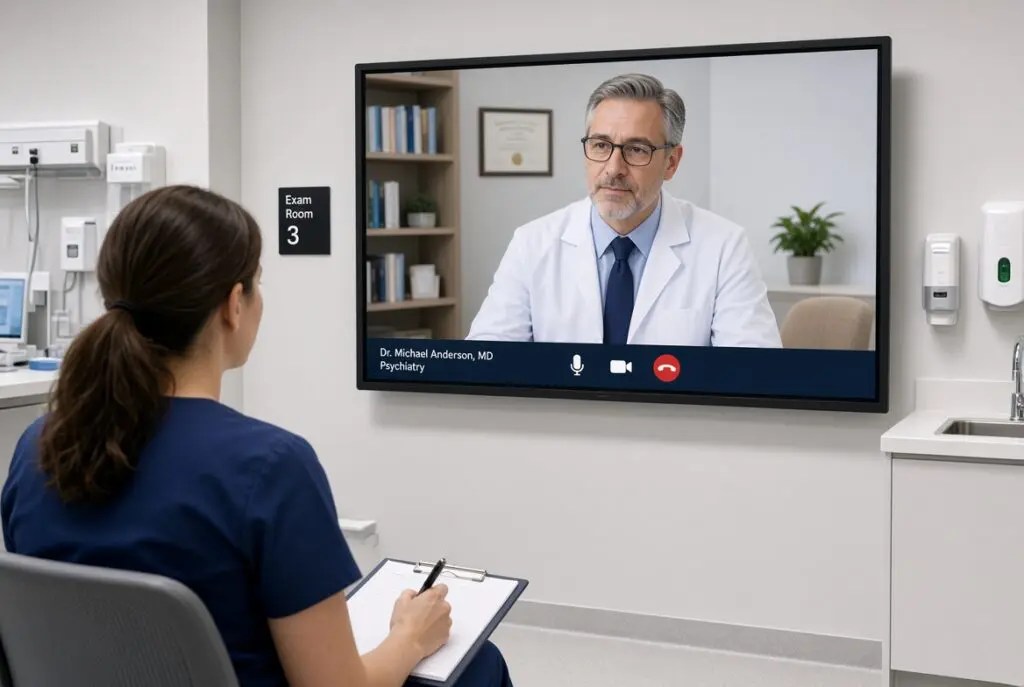
The practical requirements are straightforward. The facility retains clinical governance and the medical record. Providers are state-licensed and credentialed to the site. Sessions occur on a HIPAA-compliant platform that integrates with the existing EHR. Scheduling can be fixed blocks, on-demand consults, or a hybrid of both (hybrid telepsychiatry models). Payment is typically usage-based so the organization is not carrying a full-time salary while volume ramps or fluctuates. The distinction between this approach and a parallel virtual clinic is covered in Virtual Clinic vs. Psychiatry Staffing Network. Technology that supports flexible behavioral health delivery under Medicaid can further reduce the need for geographic moves; see how technology is reshaping behavioral health under Medicaid.
Key takeaways for program leaders:
- The pressure to relocate for psychiatric care is often a symptom of local specialist shortages, not a clinical necessity. More than 130 million Americans currently live in designated Mental Health Professional Shortage Areas (HRSA HPSA data).
- Continuity suffers when patients or panels move; the history, the treatment plan, and the accountability for outcomes stay with the originating organization only if coverage remains inside that organization.
- Placing a licensed prescriber inside the existing workflow reduces the incentive for patients or programs to seek specialist care elsewhere (telepsychiatry services overview).
- Advance credentialing of backup coverage reduces the window in which an unexpected departure forces either boarding or out-of-area transfers. See the dedicated backup coverage page for operational detail.
- Hybrid arrangements (occasional in-person visits plus ongoing virtual follow-up) are feasible when programs want periodic face-to-face contact without full-time on-site presence (hybrid telemedicine).

FasPsych has operated this model since 2007, supplying state-licensed psychiatrists and psychiatric nurse practitioners to hospitals, emergency departments, community clinics, residential programs, correctional facilities, and other organizations that already own the patient relationship (provider network). Providers document in the facility’s record, work under the facility’s clinical governance, and can be scheduled for dedicated blocks or responsive coverage. The goal is reliable specialist access that does not require patients or programs to leave the setting where treatment is already under way.
Organizations that want to evaluate whether virtual psychiatric coverage can reduce the pressure to relocate—while still directing specific gap scenarios to the appropriate existing resources—can review options and implementation timelines at faspsych.com/partner-with-us or call (877) 218-4070. The practical question is not whether better access exists. It is whether that access has to be reached by moving, or whether the licensed clinician can arrive where the work already happens.
Frequently Asked Questions
Can telepsychiatry prevent patients from needing to relocate for specialist psychiatric care?
Yes. When a licensed psychiatrist or psychiatric nurse practitioner can open the facility’s existing record and see the patient on a scheduled or responsive basis, the clinical need can often be met without an out-of-area transfer or a permanent move. The patient stays on the organization’s census and the history remains in one place.
What are the mental health costs of relocating for psychiatric treatment?
Longitudinal research shows that residential mobility is associated with higher rates of depression and anxiety, and that people already experiencing these conditions are more likely to move again—sometimes into higher-deprivation areas. Relocation can also interrupt existing primary-care relationships, peer supports, and housing stability that were helping manage symptoms.
How does keeping coverage inside an existing program reduce out-of-area transfers?
When specialist access is available inside the program the patient already uses, there is less incentive for the patient, family, or referring facility to seek care elsewhere. Outcomes, quality measures, and aftercare planning stay with the originating organization rather than transferring with the patient.
Is this the same as backup coverage when a psychiatrist is temporarily unavailable?
No. Temporary gaps (vacation, medical leave, or short-term resignation windows) are addressed on the backup psychiatrist coverage page. This article focuses on the broader pressure to relocate when local specialist capacity is persistently insufficient.
Does FasPsych work inside our existing EHR and medical staff?
Yes. Providers are credentialed and privileged to the facility, document in the facility’s record, and work under the facility’s clinical governance. The model is designed to support the program the organization already operates rather than create a separate destination for patients.