


Yes, a remote physician can serve as medical director for a rural health clinic (RHC) or FQHC in 2026. That physician can write policies with your NP and PA staff, issue protocols, review charts and answer clinical questions by phone or video. For behavioral health medical direction, FasPsych’s remote medical director service covers psychiatric protocols, medication oversight and intake standards without a local recruitment search. Some duties stay local, because CMS ties the building, safety and daily accountability to people who are physically present. Settle that split first, because it decides which vendor model fits. A remote contract cannot cover a duty that has to happen in the room.
Rural health clinic medical director requirements under CMS in 2026: what a remote physician can cover and what stays on site
The core rule is 42 CFR 491.8, the staffing and staff responsibilities condition for certified RHCs. It requires the clinic to have a physician who provides medical direction for its health care activities and who consults with and supervises the clinical staff. The physician works with the NPs and PAs to develop, carry out and periodically review the clinic’s written patient care policies. The physician also periodically reviews patient records and provides medical orders where needed. Separately, the staffing rules expect a practitioner to be available to patients whenever the clinic is open.
Most of that list works by telehealth. A physician can write and sign policies from anywhere. Records can be reviewed in the EHR, and consultation works over a secure video or phone line. What matters to a surveyor is that each duty happens on schedule and leaves a record, not where the physician was sitting when it happened.
Location does matter for licensure, though. Section 491.2 sets the definitions, and a physician must be legally authorized to practice by the state where the clinic operates. In practice, your remote director needs a license in your state, not only their home state.
The physical plant is the clear exception to remote coverage. Section 491.6 requires the clinic to be safe, clean and maintained, with drugs and supplies stored correctly. Someone on site has to own those duties, usually the administrator or a local designee. A remote physician cannot inspect a supply room or walk an exit route, so name that local owner in writing alongside the remote director’s agreement.
Regulation text and state scope-of-practice rules change. Confirm the current version of each section, and any state supervision rules for NPs and PAs, with your counsel before signing.
RHC and FQHC medical director roles are not the same job
The Part 491 duties above apply to RHCs, and FQHCs answer to a second rulebook as well, so a remote contract has to be written for the right one. An FQHC’s clinical director also works under HRSA health center governance. That means a community board, an approved scope of project and quality expectations tied to the health center program.
FQHCs also tend to run a broader service mix. That mix often includes integrated behavioral health, substance use treatment and medication-assisted treatment. Their clinical director’s job therefore touches more service lines and more reporting.
As a result, remote medical director services for rural health clinics and FQHCs should be scoped differently. An RHC may need a physician to satisfy the 491 oversight duties. An FQHC more often needs a specialist who can direct one service line inside the larger model. FasPsych’s telepsychiatric services for rural and remote FQHCs fit that second need by placing psychiatric direction inside the health center’s existing integrated care structure.
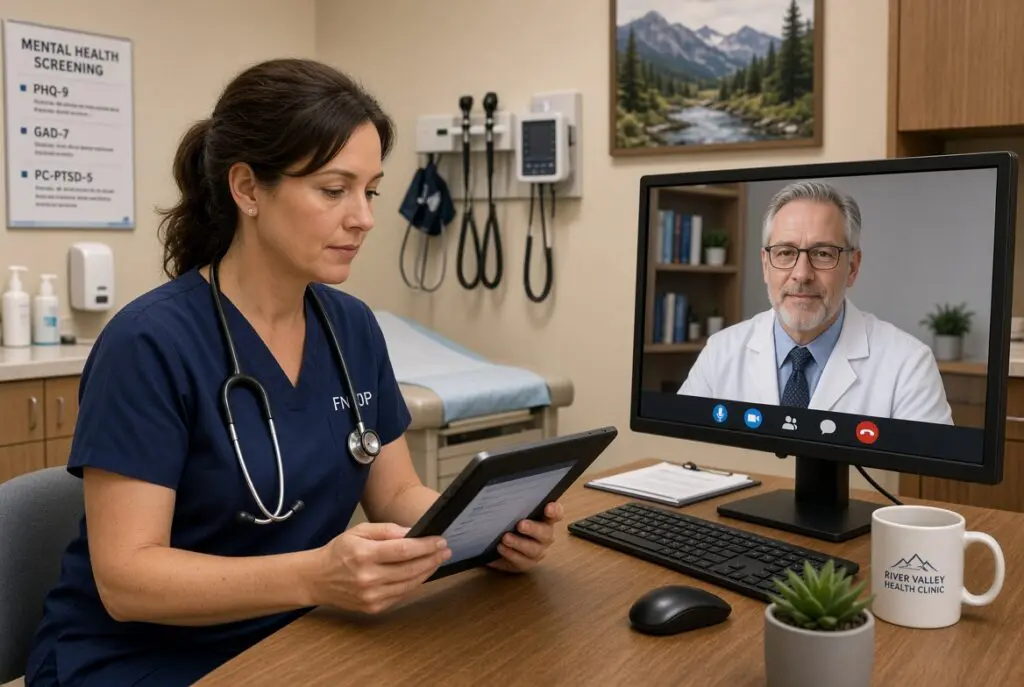
NP/PA-staffed clinics gain most from remote oversight, and the work runs on protocols, chart review and QA
Whichever rulebook applies, the clinics with the most to gain are those run day to day by NPs and PAs with little physician backup nearby. A 2026 survey of 227 rural respondents found that 65% of current rural clinicians lacked adequate specialist and colleague backup. For an NP managing a patient on several psychiatric medications, that gap is concrete. It means no one to call before adjusting a dose.
Workload adds pressure. In the same survey, 42% of rural clinicians said compensation did not fairly reflect their scope, call and workload. Asking local staff to absorb medical direction on top of patient care rarely holds for long.
The survey also points to where remote oversight works best. Seventy percent of respondents rated telehealth viable long term for psychiatry, while majorities did not rate it viable for obstetrics and gynecology, emergency medicine or general surgery. Psychiatric direction is therefore the most workable piece of physician oversight to move off site. FasPsych’s telepsychiatry support for rural health clinics gives NP/PA-staffed clinics psychiatric coverage alongside the medical oversight they already have.
Moving that oversight off site only works if it runs on a documented calendar, because the clinic has to show surveyors each activity, its cadence and who signed off. The general layer starts with written clinical protocols and standing orders that NPs and PAs follow. Scheduled chart review comes next, with the physician sampling NP/PA records and returning written feedback. Quality assurance and incident review close the loop, and the physician signs off on policies at each annual review. Each item should leave a dated record in the EHR or a compliance binder.
The behavioral health layer adds four duties. The first is psychiatric medication oversight, including review of complex regimens and side-effect monitoring. The second is intake assessment standards, so every new behavioral health patient is screened the same way. The third covers controlled-substance and medication-assisted treatment protocols. The fourth is escalation paths for suicide risk or acute decompensation, so staff know exactly whom to call. FasPsych’s remote medical direction centers on this layer. For more on how protocols, chart review and QA fit together, see what a remote medical director does in telepsychiatry.
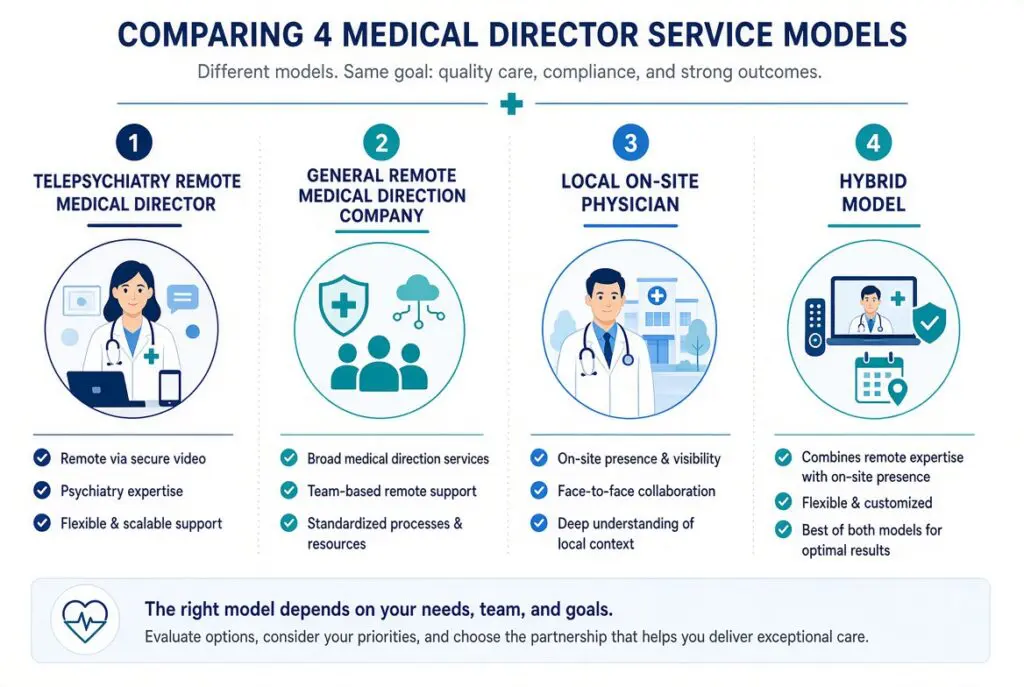
Best remote medical director services for rural health clinics: four models compared
The best remote medical director services for rural health clinics are the ones that match the duties your clinic actually needs covered. For behavioral health direction, a telepsychiatry medical director such as FasPsych fits first. For general 491 oversight and on-site duties, a general medical direction company, a local physician or a hybrid fills the rest. Many rural clinics combine two of these models.
Licensure is the criterion to check first, since every physician who directs care must hold a license in the clinic’s state. Review the state licensing requirements for telehealth providers before you compare anything else.
| Criterion | Telepsychiatry medical director (e.g., FasPsych) | General medical direction company | Local physician on contract | Hybrid: remote oversight plus periodic site visits |
|---|---|---|---|---|
| CMS on-site fit | Remote; pairs with local designee for 491.6 duties | Mostly remote; site visits vary by contract | Can be on site in person | Built to cover both |
| State licensure | Psychiatrists licensed in the clinic’s state | Depends on the vendor’s physician network | Already licensed locally | Depends on the provider |
| NP/PA oversight and chart review | Scheduled behavioral health chart review and consultation | Scheduled general chart review | Set by the physician’s availability | Remote review between visits |
| Behavioral health expertise | Core focus: medications, intake, MAT protocols | Usually general primary care | Varies by specialty | Varies |
| Telehealth billing fit | Can furnish billable distant-site psychiatric visits | Mostly oversight, few visits | In-person visits | Mixed |
| Typical pricing model | Contracted hours or per-service, quoted per scope | Monthly retainer is common | Hourly or stipend | Retainer plus visit fees |
| Time to start | Set by licensure and credentialing | Set by licensure and credentialing | Set by local recruiting | Longest; two parts to arrange |
The table shows that no single model covers every duty equally well. A common arrangement pairs a telepsychiatry medical director for behavioral health with a local or hybrid physician who owns the on-site work. When you request proposals, ask each vendor to state which 491 duties it covers, how often chart review happens and what record it leaves, so you can compare scopes rather than headline prices.

Billing, credentialing and the first 60 days of a remote medical director contract
Once you have chosen a model, the October 2026 billing change should shape how the contract is written. RHCs and FQHCs must now bill distant-site telehealth with the individual CPT or HCPCS code plus modifier 93 or 95, instead of HCPCS G2025, according to CMS’s FQHC and RHC announcements. CMS states that modifier 93 identifies synchronous audio-only and modifier 95 identifies real-time audio-video telemedicine on these claims. CMS also sets a separate distant-site payment rate each calendar year, so confirm the current figure with your billing team before you budget visit revenue.
Three contract terms follow from this. First, name who documents modality on every telehealth visit, because the modifier depends on it. Second, separate the services the remote physician furnishes as billable patient visits from the oversight work that is not a visit. Third, set how direction time is paid. Policy review, chart review and QA are generally an administrative cost, not a billable encounter. Price them as contracted hours or a retainer rather than counting on visit revenue to cover them.
With terms settled, most of the start-up time goes to credentialing. In the early weeks, confirm the physician’s license in your state and finish clinic credentialing and payer enrollment. Then sign the medical direction agreement and adopt the written protocols. Set the chart review schedule and connect the physician to your EHR with the right access level.
Before day 60, run one full QA cycle: one chart review round, one policy check and one documented feedback session, so the records exist before a surveyor asks. A step-by-step telepsychiatry implementation plan walks through the sequence in more detail.
Your next step is to request a consultation with FasPsych on its remote medical director service. Bring your current protocols and staffing mix so the scope can be set for your clinic.