

In the 1992 film The Bodyguard, Kevin Costner’s character Frank Farmer arrives ready to protect a high-profile singer under credible threat, works largely alone, skips thorough risk assessment, and ultimately becomes romantically involved with the person he is supposed to protect. Kevin Costner was a terrible bodyguard. Executive protection professionals have noted that these choices invert real protection work, which requires layered teams, continuous preparation, and clear professional boundaries rather than a solitary operator treated as immediately effective. Industry analyses highlight the same gaps: one bodyguard for an ongoing high threat and the decision to mix a personal relationship with the assignment.
Behavioral health programs face a parallel problem when they treat the arrival of a new psychiatrist or psychiatric nurse practitioner as the end of the process. A clinician can be clinically ready, licensed in the relevant state, and available to start, yet still unable to open a chart, document in the facility’s system, or generate a billable encounter. The credentialing file is incomplete, hospital or facility privileging has not cleared, DEA registration has not been addressed, or payer enrollment remains pending. These are not minor administrative details. They are the difference between a signed agreement and a clinician who can actually work inside the program. Telepsychiatry credentialing timelines are driven by these operational steps, not by the simple availability of clinicians. Organizations evaluating affordable telepsychiatry services staffing payment options often find that credentialing and privileging, not clinician availability, determine when coverage can actually begin.
Why Credentialing, Privileging, and Enrollment Take Longer Than Expected
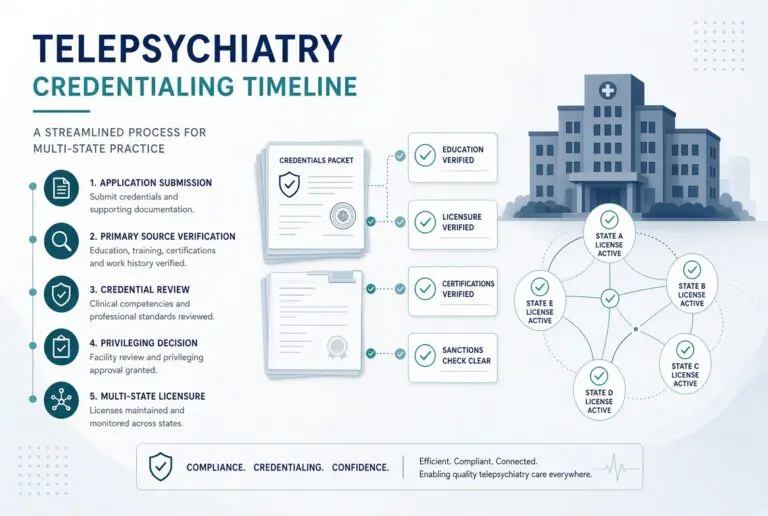
Credentialing, privileging, and payer enrollment are related but distinct processes that frequently run in sequence rather than in parallel. Credentialing verifies that a provider is who the application claims—education, training, licensure, board certification, work history, malpractice history, and sanction checks—through primary source verification rather than provider attestation alone. Privileging grants specific clinical permissions at a particular facility. Payer enrollment registers the clinician with Medicare, Medicaid, or commercial plans so claims can be submitted and paid.
Primary source verification alone commonly requires 30–60 days when applications are complete. Hospital or facility privileging adds committee schedules that often meet monthly, plus site-specific bylaws and any telemedicine requirements. Commercial payer enrollment typically runs 60–120 days; Medicaid timelines vary by state and managed care organization. Incomplete applications or a single unexplained gap in work history reset the clock at multiple points.
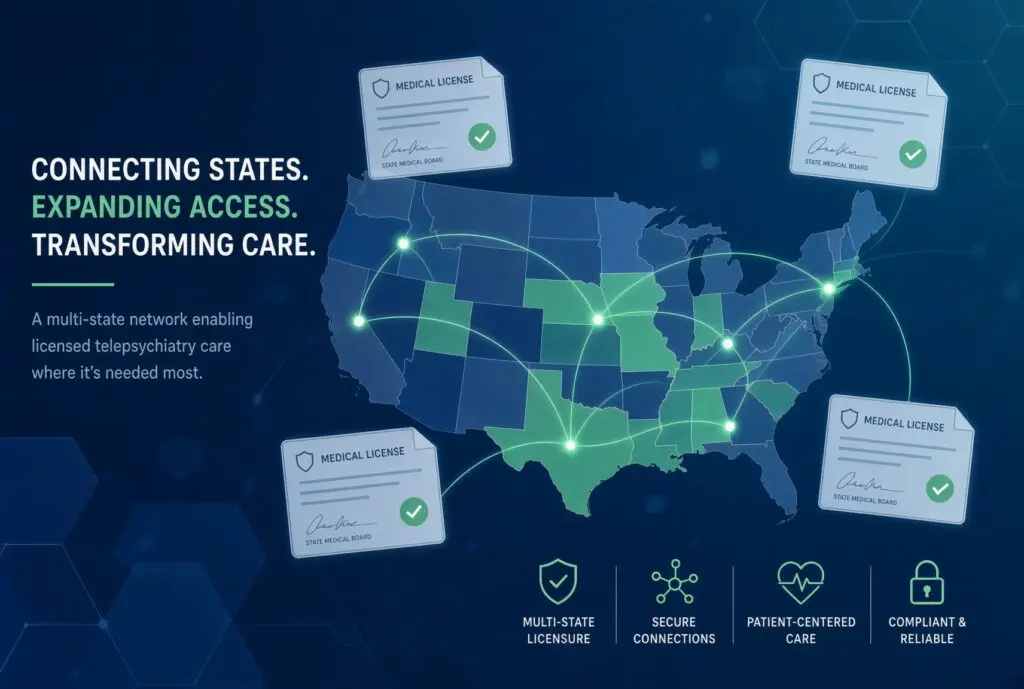
Multi-state telepsychiatry coverage adds another constraint. A clinician generally needs an active license (or compact privilege) in every state where the patient is physically located. The Interstate Medical Licensure Compact streamlines the process for eligible physicians, but it does not eliminate the need for facility privileging, payer enrollment, or DEA registration where controlled substances are prescribed.
Common Bottlenecks That Stall Go-Live
Programs most often lose time on a predictable set of issues:
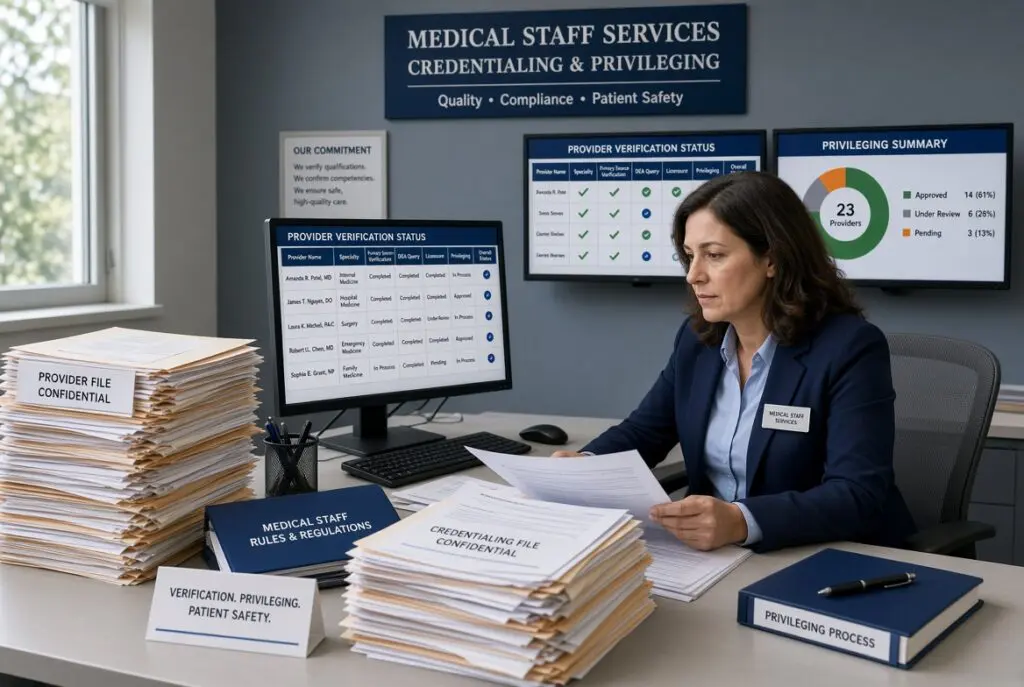
- Incomplete or outdated applications that require re-submission after primary source verification begins
- Delays obtaining documents from previous employers, training programs, or state boards
- Medical staff offices whose credentialing committees meet only monthly
- Payer portals that reject submissions for minor discrepancies in NPI, taxonomy, or group affiliation
- DEA registration logistics for clinicians who will prescribe controlled substances
- The need to add a new clinician to an existing group billing entity or complete site-specific privileging
A program that measures “time to first visit” from the date a clinician is identified, rather than from the date the clinician is privileged and enrolled, systematically underestimates the operational start date.
Credentialing by Proxy and Facility-Specific Steps
Since 2011, hospitals that have agreements with each other to provide telemedicine services have been able to use credentialing by proxy, relying on information from the distant site rather than repeating full primary source verification for every telepsychiatry clinician. The American Psychiatric Association notes that telepsychiatrists should inform credentialing departments of this option so processes can be streamlined. Even with proxy arrangements, however, facility-specific privileging, bylaws compliance, and payer enrollment remain necessary. These residual steps still drive a meaningful portion of the telepsychiatry credentialing timeline. Broader shifts in how technology revolutionizes behavioral health under Medicaid have increased demand for scalable telepsychiatry models, but they have not removed the underlying credentialing and privileging requirements.
What Facilities Control and What a Staffing Partner Should Handle
Facilities control several variables that affect speed. They can designate a single internal owner for credentialing communications, supply complete and current privileging packets, and identify in advance which payers must be enrolled before the first billable encounter. They can also set internal expectations that distinguish “clinician identified” from “clinician privileged and enrolled.”
Most organizations should not attempt to manage repeated primary source verification, multi-state license tracking, DEA logistics, and ongoing re-credentialing for a panel of telepsychiatry clinicians. A staffing partner that maintains a pre-credentialed network of psychiatrists and psychiatric nurse practitioners can compress the remaining timeline because foundational verification has already been completed and is maintained. Facility-specific privileging and the final payer enrollment steps are then the primary items left on the critical path. This is especially relevant for programs implementing or expanding models such as the Collaborative Care Model, where consistent psychiatric consultation depends on clinicians who are fully privileged and enrolled rather than simply identified.
Organizations that recruit individual locum tenens clinicians often face 60–120 days or longer from signed agreement to first billable visit once all steps are accounted for. Organizations that work with a network that has already performed primary source verification, maintains active multi-state licenses, and has established payer enrollment pathways frequently reduce the remaining window to 2–6 weeks for facility-specific requirements. FasPsych’s telepsychiatry staffing model is built around this approach.
Building a Realistic Timeline Into the Agreement
A useful statement of work or implementation plan separates the identification of a clinician from the point at which that clinician can document and bill. It should include:
- A clear list of facilities and payers that must be completed before go-live
- An agreed window for the remaining facility-specific credentialing and privileging steps
- Named owners on both the facility side and the staffing partner side
- Contingency language for what happens if a committee schedule or payer request extends the timeline
Without these elements, the operational start date remains an estimate. Organizations writing a telepsychiatry staffing RFP or evaluating partners can score these operational timelines alongside clinical coverage and continuity requirements.
FasPsych has staffed psychiatrists and psychiatric nurse practitioners into organizational programs since 2007. The model places licensed clinicians inside the facility’s existing workflows, electronic health record, and clinical governance rather than creating a parallel clinic. Credentialing support, primary source verification, multi-state licensure coordination, and payer enrollment assistance are handled as part of implementation so the remaining facility-specific steps are the only items left on the critical path. Most partners reach their first billable visits in 2–6 weeks once the facility’s privileging and enrollment requirements are known. Providers in the network undergo comprehensive credentialing that includes primary source verification of licenses, board certifications, and DEA registration, criminal background checks, malpractice history review, and telehealth compliance training before they are placed. Facilities that also need clinical oversight during implementation or ongoing operations can add a remote medical director for protocol ownership, chart review, and supervision.
Frequently Asked Questions
How long does telepsychiatry credentialing typically take?
From complete application through primary source verification, hospital privileging, and payer enrollment, the full process commonly runs 60–120 days or longer for individual clinicians. A staffing partner that has already completed foundational verification can reduce the remaining facility-specific window to 2–6 weeks in many cases.
What is credentialing by proxy?
Credentialing by proxy allows a hospital to rely on the credentialing and privileging decisions of a distant-site hospital or telemedicine provider for telepsychiatry clinicians, rather than repeating full primary source verification. Facility-specific privileging and payer enrollment are still required.
Does multi-state licensing affect telepsychiatry credentialing timelines?
Yes. Clinicians generally need an active license in every state where the patient is located. The Interstate Medical Licensure Compact can accelerate licensing for eligible physicians, but privileging and payer enrollment remain separate steps.
If the constraint on new or expanded psychiatric coverage is no longer the availability of clinicians but the time required to make them operational inside the program, the next step is to map the remaining credentialing and privileging steps against a defined implementation window.
Partner with FasPsych or call (877) 218-4070.