

An extended analysis for hospitals, FQHCs, CMHCs, and primary care practices · September 2026
In 2024, behavioral health visits surpassed primary care visits among commercially insured Americans for the first time. That utilization crossover is the clearest available signal that mental health has become a primary care issue in the United States — not because psychiatry should replace family medicine, but because behavioral health is now a high-frequency first contact with the health system, and because primary care continues to carry mental health work it was never staffed to own alone.
This article reads the 2024 claims data against the clinical literature on primary mental health care, the evidence that integrated primary care increases treatment reach, and the workforce arithmetic that makes unaided primary care an unstable solution. The operational implication for health systems is narrow: keep psychiatry inside the programs patients already use, rather than opening a second clinic door.
Key Takeaways
- Among commercially insured Americans in 2024, behavioral health recorded 66.4 million visits versus 62.8 million primary care visits — the first year behavioral health volume was higher.
- Behavioral health visits rose 11.4% that year while primary care visits fell 5.6%. Since 2018, behavioral health utilization in this population is up 44%; primary care is down 7%.
- Mental health is a primary care issue in two senses: it is increasingly the patient’s front door to healthcare, and it remains a large share of what happens inside primary care visits.
- Integrated primary care models multiply the odds that a patient actually receives a mental health intervention. Telehealth is a strong but imperfect substitute, accounting for 67% of telehealth visits in 2024.
- The constraint is workforce, not awareness. The durable response is psychiatric capacity embedded in existing primary care, FQHC, CMHC, and hospital programs — not a parallel virtual storefront.

The 2024 Utilization Crossover
Trilliant Health’s October 2025 Trends Shaping the Health Economy report placed the crossover inside a larger argument: the U.S. delivery system still rewards specialty intervention more than primary care prevention. In that report’s 2024 commercial claims, behavioral health visits rose 11.4% year over year while primary care visits declined 5.6%, “marking the first time behavioral health utilization surpassed primary care.”
The visit counts themselves were reported by Chris Larson for Behavioral Health Business on October 9, 2025: 66.4 million behavioral health visits against 62.8 million primary care visits. Since 2018, behavioral health utilization in this commercially insured slice increased 44%, while primary care use decreased 7%. The American Hospital Association later summarized the same analysis.
Allison Oakes, Trilliant’s chief research officer, called the pattern “remarkable.” She attributed falling primary care use to affordability and “issues of trust and distrust in the healthcare system,” and she noted that behavioral health’s structure — frequent touchpoints for chronic conditions — will produce a crossover whenever primary care is used only intermittently. “If people are using primary care somewhat intermittently but behavioral health more frequently,” she said, “that’s where you start to see the pattern… where these lines are actually crossing one another as of 2024.”
One methodological caveat belongs in any internal briefing. The primary care count is limited to physicians and excludes nurse practitioners and physician assistants. Oakes told Behavioral Health Business that including those clinicians would not change the overall conclusion. The direction of travel holds: behavioral health volume is rising, and conventional primary care engagement is not.
Confirmed 2024 visit volume among commercially insured patients — behavioral health visits surpassed primary care
| Measure (2024) | Behavioral health | Primary care |
|---|---|---|
| Visits (millions) | 66.4 | 62.8 |
| Year-over-year change | +11.4% | −5.6% |
| Change since 2018 | +44% | −7% |
Source: Trilliant Health 2025 Trends report, as reported by Behavioral Health Business. Primary care counts exclude nurse practitioners and physician assistants.
FasPsych described the longer arc of access, telehealth, and integration before these 2024 counts were published, in Trends in Mental Health Services in the U.S. Over the Past Decade. That earlier piece remains useful context. It did not have the commercial visit-volume crossover. This article is the crossover paper.
Why Behavioral Health Became the Patient Front Door
Visit frequency, not raw prevalence, is what moved the lines. A course of psychotherapy or medication management produces many encounters in a year. A commercially insured adult who still has a primary care physician may see that physician once, or not at all. When one service line is built on weekly or monthly contact and the other has become episodic, volume accrues to behavioral health even if the number of unique patients is not dramatically different.
The demand underneath those visits is still large. Mental Health America’s State of Mental Health in America 2025 found that 23.40% of U.S. adults — more than 60 million people — experienced any mental illness in 2024, a rate that was essentially unchanged from 2021 through 2024. Among youth ages 12–17, major depressive episodes fell from 18.10% in 2023 to 15.40% in 2024, but 11.30% still had severe impairment, about 2.8 million adolescents. Access did not keep pace. In 2022–2023, 9.20% of adults with any mental illness were uninsured (more than five million people), one in four reported an unmet need for treatment, and 28.60% of adolescents had no preventive visit.
The World Health Organization’s 2 September 2025 briefing put the global burden above one billion people living with mental health conditions. Median government spending on mental health remains about 2% of health budgets. Depression and anxiety alone are estimated to cost the world economy a trillion dollars a year in lost productivity. WHO’s accompanying Atlas and epidemiology reports treat primary care as the only setting with enough surface area to close that gap.
Robert C. Garrett, writing the World Economic Forum’s four imperatives for mental health care in 2025, made the same systems point from the hospital side. Mental disorders account for roughly 10% of the global disease burden, yet only about 1% of the health workforce is dedicated to mental health, and governments still allocate about 2% of health budgets to the field. Nearly one in ten U.S. emergency department visits involves mental health. Garrett’s argument is integration rather than a separate tower: “By embedding behavioural health services within primary care, we tackle two major barriers: the shortage of mental health professionals and the stigma associated with seeking treatment.” Hackensack Meridian Health’s own integrated screening-and-referral program, which he cites, cut emergency department costs by more than half.
That is the patient-side meaning of “front door.” A commercially insured adult is now more likely, in a given year, to generate a behavioral health claim than a primary care claim. The clinician who sees them first may be a therapist or psychiatrist, not a family physician. If that relationship never connects back to a medical home, the system gets more behavioral health volume and less prevention — the fragmentation Trilliant’s broader report already warns about.
What “Primary Mental Health Care” Actually Means
Before treating the crossover as a slogan, it helps to say what primary mental health care is. In an August 2025 paper in the Indian Journal of Psychological Medicine, Sabhahit, Nirmala, and Math work through defining primary mental health care as a set of domains rather than a single clinic type: which disorders are in scope, which tasks (screening, brief treatment, referral, follow-up), which setting, which duration, and which cadre delivers the work. They note that “primary” is often used sequentially — first contact — but also describes care delivered by non-specialist cadres. Drawing on Kates and colleagues (2018), they define primary mental health care as mental health services provided by primary care clinicians in a way that does not always require a specialist in the room.
Athanasios Tselebis and Argyro Pachi made the gateway claim explicit in a 2022 Healthcare editorial, Primary Mental Health Care in a New Era (PMC full text). Primary health care, they write, is “the gateway to the health care system and first point of contact for patients with mental disorders,” especially common mental disorders. Its job is early diagnosis and intervention, assessment, treatment planning, referral, monitoring, and prevention. The principles they list — accessibility, integrated and coordinated care, continuity, efficiency, equity, human rights — are the same principles WHO uses when it tells countries to scale mental health inside primary care rather than only inside specialty hospitals. Collaborative care and other integrated models are, in their account, the cost-effective delivery vehicles.
Two implications follow for a U.S. hospital or FQHC reading 2024 claims. First, “mental health as primary care” is not a metaphor. It is a defined service: first-contact assessment and ongoing management of common conditions, with a path to specialty psychiatry when severity or complexity requires it. Second, the 2024 volume shift means a growing share of that first contact is happening in behavioral health settings instead of in the medical home. The clinical literature still wants the medical home to hold the function. The claims data show patients voting with their appointments.
Mental Health as a Primary Care Issue — Two Meanings
Calling mental health a primary care issue is easy to flatten. It does not mean every psychiatrist should rebrand as a family physician. It means organizations have to staff two facts at once.
Behavioral health is now a common first contact
When visit volume crosses, the patient’s therapist or psychiatrist often becomes the person who first hears about insomnia, missed work, medication side effects, substance use, and worsening diabetes or hypertension. That clinician is then the de facto coordinator — or the last clinician the patient sees if the rest of the system never connects. The risk is not “too much mental health care.” The risk is a specialty relationship that never returns the patient to preventive and chronic-disease care.
Primary care still carries a large share of the mental health workload
The utilization crossover does not empty the exam room. The Duke Endowment noted in October 2025 that experts estimate as many as one in five primary care visits involve mental health issues, and that primary care physicians are typically not trained or equipped to handle them alone — which is why the foundation has funded programs that place mental health specialists in primary care offices. That figure is a foundation summary of expert consensus, not a single national claims study, but it matches what administrators already see on the schedule: depression, anxiety, insomnia, ADHD follow-up, and substance use arriving in 15- and 20-minute medical slots.
The bind is structural. Patients are using behavioral health more than primary care, and primary care is still being asked to diagnose, prescribe, and monitor psychiatric conditions without enough psychiatric backup. The question is not which door is correct. It is that both doors are crowded, and they are not connected.
Integration Increases Utilization — That Is the Point
If the problem is reach, the relevant outcome is whether a patient who screens positive actually receives treatment. Cody A. Hostutler and colleagues tested that question in a 2025 Pediatrics meta-analysis of integrated primary care and mental health service utilization. Across trials published from 1998 through 2024, integrated primary care (IPC) produced sharply higher odds of receiving any mental health intervention (OR 12.23; 95% CI 3.64–41.07), a minimum dose of intervention (OR 10.92; 95% CI 3.28–36.32), and a full course of intervention (OR 19.17; 95% CI 3.02–121.53) compared with usual or enhanced usual primary care. The authors are careful about heterogeneity and about how poorly some papers specified the model. The direction is not subtle. Putting mental health into the primary care workflow is how patients get treated.
Nurse practitioners are already doing a large share of that work. Eleanor Turi, Amy McMenamin, and colleagues, in a 2023 Nursing Outlook systematic review of nurse practitioner care for patients with mental health conditions in primary care, found that four high-quality U.S. studies showed NP evidence-based care and prescribing comparable to physicians for anxiety, depression, and substance use disorders. Seven lower-quality studies associated NP-led collaborative care with symptom reduction. Their conclusion is appropriately modest — more rigorous trials are needed — but it is no longer plausible to treat NPs as a temporary patch on a physician-only design.
Those findings are why FasPsych writes about psychiatrists as members of a team rather than as a destination clinic. See Psychiatrists in Integrated Care Teams and the Collaborative Care Model guide for FQHCs and CMHCs. The mechanics of CoCM — screening, a care manager, a registry, and a consulting psychiatrist — live on those pages. This article only needs the utilization result: integration is how a primary care issue becomes treated care instead of an unfunded screening quality measure.
Primary care groups that want the operational sequence, rather than the evidence review, can use FasPsych’s integrated care implementation guide for primary care providers and the service page for virtual mental health in primary care practices.

Telehealth’s Uneven Role in Behavioral Health
Telehealth is why behavioral health could absorb 2024 volume at all. In the same Trilliant commercial data set Behavioral Health Business reported, behavioral health accounted for 67% of telehealth visits in 2024. All other specialties combined accounted for fewer than 20 million virtual visits. LifeStance has reported that about 70% of its visits are virtual. Oakes’s summary is the one operators should keep: behavioral health is “the primary area where telehealth is a good substitute for in-person care.” It is a good substitute. It is not a perfect substitute.
The channel is also not expanding without limit. Behavioral health telehealth visits fell from nearly 50 million in 2023 to under 40 million in 2024 — the steepest drop since the early pandemic surge. Overall telehealth volume across specialties is down 32% from 2020. Patients moved back toward in-person-only care across age and gender groups; hybrid rates were flat or down. Tselebis and Pachi had already argued, after COVID-19, that digital consultation expands reach and should sit inside primary care rather than replace it. The 2024 counts look like that mixed equilibrium: video remains the majority modality for behavioral health, while a share of patients return to the office.
2024 telehealth mix among commercially insured patients
| Channel | 2024 snapshot |
|---|---|
| Behavioral health share of all telehealth visits | 67% |
| Behavioral health telehealth visits | Under 40 million (down from ~50 million in 2023) |
| All other specialties, telehealth visits | Under 20 million |
| All-specialty telehealth volume vs. 2020 | −32% |
Source: Trilliant Health analysis as reported by Behavioral Health Business, October 2025.
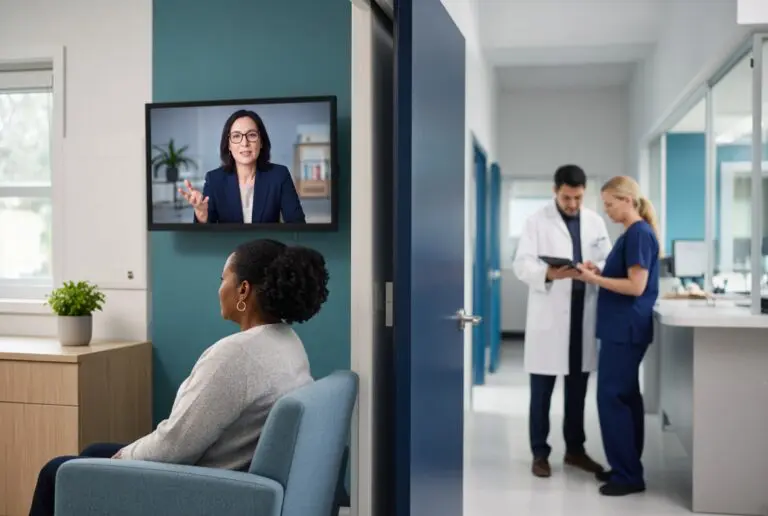
For a hospital, FQHC, or multi-site primary care group, video is coverage, not a product line. It works for evaluation, medication management, and collaborative consultation when the patient is in a private, staffed room and the psychiatrist can write in the host organization’s record. It does not replace on-site safety planning or a primary care team that still owns the medical home. That referral-and-coverage design is laid out in Telepsychiatry for PCP Referrals, Hospitals, and Multi-Site Care.
The Workforce Constraint Behind the Crossover
None of the utilization data implies that the country has enough psychiatrists. Anand Satiani, Julie Niedermier, Bhagwan Satiani, and Dale Svendsen projected the opposite in their 2018 Psychiatric Services population analysis of the U.S. psychiatrist workforce (ResearchGate full text). Using AAMC, ABPN, and Census data, they estimated the workforce would contract through 2024 to 38,821 psychiatrists — a shortage of 14,280 to 31,091 depending on the psychiatrist-to-population ratio. Expansion would begin in 2025. By 2050 the range ran from a shortage of 17,705 to a surplus of 3,428. Their blunt conclusion: it was unclear whether the shortage would resolve even three decades out.
The American Psychiatric Association’s workforce development brief still frames the same gap as a pipeline problem: a persistent psychiatrist shortage that limits access to mental health and substance use treatment, with adult-psychiatrist supply projected to fall even as demand rises, leaving a shortfall on the order of 12,000 fully trained psychiatrists by 2030 under APA’s cited scenario. APA’s policy ask is federal and state investment in training. That is necessary. It is also slow relative to a 2024 volume shift that has already arrived.
A June 2025 Psychiatric Times review of the future psychiatric workforce restated the access failure in current survey terms: roughly a quarter of adults with any mental illness perceived an unmet need for treatment in the prior year, about 60 million Americans live with a mental health condition, and more than a third of the population lives in a Mental Health Professional Shortage Area. The authors’ forward path is not “hire 30,000 psychiatrists this year.” It is team-based care that uses all prescribing professions — physicians, nurse practitioners, and physician assistants — with psychiatrists leading rather than seeing every patient alone.
FasPsych has already published the staffing arithmetic separately in The Growing Psychiatrist Shortage and How Telepsychiatry Helps and the reimbursement constraints in Mental Health Spending: Funding Cuts and Telepsychiatry Solutions. Those pages own those keywords. The point here is narrower. A system in which behavioral health visits have already overtaken primary care cannot wait for the residency pipeline to refill Satiani’s gap. It has to put the psychiatrists who exist into the rooms where the visits are happening.
That constraint is sharpest where Medicaid is the payer. Dr. Paul Watson, in Technology Revolutionizes Behavioral Health Under Medicaid (Free Medical Journals, July 22, 2026), describes the CMHC and FQHC bind: last-resort coverage, thin reimbursements, recruitment difficulty, and no-show risk that makes a salaried psychiatrist hard to carry. His operational claim is that two-way video has already become ordinary practice — “up to 90% of mental health providers using some sort of telemedicine technology” — and that specialist telepsychiatry firms can place remote clinicians into existing workflows on an hourly or per-appointment basis rather than forcing a direct hire. Using the host organization’s EHR is what keeps the visit inside the program instead of inventing a parallel chart.

Integration Without Creating a Second Clinic
The wrong response to “behavioral health is the front door” is to build a second front door — a national virtual practice with its own brand, chart, and quality-measure denominator. That design can serve a system that has no outpatient behavioral health infrastructure. It is a poor fit for a hospital, FQHC, CMHC, or primary care group that already owns the patient relationship. FasPsych’s comparison of a virtual clinic model versus a psychiatry staffing network is explicit on this point: patients should stay in the program they already entered. CCBHC, Medicaid, and value-based primary care contracts locate accountability at the host organization, not at an outside clinic.
The literature above points the same way. Tselebis and Pachi want mental health inside primary care. Hostutler and colleagues show that integration is what raises treatment rates. Garrett’s WEF essay treats embedding behavioral health in primary care as the way to cut emergency-department waste and stigma at the same time. None of those arguments require a consumer app with a new logo. They require a psychiatrist or psychiatric nurse practitioner who can see the patient on the organization’s schedule, write in its record, and join its huddle.
That is the service FasPsych has provided since 2007: licensed psychiatrists and psychiatric nurse practitioners staffed into existing hospital, community, correctional, and primary care programs — currently more than 130 partner organizations, with a network of 100-plus psychiatrists and 400-plus providers. Coverage is billed by visit, hour, or day. The model exists so a primary care issue can be treated as primary care infrastructure rather than as a referral that dies on a waitlist.
Ryan Mitchell’s DGM News profile of FasPsych’s multi-setting telepsychiatry work is useful here because it describes the same design outside the primary care exam room: dedicated psychiatrists and psychiatric nurse practitioners for a given hospital, jail, prison, school, or residential program — not a rotating call-center pool — on the facility’s existing video and EHR stack (Epic, Cerner, or otherwise). The piece frames FasPsych as a clinical staffing partner rather than a software vendor: remote evaluation and medication management where an on-site psychiatrist cannot be recruited, including emergency departments and correctional intake, with the host organization still owning the encounter. That is the “no second front door” model applied to every setting that is now absorbing the volume primary care no longer holds alone.
What Health Systems Should Do Next
The 2024 counts will not reverse because a health system publishes a wellness page. They change, if they change, when organizations treat mental health as core primary care capacity.
- Assume behavioral health is a high-frequency service line. Therapy and medication management created the volume that crossed primary care. Staff for repeated visits, not one-time referrals.
- Keep psychiatry inside the medical home. Screening without a clinician who can act on a positive PHQ-9 or GAD-7 is how depression-screening measures fail. Hostutler’s odds ratios are the empirical case for putting treatment in the same workflow as the screen.
- Use every prescribing profession on purpose. Turi’s review and the Psychiatric Times workforce essay both point to NPs and PAs as part of the primary care mental health supply, with psychiatrists concentrating on complexity, consultation, and medication that exceeds primary care scope.
- Use telepsychiatry as coverage, not as a competing clinic. Video is how scarce psychiatrists reach rural panels, after-hours blocks, and multi-site groups. It should extend the host program.
- Do not starve primary care to feed behavioral health. The crossover already shows people stepping back from routine medical care. Integration is how those patients return to whole-person follow-up.
- Plan for workforce math, not slogans. Satiani’s range and APA’s pipeline brief are the constraint. Hiring on a six-to-twelve-month cycle will not match 2024 demand.
To match psychiatric coverage to referral volume or a primary care integration plan, contact FasPsych at (877) 218-4070 or faspsych.com/partner-with-us.
FAQ
What does it mean that behavioral health visits surpassed primary care? It means that in 2024, commercially insured Americans generated more behavioral health encounters (66.4 million) than primary care encounters (62.8 million), according to Trilliant Health data reported by Behavioral Health Business. Behavioral health is functioning as a high-frequency entry point into healthcare. It does not mean primary care is obsolete.
Why is mental health now a primary care issue? Two reasons run together. Behavioral health is increasingly the first door patients use. Primary care remains where a large share of depression, anxiety, insomnia, and substance use still presents. Organizations have to staff both facts.
What is primary mental health care? In the literature, it is first-contact mental health work delivered in primary care — screening, brief treatment, referral, and follow-up — often by non-specialist cadres with specialist support. See Sabhahit et al. on defining the term and Tselebis and Pachi on primary mental health care as the system gateway.
Does integrating mental health into primary care actually increase treatment? Yes, on the best available synthesis. Hostutler and colleagues’ 2025 Pediatrics meta-analysis found that integrated primary care raised the odds of receiving any intervention more than twelvefold compared with usual primary care.
If behavioral health is the patient’s front door, should we launch a virtual clinic? Usually no, if you already operate clinics, an EHR, and quality contracts. A second front door splits the denominator. Staff psychiatry into the program patients already entered, as described in Virtual Clinic vs. Psychiatry Staffing Network.
Where does telepsychiatry fit? Telepsychiatry is how organizations add evaluation and medication management when they cannot recruit an on-site psychiatrist fast enough. It is the coverage layer behind the front door, not a replacement for primary care or on-site safety work.
How is this different from FasPsych’s spending and shortage articles? The spending and funding-cut article covers reimbursement pressure. The shortage article covers workforce supply. This piece is the 2024 visit-volume story and what it means for primary care operations.
Partner with FasPsych
If behavioral health is now how many of your patients first touch the system, the next question is whether a psychiatrist can see them inside your program this month. Call (877) 218-4070 or visit faspsych.com/partner-with-us.