


A reliable telemedicine MAT service needs five things in place before the first induction. Most programs get there fastest by staffing the prescriber role through a telepsychiatry partner such as FasPsych. Telepsychiatry services are expanding access to mental healthcare across the United States, helping organizations reach patients who would otherwise face long wait times or geographic barriers. The five requirements are:
- Controlled-substance prescribing that meets current DEA and SAMHSA rules
- A prescriber licensed in each patient’s state
- Payer coverage for the visits
- Counseling tied to the medication plan
- A defined visit cadence
If one piece is missing, the service can still see patients. However, it will either lose them or expose the program to compliance risk.
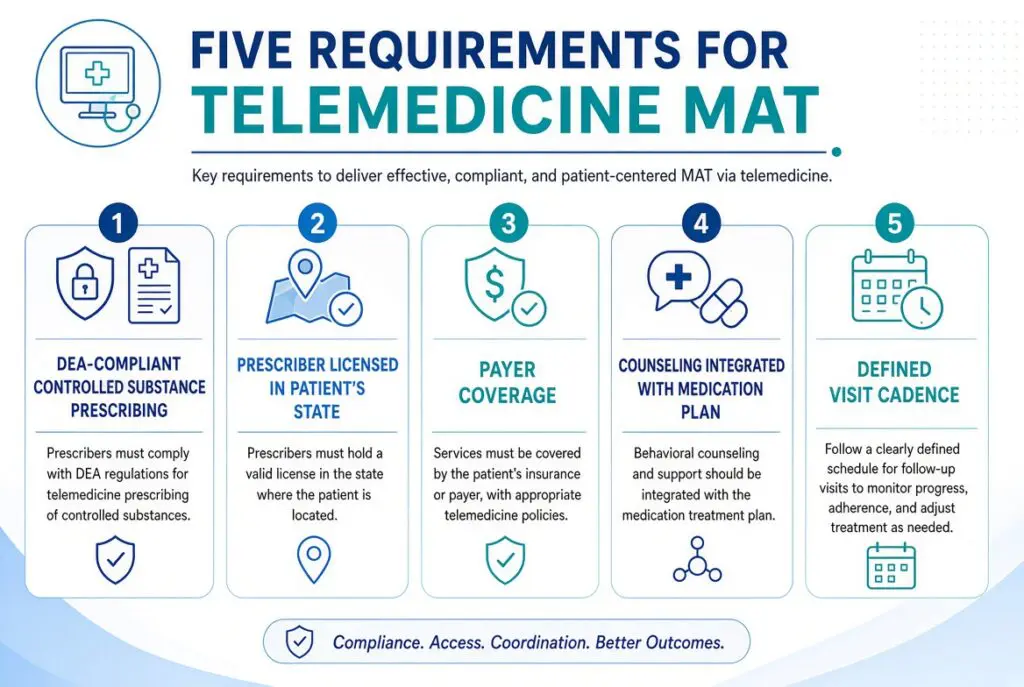
Building all five in-house is hard for clinics, hospitals, and correctional health programs because recruiting and credentialing prescribers state by state is slow. Smaller facilities in particular often face resource constraints when standing up these programs. For that reason, FasPsych provides virtual medication-assisted treatment for substance use care to organizations that already run their own counseling and nursing but need the prescribing layer. FasPsych’s hybrid telemedicine services further support programs that want flexible combinations of remote and on-site coverage. Broader telepsychiatry efforts are also expanding access to mental health care in similar ways. The sections below cover each requirement in turn. They end with a vetting checklist you can apply to any vendor. Facilities exploring a full build can also review the steps for creating an effective telepsychiatry program by smaller facilities.
Why retention data supports telemedicine buprenorphine, and what it cannot prove
Before you invest in that service, you need to know whether it keeps patients in care. Recent evidence says it can. A 2026 multistate retrospective cohort study of telehealth-delivered buprenorphine (Monico et al., Journal of Medical Internet Research) reported retention of 86.8% at month 1, 71.0% at month 6, 59.2% at month 12, and 46.4% at month 24 among more than 22,000 patients. The authors described these results as comparable to or higher than national benchmarks.
The authors also broke six-month retention down by induction pathway. The high-dose, standard, and quick-start pathways landed within a few points of each other. As a result, the pathway a prescriber chooses matters less than whether patients keep showing up.
A second 2026 comparison of telemedicine and in-person buprenorphine found 42.5% of telemedicine patients still in treatment at six months, against 30.3% of in-person patients. The advantage held after the authors adjusted for differences between the two groups.
However, both studies are retrospective. Patients who chose telehealth may differ from those who did not, so neither study proves that telemedicine causes better retention. Use the figures to set expectations. Then make retention at months 1, 6, and 12 a metric any provider must report to you.
Which prescribing, licensure, and payer rules decide where and how you can offer telemedicine MAT
Those retention numbers only hold if the prescribing is compliant, so the next layer is operational. Under current DEA and SAMHSA rules (including the permanent Expansion of Buprenorphine Treatment via Telemedicine Encounter rule and temporary flexibilities extended through December 31, 2026), a prescriber can initiate buprenorphine by telemedicine without a prior in-person exam. Programs should confirm current federal and state requirements and track each patient’s care timeline so that ongoing prescribing stays within applicable rules.
Each prescription also needs safeguards of its own. Run a prescription drug monitoring program (PDMP) check at induction and at each refill, and document the result (including date and time) in the chart. Check neighboring states where patients commonly fill, too. Identity verification belongs at intake. For example, have the patient show a government ID on camera, match it to the name and date of birth on the prescription, and record how you verified it. Our guide to safeguards against diversion in telemedicine prescribing of controlled substances covers these controls in more detail.
Pharmacy coordination is the step programs most often skip, even though it decides whether induction day goes well. Before induction, confirm that the patient’s pharmacy stocks buprenorphine and will fill telemedicine prescriptions. Keep a backup pharmacy on file as well. A patient who cannot fill a prescription on induction day is at real risk of withdrawal and return to use.
Geography adds a second set of limits. Licensure follows the patient rather than the prescriber. Whoever writes the prescription needs a license that is valid in the state where the patient sits during the call. A program serving patients across state lines therefore needs prescribers licensed in each of those states, or it needs to restrict enrollment. DEA registration is also state-specific for controlled substances.
Payers set the third limit. Does Medicaid cover telehealth? Yes. Medicaid programs cover behavioral health telehealth, but each state sets its own rules on audio-only visits, originating sites, and which provider types can bill. Check each state’s current policy before you enroll patients there. Our overview of state Medicaid and behavioral health funding for telepsychiatry covers the funding side.
Medicare rules shifted as well. The 2026 Medicare Physician Fee Schedule final rule simplified additions to the Telehealth Services List by removing the distinction between provisional and permanent services. It also made permanent a definition that allows direct supervision through real-time audio-video, but not audio-only. That matters if a remote prescriber supervises on-site nurses or counselors. In addition, CMS added optional Advanced Primary Care Management add-on codes that support behavioral health integration and Psychiatric Collaborative Care Model services.
Which medications to offer and how to manage patients from intake to escalation
Compliance rules also differ by medication. For that reason, a full telemedicine addiction treatment medication management service should cover alcohol use disorder (AUD) as well as opioid use disorder (OUD). Most AUD medications are not controlled substances, so they are simpler to start remotely, although they still need lab monitoring.
| Medication | Use | Controlled status | Telemedicine-only initiation | Monitoring needs |
|---|---|---|---|---|
| Buprenorphine | OUD | Schedule III | Yes, within current DEA telemedicine rules | PDMP checks, urine drug screens, ongoing monitoring |
| Methadone | OUD | Schedule II | Only within opioid treatment program rules | Dispensed through an opioid treatment program, frequent observed dosing early on |
| Naltrexone (oral or extended-release) | OUD and AUD | Not controlled | Yes | Opioid-free period before starting, liver function tests; injection needs an in-person visit |
| Acamprosate | AUD | Not controlled | Yes | Kidney function before and during treatment |
| Disulfiram | AUD | Not controlled | Yes, with caution | Liver tests, confirmed abstinence before starting, adherence support |
The table covers prescribing only. Medication works best paired with counseling, and that pairing shapes the pros and cons of medication-assisted treatment vs traditional therapy for alcohol addiction. In practice, medication reduces cravings and lowers relapse risk while patients do the work of therapy. Therapy alone, by contrast, asks patients to manage cravings without that support. On the medication side, the trade-offs are side effects, lab monitoring, and the need to support adherence. For a deeper comparison, read the evidence comparing MAT with traditional recovery approaches.
Whichever medication you choose, the first visit is a full intake assessment. It covers substance use history and prior treatment. It also covers co-occurring psychiatric and medical conditions, pregnancy status, and current medications that could interact. The prescriber then agrees on an induction plan with the patient and orders a baseline urine drug screen, collected on site or through a partner lab. The PDMP and ID checks described above happen at the same visit.
After induction, follow-up should be frequent in the early weeks, because that is when dose adjustments and dropout are most likely. Weekly contact is a common starting point. Stable patients then step down to longer intervals, and toxicology continues at a defined rhythm. In other words, this is ongoing telehealth medication management, not a one-time induction. If you need prescriber capacity for this phase, FasPsych provides online psychiatric medication management services that cover follow-up after induction. Programs that prefer blended coverage can also use FasPsych hybrid telemedicine services.
Escalation decisions are hard to make in the moment, so write the triggers down before you need them. Move patients to higher-level care for repeated missed visits, unexpected toxicology results, signs of diversion, severe withdrawal, medical complications, pregnancy, or suicidal ideation. Patients with co-occurring psychiatric conditions often need psychiatric oversight alongside the MAT prescriber. Our guide to virtual care strategies for co-occurring disorders explains how to structure that.

How to find reliable telemedicine medication management for substance abuse counseling
To find reliable telemedicine medication management for substance abuse counseling, test each vendor against the requirements above. Ask for documentation, not assurances. The checklist below works for any of the telemedicine medication assisted treatment providers US programs typically shortlist. That includes national staffing partners and other telemedicine MAT providers nationwide.
| Requirement | What to ask | Red flag |
|---|---|---|
| DEA registration | Is each prescriber registered in every state where patients are located? | Registration in one state only |
| State licensure | Which states is each prescriber licensed in? | No state-by-state roster |
| PDMP and ID protocols | When are PDMP checks run, and how is identity verified? | No documented protocol |
| Pharmacy coordination | How is stock confirmed before induction? | Pharmacy access left to the patient |
| Counseling integration | How do prescribers share plans with your counselors? | No shared record or case review |
| Medicaid and insurance | Which state Medicaid plans and payers do you bill? | Cash-pay only |
The red flags tell you the most. A vendor that cannot produce a roster or a written protocol is unlikely to have one. A staffing partner such as FasPsych fits programs that already have counselors, nurses, and a location and need the prescriber layer. Because FasPsych already places prescribers in outpatient clinics, hospitals, and correctional health programs, its team is used to working inside the intake, counseling, and pharmacy routines those settings run.
To see how FasPsych would staff MAT in your program, request a demo through the FasPsych virtual MAT page.
FAQ
Do telemedicine MAT prescribers need a DEA registration in the patient’s state?
Yes. DEA registration is state-specific. A prescriber issuing controlled substances such as buprenorphine generally needs a registration in each state where patients are located, in addition to a state medical license there. For that reason, ask vendors for a roster showing both for every prescriber assigned to your program.
How long can a patient stay on buprenorphine through telemedicine?
There is no fixed limit on treatment length under current rules. Programs should track each patient’s care timeline and confirm that continued prescribing remains within applicable federal and state requirements.
What should a telemedicine MAT contract specify about prescriber continuity?
The contract should name the assigned prescribers and guarantee backup coverage for absences. It should also set a notice period before any prescriber change and require written handoff notes. Because continuity protects retention, add reporting on retention at months 1, 6, and 12 and on missed-visit rates.
Which official tools should we give people who are not enrolled in our program?
Point them to FindTreatment.gov, the federal directory of licensed treatment facilities. You can also give them the SAMHSA National Helpline at 1-800-662-4357, which offers free, confidential referrals around the clock. Anyone in immediate crisis should call or text 988.