

The audience always knows who did the work. The org chart does not.
In P. G. Wodehouse’s Jeeves stories, Bertie Wooster narrates himself as the gentleman of the house. Jeeves studies “the psychology of the individual,” moves from room to room without being heard, and engineers the ending while Bertie takes the credit. Richard Usborne called him a “godlike prime mover.” The valet’s line is “I endeavor to give satisfaction.” That is not humility. It is the social contract that keeps the competence unofficial. Jeeves Takes Charge put the same arrangement back on a London stage this summer: twenty-two characters, one actor, and the person who actually runs the plot still billed as staff.
That is the psychology of this piece. Some facilities run on a named leader and an unnamed one. The named leader takes the meeting. The unnamed one keeps the census moving, the family from exploding, and the next shift from inheriting a chart that explains nothing. That pattern is invisible competence: high skill the org chart is not allowed to title. The work is real. The role stays unofficial.
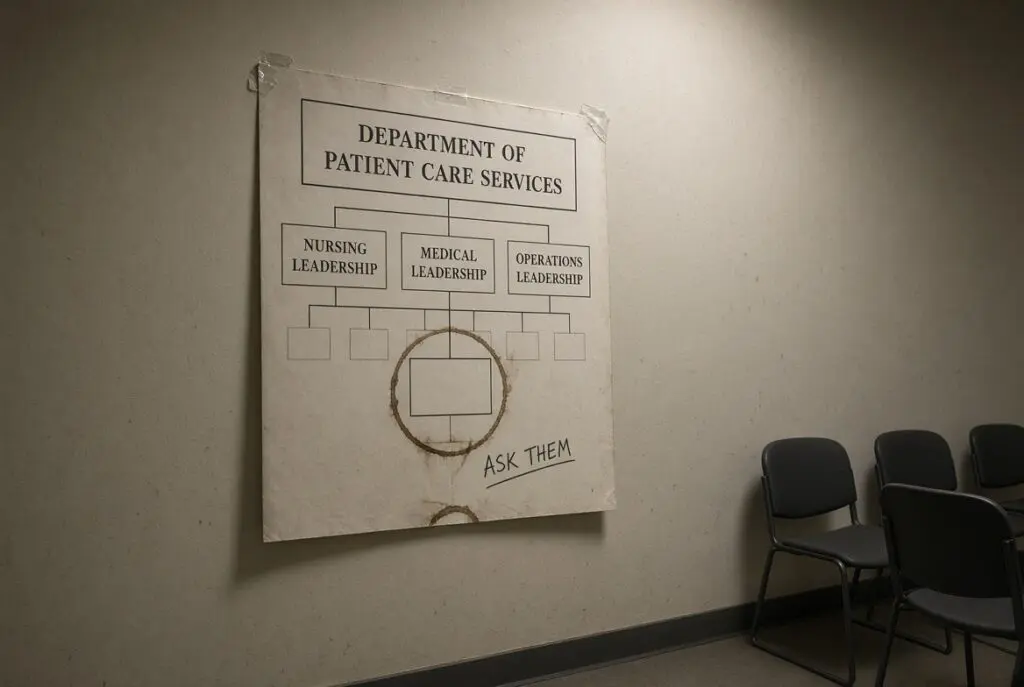
Competence That Cannot Be Called Leadership
High skill in a service role is not the same as missing a title by accident. It is often the condition of the job. If the person who actually runs the unit were named as the lead, the social contract of the place would break. Patients were promised a physician. The board was promised a medical director. The schedule was built around a psychiatrist who can only be in one room. So the work that makes those promises hold is done one layer down — and must stay one layer down.
Marty Downey, Susan Parslow, and Marcia Smart described this in nursing as informal leadership: influence without positional authority, built on expertise, relationships, and the fact that other people migrate toward the person who can actually finish the hour. A later hospital study of more than 3,000 nurses found the same pattern. About one in five were identified by peers as informal leaders. They had more experience and higher job satisfaction. They were not on the org chart as the people in charge.
This is not impostor phenomenon. The unnamed person is not secretly afraid they are a fraud. They know the work. The problem is that naming the work as leadership would violate the story the organization told about who is in charge.
It is also not “the fixer who never clocks out,” and it is not clinical perfectionism. Over-functioning and a demand that an error must not exist are different loads. Invisible competence is a status problem. The skill is allowed. The credit is not.
Where the Unofficial Work Already Sits
Facilities already know the roster, even when they will not write it down.
- The charge nurse who decides which evaluation is same-day and which can wait, while the attending is still in the meeting
- The unit clerk who knows which consultant will actually call back
- The case manager who keeps the discharge from collapsing after the note is signed
- The medical assistant who has already de-escalated the family before anyone with a longer title walks in
- The intake worker who can tell a mixed presentation from a stacked form
- The correctional officer or school counselor who is the only person the patient will speak to before the psychiatrist joins by video
A 2025 concept analysis of invisible nursing care named the pattern in clinical language: essential actions that are unrecognized and undocumented — presence, translation of the plan, protection of dignity — with a holistic and contextual character that does not show up as a billable line. The same analysis warned that invisibility is not a reason to invent a new form for every conversation. It is a reason to stop pretending the documented work is the whole job.
When the titled psychiatric role is thin, the unofficial lead inherits coordination the missing role used to absorb — and still cannot be called the lead. That is not the same problem as after-hours coverage, which is a night-and-weekend consult workflow. It is also not the same problem as rebuilding a psychiatry program after a break, which starts when the named clinician is already gone. Invisible competence is what the unit was already running on before either of those pages applies. When there are no psychiatrists, that unofficial layer just gets thicker.

What the Load Looks Like When Credit Is Forbidden
Invisible competence is praised until it fails. Then the failure is treated as a gap in the named role, not as a signal that the unnamed one was carrying the system.
The load shows up as:
- Doing the real triage while someone else signs the note
- Being asked, off the record, what should actually happen
- Training the next official lead without being in the interview
- Absorbing family affect so the titled clinician can stay “clinical”
- Having no authority to change the staffing that makes the unofficial job necessary
- Being told the work is “just being a team player”
The clinical risk is not vanity. It is attrition of the people who know the building, plus a chart that only records the person who was allowed to sign. Informal power can keep a unit safe for a long time. It cannot survive a vacation, a resignation, or a night when the unofficial lead is the one who is out.
What Actually Makes the Work Visible Enough to Survive
What helps is not a poster that says “we value every team member.” That sentence leaves the contract intact.
What helps is more precise:
- Name the function, not the romance. “Who decides same-day versus scheduled?” is a staffing question. “Who is the heart of the unit?” is a toast.
- Put the unofficial work on the coverage plan. If one person is the only one who knows which consult is real, that knowledge has to exist in more than one head.
- Stop using invisibility as a compliment. “They just handle it” means the organization has no backup.
- Give the person a channel that is not a performance. A private conversation about load is not a bid for the medical director’s chair.
- Staff the titled role so the untitled one is not the entire safety net. Continuity of the work is possible. Interchangeability with a myth is not.
When those moves fail, the person who actually runs the place leaves, or stays and becomes the single point of failure. Either way the unit discovers, late, that the org chart was a story.
When the Load Needs Clinical Care — and When the Unit Needs Coverage
Invisible competence is not automatically an illness. It becomes a clinical issue when the person cannot disclose strain without it being treated as disloyalty, when rest is framed as the building falling down, or when self-worth has been welded to remaining unofficial.
It becomes an operational issue sooner. A facility that runs on one untitled expert is one call-out away from a missed assessment. Confidential psychiatric care is useful because the conversation cannot be a performance in front of the people who depend on the unofficial lead. Telepsychiatry inside the facility’s own workflow gives that conversation a private room. How organizations actually staff titled psychiatric roles — including telepsychiatry staffing in medical care facilities — is part of whether the unnamed coordinator is still doing two jobs. That model is part of a wider shift in how telepsychiatry is improving access to modern mental health care. The same access problem is acute in Medicaid behavioral health, where technology is changing how CMHCs and FQHCs deliver psychiatric care without requiring the next clinician to become a replica of the last unofficial expert.
The task is not to promote every untitled expert into administration. It is to stop running the building on competence the org chart is not allowed to see.
FasPsych partners with organizations — hospitals and emergency departments, CCBHCs, community mental health centers, FQHCs, schools, correctional facilities, and residential programs — to place licensed psychiatrists and psychiatric nurse practitioners into existing workflows through secure, real-time video. The point is not to replace the people who already run the hour. It is to staff the titled psychiatric work so those people are not the entire system.
To map that onto your program, partner with FasPsych or call (877) 218-4070.
Frequently Asked Questions
What is invisible competence?
High skill located in a role that cannot be named as leadership without breaking the organization’s story about who is in charge. The work is real. The credit is unofficial on purpose.
How is that different from informal leadership?
They overlap. Downey, Parslow, and Smart described informal leaders as people without positional authority whom others still follow. Invisible competence is the status half of that: the skill is used, the title is withheld.
Is this the same as outsourced executive function?
No. Outsourced executive function is a principal who no longer practices planning because someone else holds the working memory. Invisible competence is a skilled person whose work must stay off the org chart. One is atrophy in the named role. The other is uncredited expertise in the unnamed one.
Who carries this in a facility?
Charge nurses, unit clerks, case managers, medical assistants, intake workers, and the staff member everyone already calls before they call the person with the longer title.
When does it become a clinical problem?
When the person cannot say they are overloaded without it being treated as a threat to the unit, when rest is framed as the building collapsing, or when their only allowed identity is “the one who just handles it.”
What should a facility stop doing?
Stop praising invisibility. Stop asking the unofficial lead what to do in the hallway and then signing the note as if the decision originated upstairs. Stop treating their vacation as an unexplained crisis.
How does telepsychiatry help?
It staffs the titled psychiatric work — evaluation, medication decisions, same-day coverage — inside the program that already exists. That keeps the unofficial coordinator from also being the missing psychiatrist.
Does FasPsych replace charge nurses or case managers?
No. FasPsych partners with organizations and places licensed psychiatrists and psychiatric nurse practitioners into existing teams. The people who already run the hour remain on the team. The titled psychiatric coverage stops being their second unpaid job.