


What clinic leaders need to decide before adding ketamine treatment
This guide is written for clinic administrators, behavioral health directors, and operations leaders weighing whether ketamine or esketamine belongs in an existing service line. It is not a pharmacology review. The questions here are operational and policy-driven: who prescribes, who monitors, who documents, and who holds the controlled-substance registration at the site where the drug is actually administered.
Readiness comes down to six things — staffing, room flow, monitoring capacity, prescribing oversight, documentation, and controlled-substance handling. Most clinics already have part of that list. The gap is usually the psychiatric layer.
That is why the sections ahead separate the remote clinical layer from the in-person treatment layer. A telehealth psychiatrist can carry evaluation, candidacy screening, prescribing, protocol authorship, and ongoing medication management; the clinic still owns dosing, vital-sign checks, the two-hour observation period Spravato’s restricted REMS requires, secure storage, and DEA registration at the administering site.
The decisions to settle before launch: whether you need contracted psychiatry telehealth coverage, a remote medical director for oversight, workflows that satisfy REMS, and a follow-up process that holds up to an audit.
Clinical, staffing, and room-flow requirements for ketamine services
Before a single dose is administered, an administrator needs to know which functions sit with a remote prescriber and which stay inside the building. The clinical decision layer — psychiatric evaluation, candidacy screening, prescribing, ongoing telehealth medication management, protocol authorship, and medical director oversight — can be run by a telepsychiatry partner. The physical layer cannot: dosing, vital-sign monitoring, Spravato REMS observation, controlled-substance storage, and DEA registration at the administering site remain the clinic’s responsibility.
Staffing. At minimum, plan for an intake pathway that routes candidates to a psychiatric evaluation, a licensed on-site clinician credentialed to administer and monitor, and a nurse or trained staff member who stays with the patient through observation and discharge. Someone must be authorized to escalate — hypertensive response, prolonged dissociation, nausea, or a patient who cannot safely leave. For esketamine, that observation window runs at least two hours after administration under the restricted REMS program, which shapes staff scheduling more than any other single variable.
Room flow. You need a private, low-stimulation treatment space with a reclining chair or bed, blood pressure and pulse oximetry monitoring, and a line of sight or call system to staff. Observation capacity, not chair count, is the real throughput ceiling. Build a written handoff: what the remote psychiatrist documents before dosing day, who confirms vitals and consent on arrival, and how a dose-hold decision reaches the on-site team in real time.
Oversight. A remote medical director or supervising psychiatrist should author the treatment protocol, review candidacy and exclusion criteria, and sign off on dose escalation and discontinuation. Storage, inventory, and prescription controls follow Schedule III requirements under 21 CFR Part 1301.
Capacity test. Map one dosing day against current rosters. If observation hours collide with existing visits, or no psychiatrist is available for follow-up medication management, the gap is behavioral health staffing — not scheduling.
Who can prescribe ketamine, and what compliance issues clinics must review
Two different products sit under the same shorthand, and conflating them is the fastest way to create a policy problem. Esketamine (Spravato) is FDA-approved for treatment-resistant depression and distributed only through a restricted Risk Evaluation and Mitigation Strategy (REMS) program, which requires certification of the site and pharmacy and monitoring of the patient for at least two hours after each dose. Racemic ketamine used in infusion or intramuscular protocols is prescribed off-label and, when sourced from a compounding pharmacy, carries a different risk profile — the FDA’s compounding risk alerts document serious illnesses and deaths linked to poor-quality compounded drugs. Your written protocol should name which product each pathway uses, who sources it, and what happens if supply changes.
Prescribing authority is a state question, not a national one. Physicians generally hold it; whether nurse practitioners and physician assistants can prescribe independently, under collaboration, or not at all depends on state licensure and scope-of-practice rules. A psychiatrist practicing through video can evaluate, diagnose, and prescribe where licensure and controlled-substance rules permit — the constraint is jurisdiction and DEA status, not the modality. Verify the license, the DEA registration, and the state’s telemedicine prescribing provisions for every clinician who will touch the program, including locums coverage.
Controlled-substance obligations attach to the physical site. Ketamine is a Schedule III controlled substance, which brings DEA registration at the administering location, secure storage, perpetual inventory and reconciliation, documented waste, and written prescription protocols under 21 CFR Part 1301. Safe Harbor Group’s compliance guidance frames these as program-level controls rather than one-time paperwork, and that framing is useful: assign an owner, set an audit interval, and train staff against the protocol.
Payer rules shape the service model more than most administrators expect. Spravato coverage, prior authorization, and site-of-care requirements vary by plan, and racemic ketamine infusions are frequently self-pay. Medicaid programs do cover many telehealth services, but coverage, originating-site rules, and billable provider types differ state by state — confirm your state’s current policy before building financial projections.
Where telehealth psychiatry fits is the clinical decision layer: evaluation, candidacy screening, prescribing, and ongoing telehealth medication management.
Patient workflow from referral to screening, treatment, and follow-up
A ketamine program runs on a defined path, not ad hoc scheduling. Mapping it before launch tells administrators exactly where video visits end and in-person care begins.
Referral and intake. Referrals arrive from primary care, therapists, inpatient discharge planners, or internal panels. Intake staff collect diagnosis history, prior antidepressant trials, current medication list, and insurance or REMS eligibility. Candidacy for treatment-resistant depression typically turns on documented failed trials, so the intake assessment should capture drug names, doses, and durations — not just “has tried SSRIs.”
Screening before the first dose. A psychiatric evaluation by video can carry this step. A remote psychiatrist reviews prior antidepressant trials and screens for psychosis, substance use history, and cardiovascular risk before documenting why ketamine or esketamine is appropriate. Pair that with a local medical review: vital signs, blood pressure history, pregnancy status, and any aneurysmal vascular disease. Record exclusions explicitly — a blank field is not a negative finding during an audit.
Treatment day. Check-in confirms a responsible ride home and an empty-stomach interval per protocol, then informed consent is signed and scanned. Nursing verifies the order, pulls the dose from controlled-substance storage with a witnessed count, and documents baseline vitals. Dosing, monitoring, and discharge are local work. For esketamine, FDA requires administration in a REMS-certified, medically supervised setting with monitoring for at least two hours after each dose, which drives chair capacity and nurse ratios more than any other variable. Discharge instructions cover driving restrictions, side-effect reporting, and the next appointment.
Follow-up. Within a week, the prescribing telehealth psychiatrist reviews PHQ-9 or MADRS scores, side effects, and the oral antidepressant regimen, then decides whether to continue, space out, or stop maintenance. Keeping induction and maintenance decisions with one clinician through ongoing telehealth medication management avoids the split where nobody owns the oral medication.
Every step — screening rationale, consent, dose count, observation times, score trends — should land in the shared record the same day.
How telehealth medication management supports ketamine programs
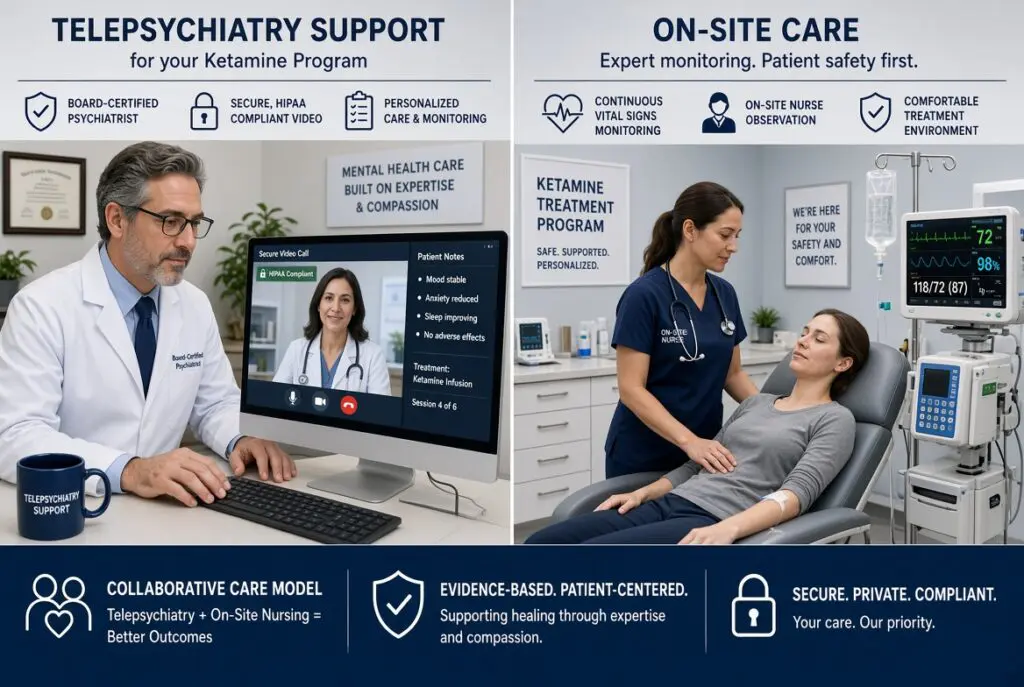
A ketamine or esketamine program splits cleanly into two layers, and only one of them has to happen on site. The clinical decision layer — psychiatric evaluation, candidacy screening, prescribing, protocol authorship, and ongoing follow-up — can be delivered by video. A telehealth psychiatrist can review prior antidepressant trials, screen for psychosis, substance use history, and cardiovascular risk, document why treatment is appropriate, and then manage maintenance intervals and the companion oral antidepressant after induction. Whether that clinician can prescribe remotely depends on state licensure and controlled-substance rules, so verify both before scheduling the first patient.
The physical layer stays with your clinic: dosing, vital-sign monitoring, the two-hour observation window the Spravato REMS requires after administration, controlled-substance storage, and the DEA registration at the administering site. Sedation and respiratory depression need trained hands in the room. A video link cannot substitute.
That division is why psychiatric telehealth suits clinics with nurses and a treatment room but no full-time psychiatrist. A remote medical director can hold protocol authority and define on-site delegation without the cost of building an in-house psychiatry department.
The tradeoff is real: telehealth medication management improves access and staffing flexibility, but only if on-site execution is disciplined and escalation pathways are written down.
FAQ: common questions before a clinic starts ketamine services
Who is actually allowed to prescribe it? Prescribing sits with licensed clinicians working inside state scope-of-practice rules — physicians, and in many states nurse practitioners or physician assistants under collaborative or supervisory agreements. So yes, a psychiatrist can prescribe ketamine where state law and the clinic’s own protocol permit it, but the controlling detail for administrators is registration, not credentials alone. Safe Harbor Group’s ketamine compliance guidance describes the Schedule III obligations — registration, storage, inventory management, and prescription protocols under 21 CFR Part 1301 — that attach to the site where the drug is held and given.
Can the prescriber be remote? For the clinical decision layer, yes. A telehealth psychiatrist can run psychiatric evaluation, candidacy screening, prescribing, ongoing telehealth medication management, protocol authorship, and remote medical director oversight, while the clinic retains the physical layer: dosing, vital-sign monitoring, Spravato REMS observation, controlled-substance storage, and DEA registration at the administering site. That same documentation notes esketamine is available only through the restricted REMS and requires at least two hours of post-administration monitoring. Confirm current DEA telemedicine rules for controlled-substance prescribing before you build the workflow around a remote prescriber.
What should we verify about Medicaid and telehealth billing? Treat the virtual visit and the in-clinic encounter as two separate reimbursement questions. Ask your state Medicaid agency and each managed care contract which provider types are eligible, whether video is required, how originating-site rules apply, and how observation time is billed. Medicare telehealth waivers and state parity rules change on their own schedules — verify in writing rather than relying on last year’s policy summary.
Is this a fit for postpartum depression patients? Interest in virtual perinatal mental health care is high, and psychiatry telehealth is often the fastest route to an intake assessment. Candidacy for ketamine or esketamine is a separate clinical decision involving approved indications, lactation status, concurrent medications, and payer coverage. Confirm all four before you market the service line to that population.
What’s the minimum operational check before opening? Five items: DEA registration and storage at the administering site; a written protocol with a named medical director; monitoring staff and a room that can hold a patient for the full observation window; documented payer coverage; and a clear sourcing decision — the FDA’s compounding risk alerts tie serious illnesses and deaths to poor-quality compounded drugs, so compounded ketamine and FDA-regulated esketamine should never be conflated in your policies.
For help building a compliant ketamine program, contact FasPsych.