


Hospitals are operating under tighter financial constraints than they have in years. Recent data from Kaufman Hall’s National Hospital Flash Report shows that roughly 43% of hospitals are operating at a loss, up from about 33% before the pandemic, with margins remaining under pressure even as revenue grows (Kaufman Hall; Medical Daily coverage). At the same time, psychiatric coverage remains essential for emergency departments, inpatient units, and medical floors. The practical question is not whether hospitals need psychiatrists. It is how to secure reliable coverage without committing scarce capital to a fixed full-time hire that may not match actual demand.
Recruiting and retaining a full-time psychiatrist carries significant opportunity costs. Those costs go beyond base salary and include recruitment fees, signing bonuses, benefits, malpractice coverage, and the revenue lost while a position sits vacant for months. Even after a hire is made, hospitals often carry idle capacity during lower-volume periods while still paying the full fixed cost.
FasPsych’s model of flexible telepsychiatry staffing addresses this directly. Hospitals pay only for the coverage they use—whether on-demand consults, block hours, or dedicated remote support—without the long-term fixed overhead of an employed psychiatrist. Learn more about telepsychiatry services for organizations.

The Real Cost of a Full-Time Psychiatrist
A full-time psychiatrist position is rarely just a salary line. Typical added costs include:
- Recruitment fees or internal recruiter time that commonly range from $20,000 to $40,000 or more, depending on specialty and market (industry estimates place average search costs near $30,000; OnCall Solutions analysis)
- Signing bonuses that frequently run $20,000 to $50,000 or higher in competitive markets
- Benefits, retirement contributions, paid time off, and CME
- Malpractice insurance and credentialing overhead
- Months of lost clinical capacity while the search and onboarding process runs—often 90 to 180 days or longer, with vacancy revenue losses that can reach thousands of dollars per day (OnCall Solutions)
During that vacancy period, hospitals frequently rely on expensive locum coverage or transfer patients elsewhere. Both options add cost and disrupt continuity. Once the position is filled, the hospital still pays the full package even if volume fluctuates or certain shifts go underutilized.
For facilities already operating on thin margins, locking capital into a fixed FTE can limit investment in higher-priority areas such as equipment, outpatient growth, or other service lines. HRSA data continues to show that more than 137 million Americans live in mental health professional shortage areas, which keeps recruitment timelines long and competition intense (KFF summary of HRSA data; HRSA shortage area data).
Why Flexible Coverage Aligns Better With Current Hospital Finances
Many hospitals no longer have the luxury of overstaffing for peak demand. Flexible telepsychiatry staffing lets organizations match cost to actual need. Coverage can scale up during high-census periods or after-hours spikes and scale down when volume drops, without the fixed expense of an employed provider.
This approach is especially relevant for:
- Emergency departments that need reliable psychiatric evaluation to reduce boarding
- Medical-surgical floors that require consult-liaison support for patients with comorbid conditions
- Facilities that experience uneven or seasonal psychiatric demand
- Smaller or mid-sized hospitals that cannot consistently fill a full-time psychiatrist role
FasPsych places licensed psychiatrists and psychiatric nurse practitioners into the hospital’s existing workflow on secure video. The hospital retains ownership of the service line, the medical record, and clinical governance. Providers document in the facility’s EHR and function as an extension of the on-site team. See how FasPsych supports organizations across care settings.
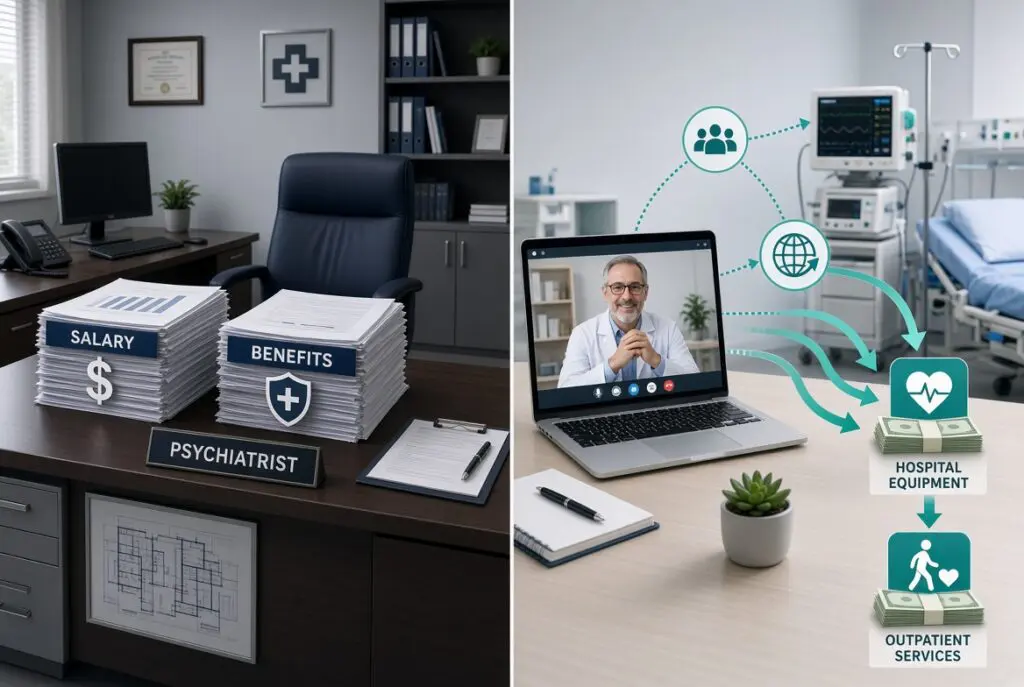
Comparing Fixed FTE and Flexible Staffing
| Factor | Full-Time Employed Psychiatrist | Flexible Telepsychiatry Staffing (FasPsych) |
|---|---|---|
| Cost structure | Fixed salary + benefits year-round | Pay only for hours or visits used |
| Time to coverage | Often 3–6+ months | Typically weeks once credentialing begins |
| Idle capacity risk | High during low-volume periods | Low; scale coverage to demand |
| Recruitment overhead | Significant upfront and ongoing | Handled by the staffing partner |
| Capital impact | Locks resources into one role | Preserves capital for other priorities |
For more detail on matching payment structure to volume, see FasPsych’s guide on choosing a behavioral health staffing payment model.
Preserving Capital While Meeting Essential Needs
Hospital leaders are being asked to protect access to behavioral health services while also controlling expenses and directing limited capital toward strategic priorities. Flexible psychiatric coverage supports both goals.
By avoiding the full fixed cost of recruitment and employment, hospitals free resources that can be directed toward:
- Expanding higher-margin outpatient or ambulatory services
- Addressing other workforce or infrastructure needs
- Maintaining overall financial stability amid rising supply costs and payer-mix pressures documented in Kaufman Hall’s ongoing reports
At the same time, patients continue to receive timely psychiatric evaluation and medication management. On-site teams gain reliable specialist support without the administrative burden of managing another employed physician.

Moving Forward With Coverage That Matches Reality
Hospitals that treat psychiatric staffing as a fixed headcount decision often absorb unnecessary cost and risk. Facilities that treat it as a variable coverage need can maintain access while protecting capital.
FasPsych has partnered with hospitals and health systems since 2007 to provide flexible psychiatric staffing. Coverage can be structured around the hospital’s actual volume pattern—whether that means after-hours ED support, daily consults, or broader remote staffing—without locking the organization into a permanent FTE.
If your hospital is evaluating how to sustain psychiatric coverage under current financial pressures, the next step is a straightforward assessment of volume, coverage gaps, and preferred model.
Partner with FasPsych to discuss flexible psychiatric staffing options that scale with demand and help preserve capital for other priorities. Call (877) 218-4070 to start the conversation.