
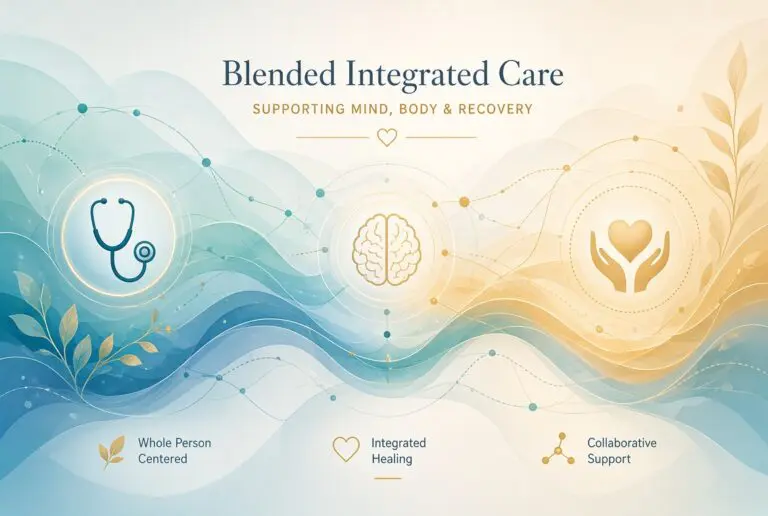

In 2017, “Despacito” by Luis Fonsi featuring Daddy Yankee became a global phenomenon by blending reggaeton rhythms with Latin pop melody and crossing linguistic and cultural borders. The track, later boosted by a Justin Bieber remix, topped charts in dozens of countries and showed that intentional fusion of distinct styles can produce something larger than either element alone. The same principle applies to the care of patients with dual diagnosis, also called co-occurring disorders—those living with both a mental health condition and a substance use disorder. Treating only one side of the problem, or handing patients between siloed specialists, routinely produces poorer outcomes than an intentionally blended specialty approach.
Blended specialty care for dual diagnosis patients addresses mental health, substance use, and related medical and trauma factors within one coordinated pathway rather than through separate, poorly linked services. According to SAMHSA’s 2024 National Survey on Drug Use and Health, approximately 21.2 million U.S. adults had both a mental illness and a substance use disorder in the past year. Only a small fraction received treatment that addressed both conditions. SAMHSA’s TIP 42 on Substance Use Disorder Treatment for People With Co-Occurring Disorders establishes that integrated treatment is the preferred standard. Trauma is nearly ubiquitous in these cases, so trauma-informed practices must be woven into the model rather than added later.
When organizations attempt to assemble this blend with separate psychiatry, addiction, and medical contracts, coordination overhead rises and patients fall through the gaps. FasPsych’s telepsychiatry staffing model supplies the blended capacity inside the facility’s existing workflow. Providers document in the partner’s EHR, follow the partner’s clinical protocols, and can be matched for expertise in trauma-informed care, addiction psychiatry (including coordination with medication-assisted treatment), and medical-psychiatric management. Organizations that already operate residential, hospital, or outpatient dual-diagnosis programs can add or expand this layer without standing up a second clinical system.
Why Siloed Care Fails Dual-Diagnosis Patients
Patients with co-occurring disorders face higher rates of hospitalization, relapse, and treatment dropout when care is fragmented. A psychiatrist may stabilize mood symptoms while an addiction program addresses substance use on a separate schedule, and neither may systematically screen for or address trauma. Medical complications—withdrawal, liver disease, chronic pain, or interactions between psychiatric medications and MAT agents—further complicate the picture. Dual-licensed physicians who hold credentials in both medicine and psychiatry can reduce some of this fragmentation by managing medical and psychiatric issues in the same encounter, but most programs still need a broader specialty blend that includes trauma-informed dual diagnosis telepsychiatry staffing and addiction expertise.
Integrated models that combine psychiatric evaluation and medication management with trauma-informed approaches and addiction expertise produce better retention and symptom reduction. The challenge for most facilities is not the clinical evidence; it is the practical difficulty of staffing and coordinating those elements consistently.
Building a Blended Specialty Pathway for Dual Diagnosis
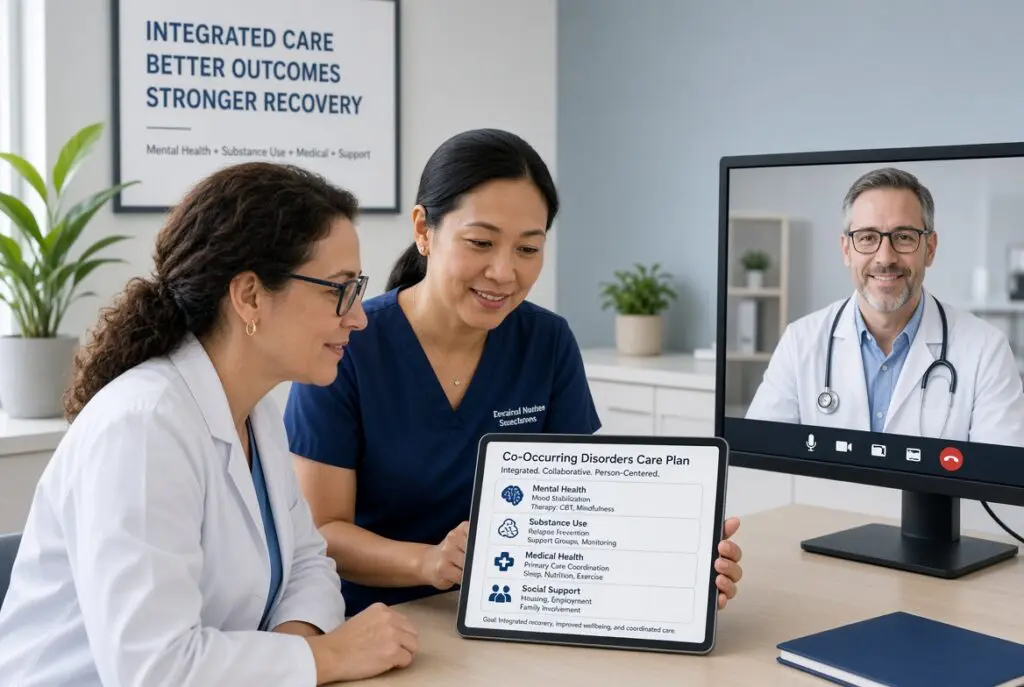
A practical blended specialty care pathway for dual-diagnosis patients typically includes four elements that can be staffed through a telepsychiatry partner:
- Comprehensive psychiatric evaluation that screens for both mental illness and substance use, with trauma history taken in a non-retraumatizing manner. Providers trained in trauma-informed care avoid re-exposure while still documenting the history needed for treatment planning.
- Medication management that accounts for co-occurring conditions. This includes careful prescribing around MAT agents such as buprenorphine or naltrexone, monitoring for interactions, and addressing medical comorbidities. This dual diagnosis psychiatric medication management layer is a core part of the blend.
- Coordination with on-site counseling and case management. The telepsychiatrist or psychiatric nurse practitioner does not replace the facility’s therapists; they supply the medical and diagnostic layer that supports the rest of the team.
- Measurement and adjustment. Tracking symptom scales and substance use markers allows the team to adjust the plan rather than continuing a static regimen that is not working.
This approach is distinct from a pure Collaborative Care Model in primary care. It is an operational staffing model for programs that already treat dual-diagnosis patients and need reliable, specialty-matched psychiatric capacity that understands trauma, addiction, and medical complexity at the same time.
How FasPsych Supports Integrated Addiction Psychiatry and Trauma-Informed Dual Diagnosis Care
FasPsych places licensed psychiatrists and psychiatric nurse practitioners into the partner organization’s existing programs on secure, real-time video. The same network that supports adult psychiatric services, dual-licensed medical-psychiatric providers, and MAT coordination can be configured for dual-diagnosis pathways. Facilities pay for the clinical time used, with no requirement to hire full-time specialists or manage multiple vendor contracts. Providers work inside the facility’s EHR and clinical governance, so the blend remains under the organization’s control.
Programs that have struggled to keep addiction, trauma, and psychiatric expertise aligned—whether in residential treatment, hospital consult services, or outpatient dual-diagnosis clinics—can use this model to reduce fragmentation without rebuilding their entire service line.
Key Takeaways
- Roughly 21.2 million U.S. adults have co-occurring mental illness and substance use disorder; integrated, blended specialty care remains the evidence-based standard.
- Trauma-informed practices, addiction expertise (including MAT coordination), and medical-psychiatric management produce better outcomes when they are deliberately blended rather than siloed.
- Dual diagnosis telepsychiatry staffing can supply that blended capacity inside the facility’s existing workflow, documentation system, and clinical protocols.
- The operational goal is continuity and coordination, not the creation of a separate dual-diagnosis clinic.
Organizations evaluating coverage for dual-diagnosis programs can review FasPsych’s provider capabilities and contact the team to map a blended specialty pathway that fits their current structure. Partner with FasPsych or call (877) 218-4070.