
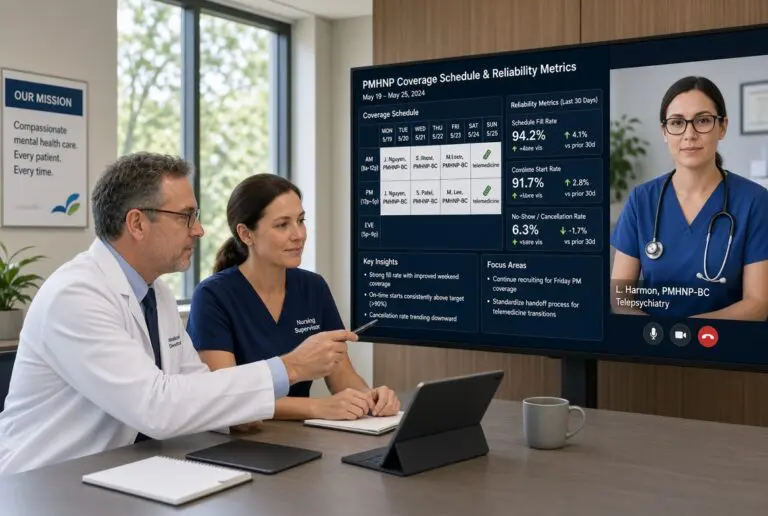

Organizations searching for telepsychiatry providers that supply psychiatric nurse practitioners are usually trying to close a specific capacity gap. Psychiatric mental health nurse practitioners (PMHNPs) can expand medication management and evaluation capacity in settings where recruiting full-time psychiatrists is slow or cost-prohibitive. The practical question is which partners can deliver consistent, appropriately licensed PMHNP coverage that works inside the organization’s existing systems rather than as a parallel service.
The American Psychiatric Association supports telepsychiatry as a validated method of increasing access when used consistent with ethical standards and applicable law. The APA and American Telemedicine Association’s Best Practices in Synchronous Videoconferencing-Based Telemental Health emphasize that clinical standards should remain consistent regardless of modality. State scope-of-practice rules and collaborative practice requirements for nurse practitioners vary and must be confirmed for each location.
PMHNP Supply Reliability Framework
Programs can evaluate telepsychiatry partners for psychiatric nurse practitioner supply against four practical pillars.
- Consistent Availability — The partner maintains a bench of board-certified PMHNPs licensed in the relevant states and can commit to defined hours or a defined response window rather than one-off placements.
- Scope and Collaboration Fit — The partner understands and can support the state’s practice rules, including any required physician collaboration or supervision. Documentation and prescribing workflows align with those requirements.
- Workflow Integration — PMHNPs document in the organization’s EHR, follow the organization’s clinical protocols, and coordinate with onsite staff. The service does not create a separate virtual front door or parallel record system.
- Continuity and Measurement — The same PMHNP or a small, stable team covers a defined panel or set of hours over time. The organization can track basic indicators such as fill rate of scheduled hours, time from referral to first visit, and referring-clinician feedback.
Partners that score high on these pillars treat PMHNP coverage as added capacity inside the existing program. Those that score low often produce short-term placements with limited continuity or workflow friction.

Practical Steps to Evaluate Providers for PMHNP Supply
Clarify the clinical role needed.
Decide whether the primary need is outpatient medication management, inpatient or ED coverage, collaborative care support, or a mix. Confirm the expected weekly hours and the states involved.
Confirm licensing and scope alignment.
Ask the partner how they verify current state licensure, DEA registration where needed, and board certification for PMHNPs. Request a clear description of how collaborative practice agreements are managed in states that require them.
Assess integration and continuity.
Confirm that the PMHNPs will document in the organization’s EHR and that a defined process exists for care coordination with onsite clinicians. Ask about typical duration of assignment for a given clinician and what happens if a provider leaves.
Pilot and measure.
Start with a defined set of hours or a specific service line. Track:
| Metric | What it measures | Early target direction |
|---|---|---|
| Scheduled hour fill rate | Reliability of supply | High and stable |
| Time from referral or request to first PMHNP visit | Access speed | Decreasing |
| Continuity of the same PMHNP or small team | Relationship quality | Stable over the pilot period |
| Referring clinician or staff feedback | Workflow fit | Positive trend |
Common Pitfalls When Adding PMHNP Telepsychiatry Coverage
- Scope mismatch. The partner places a PMHNP without confirming state collaboration requirements. Mitigation: Require written confirmation of licensing and collaboration processes before go-live.
- Short-term placements only. Coverage rotates frequently, reducing continuity for patients and staff. Mitigation: Ask about average assignment length and the process for maintaining continuity when a clinician changes.
- Parallel systems. Notes live outside the organization’s EHR. Mitigation: Require documentation in the existing record from the first day.
- Unclear ownership of collaboration. In states that require physician oversight, responsibility for the collaborative agreement is unclear. Mitigation: Define who holds the agreement and how communication between the PMHNP and collaborating physician will occur.
How FasPsych Supports Psychiatric Nurse Practitioner Coverage
FasPsych’s national network includes board-certified psychiatric nurse practitioners who can be placed into existing clinic, hospital, and behavioral health workflows. Providers document in the partner’s EHR and coordinate with onsite teams. Coverage can be structured as scheduled hours, on-demand support, or a combination, with flexibility to adjust as volume changes.
This approach is designed for organizations that want reliable PMHNP capacity without managing individual recruiting and credentialing for every placement. More information on psychiatric nurse practitioners is available on the psychiatric nurse practitioner page. General telepsychiatry staffing appears on the telepsychiatry services page, and clinic-specific options are covered under clinics.
Frequently Asked Questions
Do psychiatric nurse practitioners have full prescribing authority in telepsychiatry?
Prescribing authority depends on state scope-of-practice rules. Many states grant PMHNPs independent or reduced-supervision prescribing authority; others require a collaborative practice agreement with a physician. Partners should confirm the rules that apply to each state of service.
Can the same PMHNP provide both telepsychiatry and occasional on-site coverage?
Yes, when the organization structures the arrangement that way. Hybrid models that combine virtual hours with periodic in-person visits are available from some staffing partners.
How long does it typically take to start PMHNP coverage?
Once scope, state licensure needs, and EHR access are confirmed, many programs begin scheduled coverage within four to six weeks.
What happens if a PMHNP leaves during an assignment?
Reliable partners maintain a bench of licensed clinicians and have a process for continuity of care and knowledge transfer when a provider changes.
Evaluating which telepsychiatry providers supply psychiatric nurse practitioners is most effective when organizations focus on consistent availability, scope-of-practice alignment, workflow integration, and measurable continuity. Partners that meet these criteria can expand psychiatric capacity while keeping patients and documentation inside the existing program.
To discuss how FasPsych can support psychiatric nurse practitioner coverage within your existing workflows, explore the psychiatric nurse practitioner page or the telepsychiatry services section.