
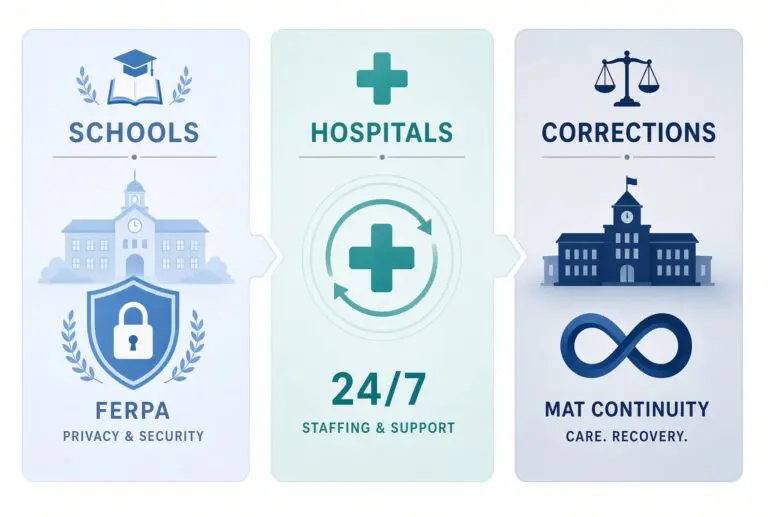

Institutions should choose telehealth medication management by the requirements of their setting rather than by consumer app features. Schools, hospitals and correctional facilities face different rules, staffing patterns and risks. As a result, each one needs to answer four questions before comparing vendors:
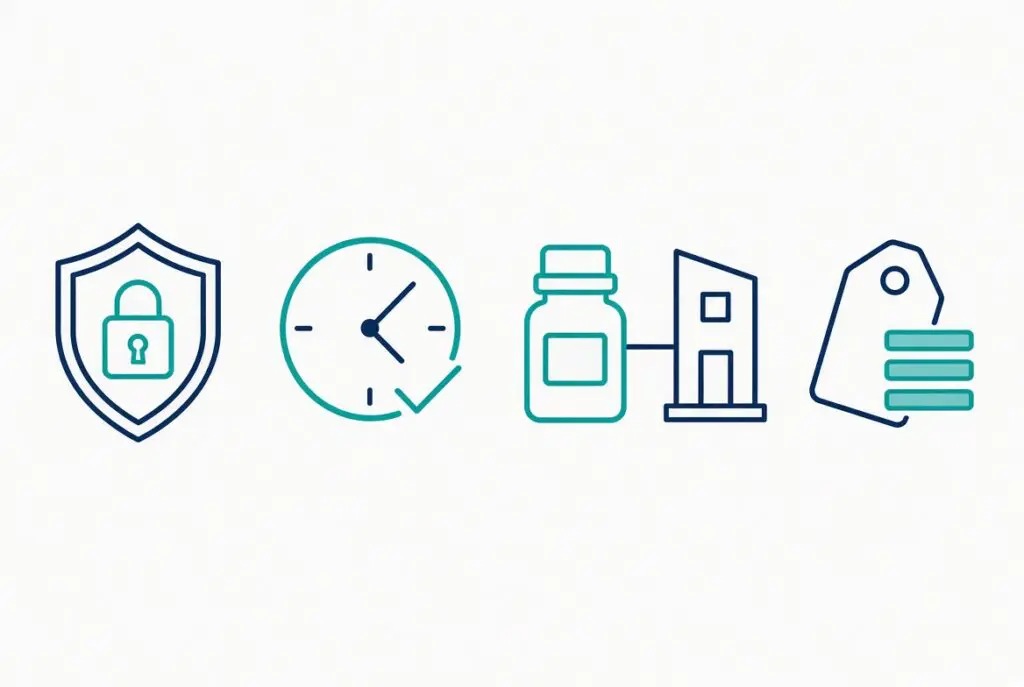
- Which privacy and controlled-substance rules apply?
- Who prescribes, and when are they available?
- Who handles medication on site?
- How is the service priced?
App reviews rarely address any of these, so they make a weak basis for comparing virtual psychiatric medication management platforms. FasPsych’s medication management services offer a practical way to staff each model. Because one service can cover campus health centers, hospital units and correctional clinics, you can apply the same evaluation across every site you run. The deciding question is which clinical model fits your patients, your staff and your regulators. See how FasPsych applies the same approach across hospitals, jails, and schools in this overview of multi-setting behavioral health telehealth.
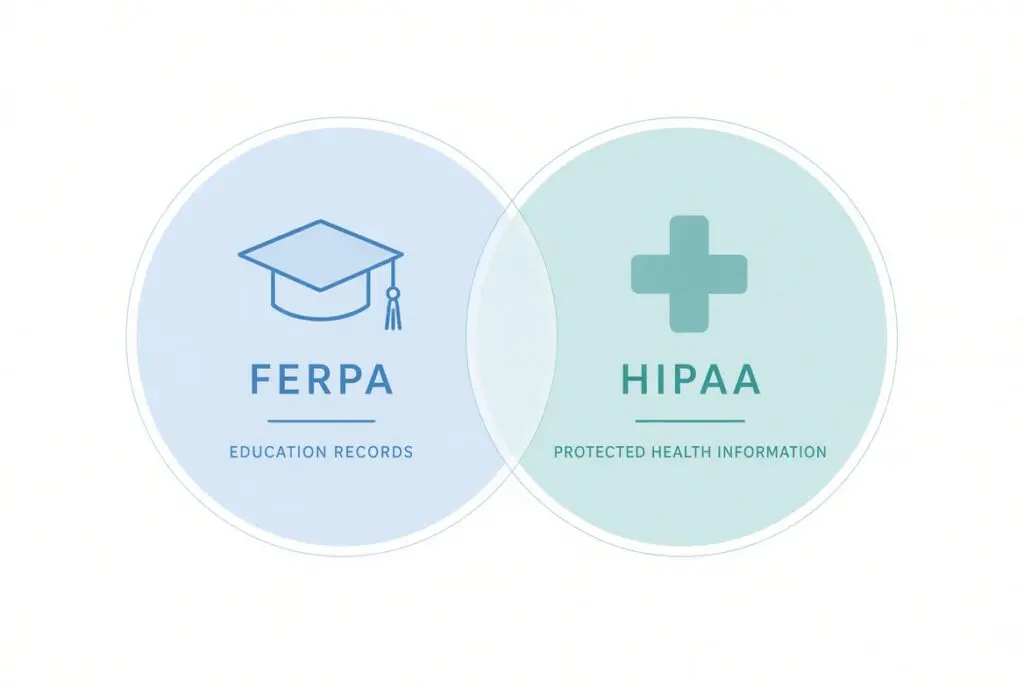
Secure Virtual Medication Management for Schools and Universities Depends on the FERPA and HIPAA Split
On campus, the first compliance question is which law governs the record, and the answer is often FERPA rather than HIPAA. Under the Department of Education’s 2026 guidance, FERPA protects records directly related to a student and maintained by an institution or a party acting for it. The same guidance says the HIPAA Privacy Rule excludes FERPA-protected records at institutions that provide health services to students. Student health records therefore fall under FERPA.
This split changes daily practice for a telehealth psychiatrist. FERPA generally requires written consent before a school discloses personally identifiable information from education records, with specified exceptions. Consent workflows therefore decide what the remote prescriber can share with counselors, families or outside pharmacies. Because the Student Privacy Policy Office administers and enforces FERPA, that office is the reference point for your record policies. HIPAA guidance alone is not enough.
The same consent logic also governs coordination with campus nurses who give medication. For example, every dosing change has to reach them through an approved channel. High-quality, secure virtual medication management services for schools and universities write these handoffs into the contract. FasPsych’s telehealth support for schools and universities builds remote prescribing around FERPA consent and on-campus administration.
Which Telepsychiatry Providers Offer Scalable Staffing and 24/7 On-Call Medication Management for Hospitals
Hospitals and emergency departments carry less privacy ambiguity than campuses, so the staffing model matters more than the platform. The providers that scale are the ones that can staff both dedicated and shared prescribers. That flexibility lets you add after-hours and on-call coverage without hiring a full psychiatrist for every shift.
A dedicated prescriber suits a high-volume inpatient unit that needs continuity across admissions. By contrast, a shared prescriber pool suits a small hospital or an emergency department with uneven overnight demand. It is often the most cost-effective option, because you pay for the coverage you use rather than for an idle full-time position.
A staffing partner such as FasPsych can provide telepsychiatry staffing for clinics and hospitals in either model. However, when you compare providers that advertise 24/7 on-call medication management, confirm weekend coverage, response times and holiday coverage in writing.
Coverage is only part of the hospital picture, because medication decisions also drive length of stay and payer authorization. Utilization management support should therefore be part of the evaluation. A provider that adds psychiatric utilization review support helps document medical necessity and reduce avoidable days.
What Correctional Facilities Need from Telehealth Medication Management for Controlled Substances and MAT
Corrections adds two requirements on top of staffing: correctional health standards and controlled-substance rules. The controlled-substance layer is still unsettled. The DEA’s Diversion Control page states that telemedicine flexibilities were extended through 2025. However, it does not establish their 2026 status or give an effective date for a final special-registration rule. (Note: current flexibilities extend through December 31, 2026.)
Because of that uncertainty, a facility should contract for two safeguards. The first is clarity on each prescriber’s DEA registration. The second is a defined in-person backup in case remote prescribing of a controlled substance becomes restricted.
Beyond regulation, the real operational test is medication-assisted treatment continuity. For example, a patient who arrives on buprenorphine should not go without a dose during intake. Likewise, a patient leaving custody needs a prescription and a community appointment arranged before release. Strong telehealth medication management solutions for correctional facilities plan for both transitions. FasPsych’s virtual medication-assisted treatment keeps MAT continuous from booking through release.
How to Compare Costs and Features, Then Launch an Online Medication Management Partner
With each setting’s requirements laid out, the differences are easiest to see side by side. Pricing should follow demand, which is why the shared-pool logic from hospitals carries into the pricing row below.
| Schools and universities | Hospitals and EDs | Correctional facilities | |
|---|---|---|---|
| FasPsych coverage | Campus telepsychiatry support | Dedicated or shared staffing | Psychiatric care and virtual MAT |
| Compliance layer | FERPA for student health records, written consent | HIPAA, payer authorization | Correctional health standards, DEA controlled-substance rules |
| Typical staffing | Shared prescriber, scheduled sessions | Dedicated for inpatient, shared pool for ED | Dedicated or block coverage |
| On-call need | Low, term-based | High, around the clock | Moderate, intake-driven |
| Who administers on site | Campus nurses | Unit nursing staff | Facility medical staff |
| Common pricing | Per-encounter or block-hour | Block-hour or dedicated FTE | Block-hour or dedicated FTE |

The same models also extend beyond these three settings. Federally qualified health centers and primary care practices usually find per-encounter or block-hour pricing affordable, because their psychiatric demand runs alongside general medicine. Integrated care programs, in turn, often need a consulting psychiatrist who advises primary care prescribers rather than one who manages every patient directly. Residential treatment facilities behave more like hospitals, since they need scheduled rounds, after-hours coverage and nursing staff who administer medication.
Once you know which column describes you, write down those requirements and test each provider against them. Verify four points:
- Prescriber credentialing and licensure in your state
- Exact coverage hours, including holidays
- DEA registration for controlled substances
- How documentation reaches the staff who administer medication
References from comparable schools, hospitals or facilities will tell you more than app reviews. Then launch in phases: begin with one unit or clinic, review the handoffs and expand from there. Smaller facilities in particular benefit from a structured approach—see the steps for creating an effective telepsychiatry program by smaller facilities. For a structured rollout, follow FasPsych’s step-by-step telepsychiatry implementation guide, then contact the team to scope coverage for your setting.