
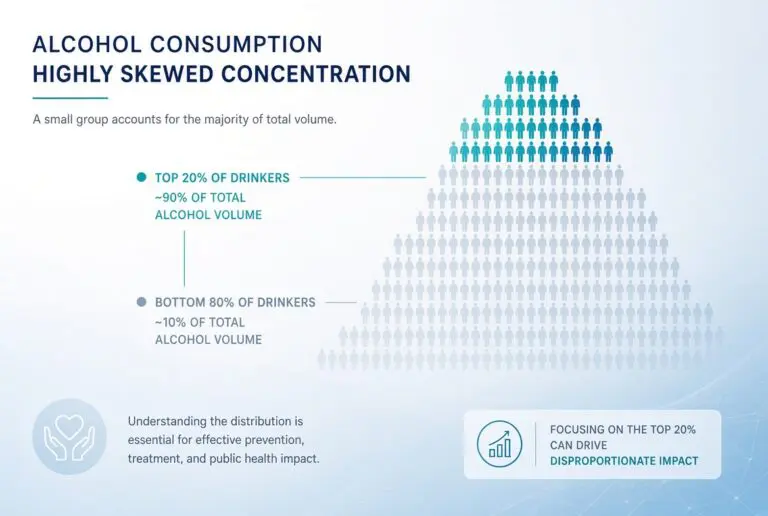

A recent Bernstein analysis, covered by the Wall Street Journal, found that roughly the top 20% of adults account for an estimated 90% of alcohol sales volume. This reinforces the industry’s structural reliance on heavier drinkers.
Earlier data from economist Philip J. Cook’s analysis in Paying the Tab, based on National Epidemiologic Survey on Alcohol and Related Conditions data and reported by the Washington Post, showed that the top 10% of drinkers account for 60% of alcohol sales and average 74 drinks per week—about 10 drinks per day. Cook’s analysis further showed that if the top 10% of drinkers reduced their consumption to the level of the next lower group, alcohol sales would fall by 60%.
The distribution is highly skewed. The bottom 30% of adults don’t drink at all, and the next 30% drink less than one drink per week.
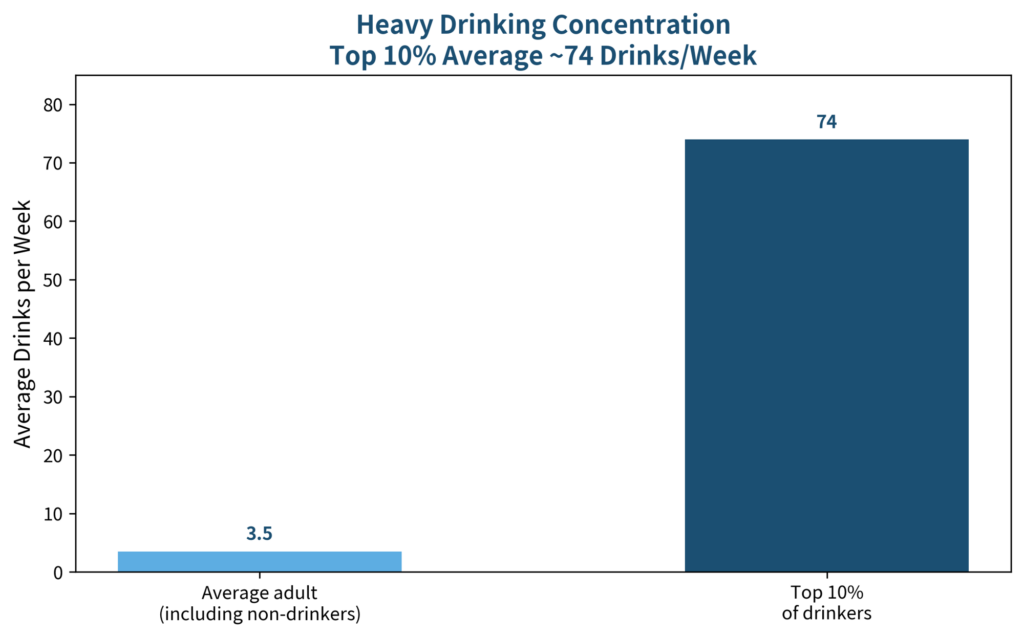
Alcohol Sales Concentration and the Scale of Heavy Drinking
Under DSM-5-TR, alcohol use disorder is diagnosed when an individual meets two or more of 11 criteria within a 12-month period; six or more criteria indicate a severe disorder. Daily or near-daily use at roughly 10 drinks per day commonly involves impaired control, continued use despite problems, and other symptoms consistent with severe AUD.
The public-health consequences of this concentration are substantial. According to the CDC, excessive alcohol use costs the United States approximately $249 billion annually (most recent comprehensive estimate, 2010 dollars), with the majority related to lost productivity and binge drinking. NIAAA reports more than 178,000 deaths attributable to excessive alcohol use each year. CDC data show that alcohol-induced death rates among adults ages 45 and older rose from 19.5 to 25.2 per 100,000 between 2014 and 2024.
The Treatment Gap Linked to Heavy Drinking Concentration
Despite the concentration of alcohol sales among the heaviest drinkers, most people who meet criteria for alcohol use disorder receive no treatment. NIAAA data show that approximately 28 million people ages 12 and older had past-year AUD in 2024. Only about 7–8% of adults with AUD received any alcohol use treatment, and roughly 2.5% received medication-assisted treatment.
Heavy alcohol use also appears frequently in clinical settings. National data indicate that roughly 1 in 11 emergency department visits and 1 in 9 hospitalizations involve adults with alcohol or other substance use disorders. Organizations that already see these patients often lack consistent psychiatric capacity for evaluation and medication management. This shortage of psychiatric resources in primary care and other front-line settings has been widely documented, including in discussions of addressing the psychiatric staffing shortage in primary care.
Evidence-Based Medication Management for the Population Identified by Sales Data
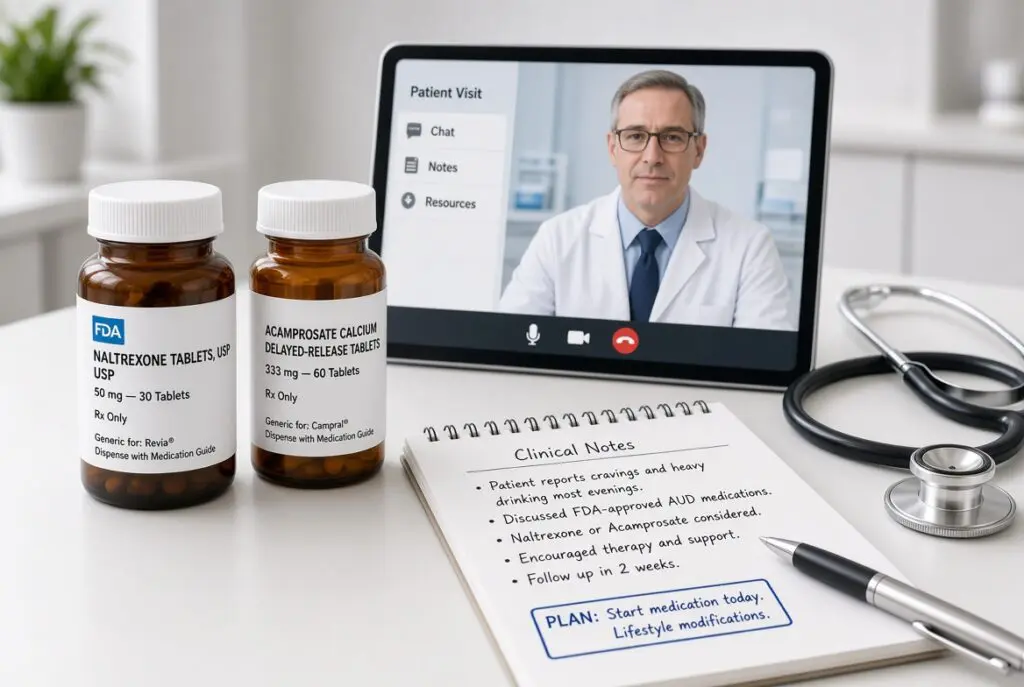
FDA-approved medications for alcohol use disorder—naltrexone, acamprosate, and disulfiram—have a substantial evidence base when combined with counseling. A 2023 systematic review and meta-analysis published in JAMA found that oral naltrexone (50 mg daily) and acamprosate reduce return to drinking, with numbers needed to treat of 18 and 11, respectively, to prevent return to any drinking. Oral naltrexone also reduces return to heavy drinking (number needed to treat of 11).
Mutual-help groups such as Alcoholics Anonymous remain widely available. A 2020 Cochrane review found that manualized 12-step facilitation programs can improve continuous abstinence relative to some other psychosocial treatments. However, pure peer-led participation does not provide medical evaluation, medication management, or treatment of co-occurring psychiatric conditions. The sales concentration data identify a population for whom the medical component of care is frequently missing.
Integrated approaches such as the Collaborative Care Model (CoCM) can help embed psychiatric expertise into primary care and other medical settings. FasPsych prioritizes access to that medical capacity. Through its telepsychiatry network, organizations gain psychiatrists and psychiatric nurse practitioners who can evaluate patients identified by high alcohol use, prescribe and monitor FDA-approved medications, and address co-occurring conditions within existing clinical workflows.
Expanding Psychiatric Capacity for Organizations Already Serving Heavy Drinkers
Organizations can address part of the treatment gap without recruiting full-time psychiatrists. Telepsychiatry staffing supplies board-certified psychiatrists and psychiatric nurse practitioners who perform remote evaluations, diagnose alcohol use disorder and co-occurring conditions, manage medications, and document directly in the facility’s electronic health record. Coverage can be scheduled in blocks or made available on demand to match actual patient volume. Smaller facilities in particular can benefit from structured approaches to building telepsychiatry programs, as outlined in guidance on the steps for creating an effective telepsychiatry program by smaller facilities.
Psychiatric staffing networks provide flexible coverage that supports modern healthcare systems without the overhead of permanent full-time hires. FasPsych connects hospitals, clinics, community mental health centers, residential programs, and correctional health systems with this national network through secure, HIPAA-compliant telepsychiatry. Partner organizations gain flexible psychiatric capacity for the population whose drinking levels drive the majority of alcohol sales, without building a permanent in-house department.
Address the Unmet Need Identified by Alcohol Sales Data
The data show a clear pattern: a relatively small group of heavy drinkers accounts for the majority of alcohol sales, a large share of those individuals meet criteria for alcohol use disorder, and most receive no treatment in a given year. Organizations that already interact with these patients are positioned to expand capacity for evaluation and medication management.
FasPsych specializes in integrating remote psychiatric capacity into existing workflows so organizations can respond to the clinical need implied by the concentration of alcohol sales.
Ready to add psychiatric capacity for patients with heavy alcohol use?
Explore FasPsych telepsychiatry services or review virtual medication-assisted treatment options and contact the team to discuss coverage that matches your patient volume and EHR.
Frequently Asked Questions
What percentage of alcohol sales comes from the heaviest drinkers?
A recent Bernstein analysis covered by the Wall Street Journal found that roughly the top 20% of adults account for an estimated 90% of alcohol sales volume. Earlier analysis by Philip J. Cook, reported by the Washington Post, showed the top 10% of U.S. drinkers account for 60% of alcohol sales and average 74 drinks per week.
How large is the treatment gap for alcohol use disorder?
NIAAA data indicate that approximately 28 million people ages 12 and older had past-year AUD in 2024. Only about 7–8% of adults with AUD received any alcohol use treatment, and roughly 2.5% received medication-assisted treatment.
Do FDA-approved medications reduce heavy drinking?
Yes. A 2023 systematic review and meta-analysis in JAMA found that oral naltrexone and acamprosate reduce return to drinking. These medications require a licensed prescriber for evaluation and monitoring.
How does this relate to mutual-help programs such as Alcoholics Anonymous?
A 2020 Cochrane review found benefits for manualized 12-step facilitation. Pure peer-led programs do not include medical evaluation or medication management. The sales concentration data highlight a population that often needs the clinical capacity those programs do not provide.
What types of organizations does FasPsych support?
FasPsych partners with hospitals, clinics, community mental health centers, residential programs, and correctional health systems. Coverage can be scheduled in blocks or made available on demand, with providers documenting in the facility’s electronic health record.
How can an organization expand capacity for the population driving alcohol sales?
Organizations can review FasPsych’s telepsychiatry services and virtual medication-assisted treatment offerings, then contact the team to discuss coverage models that match patient volume and existing workflows.