


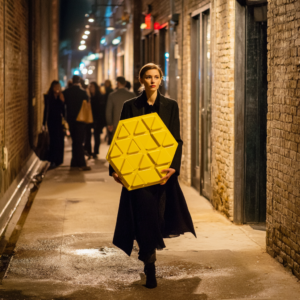
 In the ever-evolving landscape of internet culture, memes often serve as mirrors reflecting our collective psyche. One such phenomenon that has captured widespread attention is the “Shape Store” meme. Originating from a bizarre, AI-generated video, it depicts a group of enthusiastic individuals exploring a fictional store dedicated entirely to geometric shapes—like hexagons, squares, and circles—in a style reminiscent of ’90s amateur footage. The video’s dreamlike quality, filled with over-the-top excitement and interactive exhibits, has sparked discussions about its deeper implications. This article delves into the meme’s details, its potential psychological meanings, the broader impacts of perceiving the world through memes, its origins, why it resonates so strongly in 2026, and any psychological or psychiatric conditions it might subtly allude to.
Unpacking the Meme: What Is the Shape Store?
At its core, the Shape Store meme stems from a short video that portrays the grand opening of an imaginary “Shape Store.” The footage shows people riding shape-themed bumper cars, interacting with oversized geometric installations, and expressing unbridled joy over simple forms. The aesthetic is deliberately nostalgic, evoking liminal spaces—those eerie, transitional environments like empty malls or backrooms that feel both familiar and unsettling. The video’s surreal enthusiasm for mundane shapes creates a sense of absurdity, where the ordinary becomes extraordinary in a way that defies logic.
What makes this meme particularly captivating is its viral spread across platforms like X (formerly Twitter) and TikTok. Users have remixed it into parodies, fan art, and threads, often treating the Shape Store as a metaphor for escapism or existential whimsy. For instance, one popular interpretation describes it as a “liminal space where outputs are divorced from inputs”, highlighting a disconnection between appearance and function. Another views it as a place where “nothing means anything anymore,” evoking a dissolution of the ego in a chaotic yet playful environment. This blend of nostalgia, absurdity, and unease has turned it into a cultural touchstone, resonating with audiences fatigued by the predictability of modern digital content. Recent examples include user-generated content like a video of individuals in oversized, cartoonish footwear and letter blocks, blending real-life absurdity with the meme’s themes.
Possible Psychological Meanings Behind the Shape Store
The Allure of Absurdity as Mental Relief
Psychologically, the Shape Store meme taps into several layers of human cognition and emotion. One prominent theme is the allure of absurdity as a form of relief. In a world saturated with repetitive trends and information overload, the meme’s pure nonsense acts as a mental reset. As one observer noted, it “short circuits” the brain, providing oxygen-like respite from feeds that feel stale and homogenized. This aligns with psychological concepts like cognitive dissonance resolution, where embracing the illogical helps process overwhelming complexity.
Evocation of Liminal Spaces and Hauntology
Another angle is its evocation of liminal spaces, which often induce feelings of nostalgia mixed with discomfort. The ’90s-style footage harkens back to a perceived era of simpler, more whimsical social interactions—think arcade games or community events—contrasting sharply with today’s digital isolation. This “hauntology,” or the lingering presence of past cultural ghosts, can stir a yearning for lost innocence, as if the Shape Store represents a soulful escape from adult cynicism.
Nostalgia and Fresh Thought in the AI Age
This nostalgia is particularly intriguing in the context of the AI age, where the meme embodies a dual desire: a longing for the comfort of the past alongside a craving for novel, innovative thoughts generated by artificial intelligence. The AI-created video uses cutting-edge technology to produce surreal, dreamlike content that pushes boundaries of creativity, satisfying the human urge for new ideas and experiences. Yet, it cloaks this novelty in retro aesthetics, evoking a sense of familiarity and warmth from an era many viewers—especially younger ones—may not have personally lived through.
This duality highlights an inherent conflict: the pull toward nostalgia offers emotional security and a retreat from the rapid, often overwhelming advancements of AI-driven society, while the desire for new thoughts reflects an excitement for the uncharted territories that technology unlocks. However, looking for fresh thought and embracing nostalgia are both a conflict and actually a desire for the same thing—a quest for meaning and novelty in an era of digital saturation. At their core, both stem from a need to escape the mundane present; nostalgia provides a comforting illusion of stability, while fresh AI-generated ideas offer innovation, but together they fulfill a unified yearning for reinvention and connection. This faux nostalgia often isn’t for a real past but for an idealized one that was never experienced—a phenomenon known as “anemoia,” a term coined by John Koenig in The Dictionary of Obscure Sorrows to describe nostalgia for a time or place one has never known. In the Shape Store, anemoia manifests as a wistful affection for ’90s camcorder vibes, empty malls, and carefree play, even if these are romanticized constructs rather than lived memories. This faux nostalgia bridges the conflict by allowing users to indulge in a spectral past while engaging with AI’s futuristic absurdity, creating a harmonious yet illusory resolution where old and new coexist in a liminal dreamscape.
AI Content as a Source of New Thought
Paradoxically, even though all the images and videos associated with the Shape Store are clearly AI-created—evident in their surreal inconsistencies, like physics-defying shapes or dreamlike transitions—this can still be viewed as new thought. AI generates content by remixing vast datasets of human creativity, producing outputs that feel fresh because they combine familiar elements in unexpected ways. This process mimics human innovation, where “new” ideas often build on the old, but AI’s speed and scale amplify it, offering endless variations that spark original interpretations and discussions. In essence, the meme’s AI origins represent a meta-layer of novelty: it’s not just the content that’s new, but the way it challenges perceptions of authenticity, blurring lines between human and machine creativity to inspire truly novel psychological reflections.
Deeper Existential Themes
On a deeper level, the meme explores basic human desires through abstraction. Shapes become symbols of primal material wants, where endless accumulation offers fleeting satisfaction. This could reflect existential themes, such as the futility of chasing ephemeral joys, akin to arranging meaningless objects into something “meaningful” only to realize their emptiness. In essence, the Shape Store embodies a dreamlike state where reality’s rules dissolve, inviting viewers to confront the arbitrary nature of engagement with the world.
User interpretations on X have further enriched these meanings. For example, one detailed post describes the Shape Store as a “bacchanalian tempest of chaos,” a purgatory blending motion, wonder, and colors, where consumer indulgence fulfills impulses for status through absurd items like plastic shapes. It portrays a nighttime urban liminal space with incoherent vehicles, playful fights without real consequences, and simple, intuitive rules that prioritize visceral emotion over logic. Another expands on this, viewing it as a post-scarcity utopia where abundant, colorful shapes satisfy material desires, yet underlying strife and avarice persist, turning surface-level paradise into a hidden dystopia. These analyses highlight psychological themes of endless indulgence, violence divorced from repercussion, and the persistence of human flaws in idealized settings, evoking concepts like the hedonic treadmill—where satisfaction remains elusive despite abundance.
The Impacts of Viewing the World Through Memes
Memes like the Shape Store aren’t just entertainment; they shape how we perceive and interact with reality. Psychologically, this “meme-based worldview” can foster a sense of community through shared humor, helping individuals cope with stress and uncertainty. For younger generations, such as Gen Z, memes serve as a psychological safety net, using absurdity and irony to navigate complex emotions like anxiety or disappointment. They validate experiences, counteracting social media’s “happiness effect” where curated perfection dominates, and instead highlight universal struggles in a lighthearted way.
However, there are potential downsides. Over-reliance on memes can distort reality, leading to a fragmented worldview where nuanced issues are reduced to simplistic, viral tropes. This echoes memetic theory, which posits that memes evolve like organisms, influencing brain structures and behaviors in a feedback loop. In extreme cases, this might encourage detachment, where real-world problems are viewed through a lens of irony, potentially hindering genuine emotional processing or action. On the positive side, memes promote adaptability, turning chaos into communal medicine—much like the Shape Store’s nonsense alleviating digital fatigue.
How the Shape Store Meme Could Have Started
The meme’s origins trace back to an AI-generated video posted by the account Infinite Archive on March 1, 2026, initially on Instagram before exploding on X and other platforms. AI tools, trained on vast datasets of online content, often produce surreal outputs by remixing familiar elements—like ’90s home videos, amusement parks, and geometric educational toys—into something novel yet uncanny. This particular creation likely drew from nostalgic media tropes, amplifying them into absurdity.
Its rapid spread can be attributed to the internet’s appetite for “AI slop”—content that’s weirdly compelling precisely because it’s imperfect and dreamlike. Viral algorithms on platforms like X amplified it through shares and remixes, turning it into a self-perpetuating phenomenon. Psychologically, this startup phase highlights how novelty disrupts monotony, with the meme’s whimsy providing a stark contrast to everyday digital noise, fueling its momentum.
Why the Shape Store Meme Resonates in 2026
In early 2026, the Shape Store meme’s explosive popularity can be linked to a broader cultural fatigue with “brainrot” and ironic, layered memes that dominated previous years. Following the so-called “Great Meme Depression of 2025,” where social media feeds felt oversaturated with repetitive, low-effort content, there’s a collective push for a “Great Meme Reset”—a return to simpler, more whimsical formats that evoke genuine fun and nostalgia. The Shape Store fits perfectly into this shift, offering pure, unadulterated absurdity without political undertones or forced discourse.
Key factors contributing to its timeliness include:
- Escape from Digital Monotony: In a “cooked” world where every feed mirrors the last, the meme’s nonsensical joy acts as a mental palate cleanser, providing relief from homogenized trends.
- Nostalgic Pull: It evokes childhood simplicity, like kindergarten play with basic shapes or early cartoons’ whimsical chaos, tapping into a yearning for pre-digital innocence amid ongoing social media degradation.
- AI-Driven Dreaminess: As AI content becomes ubiquitous, the video’s surreal, inconsistent logic mirrors dream states, making it feel authentic and human despite its artificial origins.
- Vibe Shift Toward Curiosity: It represents a broader cultural move toward content that rewards exploration and whimsy, away from irony-stacked memes, aligning with calls for meme renewal.
This resonance underscores a psychological need for lighthearted connection in an era of information overload and social fragmentation.
Psychological or Psychiatric Conditions It May Allude To
While the Shape Store is not a diagnostic tool, its surreal, dissociated vibe may subtly allude to certain psychological experiences. In difficult times, such as economic uncertainty or global events in 2026, it’s especially important to catch mental health issues early, as more people spend increased time online, which can become an echo chamber reinforcing isolation, distorted perceptions, and amplified anxieties. Memes like this highlight how digital immersion can blur reality, making it crucial for individuals to monitor their emotional responses and seek support if feelings of disconnection persist.
While the meme is fun and engaging, it may represent underlying conditions that mental health providers should look for, such as persistent feelings of disconnection or sensory overload in daily life. As mental conditions evolve in the digital age—exemplified by how AI-driven content like this meme blurs reality and fantasy—providers are encouraged to adapt their services.
Derealization and Depersonalization
The meme’s dreamlike disconnection often evokes symptoms of depersonalization-derealization disorder (DPDR), where the world feels unreal or detached. Specific info includes how the video’s arbitrary enthusiasm for shapes can mirror episodes where individuals feel like observers in their own lives, with distorted perceptions of time and space.
- The arbitrary rules and liminal spaces in the video parallel feelings of detachment from reality, as if observing life from afar.
- Over-the-top enthusiasm for mundane shapes might symbolize emotional numbing, where everyday stimuli take on distorted significance to combat a sense of unreality.
- This allusion can resonate with those experiencing anxiety-induced dissociation, offering a humorous lens to process such states, but providers should screen for chronic symptoms like persistent fog or emotional flatness.
Sensory Processing and Neurodivergence
The fixation on basic shapes and chaotic environments could nod to sensory experiences in conditions like autism spectrum disorder (ASD), where patterns provide comfort. Specific details highlight how the meme’s vibrant, repetitive elements might reflect sensory-seeking in ASD, potentially exacerbating overload in overstimulating environments.
- Vibrant, repetitive shapes mimic sensory-seeking behaviors, turning overwhelming stimuli into soothing, predictable elements.
- The video’s playful chaos without consequences might reflect hyperfocus on details, a common trait in neurodivergence, amid broader sensory overload.
- By highlighting joy in simplicity, the meme subtly promotes understanding of diverse cognitive processing styles, though it could signal undiagnosed sensory processing disorder if individuals fixate on similar patterns to cope.
Hallucinatory or Delusional Experiences
In more intense interpretations, the bizarre logic resembles aspects of psychotic disorders, such as schizophrenia, where perceptions warp ordinary elements. Specifically, the nonsensical joy and shape obsessions may echo positive symptoms like hallucinations, where benign objects gain exaggerated meaning.
- Absurd scenarios, like shape-themed rides defying physics, echo hallucinatory distortions where logic breaks down.
- The unbridled, nonsensical happiness could metaphorically represent delusional euphoria, detached from external reality.
- These elements, when memed, help destigmatize such experiences by portraying them as shared, whimsical absurdities rather than isolating symptoms, but clinicians should monitor for signs like disorganized thinking or reality testing issues.
Conclusion: Embracing the Absurd in a Digital Age
The Shape Store meme exemplifies how internet culture weaves absurdity into psychological commentary, offering both escape and insight. By exploring its origins, meanings, impacts—including user-driven expansions like those on X—and its timely popularity in 2026, we see memes as more than fleeting laughs—they’re tools for coping, connecting, and critiquing our world. As we navigate an increasingly “cooked” reality, perhaps visiting the Shape Store mentally reminds us to find joy in the nonsensical, fostering resilience amid chaos. For more on viral psychology, stay tuned to the FasPsych blog.
FasPsych invites medical providers to partner with us for service implementation, enabling a deeper understanding of what patients are thinking. This meme illustrates the complexity and simpleness conflict many are dealing with—yearning for straightforward joys amid intricate digital lives—as well as the AI vs nostalgia conflict, where technology’s novelty clashes with idealized pasts. By integrating tools like teletherapy focused on these themes, providers can better address evolving mental health needs. Contact us to add therapy and telepsychiatry services and help address these evolving challenges.
FAQ: Understanding the Shape Store Meme and Its Mental Health Implications
What exactly is the Shape Store meme?
The Shape Store meme originates from an AI-generated video depicting a fictional store filled with geometric shapes, presented in a ’90s-style amateur format. It features enthusiastic interactions with shapes in a dreamlike, absurd setting, often evoking liminal spaces and nostalgia.
Why has this meme become so popular in 2026?
Its popularity stems from cultural fatigue with repetitive online content, a shift toward whimsical absurdity, and the blend of AI innovation with nostalgic elements. It resonates as a mental reset in an era of digital overload, tapping into desires for simplicity and novelty.
How do memes like this affect mental health?
Memes can foster community and humor as coping mechanisms, but over-reliance may lead to detachment or distorted reality views. In echo chambers, they can amplify anxieties; however, they also normalize discussions about dissociation or sensory issues.
What psychological conflicts does the Shape Store highlight?
It embodies the tension between complexity (AI-driven novelty) and simpleness (nostalgic escape), as well as AI vs nostalgia—craving fresh thoughts while longing for an idealized past. This reflects “anemoia,” nostalgia for unlived times, unified by a desire for reinvention.
How can medical professionals use FasPsych to address these issues?
FasPsych offers partnerships for expanding services like teletherapy for digital-era conditions. By implementing tools tailored to meme-influenced psyches, providers can better understand patient conflicts like AI-nostalgia tensions. Contact us to integrate your health facility.