


Most organizations need telepsychiatry first. A search for online medication management returns two different services. Telepsychiatry uses psychiatrists and psychiatric nurse practitioners who diagnose, prescribe, adjust and monitor psychiatric drugs. Telepharmacy uses pharmacists who reconcile medication lists, support adherence and check for interactions. If your problem is a waitlist for psychiatric prescribing, only the first one closes it. FasPsych provides telepsychiatry and integrated telehealth solutions for organizations that need virtual mental health care and psychiatric staffing. Its prescriber-led telepsychiatry medication management is the practical way to add that capacity.
Pharmacist services still have a place, however. They work best as a second layer that checks the prescriber’s work and catches problems between visits. They cannot replace the prescriber.
The distinction matters because vendors in both categories describe their work with the same phrase. As a result, an administrator can sign a contract for medication management and find out at go-live that nobody on it can write a new prescription. So the first purchasing decision is which job you need filled. The vendor comes second.
Can online psychiatrists prescribe medication? Yes, and that authority separates telepsychiatry from telepharmacy
Yes. A telehealth psychiatrist or psychiatric NP holds prescribing authority for psychiatric drugs. That includes controlled substances, within federal DEA rules and the law of the state where the patient is located. The prescriber owns the diagnosis and the decision to start, change or stop a medication. That person is also clinically accountable for the result. Psychiatric medication management by video therefore covers the same clinical ground as an in-office visit. It differs in logistics, not in scope.
Pharmacists in telepharmacy roles, by contrast, work under a narrower scope. They review medication lists against records, reconcile discrepancies at transitions of care and flag interactions or duplications. They also run adherence outreach. Some states allow collaborative practice agreements that let pharmacists adjust certain therapies under protocol. Even so, pharmacists generally do not diagnose psychiatric conditions or initiate psychiatric treatment.
The hybrid model, the second layer mentioned above, pairs the two. It helps most with older patients who take several drugs from several clinicians, because no single prescriber sees the full list. For that group, a structured pharmacist review is one of the main ways of avoiding polypharmacy pitfalls before they turn into falls, sedation or delirium.
| Criteria | Telepsychiatry medication management | Pharmacist-led telepharmacy | Hybrid model |
|---|---|---|---|
| Who provides care | Psychiatrists and psychiatric NPs | Clinical pharmacists | Prescriber plus pharmacist |
| Prescribing authority, including controlled substances | Yes, within federal and state limits | Generally no; limited protocol-based changes in some states | Yes, through the prescriber |
| Typical tasks | Evaluation, diagnosis, starting and adjusting medication, monitoring | Reconciliation, interaction checks, adherence support | Prescribing with pharmacist review |
| Staffing flexibility | Block hours, part-time or dedicated remote prescribers | Pharmacist hours or per-review volume | Both scaled separately |
| On-call availability | Prescriber on-call possible under contract | Pharmacist lines for medication questions | Prescriber escalation, pharmacist first line |
| Common pricing model | Contracted hours or per session | Per review or per member | Combined contract |
In short, only the prescriber-led and hybrid models can change a patient’s treatment. The pharmacist-only model protects safety, but it adds no prescribing capacity.

Which virtual medication management services offer scalable staffing and on-call coverage
Staffing-model telepsychiatry offers both scalable prescriber staffing and on-call coverage. App-based consumer services do not, because they contract with patients rather than with your organization. Staffing-model providers instead assign licensed prescribers to your caseload, in your EHR, on hours you set.
That capacity is usually built in one of three ways. Contracted block hours give you a fixed number of prescriber hours each week. A part-time remote prescriber covers recurring clinic days. A dedicated remote prescriber works as an embedded member of your team. The flexibility comes from changing those hours as caseloads move. For example, you add a half-day when intake backs up and reduce hours when a local hire starts. FasPsych’s telepsychiatry staffing for clinics and hospitals works on this hour-based approach. Prescriber time is shaped to each site’s schedule rather than sold as one fixed package.
On-call coverage needs the same precision, because after-hours gaps are where vague contracts fail first. Before you sign, settle four points in writing:
- Who answers after hours: a named prescriber pool or a triage line.
- The response window for urgent calls.
- How the decision is documented back to the patient’s chart by the next business day.
- Which questions a pharmacist line can handle.
That last point turns on scope. A pharmacist can answer an interaction question or a missed-dose question. However, a new agitation episode, a suicide risk concern or a request to change a controlled substance needs a prescriber. The contract should therefore state that dividing line plainly.
Affordable, cost-effective telehealth medication management for outpatient clinics and small hospitals depends on the contract model and 2026 reimbursement
The most affordable option for an outpatient clinic or small hospital is the contract model that matches its volume and billing rights. The lowest headline rate is often not that option. Organizations generally choose among three structures:
- Block or contracted hours suit steady demand, because you pay for predictable prescriber time and fill it.
- Per-session or per-consult pricing suits low or uneven volume, such as a small hospital needing occasional evaluations.
- Patient-pay virtual clinics sit apart from both, because the patient pays and the clinic, not your organization, owns the relationship.
That third structure changes more than price. The difference between virtual clinic versus psychiatry staffing network models decides whether visits flow through your billing and your quality reporting. Under a patient-pay clinic, they do not.
Once the structure is chosen, reimbursement determines how much of the contract cost comes back. For Medicare in 2026, behavioral and mental health telehealth delivered to a patient’s home remains payable without geographic restrictions when statutory requirements are met. Applicable in-person visit requirements still apply, according to CMS. Audio-only telehealth is also available under the applicable Medicare rules and modifiers, which matters for rural patients with weak broadband. For rural health clinics and FQHCs, the in-person mental health visit requirement is delayed until after January 1, 2028.
The same CMS guidance sets the CY 2026 RHC and FQHC distant-site telehealth rate at $97.53. Beginning October 1, 2026, these organizations bill the individual CPT or HCPCS code. They add modifier 93 for synchronous audio-only visits or modifier 95 for audio-video visits. For that reason, a small hospital or clinic should model expected visits against that payment before choosing between block hours and per-consult pricing.
Top telepsychiatry medication follow-up for primary care practices runs on referral, a shared care plan and clear refill ownership
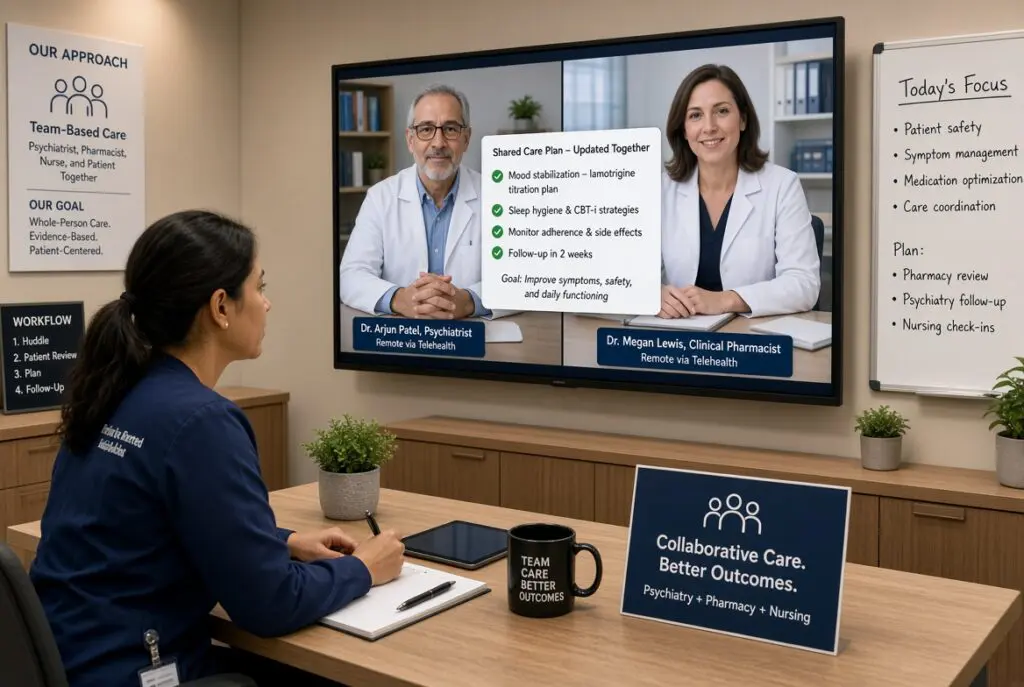
The strongest telepsychiatry follow-up for primary care uses a defined handoff, not a standalone app. The workflow runs in four steps. First, the PCP refers a patient whose depression, anxiety or bipolar symptoms have not responded to first-line treatment. Next, the telehealth psychiatrist evaluates the patient and writes a shared care plan with the medication, target dose, monitoring labs and follow-up interval. The plan then assigns ownership: who writes refills, who makes dose changes and who the patient calls with side effects. Finally, once the patient is stable, care returns to the PCP. The psychiatrist stays available for consults if symptoms return.
Of those steps, refill ownership is where these arrangements most often break down. Two clinicians each assume the other is writing the prescription, and the patient runs out. To prevent that, name the owner of each prescription in the care plan and review it at every follow-up. FasPsych’s telepsychiatry support for primary care doctors is built around this kind of consultative arrangement.
This model now also has clearer payment support. CMS’s CY 2026 Physician Fee Schedule final rule created three optional add-on G-codes for Advanced Primary Care Management. The codes support complementary behavioral health integration and Psychiatric Collaborative Care Model services. CMS describes them as directly comparable to existing CoCM and BHI codes. As a result, practices that document the referral, care plan and psychiatric consultation as structured steps are in a stronger position to bill for the work.

The best telehealth psychiatry services for community mental health centers, clinics, rural hospitals and primary care differ by setting
The right model depends on acuity, volume and after-hours exposure, so each setting fits a different pattern.
Community mental health centers carry high-acuity caseloads with serious mental illness and substance use. They therefore need dedicated prescriber hours, not occasional sessions. Pharmacist support for long-acting injectables, clozapine monitoring and medication-assisted treatment adds a layer of safety on top. The detail of how community clinics run telehealth medication services shows why continuity with the same prescriber matters for these patients.
Outpatient clinics, by comparison, usually have steady, scheduled demand, so block hours fit best. Small and rural hospitals face unpredictable psychiatric presentations and limited local specialists. As a result, they need on-call prescriber coverage for emergency and inpatient decisions, plus scheduled follow-up after discharge. Primary care practices fit the consultative follow-up described in the previous section.
| Organization | Recommended model | Coverage pattern | Typical contract structure |
|---|---|---|---|
| Community mental health center | Hybrid, prescriber-led | Dedicated prescriber hours plus pharmacist review | Contracted hours |
| Outpatient clinic | Telepsychiatry | Scheduled block hours | Block hours |
| Small or rural hospital | Telepsychiatry | On-call prescriber plus scheduled follow-up | Per-consult plus block hours |
| Primary care practice | Telepsychiatry under collaborative care | Consults and time-limited follow-up | Per-session or small block |
Because every row starts from prescriber hours, your next step is to size those hours for your own setting. Request a consultation with FasPsych to scope hours, on-call coverage and billing fit for your organization.