
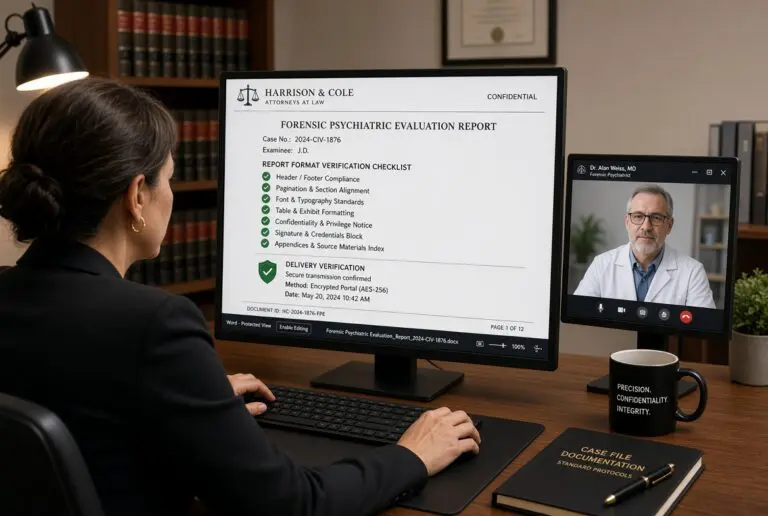

Courts and law firms searching for telepsychiatry staffing are usually trying to close a specific operational gap: delayed forensic psychiatric evaluations that contribute to backlog in competency proceedings, civil commitment matters, or other court-ordered assessments. The practical question is which partners can supply licensed psychiatrists who can complete evaluations within a defined window, produce reports that meet the court’s or firm’s documentation standards, and coordinate with existing legal workflows.
The American Psychiatric Association supports telepsychiatry as a validated method of increasing access when used consistent with ethical standards and applicable law. Research has found high levels of agreement between in-person and telepsychiatry-based forensic evaluations for competency to stand trial in controlled studies. The APA and American Telemedicine Association’s Best Practices in Synchronous Videoconferencing-Based Telemental Health provide consensus guidance on delivering care via video while maintaining clinical standards. Programs that implement structured remote psychiatric evaluation capacity have reported reductions in time from order to completed report when response expectations and report formats are defined in advance.
Court and Law Firm Evaluation Reliability Framework
Courts and law firms can evaluate telepsychiatry staffing partners for forensic work against four practical pillars focused on consistent delivery and legal workflow fit.
- Defined Turnaround Window — The partner commits to a clear target for time from referral or court order to completed evaluation and written report (for example, within a defined number of business days for standard competency evaluations) and has a named process if additional collateral or records are needed.
- Report Format and Legal Alignment — Reports address the specific legal questions posed by the court or counsel, follow the jurisdiction’s preferred structure, and are written so that judges, attorneys, and court staff can use them without extensive clarification. The partner can adapt templates when the court or firm provides them.
- Clinician Availability and Continuity — The same psychiatrist or a small, stable team handles a defined set of evaluations. A process exists for the clinician to be available for clarification questions or, when required and appropriate, testimony or deposition within a reasonable window.
- Measurement of Delivery Reliability — The court or firm tracks a small set of indicators (percentage of evaluations completed within the agreed window, average days from order to report, and feedback from judges or counsel on report usability) so the pathway can be refined.
Partners that score high on these pillars treat telepsychiatry staffing as a reliable extension of the court’s or firm’s evaluation capacity. Those that score low often produce variable turnaround times or reports that require significant revision before they can be used in proceedings.

Practical Steps to Evaluate Telepsychiatry Staffing for Courts and Law Firms
Define the evaluation types and volume.
Identify the primary evaluation types needed (competency to stand trial, mental state at the time of the offense, civil commitment or guardianship capacity, or other court-ordered assessments) and the typical monthly or quarterly volume. Confirm whether the work is primarily for the court, for defense or prosecution counsel, or both.
Confirm turnaround and report standards.
Ask the partner for their current average time from referral to completed report for the evaluation types you need. Request sample report formats (with identifying information removed) and confirm whether they can adopt the court’s or firm’s preferred template. Clarify the process and timeline when additional records or collateral interviews are required.
Assess clinician continuity and availability.
Determine whether the same psychiatrist will typically handle a series of related evaluations or whether coverage rotates. Ask about the process and typical timeline for clinician availability if the court or counsel has follow-up questions or if testimony is required.
Pilot with measurable targets.
Limit the first 60–90 days to a defined evaluation type or volume. Track:
| Metric | What it measures | Early target direction |
|---|---|---|
| % of evaluations completed within the agreed turnaround window | Delivery reliability | Increasing |
| Median days from order or referral to completed report | Access speed | Decreasing toward the agreed target |
| % of reports accepted without major revision | Report quality and alignment | High and stable |
| Court or counsel feedback on report usability | Workflow fit | Positive trend |

Common Pitfalls in Court and Law Firm Telepsychiatry Staffing
- Variable turnaround without a defined window. Reports arrive on inconsistent timelines, creating scheduling problems for hearings. Mitigation: Require a published turnaround target and a process for notifying the court or firm of any delay before go-live.
- Reports that do not address the legal question. The evaluation describes clinical findings but does not clearly answer the specific question the court or counsel asked. Mitigation: Review sample reports and confirm the partner can structure opinions to match the jurisdiction’s needs.
- Limited availability for clarification or testimony. The clinician who completed the evaluation is difficult to reach for follow-up questions or is unavailable for scheduled testimony. Mitigation: Define the expected response window for clarification requests and the process for testimony availability before the engagement begins.
- Separate systems that disrupt workflow. Staff must use a second portal to request evaluations or retrieve reports. Mitigation: Require that referral and report delivery use the court or firm’s existing process (secure email, portal, or document management system) when possible.
How FasPsych Supports Telepsychiatry Staffing for Courts and Law Firms
FasPsych places licensed psychiatrists, including those with forensic experience, into existing court and law firm workflows. Evaluations are conducted via secure video, with reports delivered according to the agreed format and timeline. The service is designed for organizations that need reliable remote evaluation capacity without managing individual clinician recruiting and credentialing for every case.
This model supports courts and law firms that want consistent turnaround and report quality without building an internal panel of forensic psychiatrists. Related information on court-ordered evaluations appears on the telepsychiatry for courts and law firms page. General mental health evaluation services are covered under mental health evaluations. Broader telepsychiatry staffing is available on the telepsychiatry services page.
Frequently Asked Questions
What turnaround time should a court or law firm expect for a standard competency evaluation?
Many programs target completion of the evaluation and written report within a defined number of business days once all required records are available. Confirm the specific target and the process for cases that require additional collateral with the partner.
Can the same psychiatrist handle both the evaluation and any required testimony?
Yes, when the engagement is structured that way. Partners that maintain continuity of the evaluating clinician can typically support clarification questions and, when appropriate, testimony or deposition within an agreed window.
Does telepsychiatry staffing for courts replace in-person evaluations?
It can serve as the primary method for many evaluation types when the court and jurisdiction accept remote assessments. Some matters or jurisdictions may still prefer or require an in-person component; the partner should be able to discuss the appropriate modality for each case type.
How are reports delivered to the court or firm?
Reliable partners deliver reports through the court or firm’s preferred secure method (encrypted email, existing portal, or document system) rather than requiring a separate platform for every case.
Finding reliable telepsychiatry staffing for courts and law firms depends less on general availability and more on whether the partner can deliver a defined turnaround window, produce reports that align with legal needs, maintain clinician continuity for clarification or testimony, and support measurable reliability. Courts and firms that evaluate partners against these criteria can reduce delays in forensic evaluations without adding permanent internal staffing.
To discuss how FasPsych can support telepsychiatry staffing for court-ordered evaluations within your existing workflows, explore the telepsychiatry for courts and law firms page or the telepsychiatry services section.