


Most reviews of telepsychiatry medication management services score convenience, price and app experience for one patient at a time. A program buying ongoing medication management should compare six other things instead: prescriber continuity, follow-up cadence, refill and prior-authorization workflow, lab monitoring, 2026 controlled-substance compliance, and Medicaid and Medicare billing support. FasPsych’s psychiatrist-led telepsychiatry medication management is a practical way to apply that scorecard. You can ask FasPsych to answer each item in writing.
Reviews of remote psychiatric medication management platforms rate the patient app, not the program partner
Consumer review sites and forums tell you how a service feels to an individual paying patient. They measure price, app design and how quickly someone got an appointment, which are fair questions for a consumer. However, they say little about whether a vendor can carry a caseload of patients on clozapine, buprenorphine or stimulants inside your program. The table below maps each consumer measure to what a program actually needs to verify, with one question to put to each vendor.
| What a program should verify | What consumer reviews capture | Question to ask the vendor |
|---|---|---|
| Prescriber continuity | Whether the patient liked their clinician | What was your prescriber turnover last year, and how do you hand off patients? |
| Follow-up cadence | How fast the first appointment came | What is the standard follow-up interval after a dose change? |
| Refill and prior-authorization workflow | Whether refills arrived | Who owns refills and prior authorizations, and what is the turnaround? |
| Lab monitoring | Rarely rated | Who orders, tracks and acts on lithium and clozapine results? |
| Controlled-substance compliance | Whether a medication was prescribed | Can you show your written controlled-substance policy? |
| Medicaid and Medicare billing support | Out-of-pocket price | Does your documentation meet current telehealth billing rules? |
Psychiatrist-led prescribing and owned workflows outweigh convenience scores
The first rows of that table matter most because complex regimens need specialist judgment. A cross-taper from one antipsychotic to another is one example. A mood stabilizer adjustment in a patient with a substance use disorder is another. Both depend on psychopharmacology training that general prescribers rarely get. FasPsych keeps its medication management psychiatrist-led for that reason. This review of psychiatric medication risks primary care prescribers face lays out the gap.
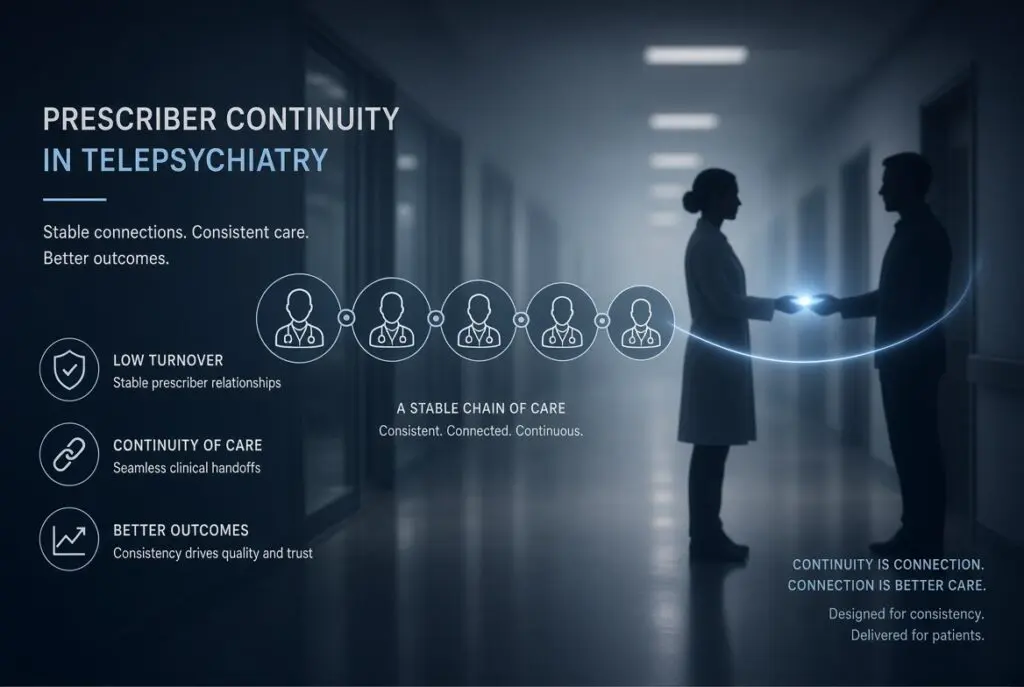
That training only helps if the same prescriber stays with the patient. Prescriber churn shows up repeatedly in patient complaints because each new clinician restarts the history and second-guesses the last plan. Ask vendors for written continuity commitments and their turnover history.
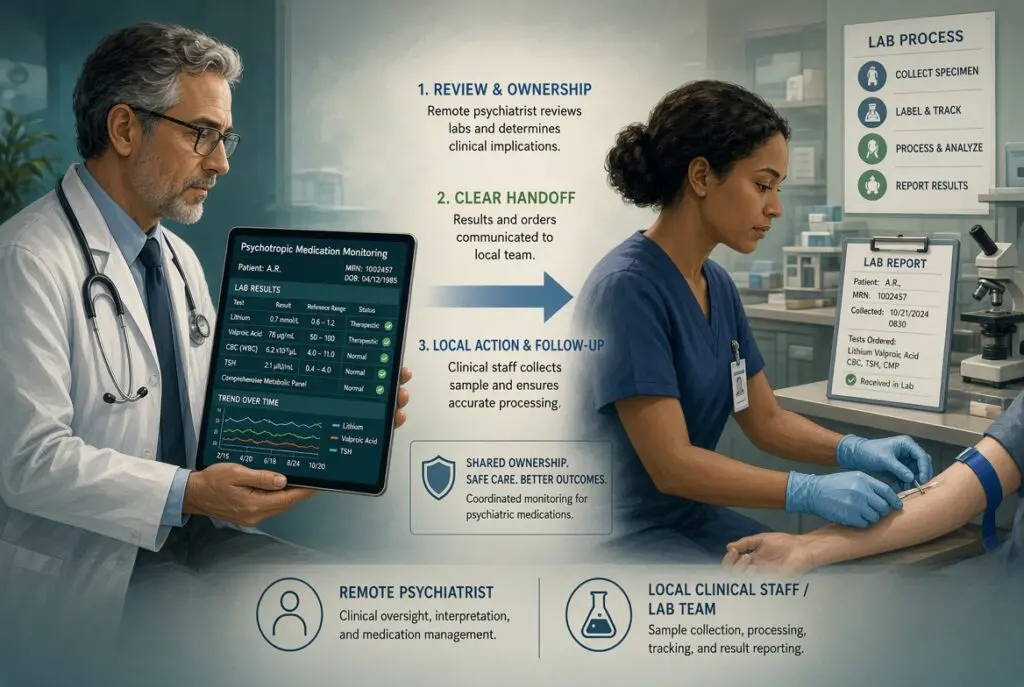
Continuity also depends on the work that happens between visits. Lithium levels, clozapine monitoring, drug interaction checks and prior authorizations each need a named owner and a set follow-up interval. Without both, a lab result can sit unread or a prior authorization can lapse. When patients complain about refill gaps, the cause is usually a workflow nobody owned rather than a clinical decision. Ask the vendor to walk you through one refill and one abnormal lab result, step by step. Expect the same discipline for older patients on several medications, where avoiding polypharmacy pitfalls depends on regular interaction reviews.
Controlled-substance prescribing in 2026 needs a written compliance plan from your telepsychiatry provider
The highest-risk workflows involve controlled substances. Under the current DEA telemedicine flexibilities, a vendor prescribing ADHD stimulants, benzodiazepines or buprenorphine should give you a written plan with diversion controls and a fallback in case the rules change. FasPsych outlines its safeguards for prescribing controlled substances via telemedicine in detail. That gives you a benchmark for what other telepsychiatry companies should be able to show.
An abrupt refusal to continue a stimulant or buprenorphine is a warning sign, because for opioid use disorder it can mean relapse risk. Substance use programs can use FasPsych’s virtual medication-assisted treatment to keep buprenorphine prescribing stable. Supervision rules matter here as well. CMS made virtual direct supervision permanent for specified services, but only over real-time audio-video, so audio-only does not qualify.

Medicaid and Medicare billing support has to match the 2026 telehealth rules
Good clinical care still has to be billable, so the vendor’s documentation must fit current rules. Since October 1, 2026, rural health clinics and FQHCs bill distant-site telehealth with the applicable service code plus a telehealth modifier instead of HCPCS G2025. Modifier 93 covers synchronous audio-only visits, while modifier 95 covers audio-video. CMS has also delayed the in-person mental health visit requirement for these centers until after January 1, 2028.
Hospitals and residential settings face a different change. The CY 2026 fee schedule final rule permanently removed frequency limits on subsequent inpatient and nursing-facility telehealth visits. That removes a cap that once constrained remote follow-up for these patients.
Funding eligibility deserves a check too, so review HRSA’s mental health shortage-area data, updated October 20, 2026. More than 34 federal programs use these designations for eligibility or funding preference. As a result, confirming your status before you budget can change what the program can afford.
Test the scorecard with a pilot and reference calls before you sign
A time-limited pilot shows whether a vendor meets these standards in your program. Run it with one patient cohort and track prescriber continuity, refill turnaround and lab adherence, so you judge the vendor on your own data rather than on star ratings. After the pilot, call references from programs like yours. Ask FasPsych for a reference whose setting and patient mix resemble your own. The step-by-step telepsychiatry implementation guide covers pilot setup. Your next step is to book a consultation with FasPsych to scope that pilot.
FAQ
Do patient satisfaction scores in reviews of telepsychiatry medication management services predict program performance?
Only partly. Satisfaction scores reflect app experience and access for individual patients. They do not measure prescriber turnover, lab follow-through, prior-authorization handling or billing documentation. Use them as background, then verify the operational items directly with the vendor and its references.
Can telepsychiatry providers manage clozapine and lithium monitoring remotely?
Yes, if the workflow is defined. The remote psychiatrist orders labs and reviews results on a set schedule, while your on-site staff or a contracted lab handles the draws. Confirm who receives results and who acts on abnormal values before go-live.
Does audio-only telepsychiatry count for Medicare and FQHC billing in 2026?
For RHCs and FQHCs, CMS allows modifier 93 for synchronous audio-only telemedicine. Virtual direct supervision is different. It requires real-time audio-video, and audio-only does not qualify.
Which patient complaints should be treated as red flags when comparing telepsychiatry companies?
Treat three patterns as red flags: repeated prescriber changes, abrupt refusals to continue stimulants or buprenorphine, and refill gaps. Each points to a problem your program would inherit, whether that is staffing instability, an unclear controlled-substance policy or a refill workflow with no owner.