


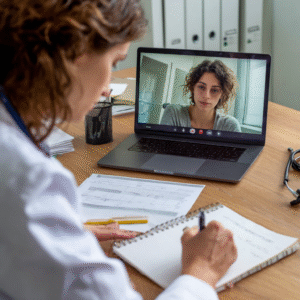
 In today’s fast-paced healthcare environment, accessing psychiatric specialists quickly can mean the difference between crisis and calm. Mental health and substance use disorders are now the leading cause of disease burden in the U.S. What once relied on simple one-way pager alerts has evolved into seamless, real-time telepsychiatry and telemedicine platforms. This progression improves efficiency, expands access, and delivers truly patient-centered behavioral health care.
At FasPsych, we specialize in flexible telepsychiatry services that connect hospitals, clinics, and organizations with a nationwide network of board-certified psychiatric providers via secure video. Understanding this evolution shows why telepsychiatry now stands as the gold standard for specialist consultations in mental health, especially in hospital emergency rooms. As we look at telepsychiatry trends in 2026, innovations like AI integration and hybrid care models are driving unprecedented growth in the sector.
The Pager Era: Early Rapid Communication in Medicine and Psychiatry
Pagers (or “beepers”) became essential in hospitals during the 1950s–1990s. A primary care physician or ER doctor facing a psychiatric emergency could page an on-call psychiatrist, who would then locate a phone to respond.
While revolutionary for the time, this system had major drawbacks in psychiatry:
One-way, asynchronous alerts with no visual cues or patient involvement for psychiatric patients
Delays from hunting down landlines
Limited detail for complex behavioral health assessments without the ability to review a patient’s presentation
Alphanumeric pagers later added text, but the process still slowed critical decisions in mental health crises. This era laid the groundwork for the history of telepsychiatry, highlighting the need for more interactive tools to bridge gaps in specialist access and treatment.
Bridging the Gap: Phones, Email, and Early Digital Tools
Mobile phones in the 1990s enabled direct voice calls, while the internet brought secure email and EHR messaging. These tools improved specialist communication but still fell short for psychiatry.
Evaluating a patient’s mood, affect, or safety often requires seeing them in real time—something phone-only or text-based consults could not provide. These early methods were essentially faster pagers, not full telepsychiatry solutions, at a time many emergency rooms are not designed to handle large volumes of mentally ill patients, leading to inefficiencies in care delivery. Most emergency rooms do not have a psychiatrist on staff, yet one-eighth of all hospital emergency visits require mental health diagnoses. The telemedicine evolution during this period set the stage for video-based virtual psychiatric consultations, addressing limitations in traditional communication and bringing appropriate care to the patient’s bedside.
The Rise of Telepsychiatry: A Game-Changing Leap in Specialist Access
Telepsychiatry—a specialized form of telemedicine—marks the pinnacle of this evolutionary chain. Using HIPAA-compliant, two-way video and audio, providers now deliver comprehensive psychiatric consultations anywhere, even the patient’s room.
Unlike traditional doctor-to-doctor phone consults, telepsychiatry lets the specialist speak and work directly with the patient. The psychiatrist can:
Observe nonverbal cues and real-time behavior
Build immediate rapport
Gather firsthand clinical insights
This direct interaction dramatically improves the patient experience by reducing anxiety, increasing engagement, giving patients a sense of control over their care and provide specialty care for more patients via telemedicine. Additionally, telepsychiatry can provide a layer of physical safety for providers while assessing highly agitated or potentially violent patients. Treatment recommendations become more precise and personalized, leading to better adherence, fewer medication adjustments, and stronger outcomes at a time most hospitals do not have an on site psychiatrist.
Key drivers of this telepsychiatry boom include:
High-speed internet and mobile devices for crystal-clear video
Secure, HIPAA-compliant platforms that protect privacy
AI-enhanced triage that flags urgent cases instantly
At FasPsych, our telepsychiatry network serves inpatient, outpatient, correctional, and community settings—including rural and tribal areas—making expert behavioral health care truly accessible. Learn more about our telepsychiatry services.
In 2024, 85.9% of psychiatrists reported providing a video visit in the prior week, underscoring the widespread adoption of telehealth psychiatrist services. The global telepsychiatry market is projected to grow from $18.8 billion in 2026 to $76.85 billion by 2034, at a CAGR of 19.24%.
Telepsychiatry in Overwhelmed Emergency Rooms: Faster Decisions and Better Resource Use
Emergency departments across the country face chronic overcrowding, especially with behavioral health crises. Telepsychiatry in the ER (also called ED telepsychiatry) changes the game by enabling rapid virtual assessments and improving care for psychiatric patients in the ER.
A psychiatric specialist can join the care team within minutes via secure video to:
Evaluate the patient directly
Determine the appropriate level of care (inpatient admission, outpatient follow-up, crisis stabilization, or community resources)
Coordinate transfers or discharges
This leads to better outcomes, including:
Shorter wait times for psychiatric evaluation
Reduced unnecessary hospitalizations
Faster throughput during surges or peak overload periods
Studies show that telepsychiatry in emergency settings helps hospitals make quicker, more accurate decisions—easing pressure on overwhelmed ERs while ensuring patients receive the right care at the right time. These programs demonstrate how telepsychiatry companies can make ERs more efficient. For instance, telepsychiatry recipients are more likely to receive 30-day outpatient follow-up (46% versus 16%) and less likely to be admitted during the index ED visit (11% versus 22%), resulting in lower 30-day inpatient costs by $2,336. Additionally, ED telepsychiatry is associated with reductions in length of stay and healthcare costs, with patient satisfaction comparable to in-person care.
One in eight emergency room visits involves a mental health condition, and telepsychiatry reduces the need for such visits by providing timely interventions. FasPsych partners with emergency departments nationwide to provide on-demand ER telepsychiatry support. Explore our ER telepsychiatry solutions.
The benefits of telepsychiatry in emergency rooms extend to rural areas, where access to specialists is limited, potentially reducing boarding times and improving overall ED efficiency by enhancing emergency department psychiatric care. As overcrowding persists, telepsychiatry in the ER not only optimizes resources but also prevents unnecessary hospitalizations, saving costs and improving patient outcomes.
Telepsychiatry Trends in 2026: AI and Hybrid Care
As we enter 2026, telepsychiatry trends are heavily influenced by AI and hybrid care models, transforming how behavioral health is delivered. AI is integrating into daily workflows, aiding in triage, predictive analytics, and clinical decision support. For example, AI-powered tools can analyze patient data in real-time, flagging high-risk cases for immediate intervention and enhancing remote monitoring.
Hybrid care, blending virtual and in-person visits, is becoming the standard, with over 80% of patients and providers preferring these models for their flexibility. This approach allows for continuous care coordination, reserving in-person slots for complex needs while leveraging telepsychiatry for routine follow-ups. In 2026, AI will further power hybrid systems, making them more intuitive and proactive.
The telehealth market is forecasted to reach $450 billion by 2030, driven by these innovations. At FasPsych, we’re incorporating AI-enhanced triage into our platforms to support behavioral health telehealth and integrated telehealth solutions. This not only improves access for underserved populations but also aligns with telepsychiatry trends 2026, where virtual care becomes embedded in hospital-at-home models.
Emerging technologies like wearables for real-time mood tracking and AI chatbots for initial assessments are set to redefine online psychiatrist services, ensuring personalized, efficient care. Challenges remain, such as ensuring equitable access, but the trajectory points to a more connected, AI-driven future.
Key Benefits of Telepsychiatry Today
Faster, more accurate care — Direct patient interaction yields superior treatment plans
Greater accessibility — Ideal for rural, underserved, and high-need populations, supported by our telepsychiatry services for Rural Health Clinics
Cost savings — Lower overhead and reduced unnecessary admissions
Improved outcomes — Higher patient satisfaction and engagement
Challenges like the digital divide and reimbursement still exist, but the direction is clear: telepsychiatry is no longer an alternative—it is the new standard for specialist consultations in behavioral health. For more on how telepsychiatry addresses disparities, visit our behavioral health resources.
Looking Ahead: The Future of Telepsychiatry
With 5G, augmented reality, and AI-powered tools on the horizon, telepsychiatry will become even more intuitive and proactive, especially for emergency room mental health crisis services. Imagine instant alerts that connect the right specialist to the right patient before a crisis escalates.
At FasPsych, we’re proud to lead this evolution as the nation’s premier telepsychiatry partner. Our flexible, on-demand services help organizations deliver high-quality behavioral health care without the barriers of yesterday’s pager systems through innovative, customizable telepsychiatry solutions. Check out our implementation guide for seamless integration.
Ready to bring modern telepsychiatry to your emergency department or other medical practice? Contact our implementation specialists today or reach out to our team to learn how we can seamlessly integrate this into your operations and support your behavioral health needs.
Frequently Asked Questions About Telepsychiatry
What is telepsychiatry?
Telepsychiatry is the use of secure video technology to deliver psychiatric evaluations, therapy, medication management, and crisis intervention remotely.
How does telepsychiatry differ from a traditional phone consult?
It allows the psychiatrist to see and interact directly with the patient, enabling visual assessment and stronger therapeutic connection.
Can telepsychiatry help in emergency rooms?
Yes – ER telepsychiatry dramatically speeds up assessments, level-of-care decisions, and resource allocation in busy emergency departments.
Is telepsychiatry secure and effective?
Absolutely. FasPsych uses fully HIPAA-compliant platforms, and research consistently shows outcomes comparable to in-person care with added benefits of speed and access.
From the humble pager to today’s virtual exam room, the goal remains the same: timely, expert psychiatric care for every patient who needs it.