

Residential treatment facility leaders reviewing telepsychiatry consultation services are usually trying to determine whether a service can support multi-week or multi-month stays rather than one-time evaluations. The practical question is how to move past surface-level testimonials and verify whether a consultation service can deliver scheduled medication management, consistent clinician continuity, and coordination with on-site nursing and counseling teams.
The American Psychiatric Association and American Telemedicine Association’s Best Practices in Synchronous Videoconferencing-Based Telemental Health emphasize that remote providers working in inpatient and residential settings should integrate into the facility’s workflows, participate in team meetings when appropriate, and use on-site staff for coordination. SAMHSA’s Telehealth for the Treatment of Serious Mental Illness and Substance Use Disorders reviews ways telehealth can support treatment for serious mental illness and substance use disorders in various settings. The World Psychiatric Association’s Telepsychiatry Global Guidelines note that remote providers in residential settings should optimize use of patient-site staff for consultations and case coordination. Programs that implement structured consultation services have reported better continuity when the same clinicians provide both initial evaluations and ongoing follow-up.
A Different Way to Evaluate Consultation Service Reviews
Instead of treating reviews as a simple satisfaction score, residential treatment facilities can use a structured verification process. The goal is to turn each review claim into a specific operational question and then request the documentation that would confirm or clarify the claim. This approach focuses on the elements that matter most for a multi-week residential stay: clinician continuity across the length of stay, documentation that nursing and counseling staff can use, and a defined process for after-hours questions or care transitions.
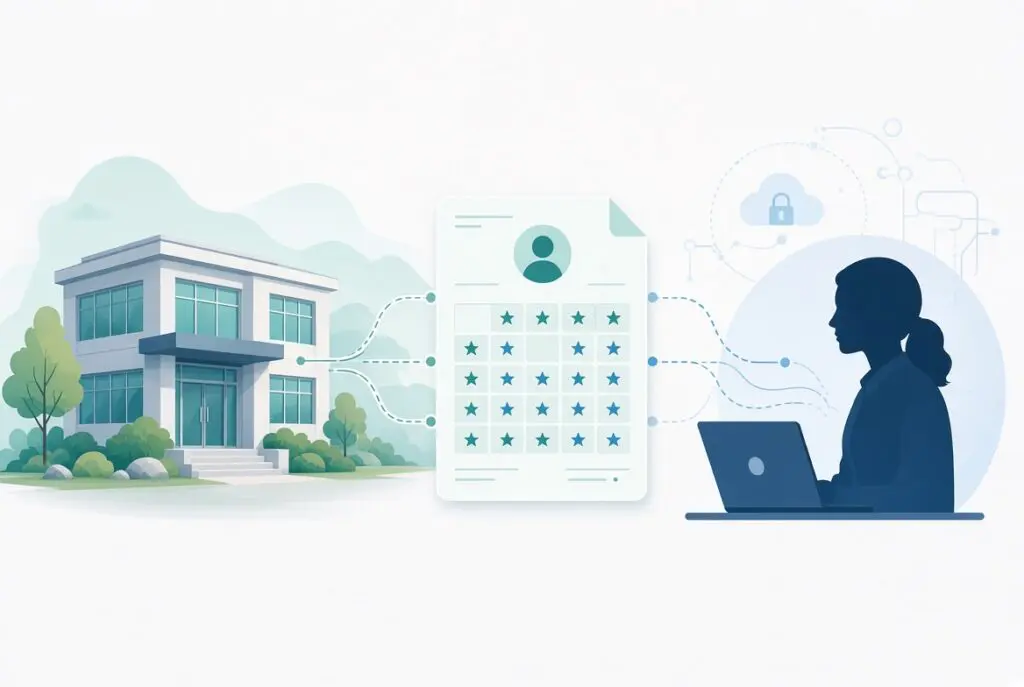
Comparison Matrix: What Residential Facilities Should Verify
| Review claim often seen | What to ask for | Why it matters for residential care |
|---|---|---|
| “Responsive providers” | Typical time from admission to first scheduled session, and any priority pathway for higher-acuity admissions | Residents often need medication management within the first few days of a stay |
| “Easy onboarding” | Average credentialing timeline from contract to first patient visit, and any state-specific requirements | Delays in credentialing can leave a facility without coverage after a clinician change |
| “Works well with our team” | Process for sharing notes with nursing and counseling staff, and whether clinicians can attend virtual team meetings | Medication changes and risk updates must reach on-site staff promptly |
| “Available when we need them” | Written after-hours escalation process and typical response time for non-emergent questions | Residential programs need a way to address questions that arise outside scheduled sessions |
| “Handles our population well” | Experience with the facility’s primary age group or diagnostic focus (e.g., adolescents, dual diagnosis, substance use), and any relevant training | Continuity of approach matters more in residential care than in single-visit settings |
| “Consistent coverage” | Typical process for maintaining the same clinician or small team across a resident’s stay, and how transitions are handled if a clinician changes | Residents benefit from the same prescriber tracking dose adjustments over weeks |
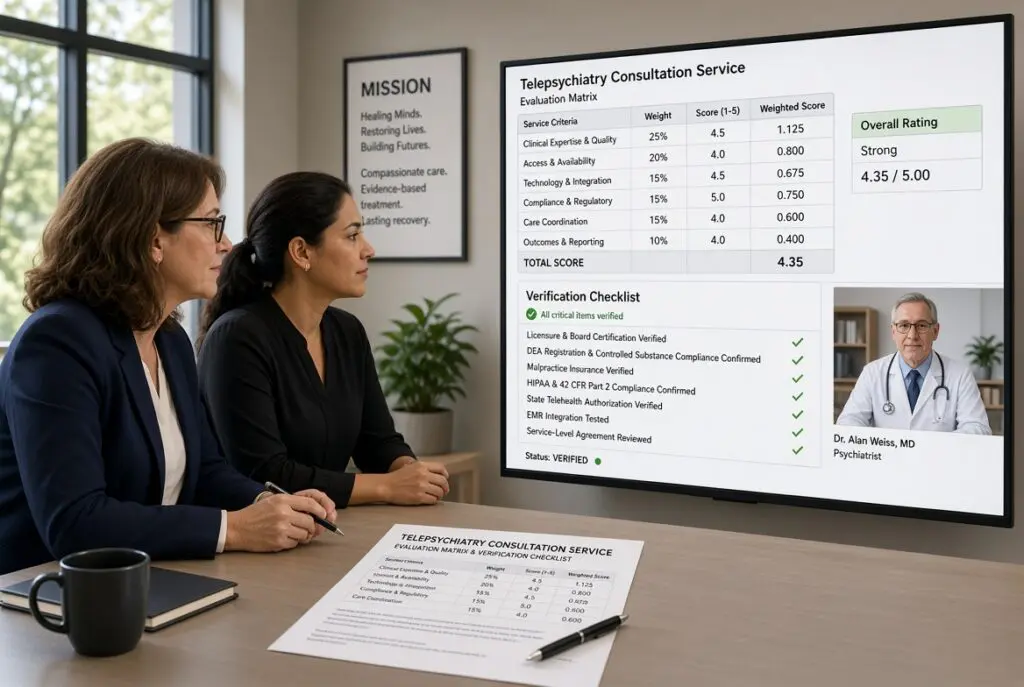
Facilities can use this matrix during initial conversations with a consultation service. Ask the service to walk through how each item is handled in practice, and request sample workflows or timelines where available.
Practical Verification Steps
Start with the length-of-stay question.
Ask how the service structures coverage for residents who stay two to six weeks or longer. Confirm whether the same clinician typically provides both the initial evaluation and subsequent medication management visits, or whether the service uses a different model.
Confirm documentation and team coordination.
Clarify whether clinicians document in the facility’s electronic health record or share notes through a defined process. Ask how nursing staff receive updates on medication changes and how the service participates in treatment team discussions when a plan changes.
Review the after-hours and transition process.
Request the written escalation pathway for questions that arise outside scheduled sessions. Ask how information is transferred if a resident is discharged or if coverage changes during a stay.
Pilot with a defined cohort.
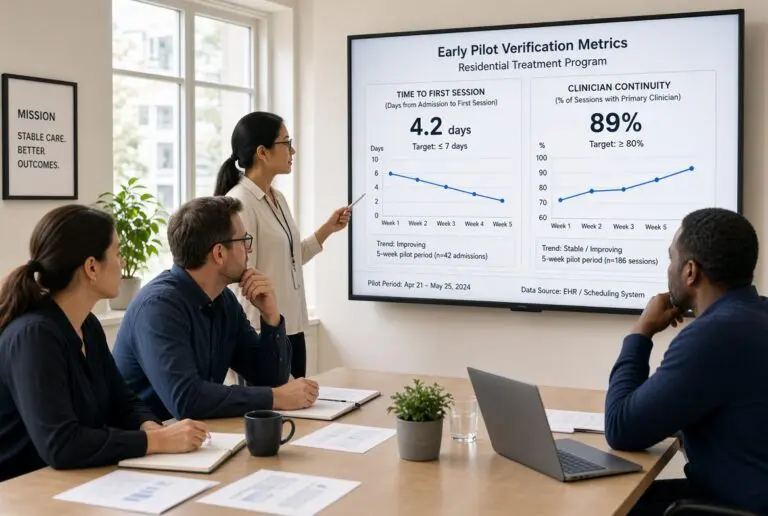
Limit the first 30–60 days to a specific unit, age group, or number of new admissions. Track a small set of operational indicators such as time from admission to first session, percentage of residents who see the same clinician for follow-up visits, and feedback from nursing staff on the usefulness of notes.
Common Issues That Surface During Reviews
- Single-visit model applied to residential care. The service is structured primarily for one-time evaluations and does not have a clear process for ongoing medication management. This can be clarified by asking about typical follow-up cadence and clinician continuity.
- Limited integration with on-site staff. Notes are not easily accessible to nursing or counseling teams, or clinicians do not participate in team meetings. Facilities can request a sample of how medication changes are communicated.
- Unclear after-hours pathway. There is no written process for questions that arise outside scheduled sessions. Ask for the escalation protocol and typical response expectations.
- Credentialing delays after a clinician change. The service does not have a documented process for replacing a clinician without interrupting coverage. Request the typical timeline for credentialing a replacement.
How FasPsych Supports Consultation Services for Residential Treatment Facilities
FasPsych places licensed psychiatrists and psychiatric nurse practitioners into existing residential treatment workflows. Providers can document in the facility’s electronic health record and coordinate with on-site nursing and counseling staff. Coverage can be structured as scheduled sessions that support both initial evaluations and ongoing medication management across a resident’s stay.
This model is designed for residential treatment facilities that want reliable consultation capacity without managing individual clinician recruiting for every placement. Related information on residential treatment centers appears on the residential treatment centers and SUD programs page. Hybrid models that can support intermittent on-site visits are covered under hybrid telemedicine. General telepsychiatry services are available on the telepsychiatry services page.
Frequently Asked Questions
How should a residential treatment facility evaluate telepsychiatry consultation service reviews?
Treat reviews as claims to verify. Use a structured matrix to turn each claim into a specific operational question, then request documentation or timelines that confirm how the service handles continuity, documentation, and coordination for multi-week stays.
Can consultation services support both initial evaluations and ongoing medication management?
Yes. Services structured for residential care typically provide both an initial evaluation and scheduled follow-up visits by the same clinician or a small, stable team.
What documentation process works best for residential facilities?
Documentation in the facility’s electronic health record, or a defined process for sharing notes with nursing and counseling staff, allows on-site teams to review medication changes and risk updates promptly.
How can facilities test a consultation service before a full commitment?
Many facilities pilot the service with a defined unit or number of new admissions for 30–60 days, tracking time to first session, clinician continuity, and feedback from on-site staff.
Reviewing telepsychiatry consultation services for residential treatment facilities is most effective when facilities move past surface-level testimonials and verify the operational details that matter for multi-week stays. A structured evaluation process focused on continuity, documentation, and coordination can help identify services that fit residential workflows.
To discuss how FasPsych can support consultation coverage within your residential treatment facility, explore the residential treatment centers and SUD programs page or the telepsychiatry services section.