


 On August 6, 2026, New Mexico First Judicial District Court Judge Bryan Biedscheid ruled that Meta Platforms created a public nuisance through Facebook and Instagram and ordered the company to pay $567 million into a youth mental health abatement fund. This came on top of a $375 million civil penalty a jury awarded earlier in 2026, bringing Meta’s total exposure in the case to approximately $942 million. The court found that Meta’s engagement-maximizing design features substantially contributed to social media mental health harm among the state’s youth. Official details are available in the New Mexico Department of Justice announcement, with additional reporting from Reuters and Ars Technica.
What “Public Nuisance” Means in the Meta Case
A public nuisance is an unreasonable interference with a right common to the general public—such as health, safety, or community welfare. Judge Biedscheid compared Meta’s platforms to a polluting factory: the apps function as the factory, the advertising and content as the product, and the psychological harm to children plus facilitation of sexual exploitation as the pollution that spreads into the real world. The court concluded that these effects create a common societal burden on children, families, schools, hospitals, and law enforcement across New Mexico. Meta was held to be a substantial contributing cause of social media mental health harm and ordered to abate the nuisance. See the full analysis in Ars Technica, the Guardian report, and the NM DOJ press release.
Key Elements of the Ruling
Meta must deposit $567 million into a five-year fund primarily for youth mental health treatment, screening, prevention, and related services. The company was also ordered to implement New Mexico-specific protections for users under 18, including monthly usage limits, restricted push notifications during school hours and overnight, default privacy settings that hide like counts, stronger age-verification measures, and prohibitions on romantic or sexualized interactions with Meta’s AI chatbots. Meta has stated it will appeal. Further details appear in Reuters and Politico’s analysis.
Similar Legal Actions in Other States
The New Mexico decision is widely viewed as a potential blueprint for other jurisdictions addressing social media mental health harm. More than 40 states and over 1,300 school districts have filed public-nuisance or related lawsuits against social media companies seeking damages and product changes. A similar case brought by Tennessee is already in trial. A major federal trial in California involving claims by approximately 29 states over child safety, addiction-related design, and consumer-protection issues is scheduled to begin in mid-August 2026. Additional school-district cases are advancing, with the first expected to go to trial in early 2027. Coverage of the broader litigation landscape is available from Politico, Reuters, and The Tennessean.
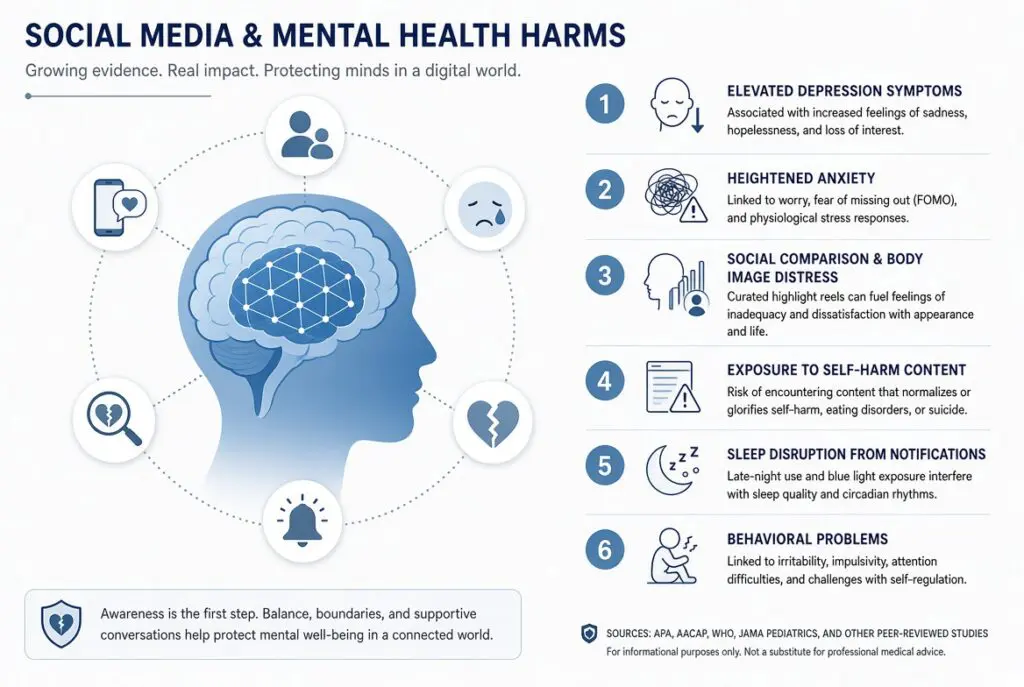
Direct Evidence of Social Media Mental Health Harm
Research consistently documents social media mental health harm in adolescents:
- Higher engagement predicts increased depression and anxiety symptoms, especially in early adolescence.
- Algorithms can expose teens to self-harm content even without searching for it, correlating with higher loneliness, anxiety, and depressive symptoms.
- Visible metrics and idealized images intensify social comparison, contributing to poorer body image and elevated eating-disorder risk.
- Notifications and endless feeds disrupt sleep, a key factor in emotional regulation and adolescent brain development.
- Problematic use shows addiction-like patterns (tolerance, continued use despite impairment) and is linked to behavioral problems and lower academic performance, as summarized in this large-scale longitudinal analysis.
These patterns of social media mental health harm place additional demand on already strained mental health systems.
Primary Care’s Front-Line Role: Screening and Specialist Integration
Primary care offices see adolescents regularly and are ideally positioned to detect emerging social media mental health harm early. Routine screening can include PHQ-9/PHQ-A for depression, GAD-7 for anxiety, questions about daily screen time, sleep, nighttime use, body-image distress, and feelings of compulsion related to social media.
When screening flags elevated symptoms or high-risk patterns, practices need rapid access to specialized expertise. FasPsych’s telepsychiatry services partner with primary care offices to provide child and adolescent psychiatrists and psychiatric nurse practitioners for evaluations, medication management, collaborative consultation, and treatment support. This approach keeps the primary care clinician as the medical home while adding specialist capacity without long waits or geographic barriers. Learn more about our specialized adolescent psychiatry providers and how we support clinics nationwide.
Call to Action for Primary Care Providers: Add Specialized Telepsychiatry Through FasPsych
 Primary care providers are on the front lines of identifying and addressing social media mental health harm in adolescents. FasPsych makes it straightforward to integrate specialized child and adolescent psychiatric expertise into your practice through secure, flexible telepsychiatry. Our board-certified providers deliver evaluations, medication management, and collaborative care support tailored to the needs of primary care teams.
To get started, call an implementation specialist at (877) 218-4070 or complete the Partner With Us form on our website. We will work with you to design a solution that expands access to specialized treatment without adding administrative burden.
Frequently Asked Questions
What is a public nuisance claim against a social media company? It alleges that the company’s product design unreasonably interferes with public health and safety rights shared by the community, not just individual users. The New Mexico court applied this to Meta’s engagement features and resulting social media mental health harm .
Does the ruling require Meta to change its platforms nationwide? No. The ordered product changes apply specifically to New Mexico users under 18 and last five years. The financial abatement fund is also state-focused. Other states are watching the case closely and may pursue similar public-nuisance theories .
How strong is the evidence of social media mental health harm? Multiple longitudinal studies and meta-analyses show consistent associations between higher social media use and increased depressive and anxiety symptoms, particularly in early teens. Effects are modest at the individual level but meaningful at population scale .
Should primary care clinics screen every adolescent for social media-related issues? Yes, brief screening during well visits and relevant acute visits is practical and recommended. Ask about screen time, sleep impact, emotional distress tied to online activity, and body-image concerns alongside standard depression and anxiety tools.
How can a primary care office integrate FasPsych telepsychiatry? FasPsych provides flexible, secure telepsychiatry staffing and collaborative care support. Practices can arrange evaluations, medication management, or ongoing psychiatric consultation that fits existing workflows. Explore our child and adolescent psychiatry services or call (877) 218-4070 to speak with an implementation specialist.
Will the Meta abatement fund reduce demand for mental health services? It will fund additional treatment and prevention capacity in New Mexico for five years. Broader demand driven by social media mental health harm is expected to continue nationwide, making primary-care screening plus specialist telepsychiatry support an important ongoing strategy.
Primary care practices that combine routine screening with ready access to expert telepsychiatry are better equipped to respond to social media mental health harm highlighted by the New Mexico ruling and the wider wave of state litigation. Call (877) 218-4070 or partner with FasPsych today to add specialized child and adolescent psychiatric capacity to your clinic.