
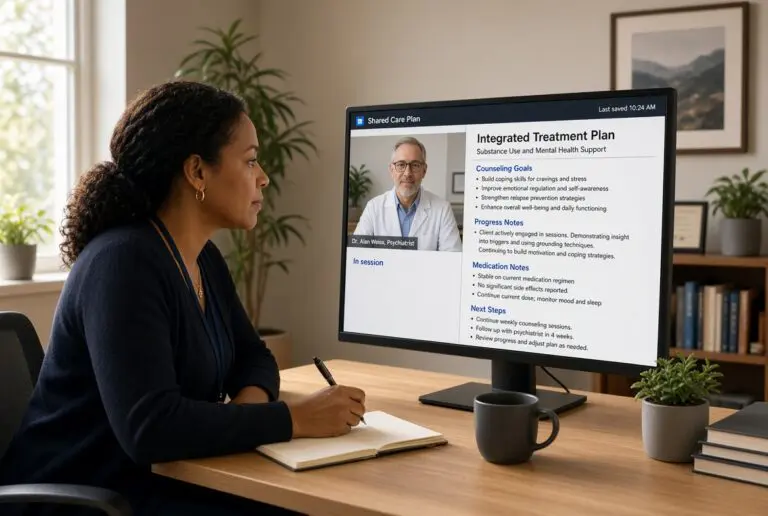

Substance abuse counseling programs frequently deliver strong therapeutic work but still face gaps when clients need timely psychiatric evaluation, medication initiation, or ongoing medication management. When counselors or program directors search for reliable telemedicine medication management for substance abuse counseling, they are typically looking for a partner that can support the existing counseling relationship rather than replace it or create parallel systems.
SAMHSA states that medications for substance use disorders are most effective when combined with counseling and behavioral therapies as part of a whole-person approach. Current federal rules allow DEA-registered practitioners to prescribe controlled substances, including buprenorphine for opioid use disorder, via telemedicine without a prior in-person exam through December 31, 2026, provided other federal and state requirements are met. This creates a practical opportunity for counseling programs to add a prescribing layer without building an in-house psychiatric department.
Reliability in a counseling setting is defined by day-to-day collaboration and continuity with the counseling team, not solely by licensing or basic compliance. The sections below outline how counseling-led programs can identify and integrate partners that meet this standard.
Counseling-Aligned Medication Management Reliability Framework
Counseling programs can evaluate potential telemedicine medication management partners against five practical pillars. These criteria focus on how the service will function inside an existing counseling workflow rather than on general compliance alone.
- Prescriber Continuity — The same psychiatrist or psychiatric nurse practitioner follows the client from evaluation through ongoing management, with a documented handoff process if a change is needed.
- Counselor Communication Pathways — A defined, reliable method exists for counselors to share observations (changes in cravings, engagement, missed sessions, or safety concerns) and receive timely clinical input between scheduled visits.
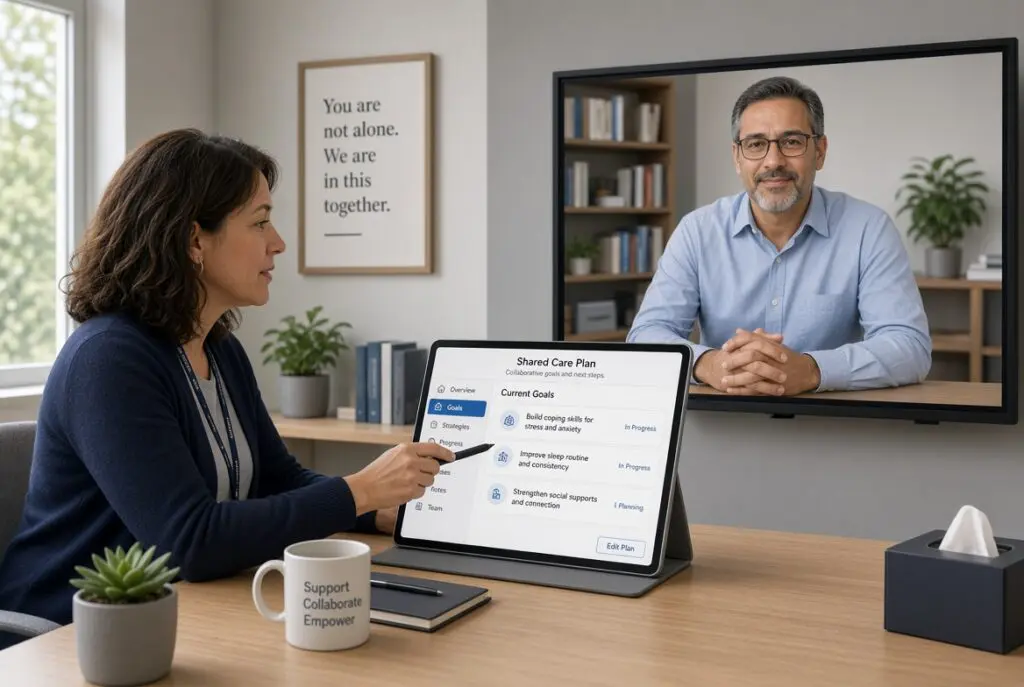
- Shared Care Plan — Medication decisions and counseling goals appear in a common format that both the counseling team and remote prescriber can use.
- Alliance Protection — Role clarity keeps the counselor as the primary therapeutic relationship. Medication changes and safety issues are communicated in a way that lets the counselor address them in the next session.
- Joint Metrics — The partnership tracks a small set of shared indicators so both sides can see whether the integration is working.
Programs that score potential partners against these pillars move beyond general assurances and identify services that will actually support counseling continuity.
What Reliable Telemedicine Medication Management Looks Like for Counseling Programs
For outpatient counseling centers, intensive outpatient programs, and other counseling-led substance use settings, reliability shows up in operational details that protect the therapeutic alliance and reduce dropout. Programs that successfully add telemedicine medication management tend to prioritize these markers:
- Same-prescriber continuity so clients and counselors develop clearer expectations.
- Defined communication pathways that allow counselors to flag clinical changes without waiting for the next scheduled medication visit.
- Shared treatment language and documentation that counseling staff can actually use.
- Scheduling that aligns with existing counseling flow rather than forcing clients to choose between services.
- Safety protocols (diversion controls, PDMP checks, limited supplies) that counselors understand and can reinforce in therapy.
Research on telehealth-delivered buprenorphine has shown retention rates comparable to or, in some cohorts, stronger than traditional in-person models when care is coordinated. One multistate study of telehealth buprenorphine treatment reported 71% retention at six months. Programs that treat medication management as a disconnected service often see higher dropout. Programs that treat the remote prescriber as an extension of the counseling team more often see better retention and more coherent care plans.
Practical Steps to Identify and Integrate a Reliable Partner
Counseling programs can use the following operational criteria when evaluating potential partners. These go beyond standard licensing and DEA questions and focus on how the service will work with an existing counseling team.
Green flags for counseling settings
- Willingness to match providers with relevant addiction or dual-diagnosis experience and document directly in the program’s EHR.
- A documented process for receiving and acting on counselor input between visits.
- Clear continuity expectations (same provider for a defined period or a structured handoff protocol).
- Flexible scheduling that can align with existing counseling sessions.
- Agreement to track joint metrics such as referral-to-first-visit time, medication management attendance, or rates of coordinated follow-up.
Red flags
- High provider turnover with no continuity plan.
- Documentation that is usable only by the remote provider.
- Rigid scheduling that forces clients to choose between counseling and medication management.
- No defined pathway for asynchronous communication about clinical changes.
- Treating medication management as a one-time induction with little planned ongoing coordination.
Shared Care Plan Elements
Successful programs use a short shared care plan or note template so both the counseling team and remote prescriber stay aligned. Useful elements include:
- Current counseling focus and stage (for example, early engagement, relapse prevention, trauma work)
- Recent substance use markers (last use, craving intensity, toxicology if available)
- Current medication status, dose, and any recent changes
- Next counseling session date and next medication management visit date
- Escalation contacts and preferred communication method for urgent issues
- Any specific counselor observations the prescriber should know before the next visit
Counselor input often directly shapes medication decisions. A drop in session attendance or a sudden increase in cravings reported by the counselor can prompt a dose adjustment, more frequent monitoring, or a change in contingency planning. When that information flows both ways, medication management supports the counseling work rather than running in parallel.

Integration Protocols That Protect the Therapeutic Relationship
Successful programs define roles early: the counseling team retains the primary therapeutic relationship, progress tracking, and psychosocial interventions. The remote prescriber owns evaluation, diagnosis, medication decisions, and medical monitoring. Shared elements typically include:
- Written consent that covers information sharing under HIPAA and 42 CFR Part 2.
- The shared care plan template described above.
- Brief joint case reviews or secure asynchronous messaging so counselors can flag issues without an extra client visit.
- An escalation path that notifies the counselor when medication changes or safety concerns arise, so the counselor can address them in the next session.
These steps help counseling programs move from a general search for telemedicine medication management to a specific, workable partnership. For practices that already deliver counseling and need to add psychiatric capacity, FasPsych’s counseling practice augmentation approach focuses on integrating remote providers into existing workflows. Broader medication management service details appear on the online medication management page.
A 90-Day Implementation Approach and Metrics
A phased rollout reduces disruption:
- Days 1–30: Finalize role definitions, consent language, shared note templates, and escalation pathways. Train a small group of counselors and pilot with a limited number of clients. Confirm EHR access and response times.
- Days 31–60: Expand the caseload. Begin joint case reviews. Track early indicators and adjust protocols based on real cases.
- Days 61–90: Review outcomes against baseline counseling retention and engagement. Refine backup coverage and visit cadence. Decide on sustainable volume.
Useful early metrics for the pilot include:
| Metric | What it shows | Target direction |
|---|---|---|
| Referral-to-first medication visit time | Access speed after counseling identifies need | Decreasing |
| Medication management attendance rate | Client engagement with the prescribing layer | Stable or improving |
| Counselor-rated usefulness of communication (1–5) | Whether the partnership actually helps the counseling team | Improving |
| Change in counseling retention among dual-service clients | Whether adding medication management supports or disrupts counseling | Stable or improving |
Programs that treat the first 90 days as a structured pilot typically identify and fix handoff issues before they affect a larger number of clients.
Common Pitfalls and How to Avoid Them
- Parallel tracks. Medication management and counseling operate with little shared information. Mitigation: Require a shared care plan element and at least one defined communication channel from the start.
- Counselor exclusion from medication changes. Clients learn about dose adjustments only from the remote provider. Mitigation: Build a notification step so the counselor can address the change in the next session.
- Over-reliance on the remote provider for psychosocial support. The counseling team steps back once medication starts. Mitigation: Reinforce that the counselor remains the primary therapeutic relationship.
- Inconsistent documentation. Remote notes are too sparse or use different language. Mitigation: Agree on a short shared template during onboarding.
How FasPsych Supports Counseling-Led Programs
FasPsych places licensed psychiatrists and psychiatric nurse practitioners into existing counseling and substance use programs on secure video. Providers can document in the partner’s EHR, follow the program’s clinical protocols, and be matched for expertise in addiction psychiatry and coordination with counseling teams. Organizations pay for the clinical time used without recruiting, credentialing, or managing additional full-time prescribing staff.
This model is designed for programs that already have strong counseling capacity and need a reliable medical and prescribing layer that integrates with the onsite team. Details on virtual medication-assisted treatment services appear on the Virtual Medication-Assisted Treatment (MAT) page.
Frequently Asked Questions
Can telemedicine medication management work if our program is primarily counseling-based?
Yes. Many outpatient counseling centers and IOPs use telepsychiatry partners to add the prescribing and medical monitoring layer while keeping counseling as the core service. SAMHSA’s guidance on telehealth for substance use disorders supports integrated models.
How quickly can counselors get input on a clinical concern between scheduled visits?
Reliable partnerships define response expectations (often same business day or next business day for non-emergent issues) and provide named contacts or secure messaging pathways.
Does adding a remote prescriber change the counselor’s role?
No. The counselor continues to own the therapeutic relationship, psychosocial interventions, and day-to-day engagement. The remote provider supplies evaluation, medication management, and medical oversight that support the counseling work.
What should we track in the first 90 days?
Useful early metrics include time from referral to first medication management visit, medication management attendance rates, counselor-reported usefulness of communication, and any change in counseling retention among clients receiving both services.
Substance abuse counseling programs can find reliable telemedicine medication management by focusing on operational continuity, shared documentation, clear communication pathways, and counselor inclusion rather than general compliance checklists alone. A carefully selected partner can close the gap between strong counseling and timely medical support while protecting the therapeutic relationship that drives long-term engagement.
To discuss how FasPsych can support medication management within your existing counseling program, contact the team through the Virtual Medication-Assisted Treatment page or explore counseling practice support.