
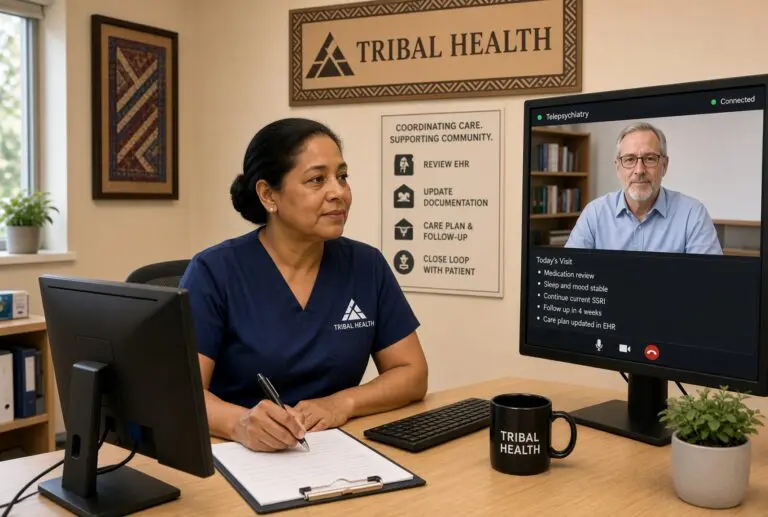

Telepsychiatry providers seeking to serve tribal communities are usually trying to address a specific access gap: limited local psychiatric capacity in many tribal health programs, Indian Health Service (IHS) facilities, and tribal clinics serving American Indian and Alaska Native populations. The practical question is how providers can deliver consistent evaluations and medication management that respect tribal sovereignty, integrate with existing tribal health workflows, and support continuity of care across rural and urban settings.
The Indian Health Service Telebehavioral Health Center of Excellence provides ongoing telehealth services for IHS, tribal, and urban Indian health programs, including adult, child and adolescent, addiction, and geriatric psychiatry. Federal guidance from Telehealth.HHS.gov on telebehavioral health for American Indian and Alaska Native communities notes that telebehavioral health can support psychiatric assessments, medication management, and care coordination with local providers. SAMHSA’s TIP 61: Behavioral Health Services for American Indians and Alaska Natives provides practical guidance on cultural awareness, historical context, and culturally responsive approaches for behavioral health professionals. Telehealth.HHS.gov guidance on preparing patients and developing strategies emphasizes engaging tribal leadership early and designing workflows that connect patients back to local supports.
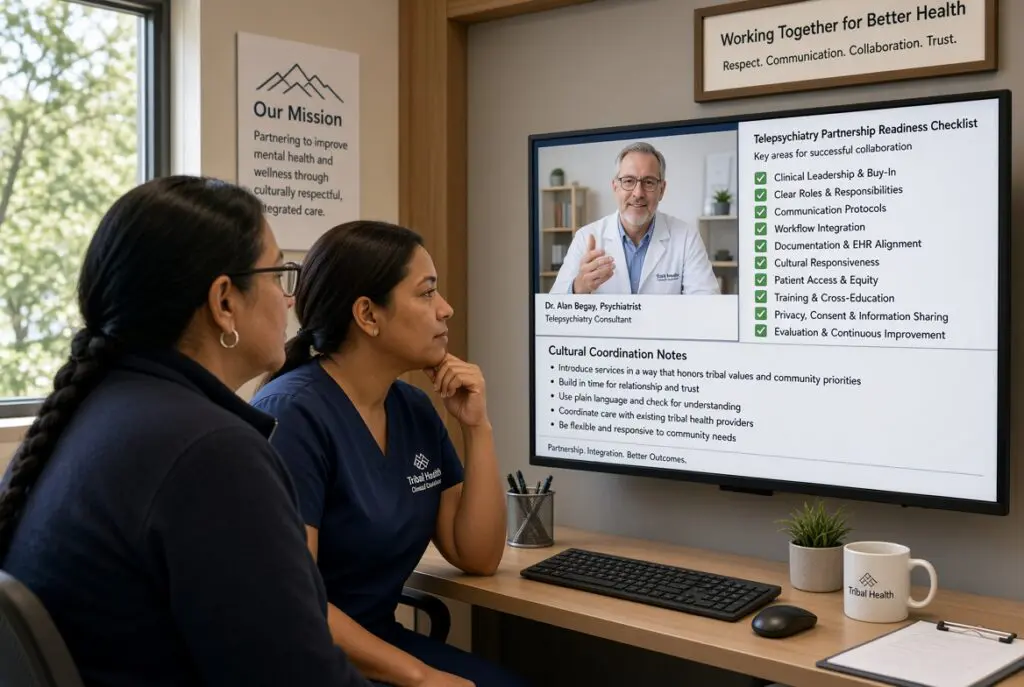
Tribal Community Telepsychiatry Partnership Framework
Telepsychiatry providers and the organizations that staff them can evaluate readiness to serve tribal communities against four practical pillars.
- Community Partnership and Cultural Humility — The provider or partner engages tribal leadership and local health staff early, seeks input on community priorities, and approaches care with cultural humility. Clinicians receive orientation on local context, including historical and cultural factors that may influence care, and are open to incorporating community supports and preferences into treatment planning when appropriate.
- Integration with Tribal Health Systems — Providers document in the tribal clinic’s or IHS facility’s electronic health record when possible, coordinate with local primary care and behavioral health staff, and follow existing referral and follow-up pathways. The service does not create a parallel system that bypasses tribal health governance.
- Licensure, Jurisdiction, and Continuity — Clinicians are licensed in the relevant states or jurisdictions where patients are located. Coverage is structured so that the same psychiatrist or a small, stable team can provide continuity for patients who may move between reservation, rural, and urban settings. A defined process exists for care transitions when a patient relocates or when coverage changes.
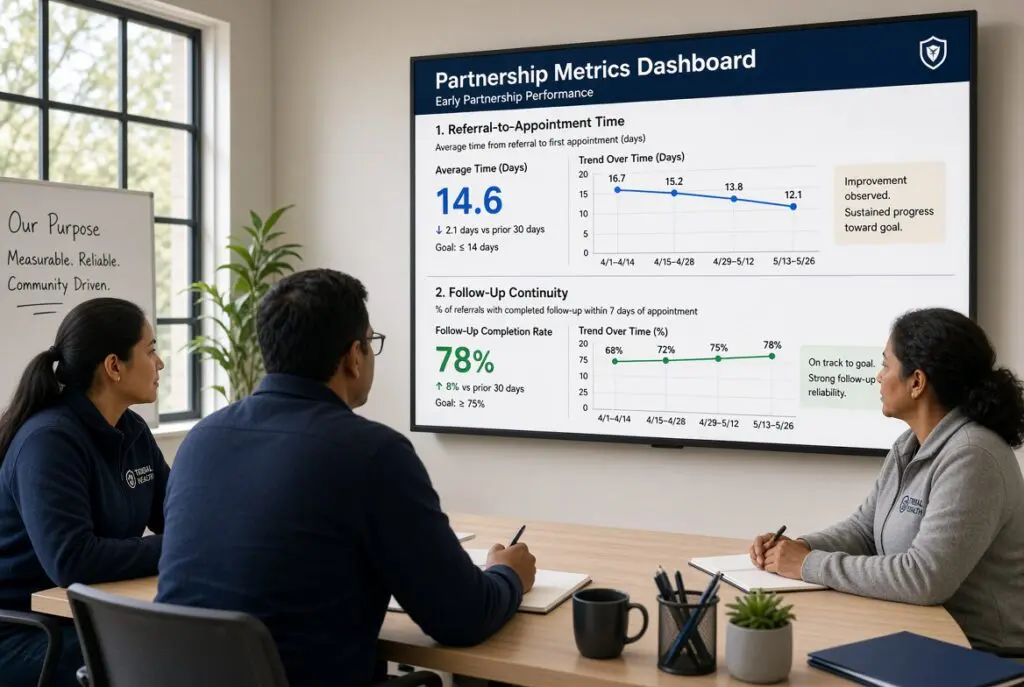
- Measurement of Access and Partnership Reliability — The tribal health program and provider track a small set of indicators (time from referral to first appointment, percentage of patients completing a follow-up visit, and feedback from tribal health staff on coordination and cultural fit) so the partnership can be refined.
Providers that score high on these pillars treat telepsychiatry as a partnership that strengthens existing tribal health capacity. Those that score low often produce short-term placements with limited coordination or cultural context.
Practical Recommendations for Telepsychiatry Providers
Engage tribal leadership and local staff before launching.
Request an introductory discussion with the tribal health director or relevant program lead. Ask about current psychiatric capacity, preferred referral pathways, and any specific community priorities or protocols. Confirm whether the tribal program prefers that providers document in their system. Review available guidance such as SAMHSA TIP 61 on cultural considerations before the first patient visits.
Confirm documentation and coordination processes.
Clarify whether clinicians will have access to the tribal clinic’s EHR. Define how notes will be shared with local primary care or behavioral health staff and how prescriptions will be coordinated with local pharmacies when needed. Establish a simple process for urgent questions or care transitions. Align with IHS or tribal facility workflows when serving those settings.
Structure coverage for continuity.
Whenever possible, assign a consistent psychiatrist or small team to a defined panel or set of hours rather than rotating one-off clinicians. Discuss how care will be maintained if a patient travels or relocates within the region, and how information will transfer if coverage changes.
Pilot and measure partnership reliability.
Start with a defined set of hours or a specific service line. Track:
| Metric | What it measures | Early target direction |
|---|---|---|
| Median days from referral to first appointment | Access speed | Decreasing |
| % of patients completing a follow-up visit within a defined window | Continuity | Stable or increasing |
| Tribal health staff feedback on coordination and note usefulness | Integration quality | Positive trend |
| Patient or community feedback on cultural fit and trust | Partnership reliability | Stable or improving |
Common Pitfalls When Serving Tribal Communities
- Bypassing tribal health governance. The provider sets up a direct-to-patient pathway without coordinating with the tribal clinic. Mitigation: Require that referrals and documentation flow through the existing tribal health system.
- Limited cultural orientation. Clinicians begin seeing patients with no introduction to local context or community preferences. Mitigation: Build a brief orientation process with tribal health staff and review resources such as SAMHSA TIP 61 before the first patient visits.
- Rotating coverage with low continuity. Patients see a different clinician for each visit, reducing trust. Mitigation: Prioritize stable team assignments and a clear process for continuity when a clinician changes.
- Unclear care transition process. Information does not follow a patient who moves between reservation and urban settings. Mitigation: Define a simple handoff protocol for transitions of care.
How FasPsych Supports Telepsychiatry for Tribal Communities
FasPsych places licensed psychiatrists and psychiatric nurse practitioners into existing tribal health and IHS workflows. Providers can document in the partner’s electronic health record and coordinate with local staff. Coverage can be structured as scheduled hours or hybrid arrangements that combine virtual care with occasional on-site visits when needed.
This model is designed for tribal health programs that want reliable psychiatric capacity without managing individual clinician recruiting and credentialing for every placement. Related information on tribal communities appears on the tribal and Native American mental health services page. Hybrid models that can support intermittent on-site visits are covered under hybrid telemedicine. General telepsychiatry services are available on the telepsychiatry services page.
Frequently Asked Questions
Can telepsychiatry providers document in a tribal clinic’s electronic health record?
Yes, when the tribal health program grants access and the provider is credentialed appropriately. Many partnerships structure documentation inside the existing record so local staff can review notes and coordinate care.
How should providers approach cultural considerations in tribal communities?
Providers should engage tribal leadership and local health staff early, seek orientation on community context, and approach care with cultural humility. Resources such as SAMHSA TIP 61 offer practical guidance on historical context and culturally responsive approaches. Treatment planning should respect patient preferences and, when appropriate, incorporate local supports.
Is hybrid coverage (virtual plus occasional on-site) available?
Yes. Some partners can structure intermittent on-site visits by the same clinicians who provide ongoing virtual care, which can support relationship-building and complex cases.
What is a reasonable expectation for continuity of the same clinician?
Programs that prioritize continuity typically assign a consistent psychiatrist or small team to a defined panel or set of hours, with a clear process for knowledge transfer if a clinician changes.
Recommendations for telepsychiatry providers serving tribal communities center on community partnership, integration with existing tribal health systems, continuity of care, and measurable reliability. Providers that evaluate their readiness against these criteria can support tribal health programs without creating parallel systems or short-term placements that reduce trust.
To discuss how FasPsych can support telepsychiatry coverage within your tribal health or IHS workflows, explore the tribal and Native American mental health services page or the telepsychiatry services section.