
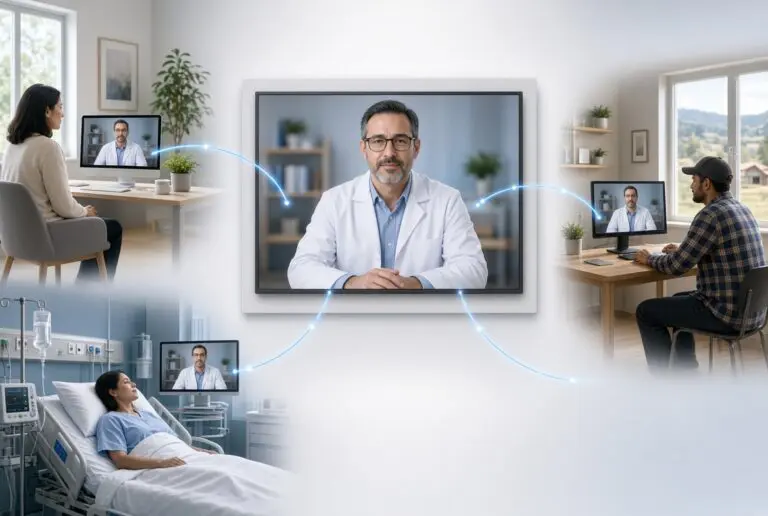

Facilities evaluating telepsychiatry coverage face a practical choice: should psychiatric support arrive only when a need arises, or should dedicated providers sit on a consistent weekly schedule?
On-demand telepsychiatry supplies evaluations and consultations as requests come in. It is well suited for emergency departments, crisis response, nights, weekends, and variable volume. Scheduled telepsychiatry places the same providers on fixed weekly blocks. It supports continuity, staff relationships, and steady outpatient or inpatient panels. Many organizations use a hybrid of both.
The right model depends on volume predictability, acuity, continuity needs, budget preference, and how quickly coverage must go live. FasPsych has delivered flexible telepsychiatry staffing since 2007 and supports both approaches—along with hybrid options—so facilities can match coverage to actual demand rather than a rigid program structure.

What Is Scheduled Telepsychiatry Coverage?
Scheduled telepsychiatry places board-certified psychiatrists or psychiatric nurse practitioners on a consistent weekly schedule at your facility. The same clinicians typically return each week. They become familiar with your staff, workflows, electronic health record, and patient population.
This model works best when volume is relatively predictable. Common uses include outpatient clinic panels at FQHCs and CMHCs, recurring inpatient rounding, long-term behavioral health units, and primary-care integration or Collaborative Care Model support. Providers document in your existing systems and can participate in team meetings and care coordination over time.
Advantages include stronger continuity of care, easier staff relationships, more predictable scheduling for patients, and cleaner longitudinal outcome tracking.
Limitations appear when volume fluctuates significantly. Some scheduled arrangements carry higher fixed commitments than pure usage-based options.
For more on matching providers to ongoing clinical needs, see FasPsych’s telepsychiatry services and adult psychiatrist network.
What Is On-Demand Telepsychiatry Coverage?
On-demand telepsychiatry supplies psychiatric expertise when a request comes in rather than on a fixed calendar. Care teams initiate a consult for an emergency department evaluation, crisis intervention, inpatient consult, or overflow need. Clinicians respond according to the agreed service level—often including nights, weekends, and holidays.
This model is designed for variable or high-acuity demand. Hospitals use it to reduce psychiatric boarding and improve ED throughput. Other facilities use it for after-hours coverage or surge capacity. Because engagement is typically usage-based or per-encounter, organizations pay for the coverage they actually consume.
Advantages include alignment with unpredictable volume, reduced fixed overhead, faster access during crises, and measurable impact on throughput metrics.
Limitations center on continuity. Patients and staff interact with different clinicians more often, and pure on-demand coverage can feel less integrated into daily outpatient workflows if it is the only model used.
FasPsych’s dedicated on-demand psychiatry services page describes how organizations request and receive this coverage. Related operational guidance appears in FasPsych resources on emergency department workflows and after-hours support.
Side-by-Side Comparison
| Factor | Scheduled Coverage | On-Demand Coverage |
|---|---|---|
| Volume fit | Steady or growing panels | Spiky, unpredictable, or crisis-driven |
| Continuity | High (same providers return) | Lower (request-based or rotating) |
| Cost structure | Often block hours or dedicated time | Primarily usage-based / per encounter |
| Best settings | Clinics, FQHCs, CMHCs, routine rounding | ED, crisis units, nights, weekends, overflow |
| Staff relationships | Strong ongoing relationships | More transactional |
| Outcomes tracking | Easier longitudinal measurement | Stronger for access and throughput metrics |
| Typical launch | 2–6 weeks | Often comparable or faster for pure on-demand |
| Flexibility to scale | Can adjust hours over time | Scales directly with demand |
When a Hybrid Approach Makes Sense
Most real-world programs benefit from a combination. A CMHC or FQHC might maintain scheduled weekday coverage for its core outpatient panel while adding on-demand support for after-hours crises or high-acuity referrals. A hospital might use scheduled providers for daily inpatient rounding and on-demand clinicians for ED evaluations and night coverage.
Hybrid models can also include intermittent on-site visits alongside virtual care for complex cases, initial evaluations, or specific protocols. FasPsych supports these mixed arrangements—PRN, fractional, locum tenens, on-call, and hybrid—without requiring a facility to stand up a separate virtual department. Learn more about combining in-person and virtual care on the hybrid telemedicine page.
For broader guidance on flexible staffing that stays inside existing workflows, see FasPsych resources on community and outpatient program models and payment structures that match actual volume.
Key Decision Factors
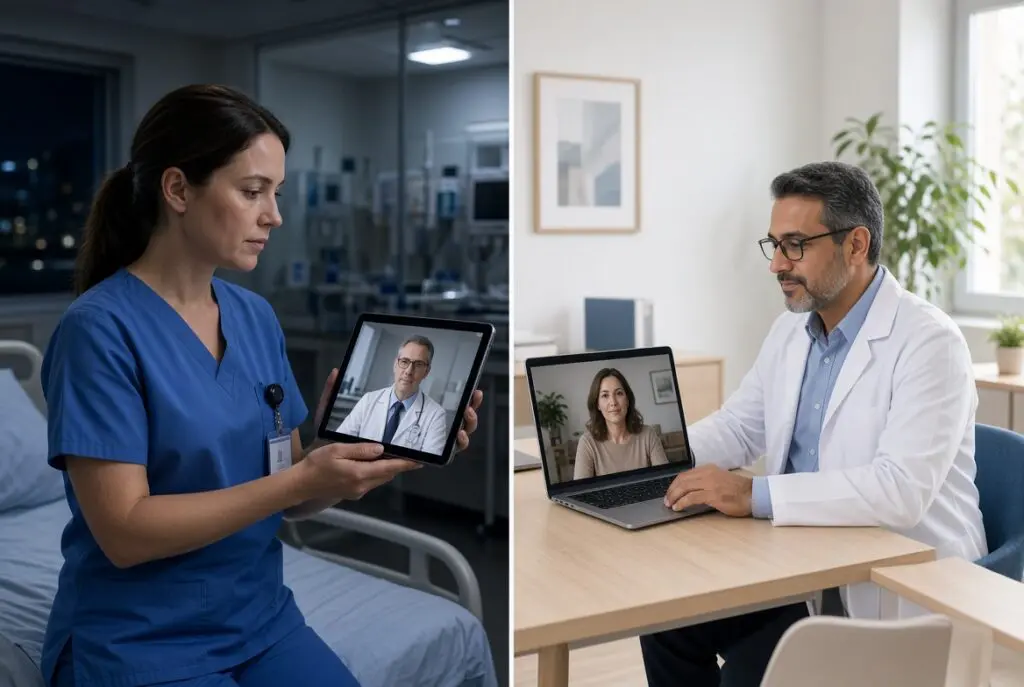
When choosing between models (or designing a hybrid), consider:
- Current and projected patient volume and acuity patterns
- Preference for fixed versus variable cost
- Importance of provider continuity versus pure access speed
- EHR integration and documentation requirements
- Desired launch timeline and ability to scale up or down
- Specific settings served (ED, outpatient clinic, correctional, MAT, rural, primary-care integration)
The American Psychiatric Association notes that telepsychiatry is effective across a range of settings and can improve access when local psychiatric supply is limited. HRSA data on Mental Health Professional Shortage Areas continues to show gaps that remote coverage can help address.
Implementation Considerations
Both models require credentialing, privileging, and technology setup. Most FasPsych programs launch in two to six weeks with support for HIPAA-compliant video, EHR integration into existing systems, and staff training. Success metrics differ by model: scheduled programs often track continuity, no-show rates, and symptom improvement; on-demand programs frequently track ED boarding time, throughput, and time-to-evaluation. Clear communication with referring staff about when and how to request coverage improves utilization in either approach.
Frequently Asked Questions
Can we start with on-demand coverage and add scheduled providers later?
Yes. Many facilities begin with on-demand or fractional coverage to address immediate gaps, then layer in scheduled providers once volume and workflows stabilize.
How quickly can either model launch?
Most programs go live in two to six weeks. Pure on-demand arrangements can sometimes move faster when credentialing is already complete or limited in scope.
Does on-demand coverage work outside of hospitals?
Yes. While ED and crisis settings are common, on-demand support is also used by clinics for after-hours needs, overflow, or specific high-acuity referrals.
How does pricing typically differ?
Scheduled coverage is often structured around committed hours or blocks. On-demand coverage is more commonly usage-based or per encounter. Exact pricing depends on specialty mix, volume, geography, and service level. FasPsych’s payment model guidance outlines the differences between fee-for-service, block hours, and coverage-day options.
Can the same clinician provide both scheduled and on-demand coverage?
In many cases yes, depending on the provider’s availability and the facility’s privileging. Dedicated scheduled providers are usually preferred when continuity is a priority.
Conclusion
Scheduled telepsychiatry excels when volume is predictable and continuity matters. On-demand telepsychiatry excels when demand is variable and rapid access is the priority. Most organizations achieve the best results with a hybrid that combines both.
FasPsych has supported facilities with flexible telepsychiatry coverage since 2007—including PRN, locum tenens, fractional, on-call, and hybrid options—across hospitals, FQHCs, CMHCs, rural sites, and correctional settings. The goal is coverage that matches your actual volume and workflows rather than a fixed program structure.
If you are evaluating on-demand, scheduled, or hybrid telepsychiatry coverage, contact FasPsych to discuss options tailored to your facility’s needs, timeline, and budget.