


The job was not “be excellent.” The job was “do not miss.”
When Curt Hennig was repackaged in 1988 as Mr. Perfect, the company did not sell a good wrestler who sometimes had an off night. It sold infallibility. A run of vignettes showed him draining jump shots, hitting home runs, throwing strikes. Wade Boggs, who later inducted him into the WWE Hall of Fame, called the batting-cage shot “absolutely perfect.” Lanny Poffo, billed as his “executive consultant,” later said the bowling spot took take after take to get twelve strikes — and that Hennig then refused to bowl live on Regis Philbin because a gutter ball on unedited television would kill the character. Editing could protect the reputation. Live television could not.
That is the psychology of this piece. Some workplaces do not ask for high standards. They sell a person who does not miss. The expectation is the absence of error. The body still breaks. The role is not allowed to say so.
When High Standards Become the Self
High standards are not a diagnosis. Plenty of competent people want the note clean, the airway secured, the handoff complete. Clinical perfectionism, as Roz Shafran, Zafra Cooper, and Christopher Fairburn defined it in 2002, is narrower. Self-evaluation becomes over-dependent on the pursuit and achievement of personally demanding standards in at least one domain that matters — despite adverse consequences. Meet the standard and it was not high enough. Miss it and the self is the failure, not the attempt.
The loop is simple and expensive. Standards stay rigid. Checking, repeating, and delaying look like conscientiousness. Self-criticism after any defect is treated as professionalism. Rest is treated as a leak in the reputation.
This is not the impostor phenomenon. Impostor feelings say I am a fraud despite evidence of competence. Clinical perfectionism says competence is not the point; the point is that an error must not exist. A person can know they are skilled and still be unable to let a small miss stand without rewriting the self.
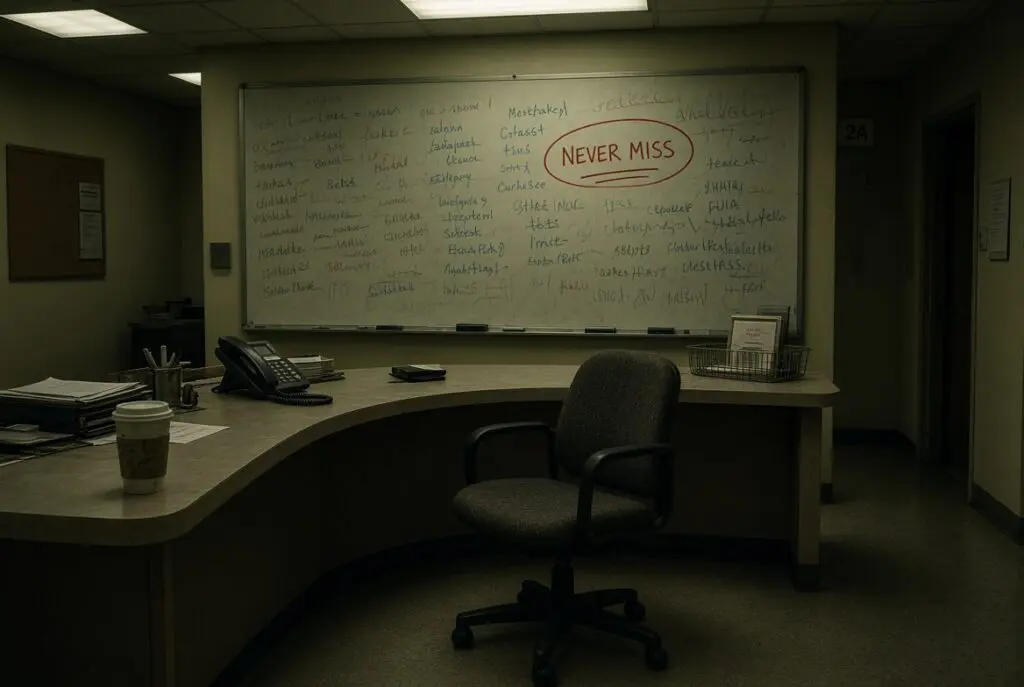
The Pressure Is Often Social Before It Is Personal
The demand to never miss rarely starts as a private hobby. It is installed.
Paul Hewitt and Gordon Flett’s 1991 model splits perfectionism into self-oriented, other-oriented, and socially prescribed. Socially prescribed perfectionism is the belief that other people require you to be flawless — family, teachers, a profession, a unit, a patient panel, a public. The standard lives outside the person first. The person then carries it as if it were their own idea.
That social pressure has a few reliable sources in clinical work:
- The audience that was promised a legend. Patients and families are told they got “the best.” After that, an ordinary delay looks like a betrayal.
- The peer group that uses one person as the rubric. If the unofficial job description is “be them,” everyone else is scoring the same myth.
- The institution that cannot absorb an off night. Thin coverage turns one clinician’s rest into everyone else’s emergency. The social message is: do not create a gap.
- The profession that treats composure as competence. Naming anxiety, pain, or a need for backup is read as a drop in status.
Socially prescribed perfectionism is especially sticky because the person can agree the standard is unfair and still feel it is non-negotiable. They are not chasing a private ideal. They are trying not to disappoint a room that has already been promised infallibility.
A 2011 review by Sarah Egan, Tracey Wade, and Roz Shafran treated perfectionism as a transdiagnostic process — a risk and maintaining factor across anxiety, depression, and eating disorders. Socially prescribed forms track especially closely with distress: the threat is not only “I failed.” It is “they will see that I failed.”
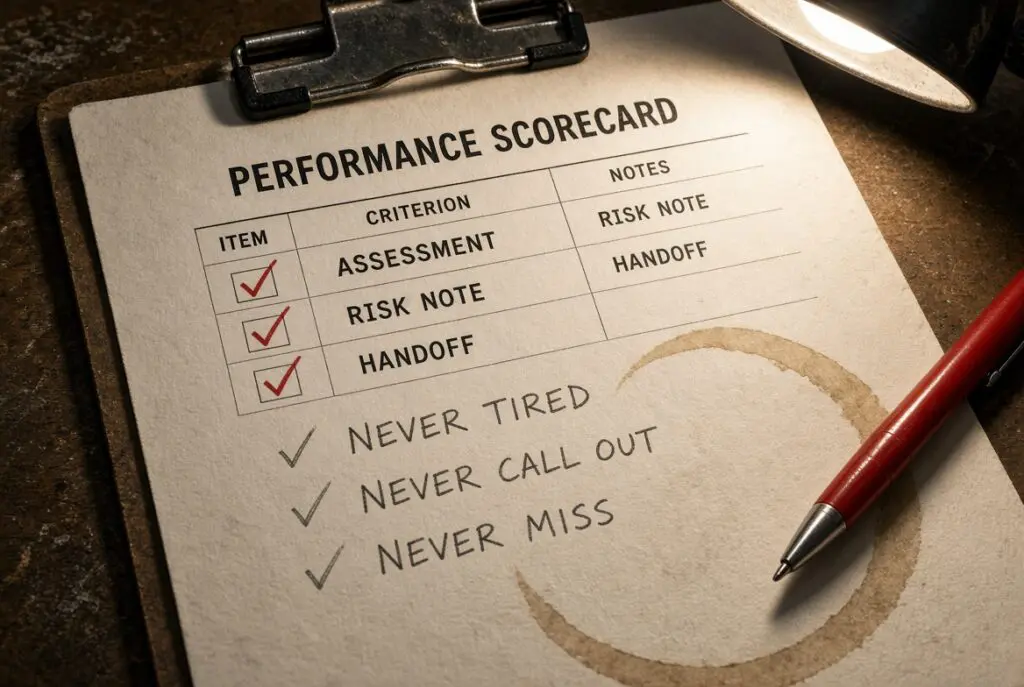
The Role Does the Enforcing
What makes the opening useful is not the athleticism. It is the enforcement. Once an organization has told the room that this person does not miss, the person is no longer allowed a public off night. Colleagues start using the reputation as a scoring rubric. The clinician starts using it as a reason not to report pain.
The instrument can change. The expectation often does not. Limited schedules, quieter assignments, and the need to still look like the person in the original pitch are what a workplace does when it cannot afford to retire a legend and cannot afford to tell the truth about the body wearing it.
Facilities do the same thing with quieter language.
- The proceduralist who has never had a complication on the record
- The psychiatrist whose notes are the template everyone else is measured against
- The program director introduced as the person who “holds the place together”
- The night nurse who is not allowed to call in, because the unofficial story is that she does not get sick
None of those people were hired to be a myth. The culture still sold one. The social pressure then does the daily enforcement: praise for never calling out, silence when someone looks tired, irritation when coverage is requested.
What the Load Looks Like at Work
In a hospital or a jail the same mechanism shows up as:
- Over-preparation that steals sleep and still does not produce a feeling of readiness
- Avoidance of visible work unless the conditions are ideal
- Inability to delegate, because someone else’s standard might be “good enough”
- Irritability when a colleague is merely competent
- Delayed help-seeking, because naming strain would puncture the reputation
- A body that has been asking for a downshift while the role keeps selling speed
The last point matters for organizations. Perfectionism is often praised until it produces a missed scan, a blown coverage hole, or a clinician who would rather work hurt than be seen needing care. By then the reputation has already done the clinical harm. When the workforce is already thin, that harm compounds. When there are no psychiatrists, the remaining people inherit not only the caseload. They inherit the social demand to look unbreakable.
What Actually Lowers the Demand
What helps is not a poster that says “nobody’s perfect.” That sentence bounces off a role that was hired to be the exception.
What helps is more precise:
- Name the job accurately. Continuity of care is not the same as an absence of error. Language that says “we need the work done, not a performance of infallibility” lowers the demand.
- Separate standards from self-worth. The note can be revised. The person does not have to be.
- Name the social source. If the pressure is coming from the unit, the family, or the legend of a predecessor, say so. A privately owned standard is easier to revise than an unspoken group contract.
- Stop using one person as the unofficial rubric. If the next clinician is scored against a predecessor’s legend, you have rebuilt the same trap.
- Make it possible to report strain without it being treated as a reputational problem. A private conversation is not a press release.
- Evaluate against the actual job. Did the assessment happen. Was the risk named. Was the handoff usable. Those are standards. “Never looked tired” is not.
When those moves fail, the load shows up as persistent anxiety, depression, rigid control, or a collapse in self-trust after an ordinary miss. It shows up in emergency departments, operating rooms, community clinics, and correctional units — anywhere the unofficial story is that this particular person does not get to miss.

When the Load Needs Clinical Care
Perfectionism is not automatically an illness. It becomes a clinical issue when self-worth has only one domain left, when rest is experienced as moral failure, or when the person cannot disclose strain at work without it being treated as disloyalty to the standard. Social pressure makes that last condition more likely. The person is not only protecting their own image. They are protecting the story the organization told about them.
Confidential psychiatric care is useful precisely because the conversation cannot be a performance. Telepsychiatry inside a facility’s own workflow gives that conversation a private room. How organizations actually staff that room — including telepsychiatry staffing in medical care facilities — is part of whether the person in the high-visibility role can get care without walking the demand into the waiting room. That model is part of a wider shift in how telepsychiatry is improving access to modern mental health care. The same access problem is acute in Medicaid behavioral health, where technology is changing how CMHCs and FQHCs deliver psychiatric care without requiring the next clinician to become a replica of the last one’s legend. The task is not to lower standards into sloppiness. It is to stop using flawlessness as the only legal self.
Organizations that keep one indispensable person on a pedestal are running the same expectation. Continuity of the work is possible. Interchangeability with a myth is not.
FasPsych partners with organizations — hospitals and emergency departments, CCBHCs, community mental health centers, FQHCs, schools, correctional facilities, and residential programs — to place licensed psychiatrists and psychiatric nurse practitioners into existing workflows through secure, real-time video. The point is not to staff a legend. It is to keep care available while the people doing the work remain allowed to be human.
To map that onto your program, partner with FasPsych or call (877) 218-4070.
Frequently Asked Questions
What is clinical perfectionism?
It is not “having high standards.” In the Shafran, Cooper, and Fairburn model, it is self-worth over-dependent on meeting personally demanding standards in a domain that matters, even when that pursuit is already causing harm. Meet the standard and it gets raised. Miss it and the self takes the hit.
What are the social pressures that drive it?
Hewitt and Flett called this socially prescribed perfectionism: the belief that other people require you to be flawless. In facilities that pressure comes from patients promised “the best,” peers who use one person as the scoring rubric, thin staffing that treats rest as a threat, and a professional culture that reads composure as competence.
How is that different from impostor syndrome?
The impostor phenomenon is an internal feeling of fraudulence despite evidence of competence. Clinical perfectionism is the demand that an error must not exist. A person can know they are qualified and still treat a small miss as a verdict on who they are — especially if they believe the room is watching.
Is socially prescribed perfectionism the same as clinical perfectionism?
Related, not identical. Clinical perfectionism is about how self-worth is organized. Socially prescribed perfectionism is about where the standard is believed to come from. They often travel together. A unit can install the second and produce the first.
When do high standards become a clinical problem?
When rest feels like failure, when help cannot be requested without shame, when checking and repeating start to steal sleep, or when mood drops after ordinary, survivable mistakes. It is also a problem when the organization uses one person’s output as the unofficial job description for everyone else.
What should a facility stop doing?
Stop praising people for never calling in. Stop introducing the next clinician as a replacement for a myth. Stop treating a request for coverage as evidence that the person was never that good. Evaluate the work. Do not evaluate the performance of being unbreakable.
How do you keep quality without selling infallibility?
Write the standard as a task: complete the assessment, document the risk, make the handoff usable. Build redundancy so one person’s off night is a staffing fact, not a character crisis. And make confidential psychiatric support available — including by telepsychiatry — so the person in the high-visibility role does not have to process the strain in public.
When should someone seek psychiatric care?
When the standard has become the only legal self, when anxiety or low mood is persistent, when work is avoided unless conditions are perfect, or when the person cannot say they are hurt without it being treated as a threat to their standing.