
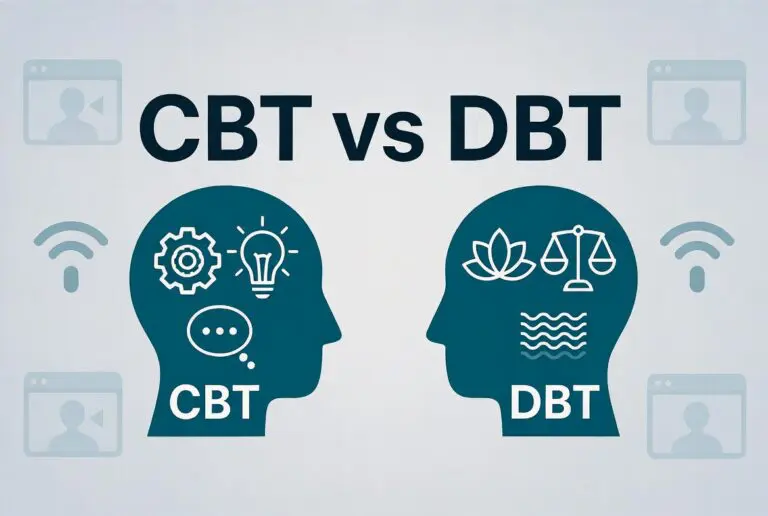

 CBT vs DBT — two of the most powerful, evidence-based therapies for mental health — help millions overcome anxiety, depression, borderline personality disorder (BPD), and more. While both share cognitive-behavioral roots, CBT vs DBT differences make each ideal for specific needs.
Telemedicine has transformed access to these therapies, delivering telehealth CBT and online DBT therapy with the same proven results as in-person care. At FasPsych, we specialize in helping hospitals, clinics, and healthcare organizations seamlessly integrate CBT vs DBT through secure teletherapy solutions.
In this guide, discover CBT vs DBT differences, their effectiveness, and how telemedicine uniquely provides specialists while simplifying integration into medical practice.
What Is Cognitive Behavioral Therapy (CBT)?
Cognitive Behavioral Therapy (CBT) is a short-term, structured, goal-oriented therapy that identifies and changes negative thought patterns and behaviors driving emotional distress. Based on the principle that thoughts, feelings, and behaviors are interconnected, CBT helps patients reframe unhelpful thinking and build practical coping skills.
Key CBT techniques include:
- Recognizing cognitive distortions (e.g., all-or-nothing thinking or catastrophizing)
- Cognitive restructuring to challenge negative thoughts
- Behavioral activation, exposure exercises, and problem-solving
- Homework assignments to reinforce skills between sessions
CBT typically lasts 8–20 sessions and works exceptionally well via telehealth CBT, empowering patients to manage symptoms long-term.
Learn how to integrate telehealth CBT into your practice.
What Is Dialectical Behavior Therapy (DBT)?
Dialectical Behavior Therapy (DBT) is a specialized form of CBT developed for individuals with intense emotional dysregulation, originally for borderline personality disorder (BPD). DBT balances acceptance and change through mindfulness and skills training.
DBT’s four core modules are:
- Mindfulness — observing emotions without judgment
- Distress Tolerance — surviving crises without self-harm
- Emotion Regulation — understanding and managing intense feelings
- Interpersonal Effectiveness — building healthy relationships
Standard DBT includes individual therapy, group skills training, phone coaching, and therapist consultation teams. Treatment often spans 6–12+ months and excels for self-harm, suicidality, and relationship instability.
CBT vs DBT: Key Differences
Understanding CBT vs DBT differences helps providers match the right therapy to patient needs. Here’s a clear comparison:
| Aspect | CBT | DBT |
|---|---|---|
| Primary Focus | Changing unhelpful thoughts and behaviors | Acceptance of emotions + skill-building for change |
| Core Components | Cognitive restructuring, exposure, problem-solving | Mindfulness, Distress Tolerance, Emotion Regulation, Interpersonal Effectiveness |
| Typical Duration | Short-term (8–20 sessions) | Longer-term (6–12 months or more) |
| Best Suited For | Anxiety, depression, OCD, phobias, PTSD | Borderline personality disorder, emotional dysregulation, self-harm, chronic suicidality |
| Format | Primarily individual therapy | Individual therapy + group skills training |
Proven Effectiveness of CBT and DBT
Both therapies are backed by robust research, including meta-analyses of randomized controlled trials.
CBT Effectiveness CBT is the gold standard for many conditions and shows strong results for anxiety disorders, depression, OCD, PTSD, and more. Meta-analyses report medium-to-large effect sizes: CBT outperforms usual care for depression (SMD 0.47–0.72) and shows even greater benefits versus waitlist controls. Real-world studies confirm large symptom reductions with low worsening rates.
Read the comprehensive meta-analysis on CBT efficacy (Hofmann et al., 2012). Panoramic meta-analysis of CBT across conditions (Fordham et al., 2021).
DBT Effectiveness DBT is the gold-standard treatment for BPD, significantly reducing self-harm, suicidality, and emotional dysregulation. Studies show large pre-post effect sizes (d = 2.45 for BPD symptoms) and moderate-to-large improvements in depression and quality of life. Benefits are maintained at follow-up.
Meta-analysis on DBT for suicidal and self-harming behaviors in BPD (Panos et al., 2014). Systematic review of DBT efficacy in BPD (Hernandez-Bustamante et al., 2024).
Telehealth Delivery Effectiveness Telehealth CBT and online DBT therapy deliver outcomes comparable to in-person care, with higher attendance and patient satisfaction.
Study on telehealth vs. in-person mental health outcomes.
Providing CBT and DBT Through Telemedicine
CBT vs DBT both thrive in telehealth formats. Secure video sessions let patients receive telehealth CBT or online DBT therapy from home or medical settings.
Key advantages of telehealth CBT and DBT:
- No travel or wait times — greater convenience
- Higher session attendance and continuity of care
- Access regardless of geographic location
- HIPAA-compliant delivery with the same clinical outcomes
FasPsych’s secure platform ensures high-quality telemedicine CBT and DBT. Explore our full telepsychiatry services.
Integrating CBT and DBT into Medical Practice Through Teletherapy
Healthcare organizations can easily integrate CBT vs DBT by partnering with FasPsych. Benefits include:
- Supplementing behavioral health teams without full-time hires
- Offering specialized telehealth CBT and online DBT therapy in primary care, hospitals, and clinics
- Providing continuity of care in emergency departments or residential settings
- Reducing wait times for mental health services
Our flexible model handles credentialing, platform setup, and support. Learn how we support integrated behavioral health services.
How Telemedicine Uniquely Provides Specialists for CBT and DBT
Telemedicine removes geographic barriers, connecting organizations with CBT vs DBT experts nationwide. FasPsych advantages include:
- Access to highly specialized therapists unavailable locally
- Matching with CBT or DBT experts experienced in complex cases
- Flexible scheduling, including evenings and weekends
- Rapid implementation — often within weeks
This nationwide network delivers licensed, experienced clinicians everywhere. Discover our provider network.
Ready to Enhance Your Behavioral Health Services with CBT vs DBT?
Contact a FasPsych implementation specialist today to build a customized teletherapy solution featuring telehealth CBT and online DBT therapy. Whether you need full integration, on-demand support, or hybrid models, we make it simple.
Visit faspsych.com/partner-with-us or call 877-218-4070 for a free consultation.
Frequently Asked Questions About CBT vs DBT
Q: What is the main difference between CBT and DBT? A: CBT focuses on changing negative thought patterns, while DBT emphasizes accepting emotions and building practical coping skills like mindfulness and distress tolerance.
Q: Can CBT and DBT be effectively delivered through telemedicine? A: Yes. Both telehealth CBT and online DBT therapy produce outcomes comparable to in-person care.
Q: Which therapy is better for borderline personality disorder? A: DBT was specifically developed for BPD and remains the gold-standard treatment.
Q: How effective are CBT and DBT? A: Extensive meta-analyses show both are highly effective. CBT delivers medium-to-large reductions for anxiety and depression; DBT produces large improvements in BPD symptoms, self-harm, and emotional regulation, often sustained long-term.
Q: How can my clinic integrate teletherapy services like CBT or DBT? A: FasPsych provides credentialed therapists, secure technology, and full implementation support that fits seamlessly into your workflows and EHR systems.
Q: What types of organizations does FasPsych serve? A: We partner with hospitals, clinics, residential facilities, schools, universities, and other healthcare organizations nationwide to deliver scalable telepsychiatry and teletherapy solutions.