


Telepsychiatry Staffing for Adolescent Impulsivity and Developmental Risk in School and Juvenile Programs
In 1986, C.C. Catch’s single “’Cause You Are Young” captured the dual reality of adolescence in a few synth-driven lines: you are right and you are wrong; you are a hero one day and done the next. The song, produced during her early collaboration with Dieter Bohlen, became one of her signature Eurodisco hits and still circulates in retro playlists decades later. For a concise overview of her career, see the C.C. Catch Wikipedia entry, her official site, or the AllMusic biography.
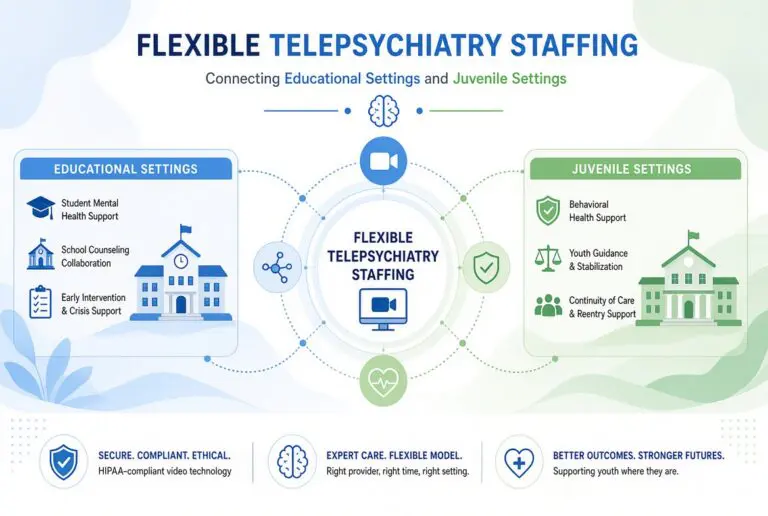
That same dual nature—high capacity for growth alongside elevated risk—appears every day in school counseling offices and juvenile programs. Adolescents can show striking resilience and creativity one week, then present with impulsive risk-taking, rapid mood shifts, or identity-related distress the next. When these presentations require psychiatric evaluation or medication management, many schools and juvenile facilities lack timely access to child and adolescent psychiatrists. Telepsychiatry staffing fills that specific gap without requiring a full-time on-site hire. For broader context on school-based models, see FasPsych’s overview of school-based mental health models for districts. Telepsychiatry more generally continues to expand access to mental health care by removing geographic barriers and matching licensed providers to organizational needs, as outlined in discussions of telepsychiatry expanding access to mental health care.
Why Adolescent Impulsivity and Developmental Risk Require Dedicated Capacity
The adolescent brain continues maturing well into the mid-twenties, with prefrontal regions responsible for impulse control, risk assessment, and emotional regulation developing later than systems that drive reward-seeking and emotional intensity. This developmental mismatch helps explain why impulsivity, risk-taking, and rapid shifts in mood or identity are common during these years—even among adolescents who function well most of the time.
In school settings, these presentations often surface as sudden behavioral escalations, academic disengagement, peer conflict, or self-harm risk that counselors identify but cannot fully address without psychiatric input. In juvenile programs, the same developmental factors intersect with higher baseline rates of trauma, substance use, and co-occurring conditions. The American Psychiatric Association has highlighted that youth in juvenile justice settings remain a particularly underserved population, and that telepsychiatry can expand access to timely evaluations and evidence-based care (APA Juvenile Justice Telepsychiatry Toolkit).
Most districts and facilities cannot sustain a full-time child and adolescent psychiatrist on staff. Community referral wait times frequently outlast a school semester or a detention placement. The operational result is delayed intervention precisely when risk is highest. FasPsych’s child and adolescent psychiatry services and dedicated adolescent psychiatrists pages describe how organizations access developmentally trained clinicians. Matching the clinician to the age group and setting matters; an adult-only prescriber can complete a note and still miss developmental context, assent dynamics, and school or facility collateral (specialty-matched telepsychiatry staffing). Broader analyses note how telepsychiatry services are expanding access to mental healthcare across the United States by addressing provider shortages and supporting flexible coverage models (how telepsychiatry services are expanding access).

Operational Requirements Unique to Schools and Juvenile Programs
Coverage in these settings must fit constraints that standard adult telepsychiatry models do not automatically solve:
- Consent, privacy, and legal frameworks. Schools must navigate FERPA for education records alongside HIPAA for health information. Juvenile facilities add court orders, parental rights, and state rules governing minor consent for psychiatric treatment. Clear documentation of these processes is essential. Related compliance considerations across institutional settings appear in FasPsych’s guidance on virtual medication management for schools, hospitals, and corrections.
- Scheduling around structured days. Academic calendars, class periods, recreation blocks, and court hearings limit available windows. Shared or block coverage that aligns with these schedules is typically more practical than pure on-demand models.
- Security and privacy protocols. Juvenile settings require staff presence that supports safety without undermining the clinical conversation. Telepsychiatry reduces the need for off-site transport, which itself carries security, staffing, and liability costs. Approaches for these environments are outlined in FasPsych’s information on juvenile detention and correctional facilities.
- Developmental and trauma-informed expertise. Clinicians need fluency with adolescent presentations—impulsivity that may reflect ADHD, emerging mood disorders, trauma responses, substance effects, or normal developmental experimentation—rather than adult diagnostic templates applied unchanged.
- Integration with existing teams. Most programs already have counselors, case managers, or school-based staff. Psychiatric capacity must join those workflows rather than operate as a parallel service. The distinction between staffing inside an existing program and opening a second clinic is covered in FasPsych’s telepsychiatry staffing RFP guidance.
Campus and school referral pathways are discussed further in FasPsych’s piece on telepsychiatry staffing for schools and universities.
FasPsych Staffing Models for School and Juvenile Settings
FasPsych supplies licensed child and adolescent psychiatrists and psychiatric nurse practitioners who join the facility’s existing program rather than operating a separate practice. The model is flexible so cost follows actual completed work instead of unused full-time headcount. Common arrangements include:
- Scheduled blocks aligned with school hours, facility programming, or a defined clinic template. These work well when volume is predictable (for example, a set number of evaluation or medication-management slots per week).
- On-demand or same-week capacity for acute presentations such as suicidal ideation, severe agitation, or sudden behavioral escalation. This adds response capability without maintaining idle positions.
- Shared-pool or PRN coverage that draws from a network of credentialed clinicians licensed in the relevant state. Organizations pay for completed visits, hours, or days rather than carrying a salaried FTE.
- Remote medical director or consultant support for protocol development, staff education, chart review, and complex case consultation when the program needs leadership in addition to direct visits.
- Hybrid options that combine virtual care with limited on-site visits when a program requires occasional in-person contact for specific evaluations or regulatory reasons.
Providers document in the facility’s electronic health record, coordinate with on-site counselors or case managers, and follow the program’s consent and escalation protocols. Organizations can start with limited hours and scale as utilization data confirm demand. Broader guidance on matching payment structures to volume patterns appears in FasPsych’s article on how to choose a behavioral health staffing payment model.

How Flexible Telepsychiatry Staffing Closes the Gap
Because the providers join the facility’s existing electronic health record and care team, documentation, handoffs, and follow-up remain inside the program. This reduces fragmentation that occurs when adolescents are referred to external clinics that do not coordinate with school or facility staff. Research on telemental health with justice-involved youth has shown promise for increasing access and engagement when technical and workflow barriers are addressed (see discussions in the Journal of Child and Adolescent Psychopharmacology).
Implementation Considerations for Program Leaders
Facilities that implement telepsychiatry staffing successfully typically address a few practical points early:
- Confirm state licensure and privileging requirements for the clinicians who will serve the program.
- Map consent and documentation workflows before the first session so on-site staff know exactly what is required.
- Establish a clear escalation path for after-hours or high-acuity situations.
- Start with a defined volume (for example, a set number of evaluation or medication-management slots per week) and adjust based on actual utilization.
- Coordinate with existing school counselors or juvenile case managers so the remote clinician receives relevant context before the visit.
These steps keep the model inside the program’s existing structure rather than creating a separate clinic.
Key Takeaways
- Adolescent impulsivity and developmental risk presentations are common in school and juvenile settings and frequently require timely psychiatric input.
- Traditional recruitment timelines rarely match the pace of crises or academic calendars.
- Telepsychiatry staffing supplies developmentally trained clinicians who work inside the facility’s workflows, consent processes, and scheduling constraints.
- Flexible models (scheduled blocks, on-demand capacity, shared-pool coverage, and remote medical director support) reduce both wait times and the fixed cost of unused full-time positions.
- Integration with existing teams and clear protocols for consent, privacy, and escalation determine whether the coverage improves outcomes or simply adds another referral layer.
How FasPsych Supports School and Juvenile Programs
FasPsych connects organizations with licensed child and adolescent psychiatrists and psychiatric nurse practitioners who deliver care via secure video. Coverage is designed for existing school-based or juvenile programs rather than as a stand-alone practice. Providers complete evaluations, medication management, and follow-up on the facility’s platforms and coordinate with on-site counselors, case managers, and medical staff.
Implementation typically includes a needs assessment, credentialing and privileging support, and workflow mapping so that the remote clinicians fit the program’s consent, documentation, and escalation processes. Organizations can start with limited hours and adjust as volume or acuity changes.
To discuss flexible psychiatric coverage for your school, juvenile facility, or transitional youth program, partner with FasPsych or call (877) 218-4070.