
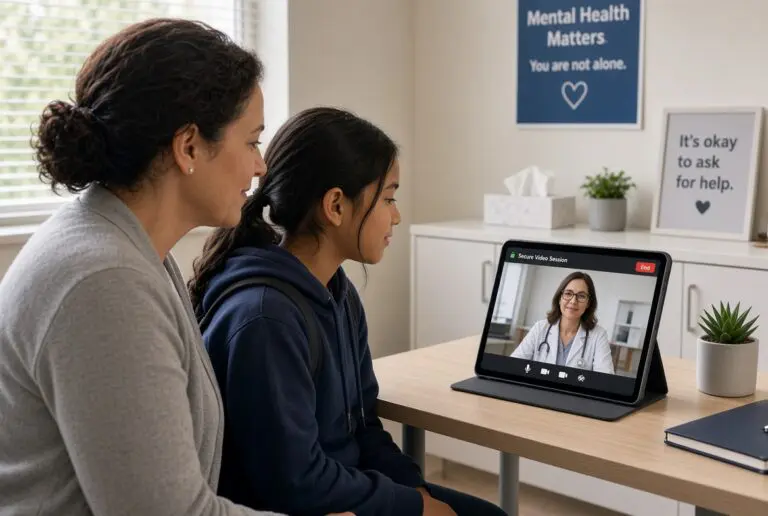

School-based mental health is a coverage problem before it is a program decision. A district can hire counselors, contract a virtual therapy vendor, and still have students waiting weeks for a psychiatric opinion — because coverage is defined by who is available at 10 a.m. on a Tuesday, who answers at 9 p.m., and who documents what happened in between.
National school partner-selection guidance reports that nearly 90 percent of schools are not confident they can serve every student who needs mental health support. Community providers often carry months-long waitlists, decline insurance, or lack multilingual clinicians.
Those gaps compound. A student who clears a counselor’s screening may wait months for a mental health evaluation. Families who speak a language the local clinic doesn’t support drop out of care entirely. Staffing turnover breaks continuity mid-treatment, so the next clinician restarts the intake assessment from zero.
Federal guidance from the Department of Health and Human Services advises schools to decide upfront which kinds of care they will provide, and to bring administrators, nurses, teachers, guidance counselors, and IT staff into that planning. The sections that follow work through the decisions that determine whether coverage holds: intake assessments, remote psychiatric evaluations, escalation pathways to crisis services, documentation standards, and staffing continuity. Smaller facilities can follow similar structured steps when building capacity, as outlined in guidance on creating an effective telepsychiatry program.

How to Evaluate a School District Mental Health Platform
Start by writing down the service model you are actually buying. A complete school-based mental health program covers intake assessments, triage against urgency, telepsychiatry visits with a prescriber, medication management, and scheduled follow-up — not just a referral into someone else’s queue.
Vendors in this category differ sharply here. Many district-facing platforms are built around short-term counseling and district-wide access, which can fit tier-one and tier-two needs. Confirm with any of them directly whether a licensed psychiatrist or psychiatric nurse practitioner can complete a mental health evaluation and manage medication. That is where counseling-first models and psychiatric staffing models diverge. FasPsych’s school and university telepsychiatry staffing fills the prescriber gap through remote evaluations and medication management.
Then test coverage math rather than access claims. Ask:
- How many hours per week does each school receive?
- Which named clinicians fill those hours?
- What happens when one clinician is out?
- How does a student in five buildings get the same clinician twice?
Partner-selection guidance notes that local providers often carry months-long waitlists and may not accept insurance or offer multilingual care. Apply the same questions to the vendor.
Finally, score operational fit. Federal school telehealth guidance recommends planning with school administration, nurses, teachers, guidance counselors, and IT staff, so ask who trains each group. Require Medicaid billing detail, documentation that returns to the school record, and a named escalation path to parents and outside providers. For a deeper look at model differences, see School-Based Mental Health Models for Districts.
What HHS and School Telehealth Guidance Says About Implementation
Federal guidance is clearer than most district plans. Behavioral health is one of the most common services delivered through school-based telehealth programs. HHS guidance tells districts to decide which kinds of care they will actually provide before selecting a delivery model. That order matters. A program scoped for brief counseling requires different staffing than one that includes a psychiatric mental health evaluation, diagnostic clarification, and ongoing medication management.
The same guidance treats planning as a cross-functional exercise rather than an IT purchase. It calls for school administration, school nurses, teachers, guidance counselors, and IT staff at the table — because each group owns a step the clinical model depends on. This cross-functional approach aligns with integrated models such as the Collaborative Care Model (CoCM), which emphasizes primary care coordination and measurement-based care.
Translated into operating terms, three questions decide whether school-based mental health coverage holds up week to week:
- Intake: Who identifies the student, obtains guardian consent, and completes the referral so the clinician receives a usable mental health assessment rather than a hallway impression?
- Escalation: Who interrupts a session or a school day when risk surfaces, and where does the handoff go — mobile crisis, the 988 Suicide & Crisis Lifeline, or an emergency department with psychiatric capability?
- Documentation: Which notes live in the education record, which live in the clinical record, and who reconciles the two for billing and continuity?
District-facing vendors define these boundaries differently, so confirm each one’s scope in writing.
How Intake, Escalation, and Crisis Routing Should Work
Districts tend to use “screening,” “assessment,” and “evaluation” interchangeably, and that imprecision shows up later as misrouted students.
- A screening flags concern.
- A mental health assessment is the structured gathering of history, symptoms, risk factors, and functional impact — usually by a school counselor, social worker, or clinician.
- A psychiatric evaluation is a diagnostic encounter with a prescriber who can establish a diagnosis and a treatment plan, including medication. When that encounter happens by video with a telehealth psychiatrist, it is the same clinical work performed remotely. An online mental health evaluation should produce the same documentation, diagnosis, and plan a room-based visit would. FasPsych’s child and adolescent psychiatric services deliver these evaluations remotely with licensed providers.
Intake should sort every referral into one of three lanes:
- Routine follow-up with school-based counseling staff
- A scheduled remote psychiatric evaluation
- Immediate higher-acuity referral
Write the triage criteria down and attach a named owner and a response window to each lane.
Urgent pathways need to be just as explicit. Suicidal ideation, psychosis, or acute agitation routes to 988, to the county or state mobile crisis team, or to emergency medical services. Many states publish mobile crisis team coverage that is free and available day or night. For families seeking non-emergency guidance, the free NAMI HelpLine is a reasonable public-facing resource, and it directs crisis callers to 988.
A school-based mental health partner should own the handoff — documenting the escalation, contacting the receiving service, and closing the loop — rather than leaving front-office staff to improvise.

Comparing School Mental Health Vendors on Staffing Continuity and Access
School partner-selection guidance is a fair benchmark for what districts now expect. It reports that nearly 90 percent of schools are not confident they can effectively provide mental health services to every student who needs them, and it names the usual failure points: months-long waitlists at local providers, practices that do not accept insurance, and the absence of multilingual care. Those concerns — confidence, wait time, payer fit, and language access — are the criteria worth scoring vendors against.
Three delivery models dominate shortlists:
- Referral and navigation services connect families to outside clinicians. They widen the funnel but hand continuity to whoever accepts the referral.
- District-partnership teletherapy vendors build around school workflows, counselor handoffs, and short-course therapy. Ask each directly about licensure coverage by state, caseload caps, languages supported, and whether prescribing is in scope.
- A staffing-led model answers a different question. When a district needs a psychiatric provider on a recurring schedule, the same clinician can carry a student from the initial mental health evaluation through medication management and follow-up, with a remote medical director supervising the clinical work rather than a rotating pool. That is where FasPsych operates: licensed psychiatrists and psychiatric nurse practitioners assigned to standing coverage blocks, including intake assessments and prescribing. Learn more about telepsychiatry staffing for schools and universities.
The tradeoff is plain. Staffing-led coverage assumes the district brings local coordination — a named on-site contact, private space, consent and records workflows, and a written escalation path to 988 or county mobile crisis teams. It supplements counselors; it does not replace them. Districts that mainly want a tightly scoped tier-two therapy program, or a vendor whose product is built around counselor referral workflows, may find a partnership model the better fit for school-based mental health. For a side-by-side comparison of models, review School-Based Mental Health Models for Districts.
When a District Should Use Telepsychiatry, Medicaid Support, and Remote Medical Director Coverage
A referral-only model is defensible when a student needs a single mental health evaluation and community capacity is real. It breaks down when care has to repeat. Partner-selection guidance for districts notes that local providers often carry months-long waitlists, may not take insurance, and may not offer multilingual care — which is a poor fit for medication management, diagnostic follow-up, or any treatment plan measured in months rather than visits. Where prescribing and ongoing psychiatric treatment are in scope, telepsychiatry is usually the more honest answer.
Remote medical director coverage is what makes that work across more than one building. A supervising psychiatrist can standardize escalation thresholds, review charts, oversee psychiatric nurse practitioners, and sign off on protocols for a whole district rather than campus by campus. FasPsych provides this model alongside remote psychiatric evaluations.
Treat Medicaid enrollment, consent documentation, and coordination with primary care and school counselors as operating requirements, not paperwork. HHS advises districts to decide up front which services they will actually provide — that decision drives billing and records design. Integrated approaches like the Collaborative Care Model can further strengthen coordination between school-based psychiatric coverage and primary care.
Several vendors serve this market differently: many are largely built around district-contracted therapy and counseling at scale. Confirm with each what prescriber coverage and supervision they include.
The same staffing math appears in clinics, hospitals, and correctional healthcare. The test is continuity — not whether one mental health assessment got scheduled. Smaller or resource-constrained settings can adapt practical steps for telepsychiatry implementation as described in guidance for creating effective telepsychiatry programs.
What Administrators Should Confirm Before Choosing a Partner
Before signing, walk one hypothetical student through the whole path and ask the vendor to name an owner at each step.
Intake and clinical ownership. Who receives the referral, who conducts the mental health evaluation, which licensed clinician signs it, and who holds the treatment plan after the first visit? If therapy and prescribing sit with different entities, get the handoff in writing.
Crisis routing. Require a written escalation protocol that names 988, the county mobile crisis team, and the threshold for emergency department transport. Confirm what your county actually dispatches, and who notifies the family and the principal.
Coverage and records. Ask about Medicaid enrollment and state licensure, where documentation lands relative to the student record, and how care coordination works when a family moves between campuses.
Continuity. Request the backup plan for clinician absence, the summer schedule, and the staffing model for adding a second or third site.
Vendors are built differently: district-contracted therapy programs lead with therapy access, language capacity, and school workflow integration, while FasPsych’s model centers on psychiatric prescribers, intake assessments, and remote medical director support — stronger on medication management, less of a packaged district therapy program. See also child and adolescent psychiatric services and pediatric telepsychiatry options.
Map your referral workflow against each partner’s clinical and operational model before you choose.
Choose FasPsych if your district needs recurring psychiatric coverage, intake assessments, and remote medical director support. Discuss staffing options at (877) 218-4070 or visit the Partner With Us page. FasPsych provides telepsychiatry and behavioral health staffing — remote psychiatric evaluations, medication management, and remote medical director coverage for partners that already handle coordination.